Eicosanoids- Chemistry and
Functions
Professor (Dr.) Namrata Chhabra
29-Apr-18 Namrata Chhabra 1
Eicosanoids
• Prostaglandins and related compounds are collectively known as
Eicosanoids.
• Most are produced from Arachidonic acid, a 20-carbon
polyunsaturated fatty acid (5,8,11,14-eicosatetraenoic acid).
29-Apr-18 Namrata Chhabra 2
Eicosanoids- Classification
Eicosanoids
Prostanoids
Prostaglandins Prostacyclins Thromboxanes
Leukotrienes Lipoxins
29-Apr-18 Namrata Chhabra 3
Characteristic structural features of prostaglandins
1) A trans double bond is present between 13th and 14th carbon atom
2) An alpha oriented -OH group is present at 15th position
3) Differences in the main groups are due to difference in structure of
cyclopentane ring.
29-Apr-18 Namrata Chhabra 5
Prostaglandins(PGs)
Prostaglandins
(PGs)
PG- F PG- A PG- B PG-C and DPG-E
PG- G and H
29-Apr-18 Namrata Chhabra 6
Series of prostaglandins
• There are 3 series of prostaglandins:
• Series-1 contain one double bond at 13-14 position (Trans)
• Series-2 have two double bonds at 13-14 (trans) and 5-6 (Cis)
• Series-3 – have three double bonds at 13-14 (trans) , 5-6 (Cis) and
17-18 (Cis) positions.
29-Apr-18 Namrata Chhabra 7
Series of prostaglandins
29-Apr-18 Namrata Chhabra 8
Types of Prostaglandins
• PG-E: PGE1,PGE2 and PGE3
• PG-F: PGF1α,PGF2αand PGF3α
• PG-A: PGA1,PGA2 and PGA3
• PG-B: PGB1,PGB2 ,19-OH-PGB1and 19-OH-PGEB2
29-Apr-18 Namrata Chhabra 9
Synthesis of Eicosanoids
29-Apr-18 Namrata Chhabra 10
Sources of Arachidonic acid
29-Apr-18 Namrata Chhabra 11
Release of Arachidonic acid
Release of
Arachidonic
acid
Activation of
phospholipase
A2
Binding of
ligand to cell
surface
29-Apr-18 Namrata Chhabra 12
Steps of synthesis of Prostanoids
• Pathway is also called Cyclo-
oxygenase pathway or cyclic
pathway.
• The type of prostanoid
produced is determined by
which downstream enzyme is
present
• Usually one downstream
enzyme predominates in a
given cell.
29-Apr-18 Namrata Chhabra 14
PGH synthase Isoforms
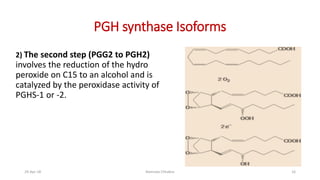
• Each PGHS isoform catalyzes two separate
reactions.
1) The first reaction (Arachidonate to PGG2)
involves insertion of two molecules of oxygen
and Cyclization of the fatty acid backbone.
• This step is catalyzed by the cyclo-oxygenase
activity of PGHS-1 or -2; it is these cyclo-
oxygenase activities (also called COX-1 and
COX-2) that are inhibited by nonsteroidal anti-
inflammatory drugs (NSAIDs).
29-Apr-18 Namrata Chhabra 15
PGH synthase Isoforms
2) The second step (PGG2 to PGH2)
involves the reduction of the hydro
peroxide on C15 to an alcohol and is
catalyzed by the peroxidase activity of
PGHS-1 or -2.
29-Apr-18 Namrata Chhabra 16
Significance of PGH synthase isoforms
There are two isoforms- PGH Synthase 1 and 2
PGH Synthase 1 – Basal form(constitutive)
Many cells, including platelets and gastric mucosal cells, have moderate levels of
the “basal” isoform, PGHS-1.
Functions attributed to PGHS-1 include:
• Regulating hemostasis and vascular tone,
• Renal function, and Maintaining gastric mucosal integrity.
29-Apr-18 Namrata Chhabra 17
Significance of PGH synthase isoforms
• PGH Synthase 2- Inducible form
Present in a smaller number of cells, such as macrophages, vascular
endothelial cells, and fibroblasts.
• Participate in cell proliferation, inflammation, carcinogenesis, and
parturition.
PGHS-2 are induced in response to cytokines or mitogens.
29-Apr-18 Namrata Chhabra 18
Catabolism of Prostaglandins
• All Arachidonic acid derivatives are quickly
inactivated in the body by :
• Self-catalyzed destruction of
cyclooxygenase ("suicide enzyme”).
• 15-hydroxyprostaglandin dehydrogenase.
The OH group present at 15th position is
changed to a keto group.
29-Apr-18 Namrata Chhabra 19
Characteristic features of prostaglandins
1) Act as local hormones.
2)Show the effects near the site of
synthesis(autocrine and Paracrine
effects)
3) Are not stored in the body
4) Have a very short life span and are
destroyed within seconds or few
minutes.
29-Apr-18 Namrata Chhabra 20
Characteristic features of prostaglandins (contd.)
5) Production increases or
decreases in response to diverse
stimuli or drugs.
6) Are very potent in action. Even in
minute (nanogram concentration),
biological effects are observed.
PGs
Local
hormones
Not stored
Short
lifespan
Stimulus
based
production
Potent
Required
in small
amounts
29-Apr-18 Namrata Chhabra 21
Physiological roles of Prostaglandins
1) Inflammation
i) Fever- PGs induce fever by stimulating the
thermoregulatory center in the brain.
ii) Pain- PGs sensitize pain receptors to
stimulation, as a result increase pain
perception.
iii) Swelling-There is vasodilatation and
increased capillary permeability induced by
PGS which is responsible for swelling of the
inflamed tissue.
iv Erythema, wheal and Flare is also induced
by PGs like PGE and PGD2.
v) PGD2 is considered an important
mediator of anaphylaxis
29-Apr-18 Namrata Chhabra 22
Effect on smooth muscle
Intestinal Bronchial Vascular Uterine
PGE and PGF produce
contraction of the
longitudinal smooth
muscles producing
diarrhea, cramps and
reflux of bile.
Clinical significance-
Diarrhea and abdominal
cramps are the
commonly observed as
side effects of PGs.
PGFs contract and
PGEs relax bronchial
smooth muscles.
Clinical significance-
PGE1 and PGE2 are
therapeutically used as
bronchodilators.
PGEs cause vasodilatation.
PGF2 α , and PG A2 cause
vasoconstriction.
Clinical significance-
Systemic blood pressure
falls in response to PGEs and
PGAs
PGE1, PGE2 and PGF2α
cause uterine contractions.
Clinical significance-
• PGE2 is used for the
induction of labor at or
near term.
• In higher dosage PGEs
are used as
abortifacients in first
and second trimester of
pregnancy.
• They are also
responsible for causing
dysmenorrhea.
29-Apr-18 Namrata Chhabra 23
Effect on platelets
• PGE1 cause inhibition of platelet
aggregation.
• Clinical significance- PGE1 has
been used for harvesting and
storage of blood platelets for
therapeutic transfusion.
29-Apr-18 Namrata Chhabra 24
Effect on Kidney
• PGEs cause:
• ↑ in renal plasma flow,
• ↑GFR,
• ↑diuresis,
• Natriuresis, and
• kaliuresis is also induced by the
action of PGE2
29-Apr-18 Namrata Chhabra 25
Effect on Gastrointestinal secretions
• PGE1and E2 inhibit gastric secretions and
are required for maintaining the integrity of
gastric mucosa.
• The effect is opposite on the pancreatic and
intestinal secretions. There is increase in the
volume, enzyme and electrolyte content of
the pancreatic and intestinal secretions in
response to PGE1.
• Watery diarrhea results in response to
administration of PGE1.
29-Apr-18 Namrata Chhabra 26
Effect on Endocrine glands
• PGEs have insulin like effects, They inhibit lipolysis and the effects on
carbohydrate metabolism are same as insulin
• PTH(Parathormone) like effects are also seen on bone metabolism by
PGs. They mobilize calcium from bones producing hypercalcemia.
• Thyrotropin like effects-are seen on thyroid gland.
• Steroidogenic effects are seen on the adrenal tissue.es
29-Apr-18 Namrata Chhabra 27
Immunological Response
• PGEs secreted by macrophages :
• modulate or decrease the
functions of
• T and B lymphocytes .
29-Apr-18 Namrata Chhabra 28
Clinical role of PGs
Tissue growth
Inflammation
And fever
Regulation of
sleep wake
cycles
Regulation of
blood
pressure
Blood clotting
Immune
system
modulation
Reproductive
processes
29-Apr-18 Namrata Chhabra 29
Prostacyclins and Thromboxanes
1)Prostacyclins(PGI) contain another
ring between 6 th and 9th carbon
atoms.
2) Thromboxanes (TX) have a six
membered Oxane ring.
There are three series for
Thromboxanes as well as for
Prostacyclins.
29-Apr-18 Namrata Chhabra 30
Functions of Prostacyclins
• Synthesized in heart and vascular endothelial cells.
• Inhibit platelet and leukocyte aggregation
• Decrease T-cell proliferation ,lymphocyte migration and secretion of
IL-1α and IL-2
• Induce vasodilatation and production of cAMP
• Prevent clot formation.
29-Apr-18 Namrata Chhabra 31
Functions of Thromboxanes
• Synthesized by platelets,
• Induce platelet aggregation,
• Promote vasoconstriction,
• Lymphocyte proliferation
• Bronchoconstriction and
• Promote clot formation
29-Apr-18 Namrata Chhabra 32
Inhibitors of Prostanoids synthesis
1) Corticosteroids act as
anti-inflammatory agents
because they inhibit
Phospholipase A2 expression,
reducing arachidonate
release.
29-Apr-18 Namrata Chhabra 33
Inhibitors of Prostanoids synthesis
2)Non-steroidal anti-inflammatory drugs
(NSAIDs), such as aspirin and derivatives
of ibuprofen inhibit :
• Cyclooxygenase activity of PGH Synthase.
• Formation of prostaglandins involved in
fever, pain, & inflammation.
• Blood clotting by blocking thromboxane
formation in platelets.
• Most NSAIDs inhibit both COX I & COX II.
29-Apr-18 Namrata Chhabra 34
Inhibitors of Prostanoids synthesis
3)Selective COX-2 inhibitors -
Celecoxib and Rofecoxib.
• coxibs very useful for anti-
inflammatory and antiproliferative
therapy with reduced
gastrointestinal side effects,
• it also makes them ineffective as
antiplatelet agents and
consequently can increase
cardiovascular risks.
29-Apr-18 Namrata Chhabra 35
Leukotrienes
• Identified as LTs.
• A family of conjugated trienes formed in
leukocytes, platelets, and macrophages
by the lipoxygenase pathway in
response to both immunologic and
nonimmunologic stimuli.
29-Apr-18 Namrata Chhabra 36
Lipoxins
• Lipoxins are a family of
conjugated tetraenes also arising
in leukocytes.
• They are formed by the combined
action of more than one
lipoxygenase.
29-Apr-18 Namrata Chhabra 37
Steps of synthesis of Leukotrienes
29-Apr-18 Namrata Chhabra 38
Steps of Synthesis of Lipoxins
29-Apr-18 Namrata Chhabra 39
Functions of Leukotrienes
• Leukotrienes have roles in inflammation.
• They are also implicated in asthmatic constriction of the bronchioles.
• The peptidoleukotrienes, LTC4, LTD4 and LTE4 are components of
slow-reacting substance of anaphylaxis (SRSA).
(The subscript 4 in each molecule refers to the number of carbon-
carbon double bonds presen.
29-Apr-18 Namrata Chhabra 40
Slow-reacting substance of anaphylaxis (SRS-A)
• Slow-reacting substance of anaphylaxis (SRS-A) is a mixture of
leukotrienes C4, D4, and E4.
• This mixture is a potent constrictor of the bronchial airway
musculature.
• These leukotrienes together with leukotriene B4 also cause vascular
permeability,
• Chemotaxis and activation of leukocytes and
• are important regulators in many diseases involving inflammatory or
immediate hypersensitivity reactions, such as asthma.
29-Apr-18 Namrata Chhabra 41
Reason for Aspirin induced Asthma
• Aspirin inhibits the COX pathway and diverts arachidonic acid
metabolites to the LO pathway.
• This also leads to a decrease in the levels of PGE2, the anti-
inflammatory PG.
• LTC4 synthase overexpression further increases the number of
cysteinyl LTs, tilting the balance toward inflammation and broncho
constriction
29-Apr-18 Namrata Chhabra 42
Reason for Aspirin induced Asthma
29-Apr-18 Namrata Chhabra 43
Pharmacological applications of Eicosanoids
1)Cardiovascular uses:
• Pulmonary arterial hypertension,
• Peripheral vascular disease
• Patency of ductus arteriosus until surgery in neonates with cardiac
malformations and
• Platelet anti-aggregating agents.
29-Apr-18 Namrata Chhabra 44
Pharmacological applications of Eicosanoids
2) Digestive Uses- indicated in the treatment of :
• Gastro duodenal ulcer and
• Prevention of NSAID-induced ulcers.
29-Apr-18 Namrata Chhabra 45
Pharmacological applications of Eicosanoids
3) Gynecological and obstetrical uses –
• Induce cervical dilatation
• Induce uterine contractions, particularly in late pregnancy.
• Used for medical termination of pregnancy and induction of labor.
29-Apr-18 Namrata Chhabra 46
Pharmacological applications of Eicosanoids
6) Ulcerative Colitis
Mesalamine also called mesalazine or 5 aminosalicyclic acid has anti
inflammatory properties in the colon and is used in the treatment of
ulcerative colitis (Crohn's disease). In addition to cyclo-oxygenases, it
also inhibits lipoxygenases.
7)Bronchial Asthma- PGE2 agonists and leukotrienes receptor
antagonists are used for the treatment of bronchial asthma.
29-Apr-18 Namrata Chhabra 47
Summary
29-Apr-18 Namrata Chhabra 48
Thank you
29-Apr-18 Namrata Chhabra 49

Eicosanoids- Chemistry and function

  • 1.
    Eicosanoids- Chemistry and Functions Professor(Dr.) Namrata Chhabra 29-Apr-18 Namrata Chhabra 1
  • 2.
    Eicosanoids • Prostaglandins andrelated compounds are collectively known as Eicosanoids. • Most are produced from Arachidonic acid, a 20-carbon polyunsaturated fatty acid (5,8,11,14-eicosatetraenoic acid). 29-Apr-18 Namrata Chhabra 2
  • 3.
    Eicosanoids- Classification Eicosanoids Prostanoids Prostaglandins ProstacyclinsThromboxanes Leukotrienes Lipoxins 29-Apr-18 Namrata Chhabra 3
  • 4.
    Characteristic structural featuresof prostaglandins 1) A trans double bond is present between 13th and 14th carbon atom 2) An alpha oriented -OH group is present at 15th position 3) Differences in the main groups are due to difference in structure of cyclopentane ring. 29-Apr-18 Namrata Chhabra 5
  • 5.
    Prostaglandins(PGs) Prostaglandins (PGs) PG- F PG-A PG- B PG-C and DPG-E PG- G and H 29-Apr-18 Namrata Chhabra 6
  • 6.
    Series of prostaglandins •There are 3 series of prostaglandins: • Series-1 contain one double bond at 13-14 position (Trans) • Series-2 have two double bonds at 13-14 (trans) and 5-6 (Cis) • Series-3 – have three double bonds at 13-14 (trans) , 5-6 (Cis) and 17-18 (Cis) positions. 29-Apr-18 Namrata Chhabra 7
  • 7.
  • 8.
    Types of Prostaglandins •PG-E: PGE1,PGE2 and PGE3 • PG-F: PGF1α,PGF2αand PGF3α • PG-A: PGA1,PGA2 and PGA3 • PG-B: PGB1,PGB2 ,19-OH-PGB1and 19-OH-PGEB2 29-Apr-18 Namrata Chhabra 9
  • 9.
  • 10.
    Sources of Arachidonicacid 29-Apr-18 Namrata Chhabra 11
  • 11.
    Release of Arachidonicacid Release of Arachidonic acid Activation of phospholipase A2 Binding of ligand to cell surface 29-Apr-18 Namrata Chhabra 12
  • 12.
    Steps of synthesisof Prostanoids • Pathway is also called Cyclo- oxygenase pathway or cyclic pathway. • The type of prostanoid produced is determined by which downstream enzyme is present • Usually one downstream enzyme predominates in a given cell. 29-Apr-18 Namrata Chhabra 14
  • 13.
    PGH synthase Isoforms •Each PGHS isoform catalyzes two separate reactions. 1) The first reaction (Arachidonate to PGG2) involves insertion of two molecules of oxygen and Cyclization of the fatty acid backbone. • This step is catalyzed by the cyclo-oxygenase activity of PGHS-1 or -2; it is these cyclo- oxygenase activities (also called COX-1 and COX-2) that are inhibited by nonsteroidal anti- inflammatory drugs (NSAIDs). 29-Apr-18 Namrata Chhabra 15
  • 14.
    PGH synthase Isoforms 2)The second step (PGG2 to PGH2) involves the reduction of the hydro peroxide on C15 to an alcohol and is catalyzed by the peroxidase activity of PGHS-1 or -2. 29-Apr-18 Namrata Chhabra 16
  • 15.
    Significance of PGHsynthase isoforms There are two isoforms- PGH Synthase 1 and 2 PGH Synthase 1 – Basal form(constitutive) Many cells, including platelets and gastric mucosal cells, have moderate levels of the “basal” isoform, PGHS-1. Functions attributed to PGHS-1 include: • Regulating hemostasis and vascular tone, • Renal function, and Maintaining gastric mucosal integrity. 29-Apr-18 Namrata Chhabra 17
  • 16.
    Significance of PGHsynthase isoforms • PGH Synthase 2- Inducible form Present in a smaller number of cells, such as macrophages, vascular endothelial cells, and fibroblasts. • Participate in cell proliferation, inflammation, carcinogenesis, and parturition. PGHS-2 are induced in response to cytokines or mitogens. 29-Apr-18 Namrata Chhabra 18
  • 17.
    Catabolism of Prostaglandins •All Arachidonic acid derivatives are quickly inactivated in the body by : • Self-catalyzed destruction of cyclooxygenase ("suicide enzyme”). • 15-hydroxyprostaglandin dehydrogenase. The OH group present at 15th position is changed to a keto group. 29-Apr-18 Namrata Chhabra 19
  • 18.
    Characteristic features ofprostaglandins 1) Act as local hormones. 2)Show the effects near the site of synthesis(autocrine and Paracrine effects) 3) Are not stored in the body 4) Have a very short life span and are destroyed within seconds or few minutes. 29-Apr-18 Namrata Chhabra 20
  • 19.
    Characteristic features ofprostaglandins (contd.) 5) Production increases or decreases in response to diverse stimuli or drugs. 6) Are very potent in action. Even in minute (nanogram concentration), biological effects are observed. PGs Local hormones Not stored Short lifespan Stimulus based production Potent Required in small amounts 29-Apr-18 Namrata Chhabra 21
  • 20.
    Physiological roles ofProstaglandins 1) Inflammation i) Fever- PGs induce fever by stimulating the thermoregulatory center in the brain. ii) Pain- PGs sensitize pain receptors to stimulation, as a result increase pain perception. iii) Swelling-There is vasodilatation and increased capillary permeability induced by PGS which is responsible for swelling of the inflamed tissue. iv Erythema, wheal and Flare is also induced by PGs like PGE and PGD2. v) PGD2 is considered an important mediator of anaphylaxis 29-Apr-18 Namrata Chhabra 22
  • 21.
    Effect on smoothmuscle Intestinal Bronchial Vascular Uterine PGE and PGF produce contraction of the longitudinal smooth muscles producing diarrhea, cramps and reflux of bile. Clinical significance- Diarrhea and abdominal cramps are the commonly observed as side effects of PGs. PGFs contract and PGEs relax bronchial smooth muscles. Clinical significance- PGE1 and PGE2 are therapeutically used as bronchodilators. PGEs cause vasodilatation. PGF2 α , and PG A2 cause vasoconstriction. Clinical significance- Systemic blood pressure falls in response to PGEs and PGAs PGE1, PGE2 and PGF2α cause uterine contractions. Clinical significance- • PGE2 is used for the induction of labor at or near term. • In higher dosage PGEs are used as abortifacients in first and second trimester of pregnancy. • They are also responsible for causing dysmenorrhea. 29-Apr-18 Namrata Chhabra 23
  • 22.
    Effect on platelets •PGE1 cause inhibition of platelet aggregation. • Clinical significance- PGE1 has been used for harvesting and storage of blood platelets for therapeutic transfusion. 29-Apr-18 Namrata Chhabra 24
  • 23.
    Effect on Kidney •PGEs cause: • ↑ in renal plasma flow, • ↑GFR, • ↑diuresis, • Natriuresis, and • kaliuresis is also induced by the action of PGE2 29-Apr-18 Namrata Chhabra 25
  • 24.
    Effect on Gastrointestinalsecretions • PGE1and E2 inhibit gastric secretions and are required for maintaining the integrity of gastric mucosa. • The effect is opposite on the pancreatic and intestinal secretions. There is increase in the volume, enzyme and electrolyte content of the pancreatic and intestinal secretions in response to PGE1. • Watery diarrhea results in response to administration of PGE1. 29-Apr-18 Namrata Chhabra 26
  • 25.
    Effect on Endocrineglands • PGEs have insulin like effects, They inhibit lipolysis and the effects on carbohydrate metabolism are same as insulin • PTH(Parathormone) like effects are also seen on bone metabolism by PGs. They mobilize calcium from bones producing hypercalcemia. • Thyrotropin like effects-are seen on thyroid gland. • Steroidogenic effects are seen on the adrenal tissue.es 29-Apr-18 Namrata Chhabra 27
  • 26.
    Immunological Response • PGEssecreted by macrophages : • modulate or decrease the functions of • T and B lymphocytes . 29-Apr-18 Namrata Chhabra 28
  • 27.
    Clinical role ofPGs Tissue growth Inflammation And fever Regulation of sleep wake cycles Regulation of blood pressure Blood clotting Immune system modulation Reproductive processes 29-Apr-18 Namrata Chhabra 29
  • 28.
    Prostacyclins and Thromboxanes 1)Prostacyclins(PGI)contain another ring between 6 th and 9th carbon atoms. 2) Thromboxanes (TX) have a six membered Oxane ring. There are three series for Thromboxanes as well as for Prostacyclins. 29-Apr-18 Namrata Chhabra 30
  • 29.
    Functions of Prostacyclins •Synthesized in heart and vascular endothelial cells. • Inhibit platelet and leukocyte aggregation • Decrease T-cell proliferation ,lymphocyte migration and secretion of IL-1α and IL-2 • Induce vasodilatation and production of cAMP • Prevent clot formation. 29-Apr-18 Namrata Chhabra 31
  • 30.
    Functions of Thromboxanes •Synthesized by platelets, • Induce platelet aggregation, • Promote vasoconstriction, • Lymphocyte proliferation • Bronchoconstriction and • Promote clot formation 29-Apr-18 Namrata Chhabra 32
  • 31.
    Inhibitors of Prostanoidssynthesis 1) Corticosteroids act as anti-inflammatory agents because they inhibit Phospholipase A2 expression, reducing arachidonate release. 29-Apr-18 Namrata Chhabra 33
  • 32.
    Inhibitors of Prostanoidssynthesis 2)Non-steroidal anti-inflammatory drugs (NSAIDs), such as aspirin and derivatives of ibuprofen inhibit : • Cyclooxygenase activity of PGH Synthase. • Formation of prostaglandins involved in fever, pain, & inflammation. • Blood clotting by blocking thromboxane formation in platelets. • Most NSAIDs inhibit both COX I & COX II. 29-Apr-18 Namrata Chhabra 34
  • 33.
    Inhibitors of Prostanoidssynthesis 3)Selective COX-2 inhibitors - Celecoxib and Rofecoxib. • coxibs very useful for anti- inflammatory and antiproliferative therapy with reduced gastrointestinal side effects, • it also makes them ineffective as antiplatelet agents and consequently can increase cardiovascular risks. 29-Apr-18 Namrata Chhabra 35
  • 34.
    Leukotrienes • Identified asLTs. • A family of conjugated trienes formed in leukocytes, platelets, and macrophages by the lipoxygenase pathway in response to both immunologic and nonimmunologic stimuli. 29-Apr-18 Namrata Chhabra 36
  • 35.
    Lipoxins • Lipoxins area family of conjugated tetraenes also arising in leukocytes. • They are formed by the combined action of more than one lipoxygenase. 29-Apr-18 Namrata Chhabra 37
  • 36.
    Steps of synthesisof Leukotrienes 29-Apr-18 Namrata Chhabra 38
  • 37.
    Steps of Synthesisof Lipoxins 29-Apr-18 Namrata Chhabra 39
  • 38.
    Functions of Leukotrienes •Leukotrienes have roles in inflammation. • They are also implicated in asthmatic constriction of the bronchioles. • The peptidoleukotrienes, LTC4, LTD4 and LTE4 are components of slow-reacting substance of anaphylaxis (SRSA). (The subscript 4 in each molecule refers to the number of carbon- carbon double bonds presen. 29-Apr-18 Namrata Chhabra 40
  • 39.
    Slow-reacting substance ofanaphylaxis (SRS-A) • Slow-reacting substance of anaphylaxis (SRS-A) is a mixture of leukotrienes C4, D4, and E4. • This mixture is a potent constrictor of the bronchial airway musculature. • These leukotrienes together with leukotriene B4 also cause vascular permeability, • Chemotaxis and activation of leukocytes and • are important regulators in many diseases involving inflammatory or immediate hypersensitivity reactions, such as asthma. 29-Apr-18 Namrata Chhabra 41
  • 40.
    Reason for Aspirininduced Asthma • Aspirin inhibits the COX pathway and diverts arachidonic acid metabolites to the LO pathway. • This also leads to a decrease in the levels of PGE2, the anti- inflammatory PG. • LTC4 synthase overexpression further increases the number of cysteinyl LTs, tilting the balance toward inflammation and broncho constriction 29-Apr-18 Namrata Chhabra 42
  • 41.
    Reason for Aspirininduced Asthma 29-Apr-18 Namrata Chhabra 43
  • 42.
    Pharmacological applications ofEicosanoids 1)Cardiovascular uses: • Pulmonary arterial hypertension, • Peripheral vascular disease • Patency of ductus arteriosus until surgery in neonates with cardiac malformations and • Platelet anti-aggregating agents. 29-Apr-18 Namrata Chhabra 44
  • 43.
    Pharmacological applications ofEicosanoids 2) Digestive Uses- indicated in the treatment of : • Gastro duodenal ulcer and • Prevention of NSAID-induced ulcers. 29-Apr-18 Namrata Chhabra 45
  • 44.
    Pharmacological applications ofEicosanoids 3) Gynecological and obstetrical uses – • Induce cervical dilatation • Induce uterine contractions, particularly in late pregnancy. • Used for medical termination of pregnancy and induction of labor. 29-Apr-18 Namrata Chhabra 46
  • 45.
    Pharmacological applications ofEicosanoids 6) Ulcerative Colitis Mesalamine also called mesalazine or 5 aminosalicyclic acid has anti inflammatory properties in the colon and is used in the treatment of ulcerative colitis (Crohn's disease). In addition to cyclo-oxygenases, it also inhibits lipoxygenases. 7)Bronchial Asthma- PGE2 agonists and leukotrienes receptor antagonists are used for the treatment of bronchial asthma. 29-Apr-18 Namrata Chhabra 47
  • 46.
  • 47.