EICOSANOIDS
PRESENTER : Dr DNYANESH AMLE
MODERATOR: Dr SARITA AGARWAL
INTRODUCTION
 Eicosanoids:
 Greek: eikosi twenty→
 Physiologically and pharmacologically active
substances derived from 20 C Poly-
unsaturated Fatty Acids
 Produced by Almost all mammalian cells
 Not synthesised in advance /stored : synthesised as
and when needed
 Act as short range messengers : Autocrine/paracrine
History
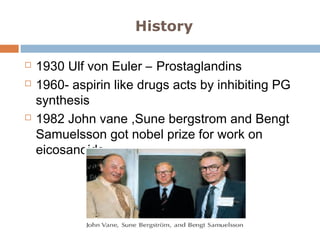
 1930 Ulf von Euler – Prostaglandins
 1960- aspirin like drugs acts by inhibiting PG
synthesis
 1982 John vane ,Sune bergstrom and Bengt
Samuelsson got nobel prize for work on
eicosanoids
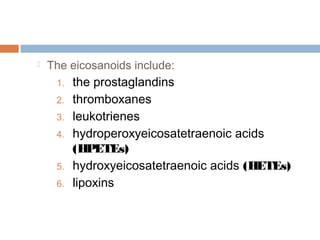
 The eicosanoids include:
1. the prostaglandins
2. thromboxanes
3. leukotrienes
4. hydroperoxyeicosatetraenoic acids
(HPETEs)
5. hydroxyeicosatetraenoic acids (HETEs)
6. lipoxins
5
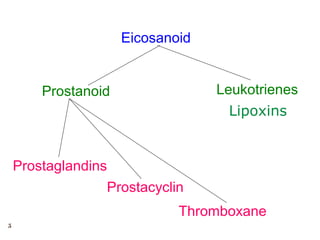
Eicosanoid
LeukotrienesProstanoid
Thromboxane
Prostacyclin
Prostaglandins
Lipoxins
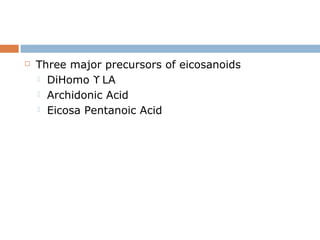
 Three major precursors of eicosanoids
 DiHomo ϒ LA
 Archidonic Acid
 Eicosa Pentanoic Acid
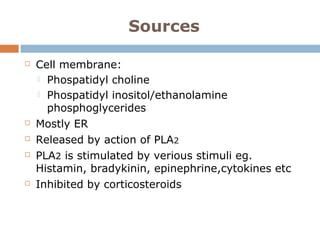
Sources
 Cell membrane:
 Phospatidyl choline
 Phospatidyl inositol/ethanolamine
phosphoglycerides
 Mostly ER
 Released by action of PLA2
 PLA2 is stimulated by verious stimuli eg.
Histamin, bradykinin, epinephrine,cytokines etc
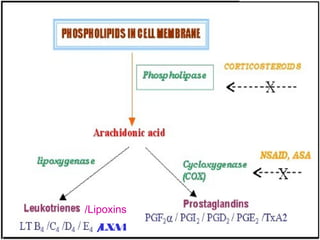
 Inhibited by corticosteroids
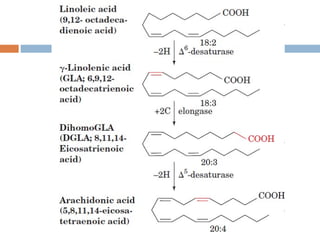
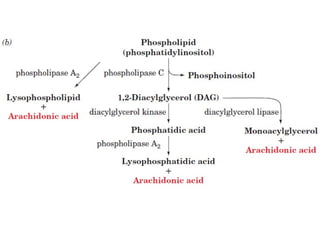
Arachidonic acid is synthesised
 From linoleic acid
 Phospholipid Hydrolysis
 Phospholipase A 2
 Phospholipase C
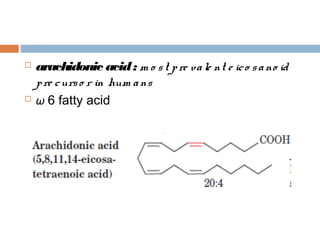
 arachidonic acid: m o st pre vale nt e ico sano id
pre curso r in hum ans
 ω 6 fatty acid
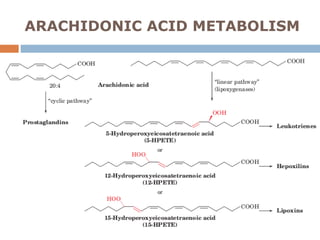
ARACHIDONIC ACID METABOLISM
/Lipoxins
/LXA4
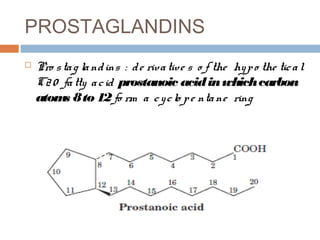
PROSTAGLANDINS
 Pro stag landins : de rivative s o f the hypo the tical
C20 fatty acid prostanoic acidinwhichcarbon
atoms 8to 12fo rm a cyclo pe ntane ring
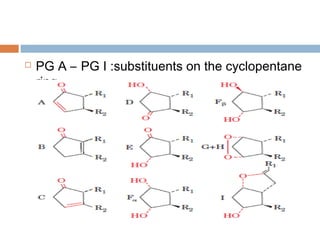
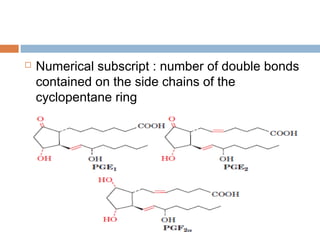
 PG A – PG I :substituents on the cyclopentane
ring
 Thromboxanes
 Numerical subscript : number of double bonds
contained on the side chains of the
cyclopentane ring
PGH Synthase
 Also called prostaglandin H synthase
/prostaglandin endoperoxide synthase/COX
 Heme-containing enzyme
 Mambrane bound
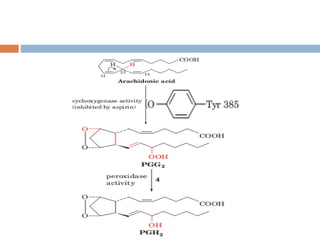
 Contains two catalytic activities
 cyclooxygenase activity
 peroxidase activity
 Cyclooxygenase Is a “Suicide Enzyme”
 15 hydroxyprostaglandin dehydrogenase
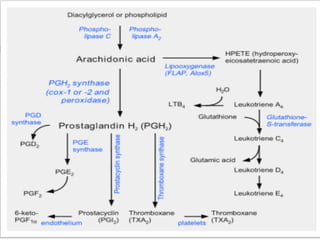
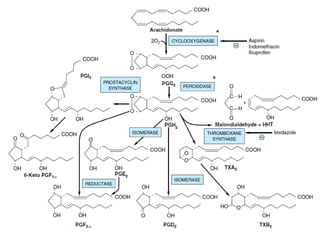
Fate of PGH2
 Fate of PGH2 thus synthesised ,depends on the
relative activities of the enzymes catalyzing the
specific interconversions
 Platelets thromboxane synthase, which
mediates
 the formation of thromboxane A2 (TxA2), a
vasoconstrictor
 and stimulator of platelet aggregation (an
initial
 step in blood clotting; Section 35-1).Vascular
endothelial
 cells contain prostacyclin synthase, which
catalyzes the synthesis
 of prostacyclin I2 (PG I2)
MECHANISM OF ACTION
 G protein coupled receptors
 Second messengers
 cAMP: PGD,PGE,PGF
 Ca: TXA2,PGF2α
 Adenylate cyclase-cAMP-Protein kinase A
 Sometimes by direct activation on cAMP
CATABOLOISM
 Eicosanoids: Very short half life
 Catabolised by
1. Oxidation of hydroxyl group(c-15)
2. Reduction of double bonds(c-13)
3. Β oxidation
 TXA2 : initial modification involving clevage of
bond between C9-C11
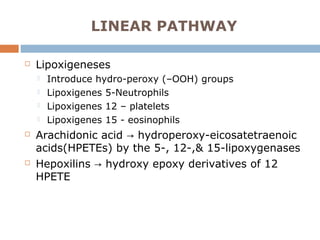
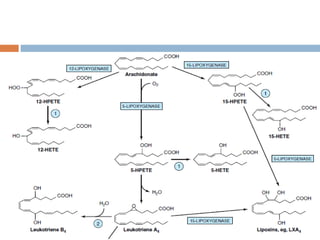
LINEAR PATHWAY
 Lipoxigeneses
 Introduce hydro-peroxy (–OOH) groups
 Lipoxigenes 5-Neutrophils
 Lipoxigenes 12 – platelets
 Lipoxigenes 15 - eosinophils
 Arachidonic acid hydroperoxy-eicosatetraenoic→
acids(HPETEs) by the 5-, 12-,& 15-lipoxygenases
 Hepoxilins hydroxy epoxy derivatives of 12→
HPETE
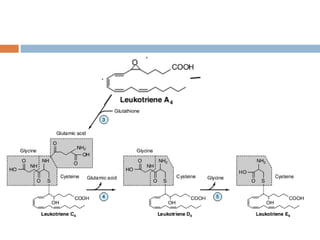
Leukotrienes:
 synthesized by: WBC, mast cells,lung, spleen,
brain and heart
 Peptidoleukotrienes (LTC4,D 4,E 4): SRS-A
 LTB4: Chemotactic factor
 Implicated in
 Asthma
 Hypersensitivity reactions
 Myocardial infarction
LIPOXINS
 Lipoxins: antiinflammatory eicosanoids
 FLAP
 5-LO activity requires the presence of 5-lipoxyge-
nase-activating protein
 facilitates enzyme–substrate binding
 5-LO’s interaction with the membrane
 Inhibited by MK-591 rsulting in inhibition of
synthesis of leukotriens
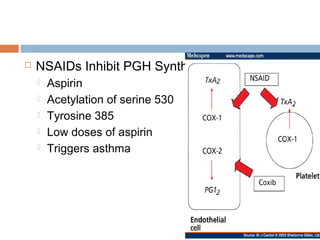
 NSAIDs Inhibit PGH Synthase
 Aspirin
 Acetylation of serine 530
 Tyrosine 385
 Low doses of aspirin
 Triggers asthma
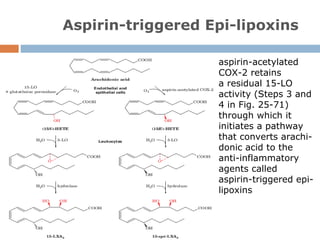
aspirin-acetylated
COX-2 retains
a residual 15-LO
activity (Steps 3 and
4 in Fig. 25-71)
through which it
initiates a pathway
that converts arachi-
donic acid to the
anti-inflammatory
agents called
aspirin-triggered epi-
lipoxins
Aspirin-triggered Epi-lipoxins
Theraputic aspects
 COX1 and COX 2
 COX inhibitors
 COX2 Specific inhibitor
 COX3
 TXA2 and PGI2
Actions:
 Vascular smooth muscle
 PGE2 and PGI2 are potent vasodilators in
most vascular beds.
 Thromboxane is a potent
vasoconstrictor.
Inflammation
PGE2 and PGI2 cause an increase in
blood flow and promote, but do not
cause, edema.
HETEs (5-HETE, 12-HETE, 15-HETE)
and leukotrienes B4 - chemotaxis
 LT C4,D4,E4 – SRS OF anaphylaxis
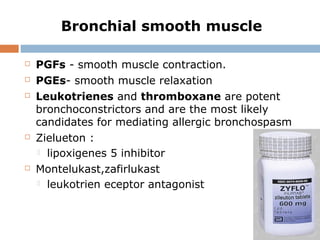
Bronchial smooth muscle
 PGFs - smooth muscle contraction.
 PGEs- smooth muscle relaxation
 Leukotrienes and thromboxane are potent
bronchoconstrictors and are the most likely
candidates for mediating allergic bronchospasm
 Zielueton :
 lipoxigenes 5 inhibitor
 Montelukast,zafirlukast
 leukotrien eceptor antagonist
Uterine smooth muscle
 PGE2 and PGF2α
 contraction of uterine smooth muscle in
pregnant women
 Nonpregnant uterusonpregnant uterus –
 variable response to PGs
 PGF2a causes contraction
 PGE2 causes relaxation.
 Induction of labor at term.
 Induction of labor is produced by:
 infusion of PGF2a (carboprost tromethamine)
[Hemabate] or
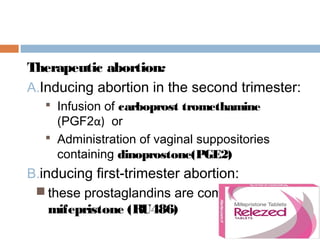
Therapeutic abortion:
A.Inducing abortion in the second trimester:
 Infusion of carboprost tromethamine
(PGF2α) or
 Administration of vaginal suppositories
containing dinoprostone(PGE2)
B.inducing first-trimester abortion:
 these prostaglandins are combined with
mifepristone (RU486)
 PGE2 and PGI2
 inhibit acid and pepsinogen
Secretion in the stomach
 Prostaglandins
 increase mucus, water, and electrolyte
secretion in the stomach and the intestine.
 Misoprostol [Cytotec]
 a methylated derivative of PGE1
 is approved for use in patients taking high
doses of NSAIDs to reduce gastric
ulceration.
Gastrointestinal tract
PGE2 and PGF2a
 increase the rate of longitudinal
contraction in the gut and decrease
transit time.
The leukotrienes
 potent stimulators of gastrointestinal
smooth muscle.
 TXA2
 is a potent inducer of platelet aggregation.
 PGI2 and PGE2
 inhibit platelet aggregation.
 PGEs
 induce erythropoiesis by stimulating the renal
release of erythropoietin.
 5-HPETE
 stimulates release of histamine
 PGI2 and PGD
 inhibit histamine release.
Blood
Management of ductus arteriosus
 Maintenance:
 is produced by PGE1 [Prostin VR] infusion
 PGE1 will maintain patency of the ductus
arteriosus, which may be desirable before
surgery
 Closure
 Indomethacin is given at birth to close the
PDA
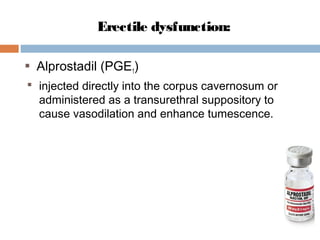
Erectile dysfunction:
 Alprostadil (PGE1)
 injected directly into the corpus cavernosum or
administered as a transurethral suppository to
cause vasodilation and enhance tumescence.
Mimic endocrine hormones:
 Bind to G-protein-coupled receptors
 Secondary messenger- cAMP
 Profound physiological effects at extremely low
concentrations
 Mediate
 Inflammatory response
 Production of pain and fever
 Regulation of blood pressure
 The induction of blood clotting
 Control of several reproductive functions such
As the induction of labor
 Regulation of the sleep/wake cycle
But….
Unlike endocrine hormones
 Not transported in the bloodstream
 Chemically and biologically unstable
substances
 Local mediators(paracrine/auto crine)
 Act in the same environment in which
they are synthesized

Eocosanoids

  • 1.
    EICOSANOIDS PRESENTER : DrDNYANESH AMLE MODERATOR: Dr SARITA AGARWAL
  • 2.
    INTRODUCTION  Eicosanoids:  Greek:eikosi twenty→  Physiologically and pharmacologically active substances derived from 20 C Poly- unsaturated Fatty Acids  Produced by Almost all mammalian cells  Not synthesised in advance /stored : synthesised as and when needed  Act as short range messengers : Autocrine/paracrine
  • 3.
    History  1930 Ulfvon Euler – Prostaglandins  1960- aspirin like drugs acts by inhibiting PG synthesis  1982 John vane ,Sune bergstrom and Bengt Samuelsson got nobel prize for work on eicosanoids
  • 4.
     The eicosanoidsinclude: 1. the prostaglandins 2. thromboxanes 3. leukotrienes 4. hydroperoxyeicosatetraenoic acids (HPETEs) 5. hydroxyeicosatetraenoic acids (HETEs) 6. lipoxins
  • 5.
  • 6.
     Three majorprecursors of eicosanoids  DiHomo ϒ LA  Archidonic Acid  Eicosa Pentanoic Acid
  • 7.
    Sources  Cell membrane: Phospatidyl choline  Phospatidyl inositol/ethanolamine phosphoglycerides  Mostly ER  Released by action of PLA2  PLA2 is stimulated by verious stimuli eg. Histamin, bradykinin, epinephrine,cytokines etc  Inhibited by corticosteroids
  • 8.
    Arachidonic acid issynthesised  From linoleic acid  Phospholipid Hydrolysis  Phospholipase A 2  Phospholipase C
  • 11.
     arachidonic acid:m o st pre vale nt e ico sano id pre curso r in hum ans  ω 6 fatty acid
  • 12.
  • 13.
  • 14.
    PROSTAGLANDINS  Pro staglandins : de rivative s o f the hypo the tical C20 fatty acid prostanoic acidinwhichcarbon atoms 8to 12fo rm a cyclo pe ntane ring
  • 15.
     PG A– PG I :substituents on the cyclopentane ring
  • 16.
  • 17.
     Numerical subscript: number of double bonds contained on the side chains of the cyclopentane ring
  • 18.
    PGH Synthase  Alsocalled prostaglandin H synthase /prostaglandin endoperoxide synthase/COX  Heme-containing enzyme  Mambrane bound  Contains two catalytic activities  cyclooxygenase activity  peroxidase activity  Cyclooxygenase Is a “Suicide Enzyme”  15 hydroxyprostaglandin dehydrogenase
  • 20.
    Fate of PGH2 Fate of PGH2 thus synthesised ,depends on the relative activities of the enzymes catalyzing the specific interconversions
  • 21.
     Platelets thromboxanesynthase, which mediates  the formation of thromboxane A2 (TxA2), a vasoconstrictor  and stimulator of platelet aggregation (an initial  step in blood clotting; Section 35-1).Vascular endothelial  cells contain prostacyclin synthase, which catalyzes the synthesis  of prostacyclin I2 (PG I2)
  • 23.
    MECHANISM OF ACTION G protein coupled receptors  Second messengers  cAMP: PGD,PGE,PGF  Ca: TXA2,PGF2α  Adenylate cyclase-cAMP-Protein kinase A  Sometimes by direct activation on cAMP
  • 24.
    CATABOLOISM  Eicosanoids: Veryshort half life  Catabolised by 1. Oxidation of hydroxyl group(c-15) 2. Reduction of double bonds(c-13) 3. Β oxidation  TXA2 : initial modification involving clevage of bond between C9-C11
  • 25.
    LINEAR PATHWAY  Lipoxigeneses Introduce hydro-peroxy (–OOH) groups  Lipoxigenes 5-Neutrophils  Lipoxigenes 12 – platelets  Lipoxigenes 15 - eosinophils  Arachidonic acid hydroperoxy-eicosatetraenoic→ acids(HPETEs) by the 5-, 12-,& 15-lipoxygenases  Hepoxilins hydroxy epoxy derivatives of 12→ HPETE
  • 28.
    Leukotrienes:  synthesized by:WBC, mast cells,lung, spleen, brain and heart  Peptidoleukotrienes (LTC4,D 4,E 4): SRS-A  LTB4: Chemotactic factor  Implicated in  Asthma  Hypersensitivity reactions  Myocardial infarction
  • 29.
    LIPOXINS  Lipoxins: antiinflammatoryeicosanoids  FLAP  5-LO activity requires the presence of 5-lipoxyge- nase-activating protein  facilitates enzyme–substrate binding  5-LO’s interaction with the membrane  Inhibited by MK-591 rsulting in inhibition of synthesis of leukotriens
  • 30.
     NSAIDs InhibitPGH Synthase  Aspirin  Acetylation of serine 530  Tyrosine 385  Low doses of aspirin  Triggers asthma
  • 31.
    aspirin-acetylated COX-2 retains a residual15-LO activity (Steps 3 and 4 in Fig. 25-71) through which it initiates a pathway that converts arachi- donic acid to the anti-inflammatory agents called aspirin-triggered epi- lipoxins Aspirin-triggered Epi-lipoxins
  • 32.
    Theraputic aspects  COX1and COX 2  COX inhibitors  COX2 Specific inhibitor  COX3  TXA2 and PGI2
  • 33.
    Actions:  Vascular smoothmuscle  PGE2 and PGI2 are potent vasodilators in most vascular beds.  Thromboxane is a potent vasoconstrictor.
  • 34.
    Inflammation PGE2 and PGI2cause an increase in blood flow and promote, but do not cause, edema. HETEs (5-HETE, 12-HETE, 15-HETE) and leukotrienes B4 - chemotaxis  LT C4,D4,E4 – SRS OF anaphylaxis
  • 35.
    Bronchial smooth muscle PGFs - smooth muscle contraction.  PGEs- smooth muscle relaxation  Leukotrienes and thromboxane are potent bronchoconstrictors and are the most likely candidates for mediating allergic bronchospasm  Zielueton :  lipoxigenes 5 inhibitor  Montelukast,zafirlukast  leukotrien eceptor antagonist
  • 36.
    Uterine smooth muscle PGE2 and PGF2α  contraction of uterine smooth muscle in pregnant women  Nonpregnant uterusonpregnant uterus –  variable response to PGs  PGF2a causes contraction  PGE2 causes relaxation.  Induction of labor at term.  Induction of labor is produced by:  infusion of PGF2a (carboprost tromethamine) [Hemabate] or
  • 37.
    Therapeutic abortion: A.Inducing abortionin the second trimester:  Infusion of carboprost tromethamine (PGF2α) or  Administration of vaginal suppositories containing dinoprostone(PGE2) B.inducing first-trimester abortion:  these prostaglandins are combined with mifepristone (RU486)
  • 38.
     PGE2 andPGI2  inhibit acid and pepsinogen Secretion in the stomach  Prostaglandins  increase mucus, water, and electrolyte secretion in the stomach and the intestine.  Misoprostol [Cytotec]  a methylated derivative of PGE1  is approved for use in patients taking high doses of NSAIDs to reduce gastric ulceration. Gastrointestinal tract
  • 39.
    PGE2 and PGF2a increase the rate of longitudinal contraction in the gut and decrease transit time. The leukotrienes  potent stimulators of gastrointestinal smooth muscle.
  • 40.
     TXA2  isa potent inducer of platelet aggregation.  PGI2 and PGE2  inhibit platelet aggregation.  PGEs  induce erythropoiesis by stimulating the renal release of erythropoietin.  5-HPETE  stimulates release of histamine  PGI2 and PGD  inhibit histamine release. Blood
  • 41.
    Management of ductusarteriosus  Maintenance:  is produced by PGE1 [Prostin VR] infusion  PGE1 will maintain patency of the ductus arteriosus, which may be desirable before surgery  Closure  Indomethacin is given at birth to close the PDA
  • 42.
    Erectile dysfunction:  Alprostadil(PGE1)  injected directly into the corpus cavernosum or administered as a transurethral suppository to cause vasodilation and enhance tumescence.
  • 43.
    Mimic endocrine hormones: Bind to G-protein-coupled receptors  Secondary messenger- cAMP  Profound physiological effects at extremely low concentrations  Mediate  Inflammatory response  Production of pain and fever  Regulation of blood pressure  The induction of blood clotting  Control of several reproductive functions such As the induction of labor  Regulation of the sleep/wake cycle
  • 44.
    But…. Unlike endocrine hormones Not transported in the bloodstream  Chemically and biologically unstable substances  Local mediators(paracrine/auto crine)  Act in the same environment in which they are synthesized

Editor's Notes

  • #3 Group of bioactive compounds that modulate cellular funtion
  • #19 former catalyzes the tyrosyl radical-mediated addition of two molecules of O 2 to arachidonic acid, forming PGG 2 . The latter converts the hydroperoxy function of PGG 2 to an OH group, yielding PGH 2 .
  • #44 inflammatory response, notably as it involves the joints (rheumatoid arthritis), skin (psoriasis), and eyes; control of several reproductive functions such as the induction of labor The enzymes that synthesize these compounds and the receptors to which they bind are therefore the targets of intensive pharmacological research
  • #45 chemically and biologically unstable substances (some decompose within minutes or less in vitro)