EVAPORATION
Name: Jon Jyoti Sahariah
M. Pharm 2nd Sem
Pharmaceutical Chemistry
Department of Pharmaceutical Sciences
Dibrugarh University
• “Evaporation means simply vaporization from the
surface of a liquid. Vaporization of a liquid below its
boiling point is called evaporation.”
• Thus, no boiling occurs and the rate of vaporization
depends on the diffusion of vapour through the
boundary layers above the liquid.
What is Evaporation?
o “The removal of liquid from a solution by boiling the
solution in a suitable vessel and withdrawing the
vapour, leaving a Concentrated liquid residue.”
o Evaporators are designed, therefore, to give maximum
heat transfer to the liquid, with the largest possible
area, a suitable temperature gradient.
What it means practically?
o When heat applied in solution the motion of
molecules increase and molecules present in the
surface overcome the surface tension of the liquid and
it evaporates because surface molecules have less
cohesive force than others.
Mechanism of Evaporation
o Temperature: The rate of evaporation is directly
proportional to the temperature.
o Surface area: The rate of evaporation is directly
proportional to the surface area of the vessel exposed to
evaporation.
o Agitation: is necessary for evaporation.
o Atmospheric aqueous vapour pressure: The rate of
evaporation is inversely proportional to the atmospheric
aqueous vapour pressure.
Factors effecting Evaporation
o Atmospheric pressure on the liquid under
evaporation: The rate of evaporation is inversely
proportional to the atmospheric pressure on the liquid
under evaporation.
o Type of product required: The selection of the
method and apparatus to be used for evaporation
depends upon type of product required.
o Economic factors: When selecting the method and
apparatus the economic factors are important.
Types of Evaporator
A) Evaporating pans
B) Evaporating still
C) Horizontal tube evaporation
D) Vertical evaporator: short tubes (standard
and basket)
E) Vertical evaporator: long tubes (climbing
film evaporators)
F) Forced circular evaporators
G) Multiple Effect Evaporation
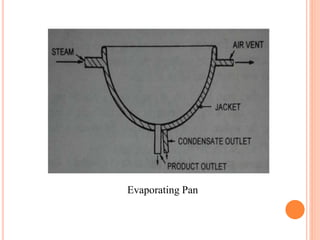
A) Evaporating pans:
 Consists of a hemispherical pan made from
copper or stainless steel and surrounded by steam
jacket.
 Provides a large surface area for evaporation.
 The evaporating pans are heated by steam which
passes through a steam jacket.
Types of Evaporator
Evaporating Pan
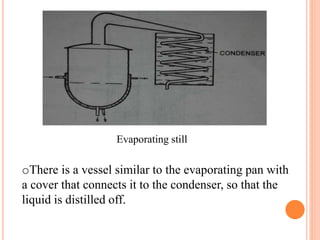
B) Evaporating still
 This type of evaporator is commonly known as a
“Still” because the evaporating pan is covered and is
connected to a condenser so that the vapours are
condensed into the liquid.
Evaporating still
oThere is a vessel similar to the evaporating pan with
a cover that connects it to the condenser, so that the
liquid is distilled off.
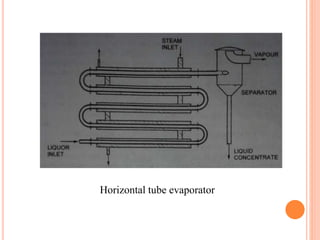
C) Horizontal tube evaporation
 In this type of evaporator, several parallel 8 feet long
tubes are joined together in series.
 Each tube is enclosed in the opposite direction to the
feed liquid in the inner tube.
Horizontal tube evaporator
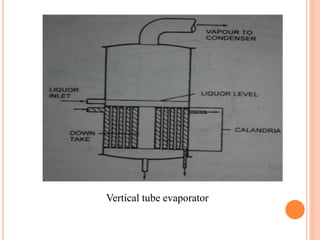
D) Vertical evaporator: short tubes (standard and
basket)
 Short tube evaporator consists of a number of tubes
which are from 1 to 2 meters in length and from 40- 80
mm in diameter.
 The tubes are filled with liquid and surrounded by
steam.
Vertical tube evaporator
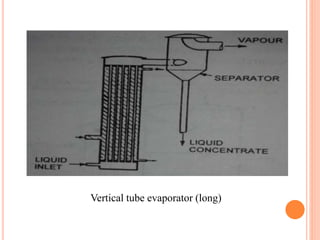
E) Vertical evaporator: long tubes (climbing film
evaporators)
 Long tube evaporators a large number of vertical
tubes about 7 meters in length and 50 mm in diameter
are enclosed in an outer jacket to which steam is
supplied.
 The pre-heated feed liquid is admitted at the base.
Vertical tube evaporator (long)
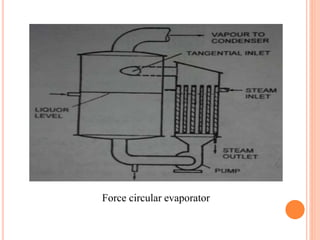
F) Forced circular evaporators
 In this types of evaporators, some mechanical device
is fitted to circulate the contents heating in it. e.g. an
evaporating pan in which the material is agitated by a
stirring rod or by mechanical propeller.
 The liquid is circulated by means of a pump and as it
is under pressure in the tubes the boiling point is
raised and no boiling takes places.
 As the liquid leaves the tubes and enters the body of
the evaporator, there is a drop in pressure and vapour
gets removed from the supper heated liquid.
Force circular evaporator
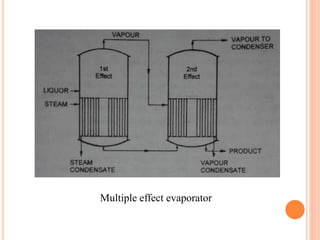
G) Multiple Effect Evaporation
 Two evaporators are connected together with a piping
arrangement so that the vapour from the first effect
(which is heated by steam) is used to heat the content
of the second effect.
 The vapour from the second effect then taken to a
condenser and converted into liquid.
Multiple effect evaporator
Reference:
 Carter S.J., Cooper and Gunn’s Tutorial Pharmacy
Edited, Sixth Edition, Part two, Pharmaceutical
Technology, 164-172.
THANK YOU

Evaporation joon

  • 1.
    EVAPORATION Name: Jon JyotiSahariah M. Pharm 2nd Sem Pharmaceutical Chemistry Department of Pharmaceutical Sciences Dibrugarh University
  • 2.
    • “Evaporation meanssimply vaporization from the surface of a liquid. Vaporization of a liquid below its boiling point is called evaporation.” • Thus, no boiling occurs and the rate of vaporization depends on the diffusion of vapour through the boundary layers above the liquid. What is Evaporation?
  • 3.
    o “The removalof liquid from a solution by boiling the solution in a suitable vessel and withdrawing the vapour, leaving a Concentrated liquid residue.” o Evaporators are designed, therefore, to give maximum heat transfer to the liquid, with the largest possible area, a suitable temperature gradient. What it means practically?
  • 4.
    o When heatapplied in solution the motion of molecules increase and molecules present in the surface overcome the surface tension of the liquid and it evaporates because surface molecules have less cohesive force than others. Mechanism of Evaporation
  • 5.
    o Temperature: Therate of evaporation is directly proportional to the temperature. o Surface area: The rate of evaporation is directly proportional to the surface area of the vessel exposed to evaporation. o Agitation: is necessary for evaporation. o Atmospheric aqueous vapour pressure: The rate of evaporation is inversely proportional to the atmospheric aqueous vapour pressure. Factors effecting Evaporation
  • 6.
    o Atmospheric pressureon the liquid under evaporation: The rate of evaporation is inversely proportional to the atmospheric pressure on the liquid under evaporation. o Type of product required: The selection of the method and apparatus to be used for evaporation depends upon type of product required. o Economic factors: When selecting the method and apparatus the economic factors are important.
  • 7.
    Types of Evaporator A)Evaporating pans B) Evaporating still C) Horizontal tube evaporation D) Vertical evaporator: short tubes (standard and basket) E) Vertical evaporator: long tubes (climbing film evaporators) F) Forced circular evaporators G) Multiple Effect Evaporation
  • 8.
    A) Evaporating pans: Consists of a hemispherical pan made from copper or stainless steel and surrounded by steam jacket.  Provides a large surface area for evaporation.  The evaporating pans are heated by steam which passes through a steam jacket. Types of Evaporator
  • 9.
  • 10.
    B) Evaporating still This type of evaporator is commonly known as a “Still” because the evaporating pan is covered and is connected to a condenser so that the vapours are condensed into the liquid.
  • 11.
    Evaporating still oThere isa vessel similar to the evaporating pan with a cover that connects it to the condenser, so that the liquid is distilled off.
  • 12.
    C) Horizontal tubeevaporation  In this type of evaporator, several parallel 8 feet long tubes are joined together in series.  Each tube is enclosed in the opposite direction to the feed liquid in the inner tube.
  • 13.
  • 14.
    D) Vertical evaporator:short tubes (standard and basket)  Short tube evaporator consists of a number of tubes which are from 1 to 2 meters in length and from 40- 80 mm in diameter.  The tubes are filled with liquid and surrounded by steam.
  • 15.
  • 16.
    E) Vertical evaporator:long tubes (climbing film evaporators)  Long tube evaporators a large number of vertical tubes about 7 meters in length and 50 mm in diameter are enclosed in an outer jacket to which steam is supplied.  The pre-heated feed liquid is admitted at the base.
  • 17.
  • 18.
    F) Forced circularevaporators  In this types of evaporators, some mechanical device is fitted to circulate the contents heating in it. e.g. an evaporating pan in which the material is agitated by a stirring rod or by mechanical propeller.  The liquid is circulated by means of a pump and as it is under pressure in the tubes the boiling point is raised and no boiling takes places.  As the liquid leaves the tubes and enters the body of the evaporator, there is a drop in pressure and vapour gets removed from the supper heated liquid.
  • 19.
  • 20.
    G) Multiple EffectEvaporation  Two evaporators are connected together with a piping arrangement so that the vapour from the first effect (which is heated by steam) is used to heat the content of the second effect.  The vapour from the second effect then taken to a condenser and converted into liquid.
  • 21.
  • 22.
    Reference:  Carter S.J.,Cooper and Gunn’s Tutorial Pharmacy Edited, Sixth Edition, Part two, Pharmaceutical Technology, 164-172.
  • 23.