Fat Metabolism
I'm not FAT, I’ve just got a lot of Potential energy..........!!!!
Biochemistry 2/e - Garrett & Grisham
Copyright © 1999 by Harcourt Brace & Company
Beta Oxidation of Fatty Acids
Knoop showed that fatty acids must be degraded
by removal of 2-C units
• Albert Lehninger showed that this occurred in
the mitochondria
• F. Lynen and E. Reichart showed that the 2-C
unit released is acetyl-CoA, not free acetate
• The process begins with oxidation of the
carbon that is "beta" to the carboxyl carbon, so
the process is called"beta-oxidation"
Beta Oxidation
The break down of a fatty acid to acetyl-CoA
units…the ‘glycolysis’ of fatty acids.
Strictly Aerobic.
Occurs in Mitochhondria.
Acetyl Co-A is fed directly into the Kreb's
cycle.
Overproduction causes Ketosis.
Examplify Aerobic Metabolism at its most
powerful phase
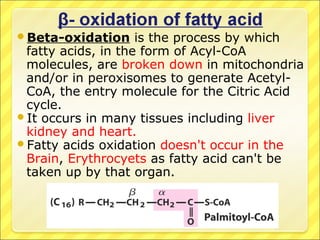
Beta-oxidation is the process by which
fatty acids, in the form of Acyl-CoA
molecules, are broken down in mitochondria
and/or in peroxisomes to generate Acetyl-
CoA, the entry molecule for the Citric Acid
cycle.
It occurs in many tissues including liver
kidney and heart.
Fatty acids oxidation doesn't occur in the
Brain, Erythrocyets as fatty acid can't be
taken up by that organ.
Beta Oxidation
The beta oxidation of fatty acids
involve three stages:
1.Activation of fatty acids in the cytosol.
2.Transport of activated fatty acids into
mitochondria (carnitine shuttle).
3.Beta oxidation proper in the mitochondrial
matrix.
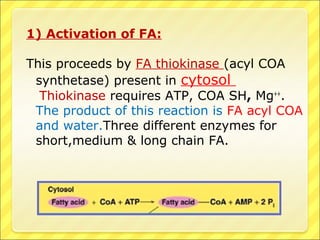
1) Activation of FA:
This proceeds by FA thiokinase (acyl COA
synthetase) present in cytosol
Thiokinase requires ATP, COA SH, Mg++
.
The product of this reaction is FA acyl COA
and water.Three different enzymes for
short,medium & long chain FA.
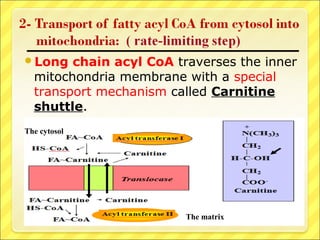
Long chain acyl CoA traverses the inner
mitochondria membrane with a special
transport mechanism called Carnitine
shuttle.
The matrix
The cytosol
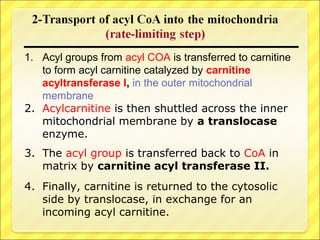
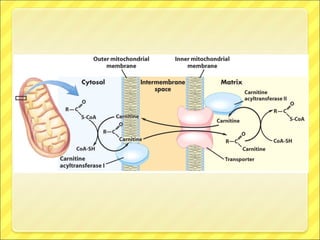
1. Acyl groups from acyl COA is transferred to carnitine
to form acyl carnitine catalyzed by carnitine
acyltransferase I, in the outer mitochondrial
membrane.
2. Acylcarnitine is then shuttled across the inner
mitochondrial membrane by a translocase
enzyme.
3. The acyl group is transferred back to CoA in
matrix by carnitine acyl transferase II.
4. Finally, carnitine is returned to the cytosolic
side by translocase, in exchange for an
incoming acyl carnitine.
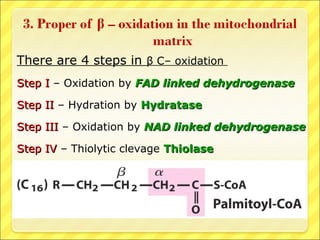
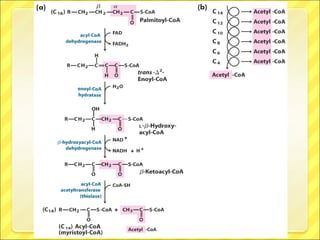
There are 4 steps in β C– oxidation
Step IStep I – Oxidation by FAD linked dehydrogenaseFAD linked dehydrogenase
Step IIStep II – Hydration by HydrataseHydratase
Step IIIStep III – Oxidation by NAD linked dehydrogenaseNAD linked dehydrogenase
Step IVStep IV – Thiolytic clevage ThiolaseThiolase
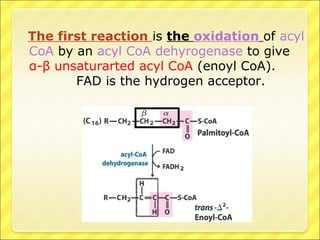
The first reaction is the oxidation of acyl
CoA by an acyl CoA dehyrogenase to give
α-β unsaturarted acyl CoA (enoyl CoA).
FAD is the hydrogen acceptor.
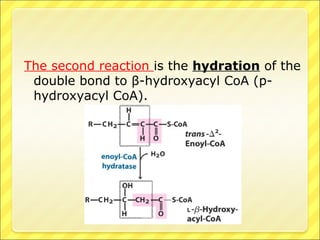
The second reaction is the hydration of the
double bond to β-hydroxyacyl CoA (p-
hydroxyacyl CoA).
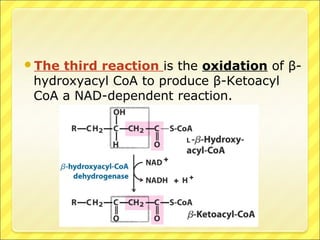
The third reaction is the oxidation of β-
hydroxyacyl CoA to produce β-Ketoacyl
CoA a NAD-dependent reaction.
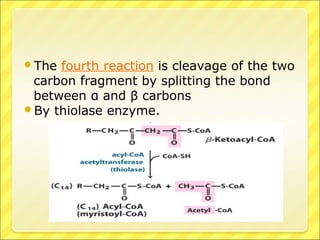
The fourth reaction is cleavage of the two
carbon fragment by splitting the bond
between α and β carbons
By thiolase enzyme.
The release of acetyl CoA leaves an acyl
CoA molecule shortened by 2 carbons.
 This acyl CoA molecule is the substrate
for the next round of oxidation starting
with acyl CoA dehydrogenase.
Repetition continues until all the carbons
of the original fatty acyl CoA are
converted to acetyl CoA.
In the last round a four carbon acyl CoA
(butyryl CoA) is cleaved to 2 acetyl CoA.
Energetics of FA oxidation
e.g. Palmitic (16C):
1.β-oxidation of palmitic acid will be
repeated 7 cycles producing 8 molecules
of acetyl COA.
2.In each cycle FADH2 and NADH+H+
is
produced and will be transported to the
respiratory chain.
FADH2 2 ATP
NADH + H+
3 ATP
So 7 cycles 5x7 = 35 ATP
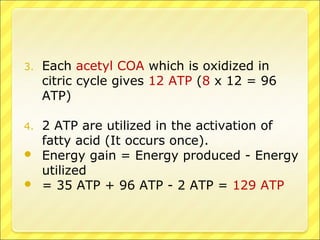
3. Each acetyl COA which is oxidized in
citric cycle gives 12 ATP (8 x 12 = 96
ATP)
4. 2 ATP are utilized in the activation of
fatty acid (It occurs once).
 Energy gain = Energy produced - Energy
utilized
 = 35 ATP + 96 ATP - 2 ATP = 129 ATP
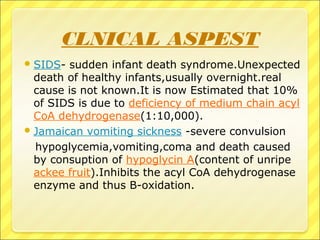
CLNICAL ASPEST
SIDS- sudden infant death syndrome.Unexpected
death of healthy infants,usually overnight.real
cause is not known.It is now Estimated that 10%
of SIDS is due to deficiency of medium chain acyl
CoA dehydrogenase(1:10,000).
Jamaican vomiting sickness -severe convulsion
hypoglycemia,vomiting,coma and death caused
by consuption of hypoglycin A(content of unripe
ackee fruit).Inhibits the acyl CoA dehydrogenase
enzyme and thus B-oxidation.
Thank You

B oxidation[1]

  • 1.
    Fat Metabolism I'm notFAT, I’ve just got a lot of Potential energy..........!!!!
  • 2.
    Biochemistry 2/e -Garrett & Grisham Copyright © 1999 by Harcourt Brace & Company Beta Oxidation of Fatty Acids Knoop showed that fatty acids must be degraded by removal of 2-C units • Albert Lehninger showed that this occurred in the mitochondria • F. Lynen and E. Reichart showed that the 2-C unit released is acetyl-CoA, not free acetate • The process begins with oxidation of the carbon that is "beta" to the carboxyl carbon, so the process is called"beta-oxidation"
  • 3.
    Beta Oxidation The breakdown of a fatty acid to acetyl-CoA units…the ‘glycolysis’ of fatty acids. Strictly Aerobic. Occurs in Mitochhondria. Acetyl Co-A is fed directly into the Kreb's cycle. Overproduction causes Ketosis. Examplify Aerobic Metabolism at its most powerful phase
  • 4.
    Beta-oxidation is theprocess by which fatty acids, in the form of Acyl-CoA molecules, are broken down in mitochondria and/or in peroxisomes to generate Acetyl- CoA, the entry molecule for the Citric Acid cycle. It occurs in many tissues including liver kidney and heart. Fatty acids oxidation doesn't occur in the Brain, Erythrocyets as fatty acid can't be taken up by that organ.
  • 5.
    Beta Oxidation The betaoxidation of fatty acids involve three stages: 1.Activation of fatty acids in the cytosol. 2.Transport of activated fatty acids into mitochondria (carnitine shuttle). 3.Beta oxidation proper in the mitochondrial matrix.
  • 6.
    1) Activation ofFA: This proceeds by FA thiokinase (acyl COA synthetase) present in cytosol Thiokinase requires ATP, COA SH, Mg++ . The product of this reaction is FA acyl COA and water.Three different enzymes for short,medium & long chain FA.
  • 7.
    Long chain acylCoA traverses the inner mitochondria membrane with a special transport mechanism called Carnitine shuttle. The matrix The cytosol
  • 8.
    1. Acyl groupsfrom acyl COA is transferred to carnitine to form acyl carnitine catalyzed by carnitine acyltransferase I, in the outer mitochondrial membrane. 2. Acylcarnitine is then shuttled across the inner mitochondrial membrane by a translocase enzyme. 3. The acyl group is transferred back to CoA in matrix by carnitine acyl transferase II. 4. Finally, carnitine is returned to the cytosolic side by translocase, in exchange for an incoming acyl carnitine.
  • 10.
    There are 4steps in β C– oxidation Step IStep I – Oxidation by FAD linked dehydrogenaseFAD linked dehydrogenase Step IIStep II – Hydration by HydrataseHydratase Step IIIStep III – Oxidation by NAD linked dehydrogenaseNAD linked dehydrogenase Step IVStep IV – Thiolytic clevage ThiolaseThiolase
  • 11.
    The first reactionis the oxidation of acyl CoA by an acyl CoA dehyrogenase to give α-β unsaturarted acyl CoA (enoyl CoA). FAD is the hydrogen acceptor.
  • 12.
    The second reactionis the hydration of the double bond to β-hydroxyacyl CoA (p- hydroxyacyl CoA).
  • 13.
    The third reactionis the oxidation of β- hydroxyacyl CoA to produce β-Ketoacyl CoA a NAD-dependent reaction.
  • 14.
    The fourth reactionis cleavage of the two carbon fragment by splitting the bond between α and β carbons By thiolase enzyme.
  • 16.
    The release ofacetyl CoA leaves an acyl CoA molecule shortened by 2 carbons.  This acyl CoA molecule is the substrate for the next round of oxidation starting with acyl CoA dehydrogenase. Repetition continues until all the carbons of the original fatty acyl CoA are converted to acetyl CoA. In the last round a four carbon acyl CoA (butyryl CoA) is cleaved to 2 acetyl CoA.
  • 17.
    Energetics of FAoxidation e.g. Palmitic (16C): 1.β-oxidation of palmitic acid will be repeated 7 cycles producing 8 molecules of acetyl COA. 2.In each cycle FADH2 and NADH+H+ is produced and will be transported to the respiratory chain. FADH2 2 ATP NADH + H+ 3 ATP So 7 cycles 5x7 = 35 ATP
  • 18.
    3. Each acetylCOA which is oxidized in citric cycle gives 12 ATP (8 x 12 = 96 ATP) 4. 2 ATP are utilized in the activation of fatty acid (It occurs once).  Energy gain = Energy produced - Energy utilized  = 35 ATP + 96 ATP - 2 ATP = 129 ATP
  • 19.
    CLNICAL ASPEST SIDS- suddeninfant death syndrome.Unexpected death of healthy infants,usually overnight.real cause is not known.It is now Estimated that 10% of SIDS is due to deficiency of medium chain acyl CoA dehydrogenase(1:10,000). Jamaican vomiting sickness -severe convulsion hypoglycemia,vomiting,coma and death caused by consuption of hypoglycin A(content of unripe ackee fruit).Inhibits the acyl CoA dehydrogenase enzyme and thus B-oxidation.
  • 20.