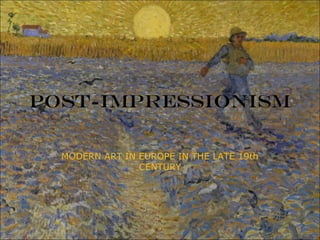
POST-IMPRESSIONISM
MODERN ART IN EUROPE IN THE LATE 19th
CENTURY
INTRODUCTION to Post-Impressionism
• By 1885-86 necessity of a shift in the conception of the
image . From impressionistic evanescence to a new kind of
firmness, solidity.
• The term “postimpressionism” does not identify a
movement but rather assembles different individual styles : post-
impressionist trends
• Most significant artists: Georges Seurat, Paul Cézanne, Paul
Gauguin, Vincent Van Gogh
• They all started from the impressionist experience but then
extended beyond it and its limitations
Post-impressionism wants to express new thematic and
stylistic force, experimenting with new visual languages
Two main trends inside post-impressionism
Scientific post-impressionism Lyrical post-impressionism
Cézanne , Seurat Gauguin, Van Gogh
Scientific post-impressionism desire to abandon and
overcome impressionist preoccupation with the fleeting
moment
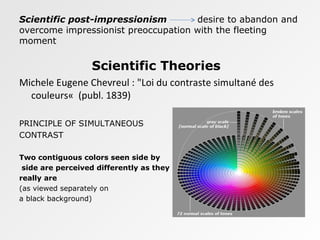
Scientific Theories
Michele Eugene Chevreul : "Loi du contraste simultané des
couleurs« (publ. 1839)
PRINCIPLE OF SIMULTANEOUS
CONTRAST
Two contiguous colors seen side by
side are perceived differently as they
really are
(as viewed separately on
a black background)
Maxwell-Chevreul new scientific theories about optics
and vision of light and colour
Seurat’s experimentation with the new theories
Contrasting and complementary colors can optically mix to
reach far more vivid tones than those achieved by mixing
paint alone (theory of SIMULTANEOUS CONTRAST AND RETINAL FUSION)
SEURAT’S NOVELTY : technique of CHROMOLUMINISM
application of the theory OF “MELANGE OPTIQUE” to the
technique of JUXTAPOSITION OF DOTS
TECHNIQUE OF CHROMOLUMINISM
- Analysis of the colors of objects
- Attempt to synthesize them through small dots or
touches of color
- Dots of color approximately equal in size lying
side by side produce an optical fusion
The result is ….
Greater luminosity and brilliance of colors are
achieved
Phenomenon of the duration of the light impression on the retina
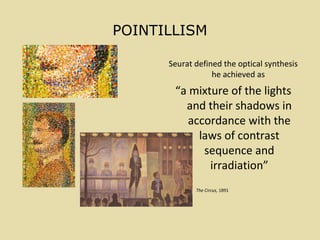
POINTILLISM
Seurat defined the optical synthesis
he achieved as
“a mixture of the lights
and their shadows in
accordance with the
laws of contrast
sequence and
irradiation”
The Circus, 1891
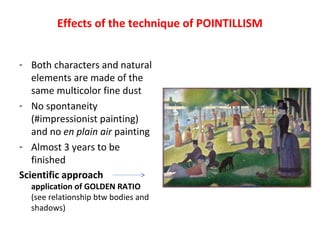
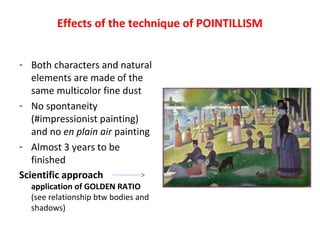
A Sunday Afternoon on the Island of La Grande Jatte
1884-86, oil on canvas, 2.07x3.08 m – The Art Institute of Chicago
1886: VIII impressionist
exhibition
Theme: summer middle class
weekend leisure
Composition: the geometry of
space and distribution of
figures is almost classical
Figures: static, volumetric but
also without body weight
( might be a criticism to
middle class society)
Effects of the technique of POINTILLISM
- Both characters and natural
elements are made of the
same multicolor fine dust
- No spontaneity
(#impressionist painting)
and no en plain air painting
- Almost 3 years to be
finished
Scientific approach
application of GOLDEN RATIO
(see relationship btw bodies and
shadows)
Effects of the technique of POINTILLISM
- Both characters and natural
elements are made of the
same multicolor fine dust
- No spontaneity
(#impressionist painting)
and no en plain air painting
- Almost 3 years to be
finished
Scientific approach
application of GOLDEN RATIO
(see relationship btw bodies and
shadows)

Post-Impressionism and Seurat

  • 1.
    POST-IMPRESSIONISM MODERN ART INEUROPE IN THE LATE 19th CENTURY
  • 2.
    INTRODUCTION to Post-Impressionism •By 1885-86 necessity of a shift in the conception of the image . From impressionistic evanescence to a new kind of firmness, solidity. • The term “postimpressionism” does not identify a movement but rather assembles different individual styles : post- impressionist trends • Most significant artists: Georges Seurat, Paul Cézanne, Paul Gauguin, Vincent Van Gogh • They all started from the impressionist experience but then extended beyond it and its limitations
  • 3.
    Post-impressionism wants toexpress new thematic and stylistic force, experimenting with new visual languages Two main trends inside post-impressionism Scientific post-impressionism Lyrical post-impressionism Cézanne , Seurat Gauguin, Van Gogh
  • 4.
    Scientific post-impressionism desireto abandon and overcome impressionist preoccupation with the fleeting moment Scientific Theories Michele Eugene Chevreul : "Loi du contraste simultané des couleurs« (publ. 1839) PRINCIPLE OF SIMULTANEOUS CONTRAST Two contiguous colors seen side by side are perceived differently as they really are (as viewed separately on a black background)
  • 5.
    Maxwell-Chevreul new scientifictheories about optics and vision of light and colour Seurat’s experimentation with the new theories Contrasting and complementary colors can optically mix to reach far more vivid tones than those achieved by mixing paint alone (theory of SIMULTANEOUS CONTRAST AND RETINAL FUSION) SEURAT’S NOVELTY : technique of CHROMOLUMINISM application of the theory OF “MELANGE OPTIQUE” to the technique of JUXTAPOSITION OF DOTS
  • 6.
    TECHNIQUE OF CHROMOLUMINISM -Analysis of the colors of objects - Attempt to synthesize them through small dots or touches of color - Dots of color approximately equal in size lying side by side produce an optical fusion The result is …. Greater luminosity and brilliance of colors are achieved Phenomenon of the duration of the light impression on the retina
  • 7.
    POINTILLISM Seurat defined theoptical synthesis he achieved as “a mixture of the lights and their shadows in accordance with the laws of contrast sequence and irradiation” The Circus, 1891
  • 8.
    A Sunday Afternoonon the Island of La Grande Jatte 1884-86, oil on canvas, 2.07x3.08 m – The Art Institute of Chicago 1886: VIII impressionist exhibition Theme: summer middle class weekend leisure Composition: the geometry of space and distribution of figures is almost classical Figures: static, volumetric but also without body weight ( might be a criticism to middle class society)
  • 9.
    Effects of thetechnique of POINTILLISM - Both characters and natural elements are made of the same multicolor fine dust - No spontaneity (#impressionist painting) and no en plain air painting - Almost 3 years to be finished Scientific approach application of GOLDEN RATIO (see relationship btw bodies and shadows)
  • 10.
    Effects of thetechnique of POINTILLISM - Both characters and natural elements are made of the same multicolor fine dust - No spontaneity (#impressionist painting) and no en plain air painting - Almost 3 years to be finished Scientific approach application of GOLDEN RATIO (see relationship btw bodies and shadows)