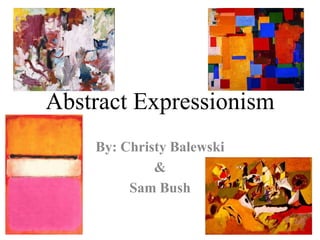
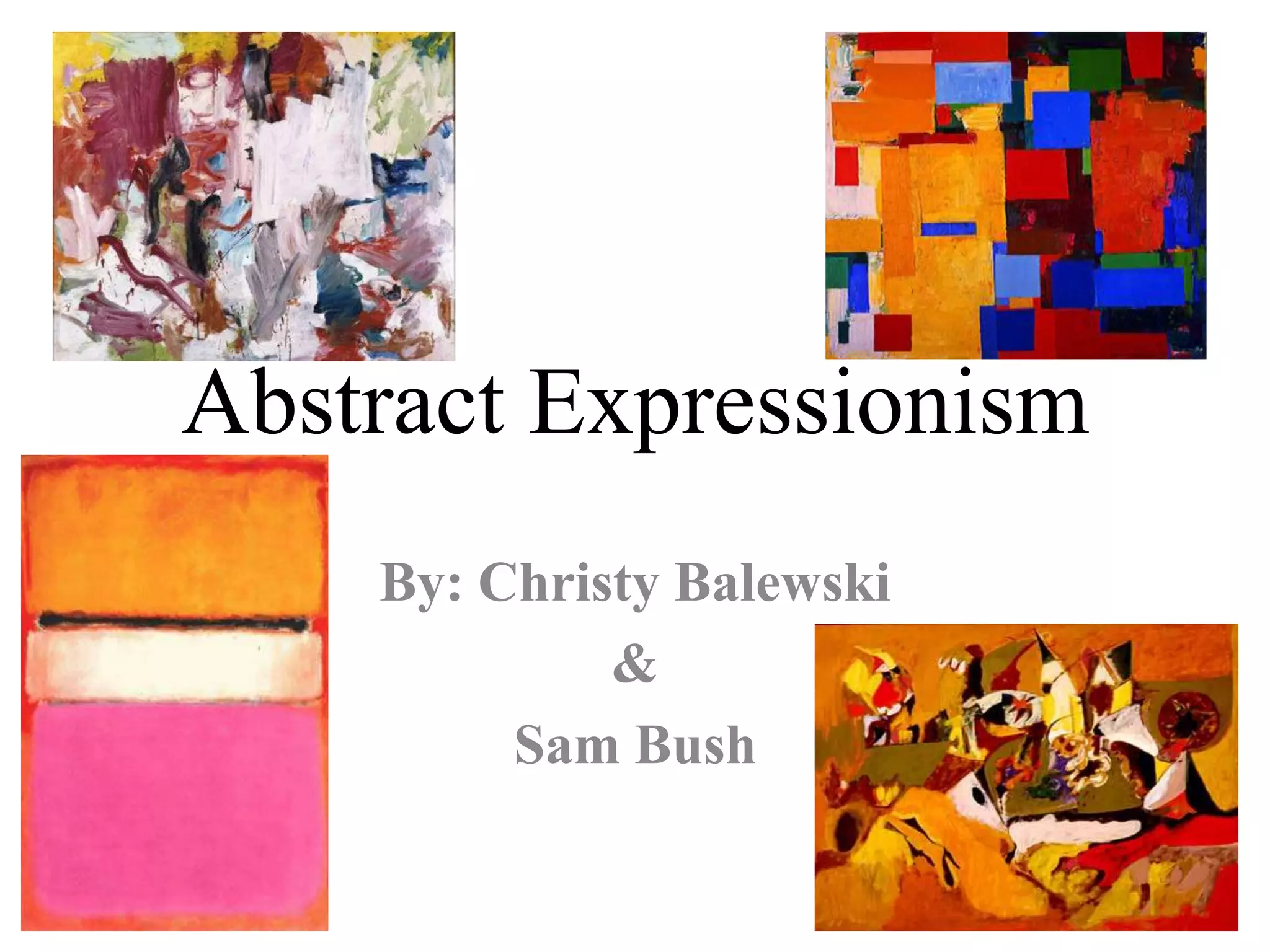
Abstract ExpressionismBy: Christy Balewski&Sam Bush
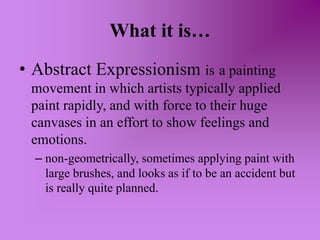
What it is…Abstract Expressionism isa painting movement in which artists typically applied paint rapidly, and with force to their huge canvases in an effort to show feelings and emotions.non-geometrically, sometimes applying paint with large brushes, and looks as if to be an accident but is really quite planned.
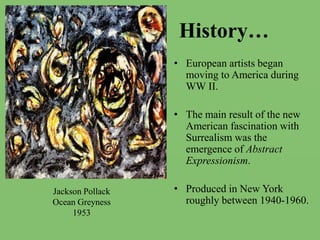
History…European artists began moving to America during WW II. The main result of the new American fascination with Surrealism was the emergence of Abstract Expressionism.Produced in New York roughly between 1940-1960.Jackson PollackOcean Greyness1953
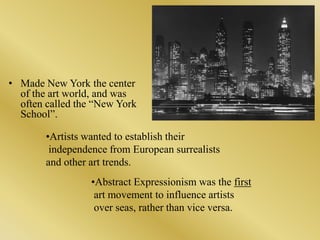
Made New York the center of the art world, and was often called the “New York School”.Artists wanted to establish their independence from European surrealists and other art trends.Abstract Expressionism was the first art movement to influence artists over seas, rather than vice versa.
Arshile Gorky was the artist to put this movement into motion, because his art ideals were obtained from Surrealism, Picasso, and Miro. Emphasized the depiction of emotion’srather then objects.Paintings consisted of shapes, lines, and forms meant to create a separate reality from the visual world.
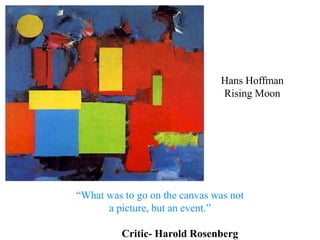
Hans HoffmanRising Moon“What was to go on the canvas was nota picture, but an event.” Critic- Harold Rosenberg
European InfluenceEuropean Surrealists obtained their notion of the unconscious mind, from Sigmund Freud. Many Americans at this time, derived Carl Jung’s theory- the “collective unconscious” holds that beneath ones private memories, is a store house of feeling and symbolic thoughts.With all the European influence, Abstract Expressionists sought universal themes within themselves.
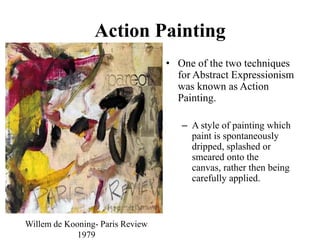
Action PaintingOne of the two techniques for Abstract Expressionism was known as Action Painting.A style of painting which paint is spontaneously dripped, splashed or smeared onto the canvas, rather then being carefully applied.Willem de Kooning- Paris Review1979
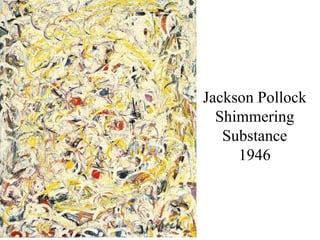
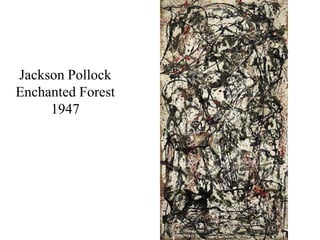
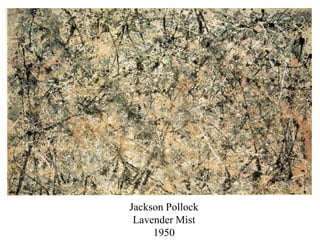
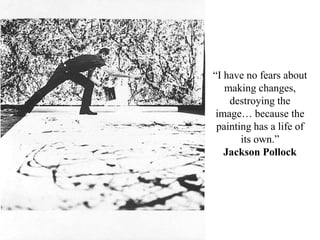
Jackson Pollock (1912-1956)Influenced by Mexican muralist painters, and Surrealism.Canvases were usually on the floor, or the wall where he dripped or poured on the paint.Used knives, sticks, or towels instead of brushes.Occasionally putting sand, broken glass, or other matter, into his paintings.Resulted in direct expression and “Action Painting”.
Jackson Pollock Shimmering Substance1946
Jackson PollockEnchanted Forest1947
Jackson Pollock  Lavender Mist  1950
“I have no fears about making changes, destroying the image… because the painting has a life of its own.” Jackson Pollock
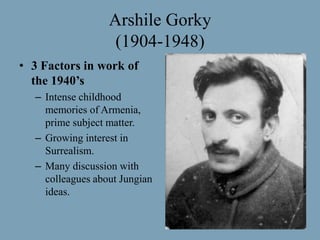
Arshile Gorky (1904-1948)3 Factors in work of the 1940’sIntense childhood memories of Armenia, prime subject matter.Growing interest in Surrealism.Many discussion with colleagues about Jungian ideas.
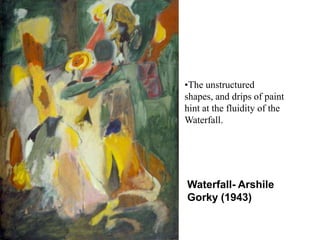
The unstructured shapes, and drips of paint hint at the fluidity of the Waterfall.Waterfall- Arshile Gorky (1943)
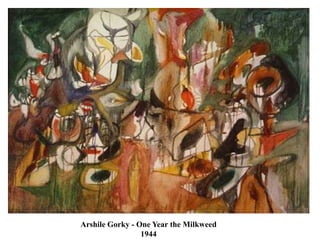
Arshile Gorky - One Year the Milkweed1944
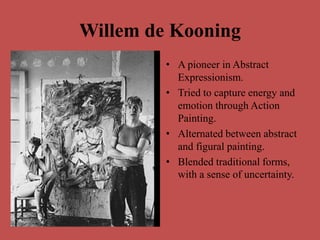
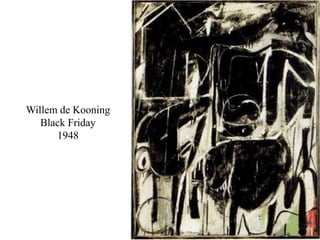
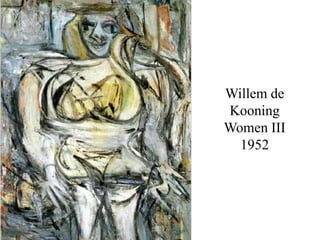
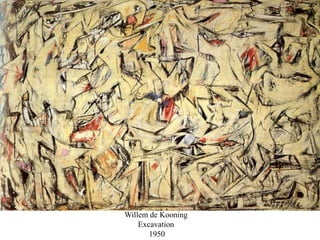
Willem de KooningA pioneer in Abstract Expressionism.Tried to capture energy and emotion through Action Painting.Alternated between abstract and figural painting.Blended traditional forms, with a sense of uncertainty.
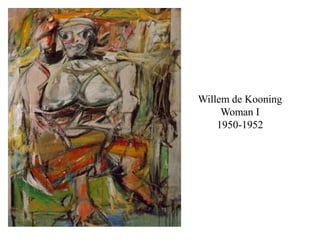
Willem de KooningWoman I1950-1952
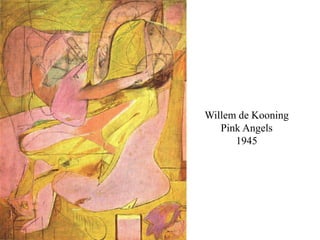
Willem de KooningPink Angels 1945
Willem de KooningBlack Friday 1948
Willem de Kooning Women III1952
Willem de KooningExcavation  1950
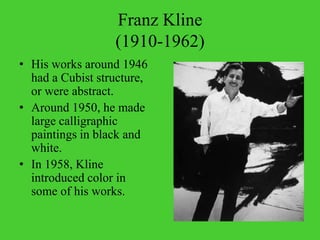
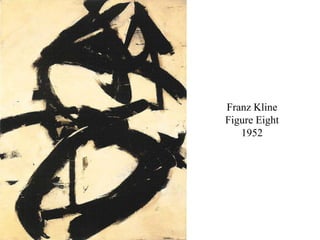
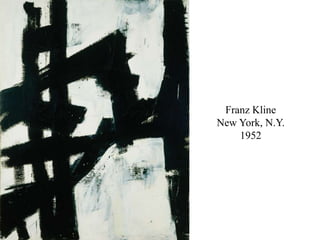
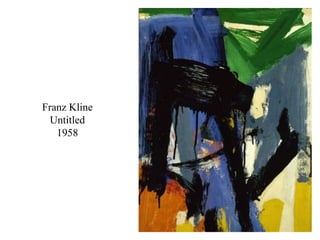
Franz Kline (1910-1962)His works around 1946 had a Cubist structure, or were abstract.Around 1950, he made large calligraphic paintings in black and white.In 1958, Kline introduced color in some of his works.
Franz KlineFigure Eight 1952
Franz KlineNew York, N.Y.1952
Franz KlineUntitled1958
Color Field PaintingThe Second Type of Abstract Expressionism paintings.Paintings with solid area of color covering the whole canvas.Meant to be seen up close, so the viewer is immersed in color.
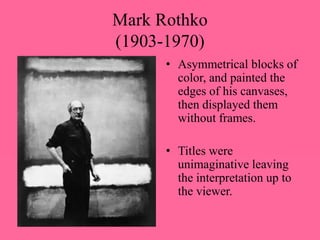
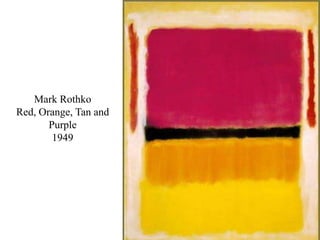
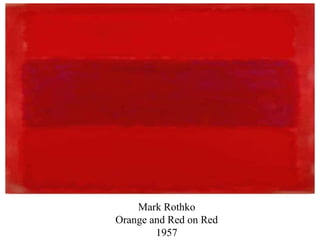
Mark Rothko(1903-1970)Asymmetrical blocks of color, and painted the edges of his canvases, then displayed them without frames. Titles were unimaginative leaving the interpretation up to the viewer.
Mark RothkoRed, Orange, Tan and Purple1949
Mark Rothko  Orange and Red on Red1957
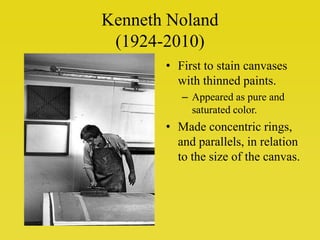
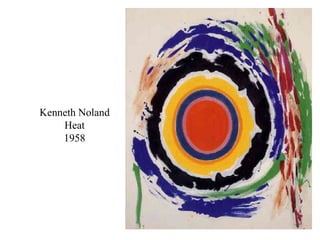
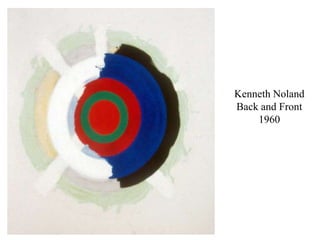
Kenneth Noland(1924-2010)First to stain canvases with thinned paints.Appeared as pure and saturated color. Made concentric rings, and parallels, in relation to the size of the canvas.
Kenneth NolandHeat1958
Kenneth NolandBack and Front1960
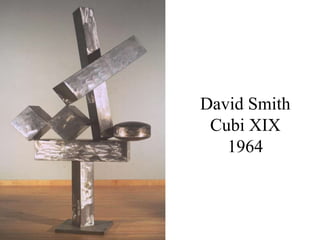
SculpturesDavid Smith is one of the most famous Abstract Expressionism sculptor’sHe created large, steel geometric sculptorsHis motivations were similar to that of the paintersHis most famous sculptors are his Cubi series
David SmithCubi XIX1964
What it InfluencedCreated a whole new way to look at artInfluenced later art movementsPop ArtMinimalismTachisme

Abstract expressionism

  • 1.
  • 2.
    What it is…AbstractExpressionism isa painting movement in which artists typically applied paint rapidly, and with force to their huge canvases in an effort to show feelings and emotions.non-geometrically, sometimes applying paint with large brushes, and looks as if to be an accident but is really quite planned.
  • 3.
    History…European artists beganmoving to America during WW II. The main result of the new American fascination with Surrealism was the emergence of Abstract Expressionism.Produced in New York roughly between 1940-1960.Jackson PollackOcean Greyness1953
  • 4.
    Made New Yorkthe center of the art world, and was often called the “New York School”.Artists wanted to establish their independence from European surrealists and other art trends.Abstract Expressionism was the first art movement to influence artists over seas, rather than vice versa.
  • 5.
    Arshile Gorky wasthe artist to put this movement into motion, because his art ideals were obtained from Surrealism, Picasso, and Miro. Emphasized the depiction of emotion’srather then objects.Paintings consisted of shapes, lines, and forms meant to create a separate reality from the visual world.
  • 6.
    Hans HoffmanRising Moon“Whatwas to go on the canvas was nota picture, but an event.” Critic- Harold Rosenberg
  • 7.
    European InfluenceEuropean Surrealistsobtained their notion of the unconscious mind, from Sigmund Freud. Many Americans at this time, derived Carl Jung’s theory- the “collective unconscious” holds that beneath ones private memories, is a store house of feeling and symbolic thoughts.With all the European influence, Abstract Expressionists sought universal themes within themselves.
  • 8.
    Action PaintingOne ofthe two techniques for Abstract Expressionism was known as Action Painting.A style of painting which paint is spontaneously dripped, splashed or smeared onto the canvas, rather then being carefully applied.Willem de Kooning- Paris Review1979
  • 9.
    Jackson Pollock (1912-1956)Influencedby Mexican muralist painters, and Surrealism.Canvases were usually on the floor, or the wall where he dripped or poured on the paint.Used knives, sticks, or towels instead of brushes.Occasionally putting sand, broken glass, or other matter, into his paintings.Resulted in direct expression and “Action Painting”.
  • 10.
  • 11.
  • 12.
    Jackson Pollock Lavender Mist 1950
  • 13.
    “I have nofears about making changes, destroying the image… because the painting has a life of its own.” Jackson Pollock
  • 14.
    Arshile Gorky (1904-1948)3Factors in work of the 1940’sIntense childhood memories of Armenia, prime subject matter.Growing interest in Surrealism.Many discussion with colleagues about Jungian ideas.
  • 15.
    The unstructured shapes,and drips of paint hint at the fluidity of the Waterfall.Waterfall- Arshile Gorky (1943)
  • 16.
    Arshile Gorky -One Year the Milkweed1944
  • 17.
    Willem de KooningApioneer in Abstract Expressionism.Tried to capture energy and emotion through Action Painting.Alternated between abstract and figural painting.Blended traditional forms, with a sense of uncertainty.
  • 18.
  • 19.
  • 20.
  • 21.
    Willem de KooningWomen III1952
  • 22.
  • 23.
    Franz Kline (1910-1962)Hisworks around 1946 had a Cubist structure, or were abstract.Around 1950, he made large calligraphic paintings in black and white.In 1958, Kline introduced color in some of his works.
  • 24.
  • 25.
  • 26.
  • 27.
    Color Field PaintingTheSecond Type of Abstract Expressionism paintings.Paintings with solid area of color covering the whole canvas.Meant to be seen up close, so the viewer is immersed in color.
  • 28.
    Mark Rothko(1903-1970)Asymmetrical blocksof color, and painted the edges of his canvases, then displayed them without frames. Titles were unimaginative leaving the interpretation up to the viewer.
  • 29.
    Mark RothkoRed, Orange,Tan and Purple1949
  • 30.
    Mark Rothko Orange and Red on Red1957
  • 31.
    Kenneth Noland(1924-2010)First tostain canvases with thinned paints.Appeared as pure and saturated color. Made concentric rings, and parallels, in relation to the size of the canvas.
  • 32.
  • 33.
  • 34.
    SculpturesDavid Smith isone of the most famous Abstract Expressionism sculptor’sHe created large, steel geometric sculptorsHis motivations were similar to that of the paintersHis most famous sculptors are his Cubi series
  • 35.
  • 36.
    What it InfluencedCreateda whole new way to look at artInfluenced later art movementsPop ArtMinimalismTachisme