ART AND CULTURE IN THE
MODERN AND
COMTEMPORARY ERAS
ARTS IV
SCHOOL YEAR 2013 - 2014
OBJECTIVES:
THE STUDENTS WILL KNOW
• THE DIFFERENT ART STYLES THAT PROLIFERATED DURING THE MODERN AND
CONTEMPORARY ERAS
• THE FACTORS THAT INFLUENCED THE STYLES OF MODERN ARTISTS
STUDENTS WILL BE ABLE TO
• IDENTIFY THE IMPORTANT EVENTS IN THE MODERN PERIODS
• ANALYZE HOW SUCH EVENTS AND CHANGES AFFECTED THE ARTIST AND ART
MAKING
• DIFFERENTIATE AMONG THE VARIOUS ART STYLES AND IDENTIFY THE
IMPORTANT ARTISTSS DURING THESE PERIOD
• DO AN INTERACTIVE PAINTING.
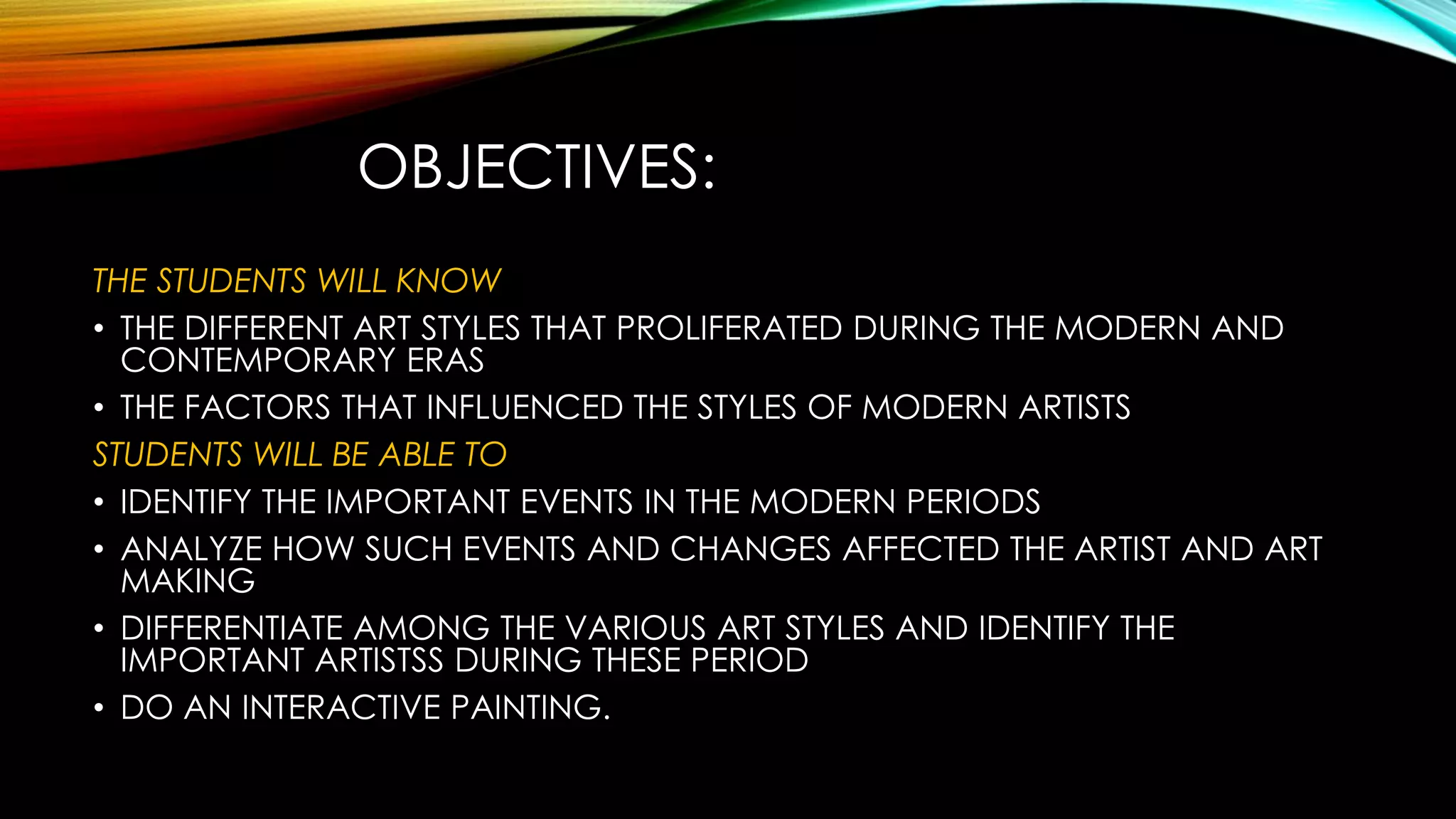
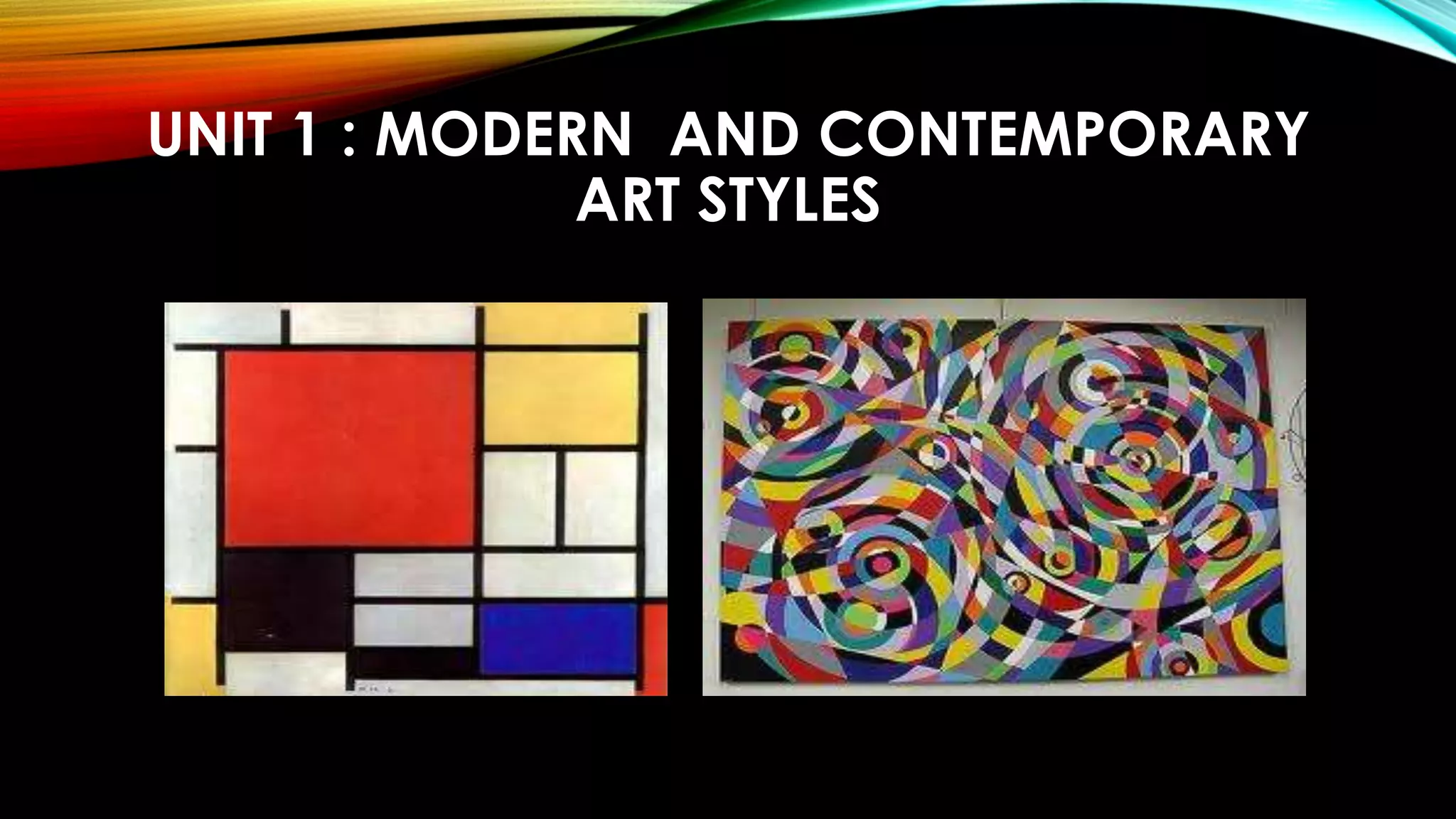
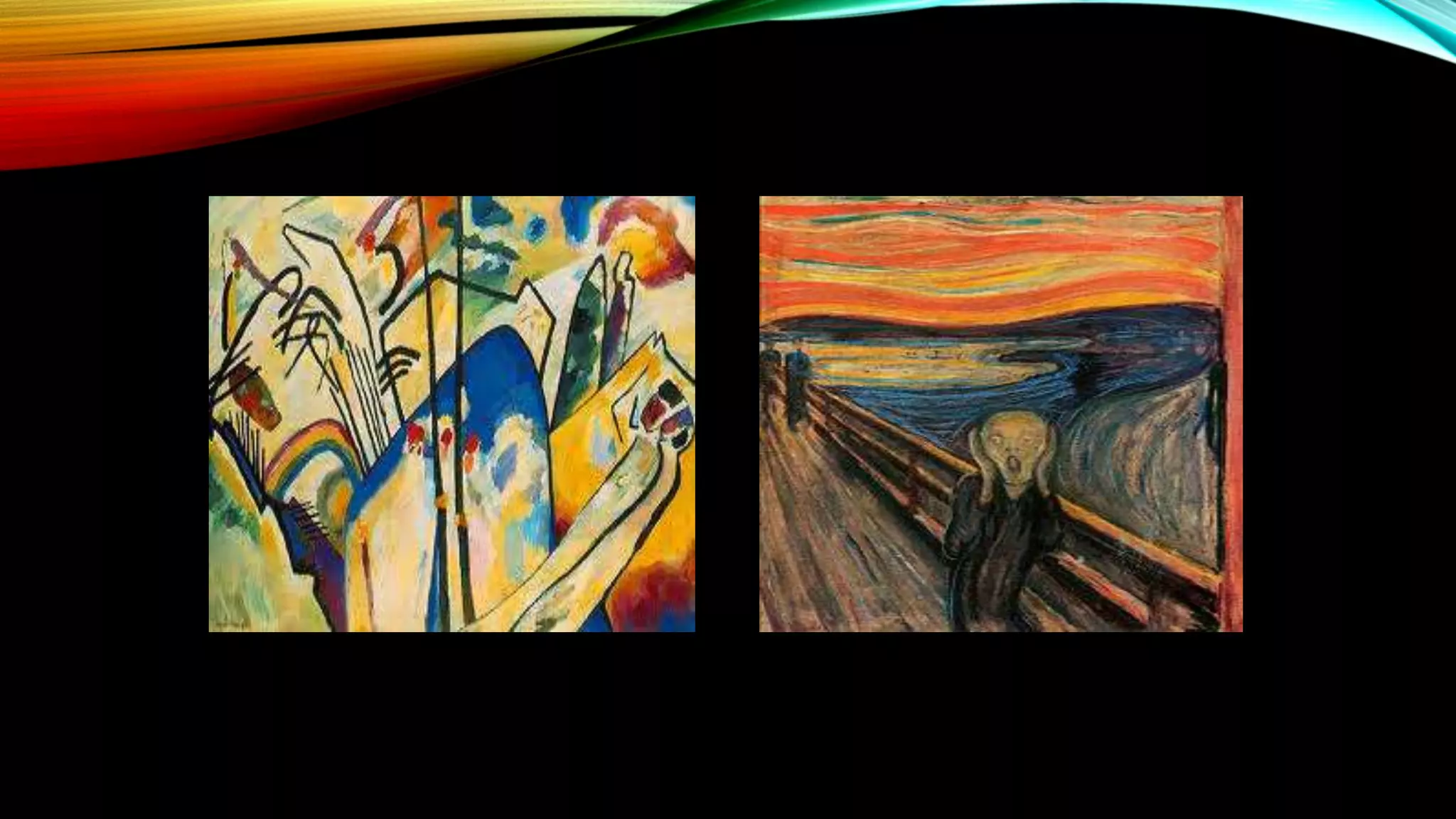
UNIT 1 : MODERN AND CONTEMPORARY
ART STYLES
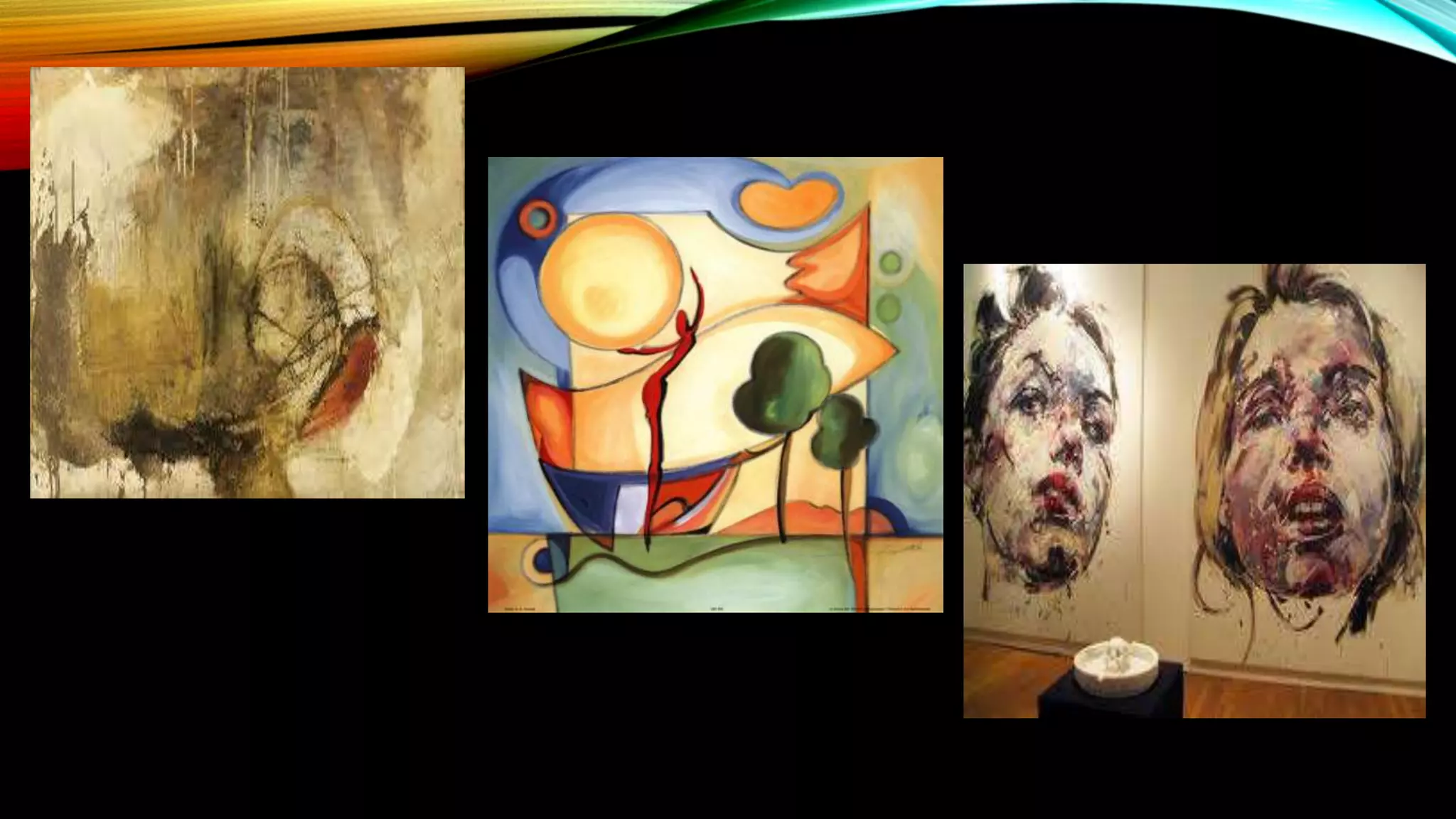
MODERN ART
The birth of modernism and modern art can be
traced back to the Industrial Revolution, a
period that lasted from the 18th to the 19th
century, in which rapid changes in
manufacturing, transportation, and technology
profoundly affected the social, economic, and
cultural conditions of life in Western Europe,
North America, and eventually the world.
New forms of transportation, including the
railroad, the steam engine, and the
subway changed the way people lived,
worked, and travelled, both at home and
abroad, expanding their worldview and
access to new ideas. As urban centers
prospered, workers flocked to cities for
industrial jobs, and urban populations
boomed.
•Different art styles emerge since the
beginning of the 20th century
•Experimentations, inspired by both
modern life and new theories about art
came out
•This is described as innovative, non-
traditional or modern art.
MODERN ART
•More difficult to understand than
traditional art
•One of the things that makes modern
painting and sculpture hard to
understand is the sheer variety of their
styles.
ART MOVEMENTS OF THE MODERN ERA
( 20TH TO 21ST CENTURY)
•FAUVISM
•SURREALISM
•CUBISM
•DADAISM
FAUVISM
•Fauvism was a joyful style of painting that
delighted in using outrageously bold colors. It
was developed in France at the beginning of
the 20th century by Henri Matisse and André
Derain. The artists who painted in this style
were known as 'Les Fauves' (the wild beasts), a
title that came from a sarcastic remark in a
review by the art critic Louis Vauxcelles.
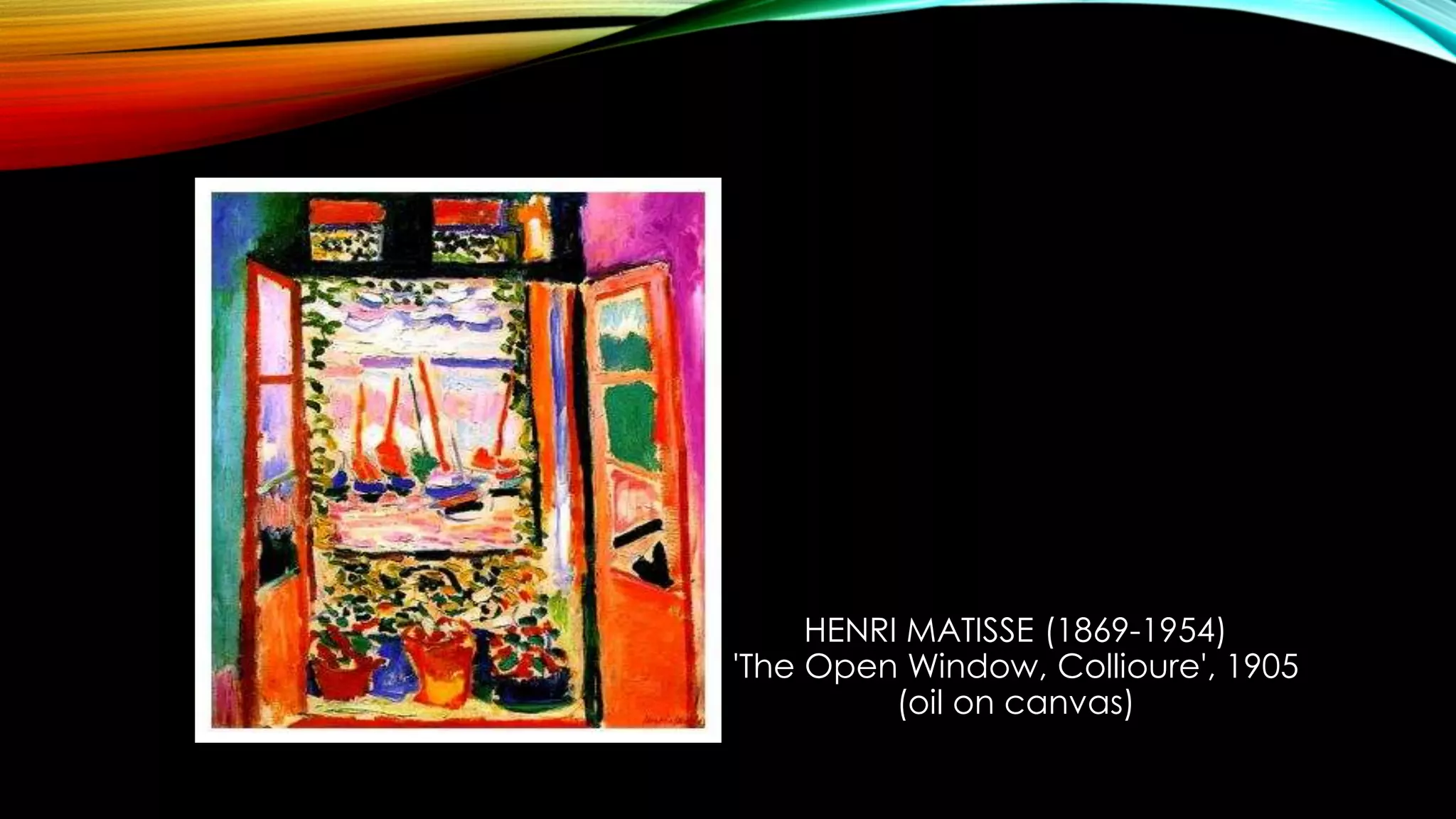
•'Les Fauves' believed that color should be
used at its highest pitch to express the
artist's feelings about a subject, rather
than simply to describe what it looks like.
Fauvist paintings have two main
characteristics: extremely simplified
drawing and intensely exaggerated color.
Fauvism was a major influence on
German Expressionism.
HENRI MATISSE (1869-1954)
'The Open Window, Collioure', 1905
(oil on canvas)
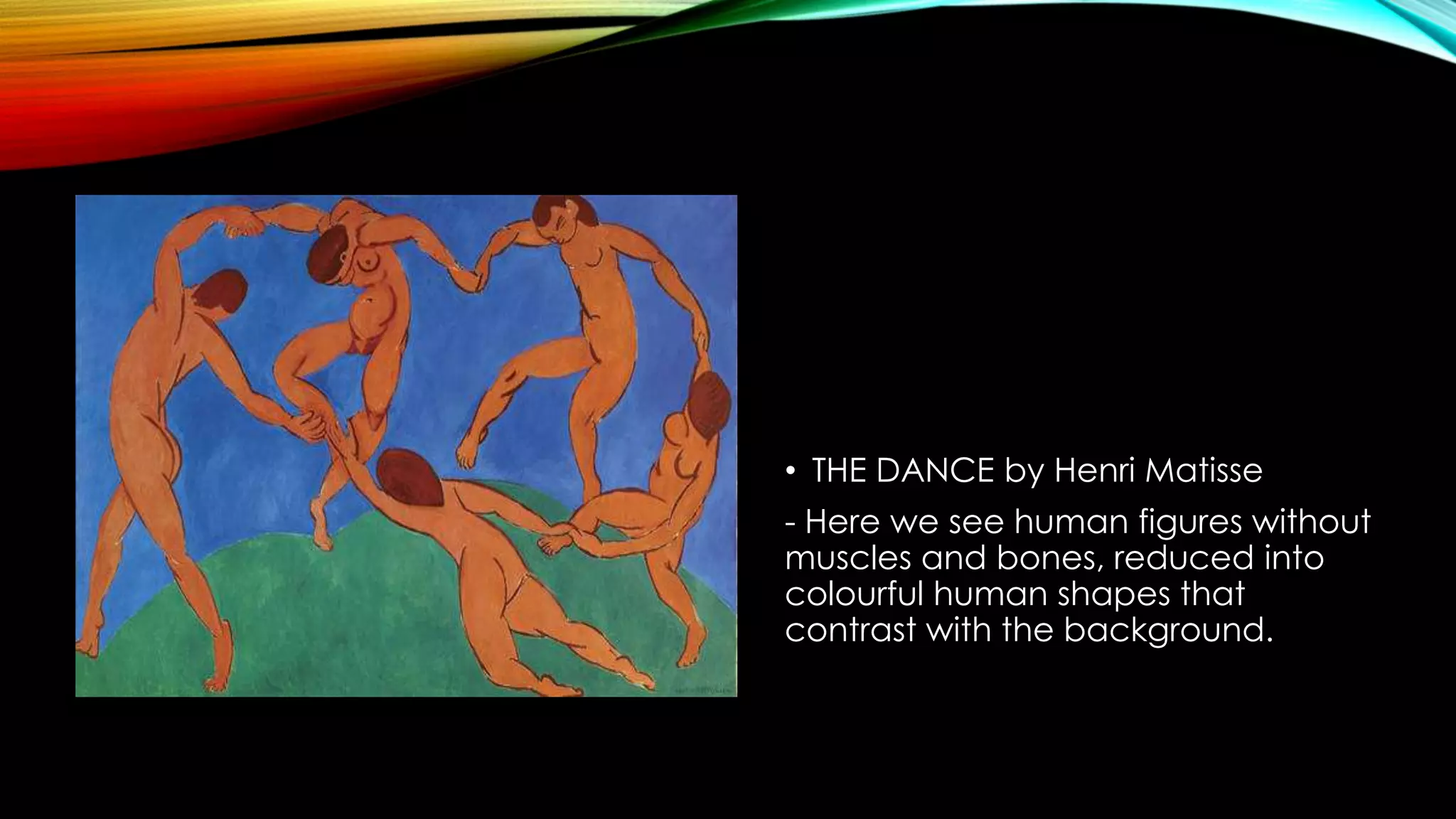
• THE DANCE by Henri Matisse
- Here we see human figures without
muscles and bones, reduced into
colourful human shapes that
contrast with the background.
FAMOUS ARTIST:
•HENRI MATISSE
•GEORGE ROUAULT
•ANDRÉ DERAIN
SURREALISM
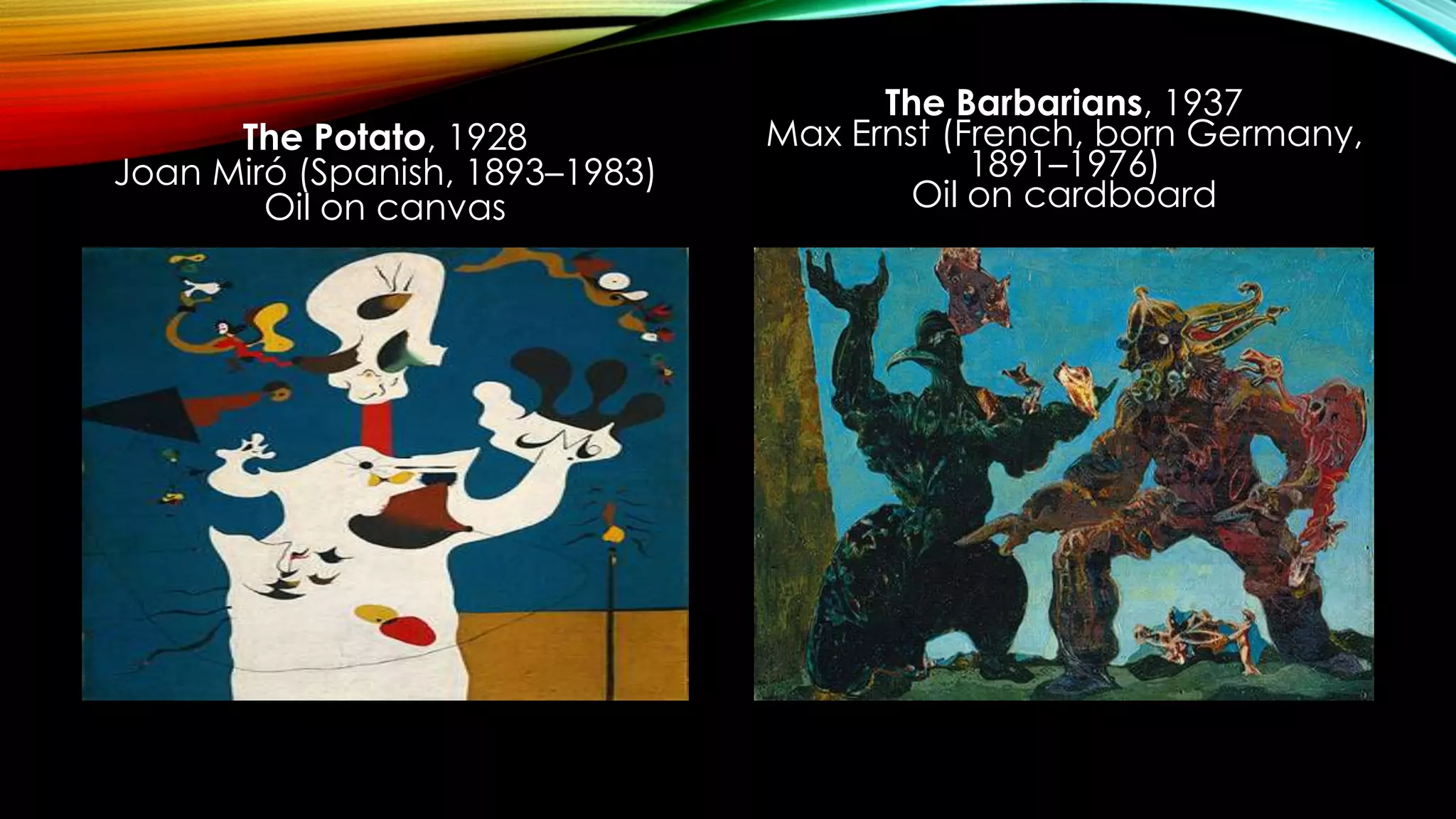
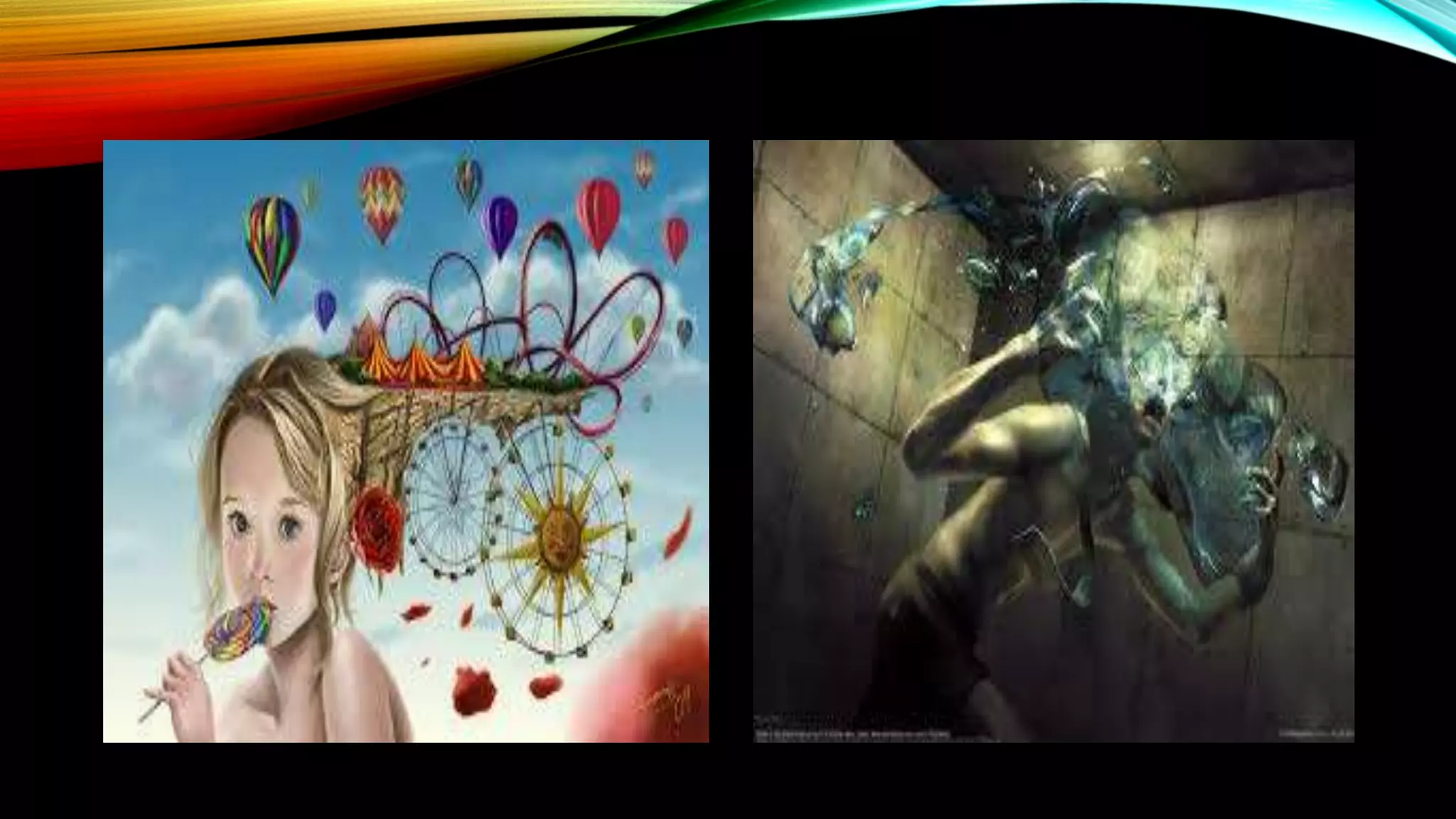
•An art movement inspired by scientific
research, Freudian psychology and dream
interpretation.
•It portrays reality and intensity of the
subconscious mind
•Surrealists feasted on the unconscious. They
believed that Freud's theories on dreams, ego,
superego and the id opened doors to the
authentic self and a truer reality (the "surreal").
•Today, we associate the word "surreal" with
strange juxtapositions or absurd combinations,
like those experienced in dreams.
How Long Was Surrealism a Movement?
•Surrealism officially began with "The Manifesto
of Surrealism," published in 1924. However, it
grew out of Dada.
•Surrealism never died, it simply splintered into
numerous directions and influenced new
movements, with different names. Some
artists still identify themselves as Surrealists and
some founding Surrealist artists are still alive.
WHAT ARE THE KEY CHARACTERISTICS OF
SURREALISM?
• The exploration of the dream and unconsciousness
as a valid form of reality, inspired by Sigmund
Freud's writings.
• A willingness to depict images of perverse
sexuality, scatology, decay and violence.
• The desire to push against the boundaries of
socially acceptable behaviors and traditions in
order to discover pure thought and the artist's true
nature.
• The incorporation of chance and spontaneity.
• The influence of revolutionary 19th century poets,
such as Charles Baudelaire, Arthur Rimbaud and
Isidore Ducasse.
• Emphasis on the mysterious, marvelous,
mythological and irrational in an effort to make
art ambiguous and strange.
• Fundamentally, Surrealism gave artists permission
to express their most basic drives: hunger,
sexuality, anger, fear, dread, ecstasy, and so
forth.
• Exposing these uncensored feelings as if in a
dream still exists in many form of art to this day.
TWO STYLISTIC SCHOOLS OF SURREALISM:
• Biomorphism
- it models artistic design elements on naturally occurring patterns or
shapes reminiscent of nature. Taken to its extreme it attempts to force
naturally occurring shapes onto functional devices, often with mixed
results.
• Naturalistic Surrealism
- naturalistic Surrealism actively pursues dreams, creating
representational scenes that have changed into a dream state or
nightmare image. These artists recorded dreams and created using
traditional techniques.
SOME OF THE FAMOUS SURREALIST AND
THEIR WORKS:
• Max Ernst, Two Children Are Threatened by a Nightingale,
1924. (Museum of Modern Art, New York).
• Joan Miró, Carnival of Harlequin, 1924-25. (Albright-Knox
Gallery, Buffalo, NY)
• René Magritte, The Treachery of Images (Ceci n'est pas une
pipe), 1929. (Los Angeles County Museum of Art)
• Jean (Hans) Arp, Head with Three Annoying Objects, 1930.
(Estate of the artist).
• Salvador Dalí, The Persistence of Memory, 1931. (Museum of
Modern Art, New York)
The Potato, 1928
Joan Miró (Spanish, 1893–1983)
Oil on canvas
The Barbarians, 1937
Max Ernst (French, born Germany,
1891–1976)
Oil on cardboard
CUBISM
•The most influential art style in the early 20th
century.
•The artist tries to show all sides of an object,
reduces recognizable images to geometric
forms, shows objects from several positions at
one time, and often makes opaque forms
transparent.
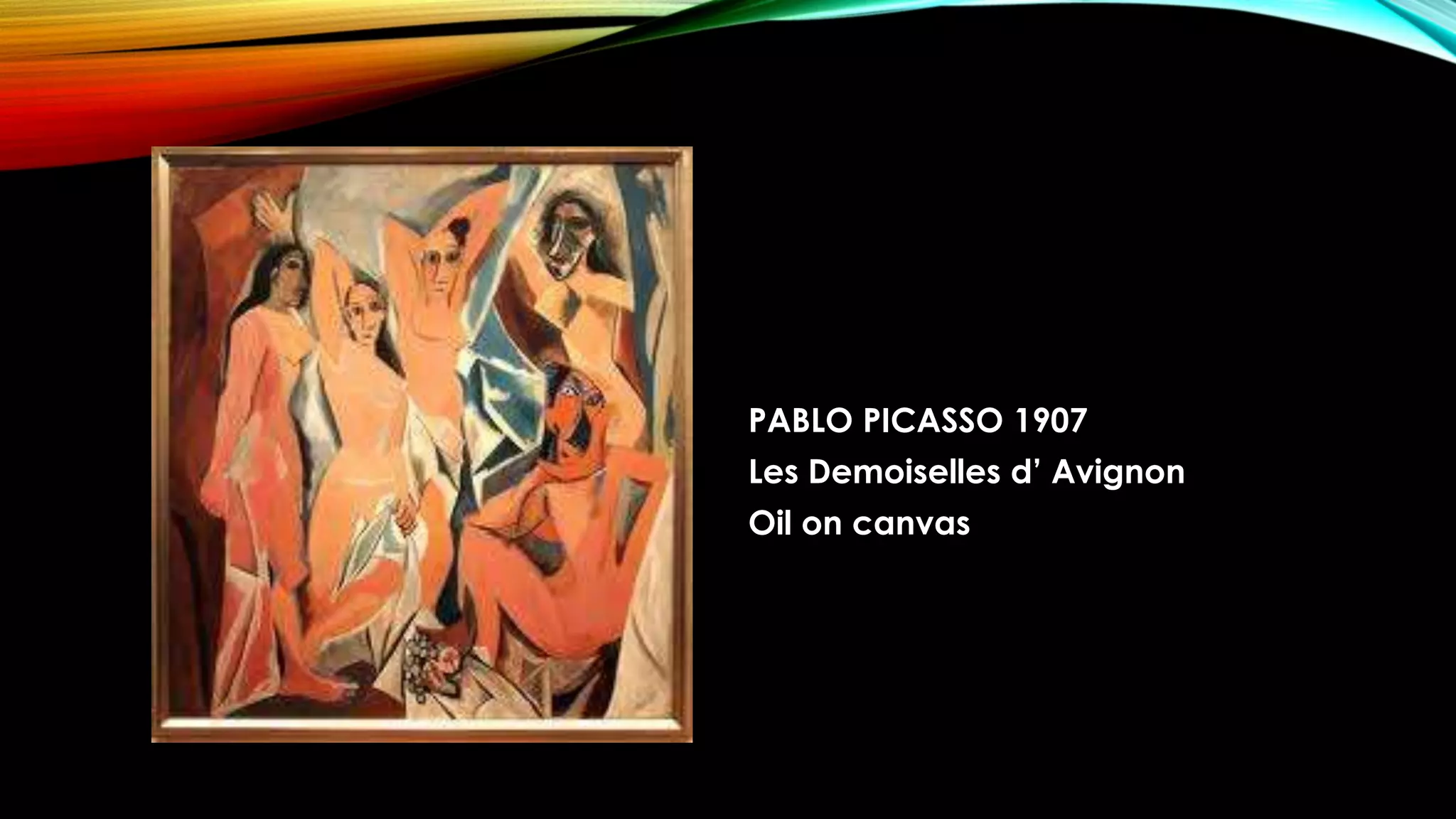
• Cubism was invented around 1907 in Paris by Pablo
Picasso and Georges Braque. It was the first abstract
style of modern art. Cubist paintings ignore the
traditions of perspective drawing and show you
many views of a subject at one time. The Cubists
believed that the traditions of Western art had
become exhausted and to revitalize their work, they
drew on the expressive energy of art from other
cultures, particularly African art.
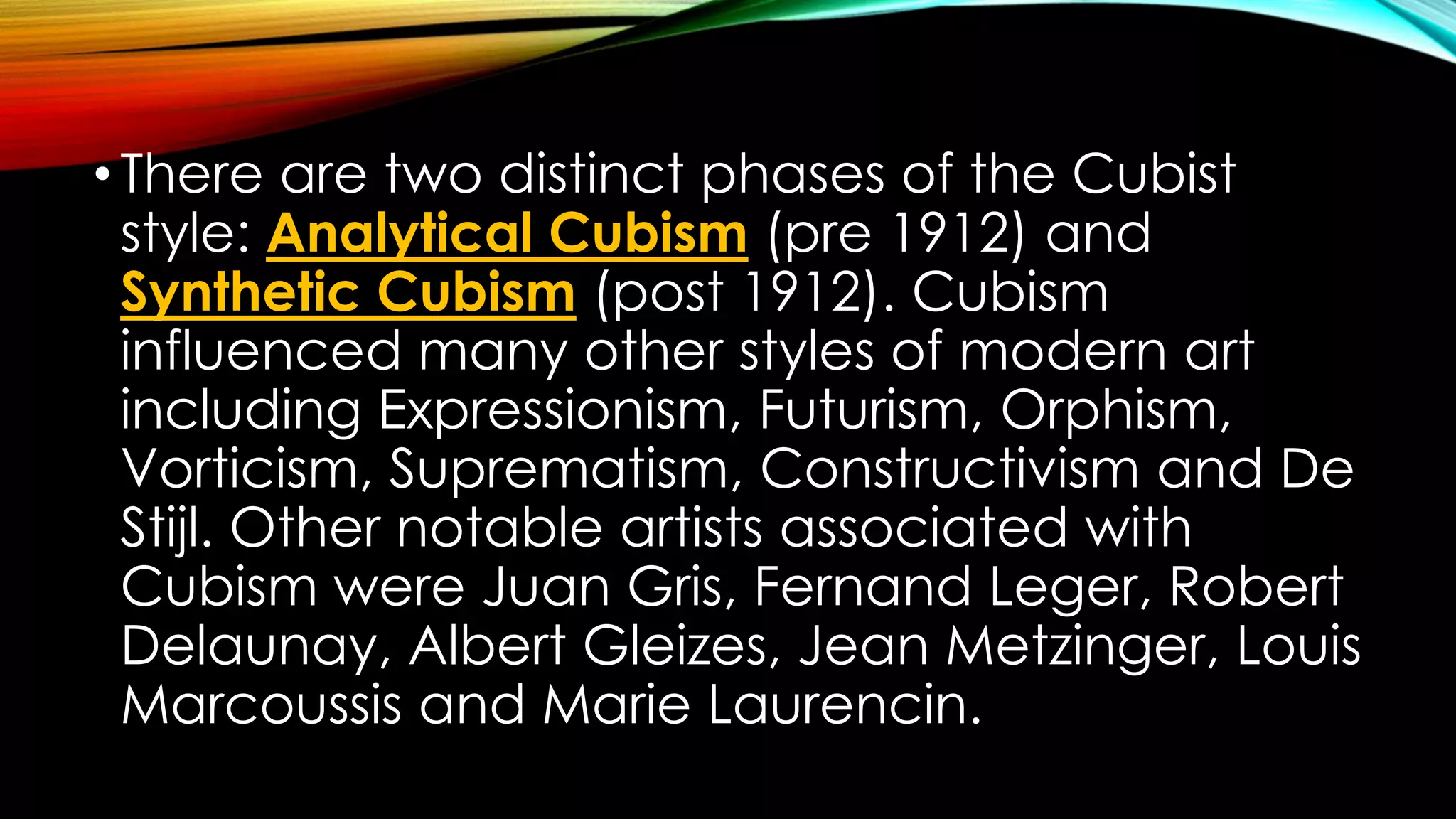
•There are two distinct phases of the Cubist
style: Analytical Cubism (pre 1912) and
Synthetic Cubism (post 1912). Cubism
influenced many other styles of modern art
including Expressionism, Futurism, Orphism,
Vorticism, Suprematism, Constructivism and De
Stijl. Other notable artists associated with
Cubism were Juan Gris, Fernand Leger, Robert
Delaunay, Albert Gleizes, Jean Metzinger, Louis
Marcoussis and Marie Laurencin.
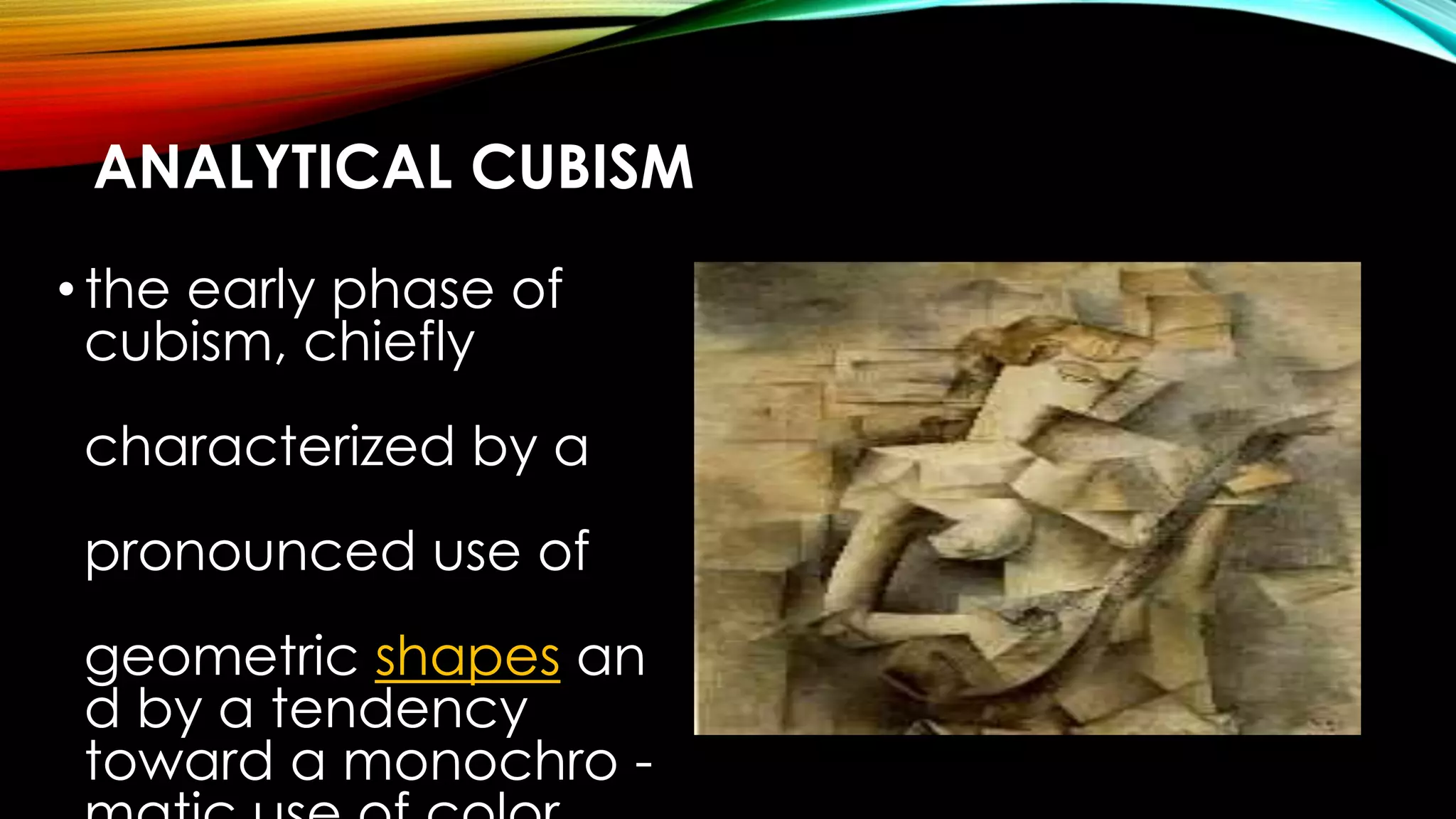
ANALYTICAL CUBISM
•the early phase of
cubism, chiefly
characterized by a
pronounced use of
geometric shapes an
d by a tendency
toward a monochro -
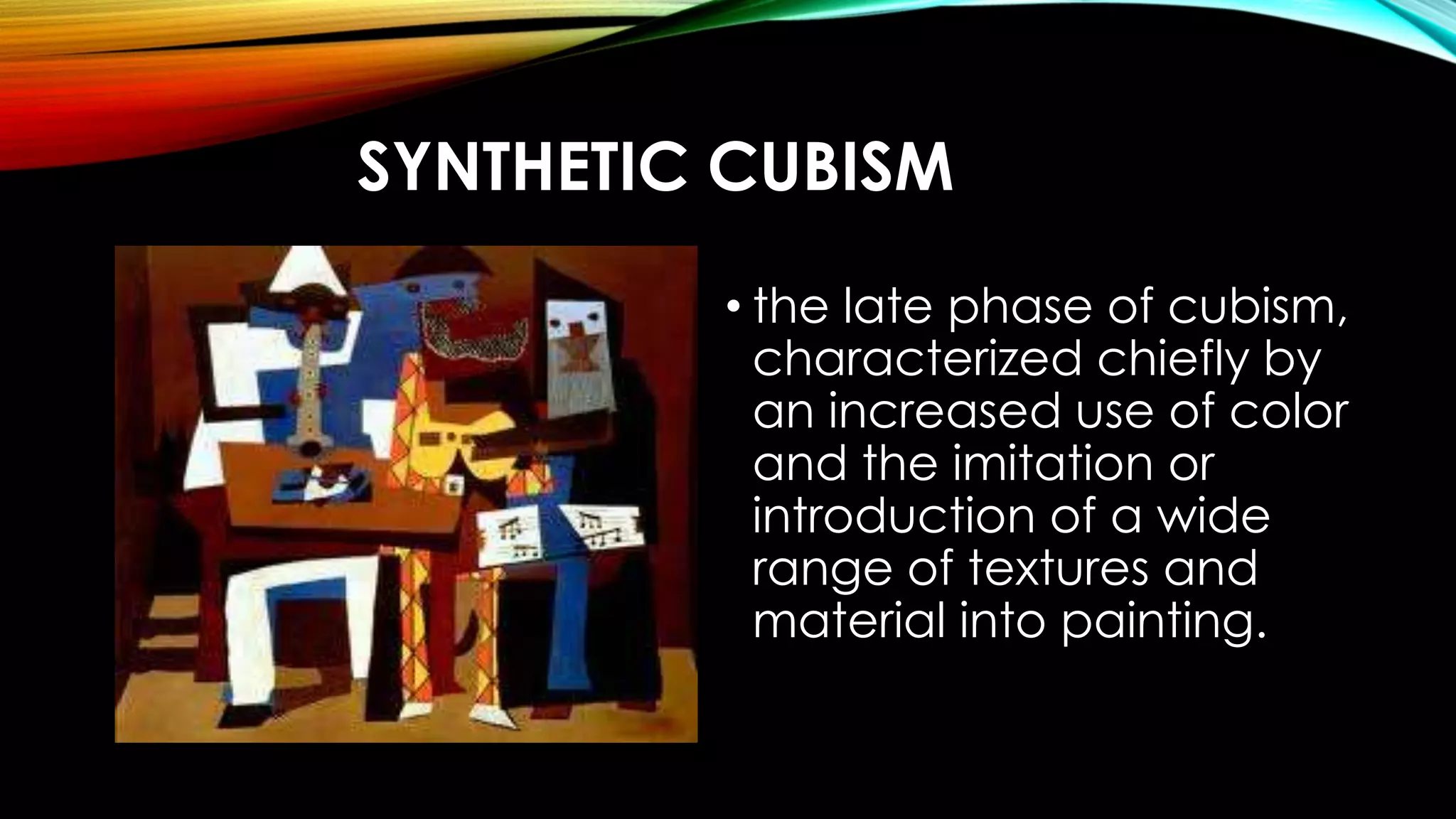
SYNTHETIC CUBISM
• the late phase of cubism,
characterized chiefly by
an increased use of color
and the imitation or
introduction of a wide
range of textures and
material into painting.
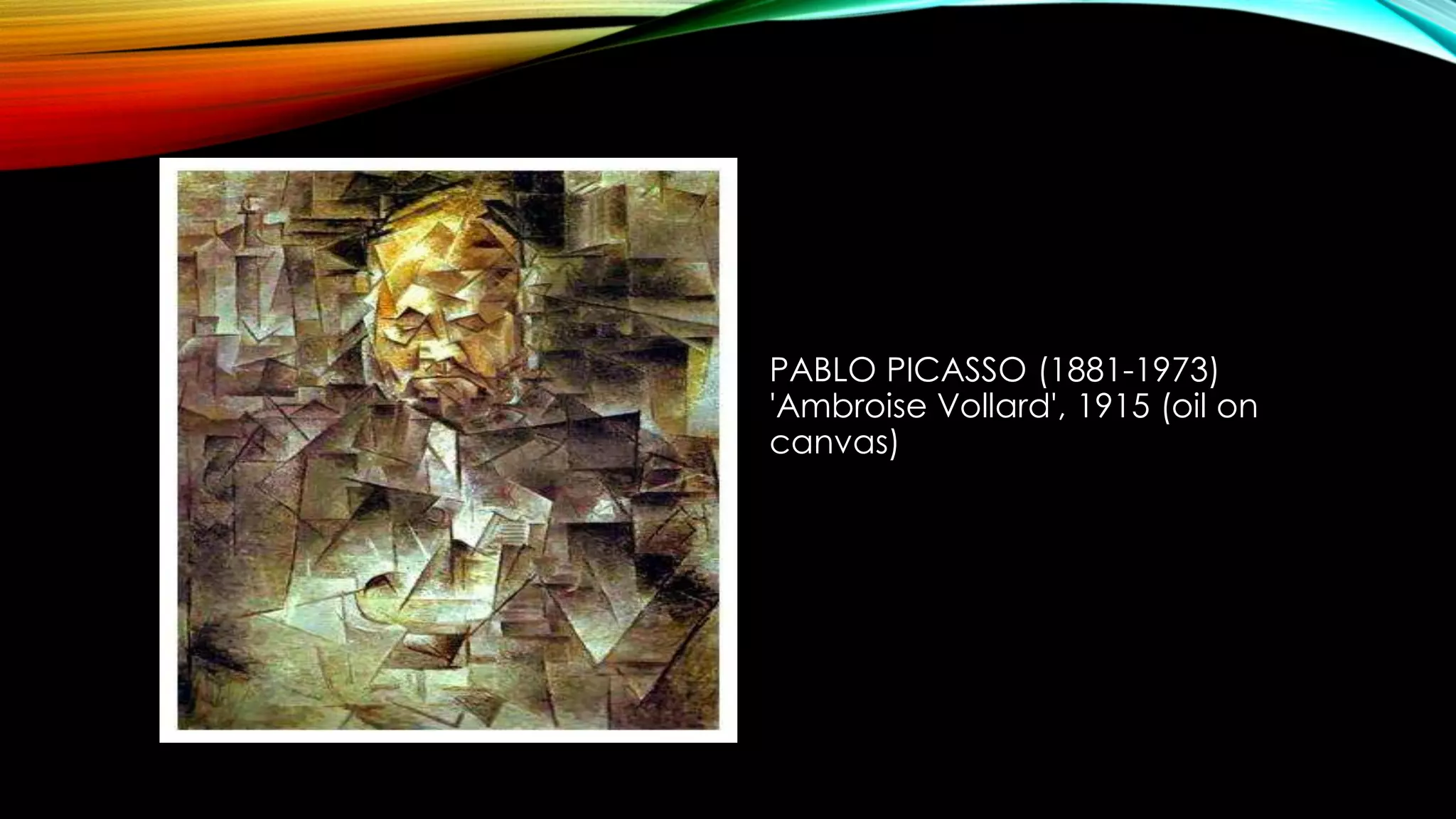
PABLO PICASSO (1881-1973)
'Ambroise Vollard', 1915 (oil on
canvas)
PABLO PICASSO 1907
Les Demoiselles d’ Avignon
Oil on canvas
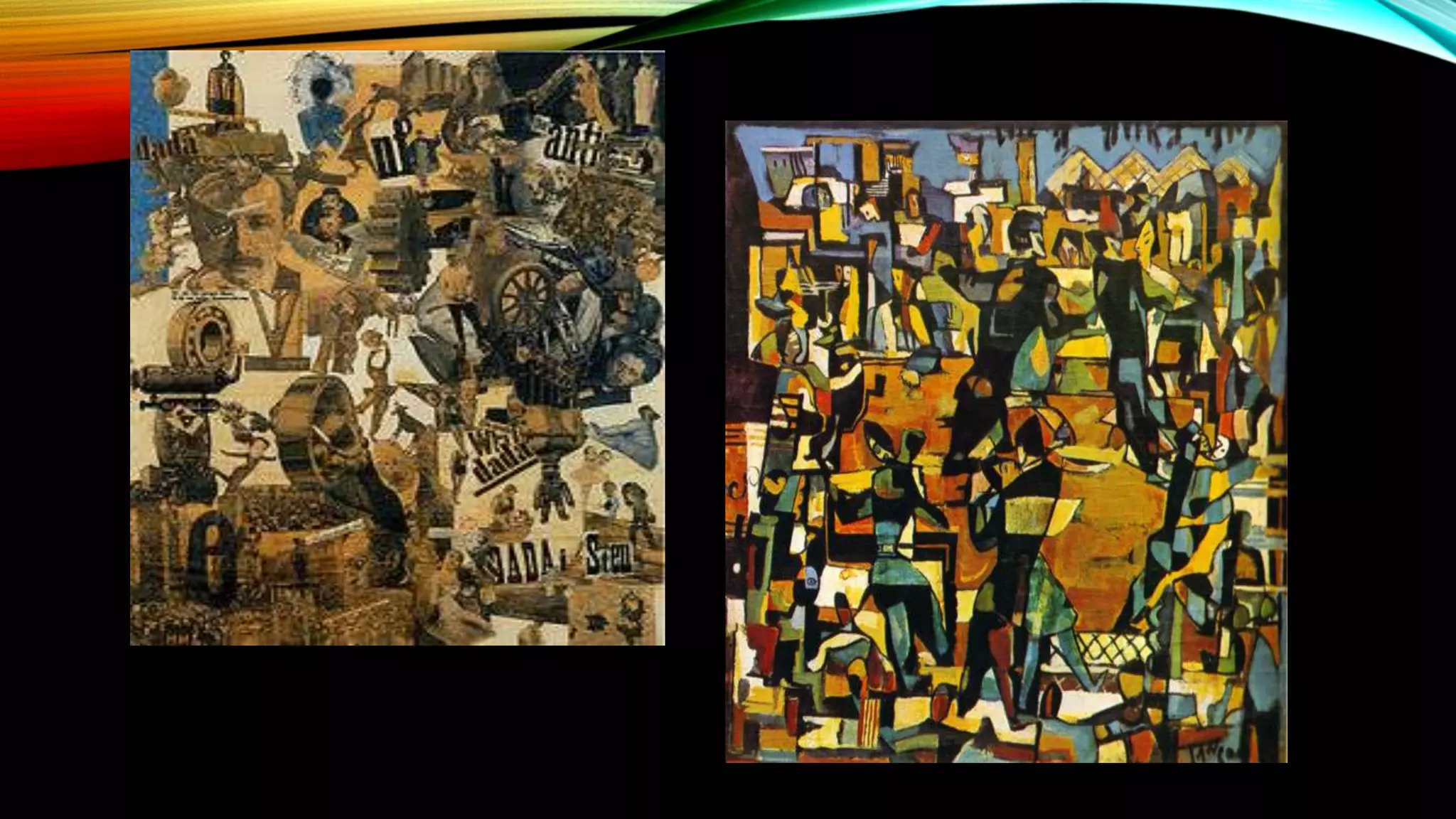
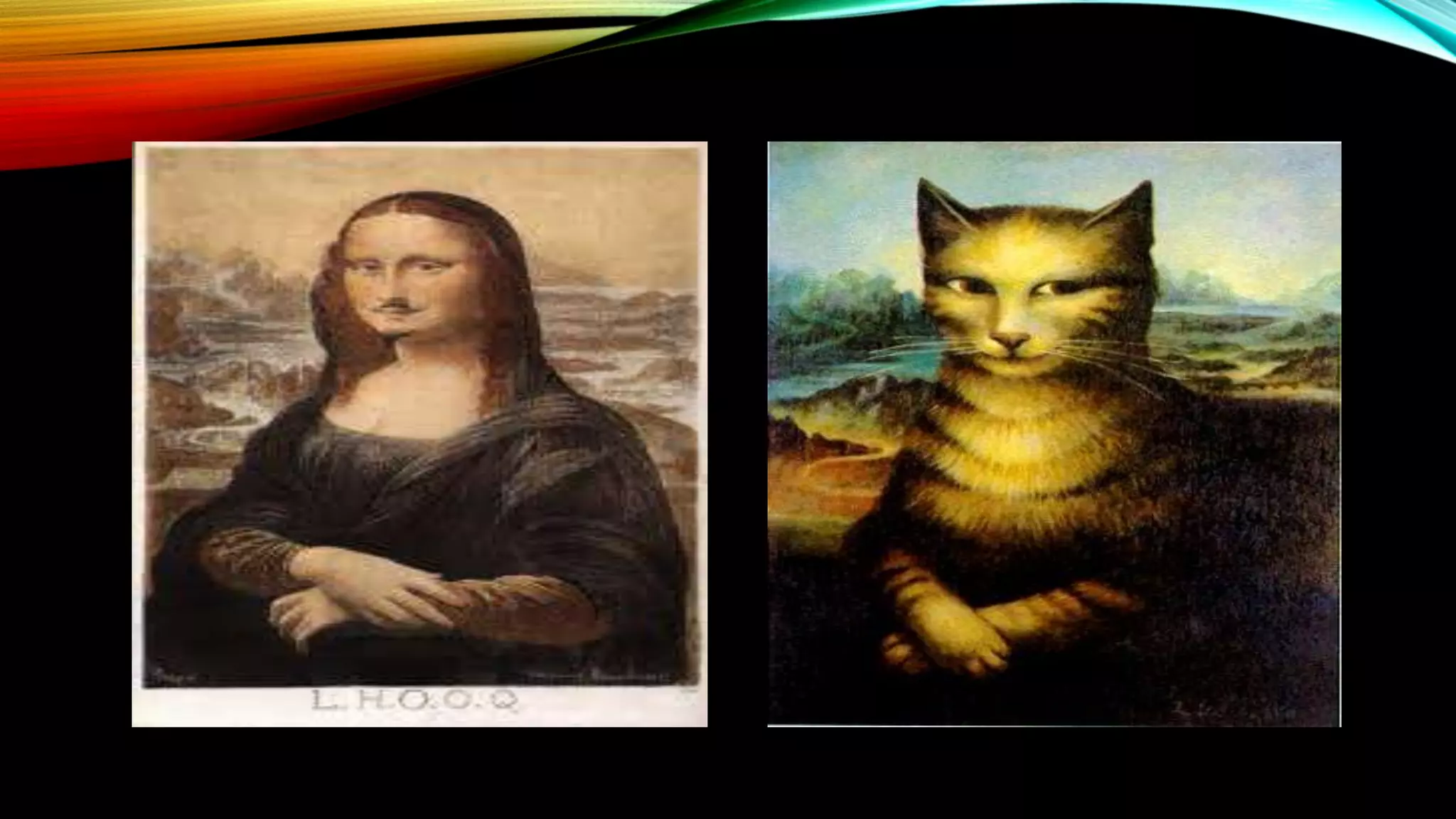
DADAISM
• It attacked established values in art.
• It declared absurdity of all conventions and
destroyed the notion of art itself.
• Marcel Duchamp was out to prove that any ready-
made object could attain the level of a work of art.
• The important thing to the Dadaists is not the work
itself but the statement they are making.
• Dadaism or Dada is a post-World War I cultural
movement in visual art as well as literature (mainly
poetry), theatre and graphic design. The movement
was, among other things, a protest against the
barbarism of the War and what Dadaists believed
was an oppressive intellectual rigidity in both art and
everyday society; its works were characterized by a
deliberate irrationality and the rejection of the
prevailing standards of art. It influenced later
movements including Surrealism.
DADAISM ARTISTS
•Jean Arp
•Marcel Duchamp
•George Grosz
•Francis Picabia
•Man Ray
•Christian Schad
Art and Culture in the Modern and Contemporary Eras

Art and Culture in the Modern and Contemporary Eras

  • 1.
    ART AND CULTUREIN THE MODERN AND COMTEMPORARY ERAS ARTS IV SCHOOL YEAR 2013 - 2014
  • 2.
    OBJECTIVES: THE STUDENTS WILLKNOW • THE DIFFERENT ART STYLES THAT PROLIFERATED DURING THE MODERN AND CONTEMPORARY ERAS • THE FACTORS THAT INFLUENCED THE STYLES OF MODERN ARTISTS STUDENTS WILL BE ABLE TO • IDENTIFY THE IMPORTANT EVENTS IN THE MODERN PERIODS • ANALYZE HOW SUCH EVENTS AND CHANGES AFFECTED THE ARTIST AND ART MAKING • DIFFERENTIATE AMONG THE VARIOUS ART STYLES AND IDENTIFY THE IMPORTANT ARTISTSS DURING THESE PERIOD • DO AN INTERACTIVE PAINTING.
  • 3.
    UNIT 1 :MODERN AND CONTEMPORARY ART STYLES
  • 6.
    MODERN ART The birthof modernism and modern art can be traced back to the Industrial Revolution, a period that lasted from the 18th to the 19th century, in which rapid changes in manufacturing, transportation, and technology profoundly affected the social, economic, and cultural conditions of life in Western Europe, North America, and eventually the world.
  • 7.
    New forms oftransportation, including the railroad, the steam engine, and the subway changed the way people lived, worked, and travelled, both at home and abroad, expanding their worldview and access to new ideas. As urban centers prospered, workers flocked to cities for industrial jobs, and urban populations boomed.
  • 8.
    •Different art stylesemerge since the beginning of the 20th century •Experimentations, inspired by both modern life and new theories about art came out •This is described as innovative, non- traditional or modern art.
  • 9.
    MODERN ART •More difficultto understand than traditional art •One of the things that makes modern painting and sculpture hard to understand is the sheer variety of their styles.
  • 10.
    ART MOVEMENTS OFTHE MODERN ERA ( 20TH TO 21ST CENTURY) •FAUVISM •SURREALISM •CUBISM •DADAISM
  • 11.
    FAUVISM •Fauvism was ajoyful style of painting that delighted in using outrageously bold colors. It was developed in France at the beginning of the 20th century by Henri Matisse and André Derain. The artists who painted in this style were known as 'Les Fauves' (the wild beasts), a title that came from a sarcastic remark in a review by the art critic Louis Vauxcelles.
  • 12.
    •'Les Fauves' believedthat color should be used at its highest pitch to express the artist's feelings about a subject, rather than simply to describe what it looks like. Fauvist paintings have two main characteristics: extremely simplified drawing and intensely exaggerated color. Fauvism was a major influence on German Expressionism.
  • 13.
    HENRI MATISSE (1869-1954) 'TheOpen Window, Collioure', 1905 (oil on canvas)
  • 14.
    • THE DANCEby Henri Matisse - Here we see human figures without muscles and bones, reduced into colourful human shapes that contrast with the background.
  • 15.
  • 16.
    SURREALISM •An art movementinspired by scientific research, Freudian psychology and dream interpretation. •It portrays reality and intensity of the subconscious mind
  • 17.
    •Surrealists feasted onthe unconscious. They believed that Freud's theories on dreams, ego, superego and the id opened doors to the authentic self and a truer reality (the "surreal"). •Today, we associate the word "surreal" with strange juxtapositions or absurd combinations, like those experienced in dreams.
  • 18.
    How Long WasSurrealism a Movement? •Surrealism officially began with "The Manifesto of Surrealism," published in 1924. However, it grew out of Dada. •Surrealism never died, it simply splintered into numerous directions and influenced new movements, with different names. Some artists still identify themselves as Surrealists and some founding Surrealist artists are still alive.
  • 19.
    WHAT ARE THEKEY CHARACTERISTICS OF SURREALISM? • The exploration of the dream and unconsciousness as a valid form of reality, inspired by Sigmund Freud's writings. • A willingness to depict images of perverse sexuality, scatology, decay and violence. • The desire to push against the boundaries of socially acceptable behaviors and traditions in order to discover pure thought and the artist's true nature. • The incorporation of chance and spontaneity.
  • 20.
    • The influenceof revolutionary 19th century poets, such as Charles Baudelaire, Arthur Rimbaud and Isidore Ducasse. • Emphasis on the mysterious, marvelous, mythological and irrational in an effort to make art ambiguous and strange. • Fundamentally, Surrealism gave artists permission to express their most basic drives: hunger, sexuality, anger, fear, dread, ecstasy, and so forth. • Exposing these uncensored feelings as if in a dream still exists in many form of art to this day.
  • 21.
    TWO STYLISTIC SCHOOLSOF SURREALISM: • Biomorphism - it models artistic design elements on naturally occurring patterns or shapes reminiscent of nature. Taken to its extreme it attempts to force naturally occurring shapes onto functional devices, often with mixed results. • Naturalistic Surrealism - naturalistic Surrealism actively pursues dreams, creating representational scenes that have changed into a dream state or nightmare image. These artists recorded dreams and created using traditional techniques.
  • 22.
    SOME OF THEFAMOUS SURREALIST AND THEIR WORKS: • Max Ernst, Two Children Are Threatened by a Nightingale, 1924. (Museum of Modern Art, New York). • Joan Miró, Carnival of Harlequin, 1924-25. (Albright-Knox Gallery, Buffalo, NY) • René Magritte, The Treachery of Images (Ceci n'est pas une pipe), 1929. (Los Angeles County Museum of Art) • Jean (Hans) Arp, Head with Three Annoying Objects, 1930. (Estate of the artist). • Salvador Dalí, The Persistence of Memory, 1931. (Museum of Modern Art, New York)
  • 23.
    The Potato, 1928 JoanMiró (Spanish, 1893–1983) Oil on canvas The Barbarians, 1937 Max Ernst (French, born Germany, 1891–1976) Oil on cardboard
  • 25.
    CUBISM •The most influentialart style in the early 20th century. •The artist tries to show all sides of an object, reduces recognizable images to geometric forms, shows objects from several positions at one time, and often makes opaque forms transparent.
  • 26.
    • Cubism wasinvented around 1907 in Paris by Pablo Picasso and Georges Braque. It was the first abstract style of modern art. Cubist paintings ignore the traditions of perspective drawing and show you many views of a subject at one time. The Cubists believed that the traditions of Western art had become exhausted and to revitalize their work, they drew on the expressive energy of art from other cultures, particularly African art.
  • 27.
    •There are twodistinct phases of the Cubist style: Analytical Cubism (pre 1912) and Synthetic Cubism (post 1912). Cubism influenced many other styles of modern art including Expressionism, Futurism, Orphism, Vorticism, Suprematism, Constructivism and De Stijl. Other notable artists associated with Cubism were Juan Gris, Fernand Leger, Robert Delaunay, Albert Gleizes, Jean Metzinger, Louis Marcoussis and Marie Laurencin.
  • 28.
    ANALYTICAL CUBISM •the earlyphase of cubism, chiefly characterized by a pronounced use of geometric shapes an d by a tendency toward a monochro -
  • 29.
    SYNTHETIC CUBISM • thelate phase of cubism, characterized chiefly by an increased use of color and the imitation or introduction of a wide range of textures and material into painting.
  • 30.
    PABLO PICASSO (1881-1973) 'AmbroiseVollard', 1915 (oil on canvas)
  • 31.
    PABLO PICASSO 1907 LesDemoiselles d’ Avignon Oil on canvas
  • 32.
    DADAISM • It attackedestablished values in art. • It declared absurdity of all conventions and destroyed the notion of art itself. • Marcel Duchamp was out to prove that any ready- made object could attain the level of a work of art. • The important thing to the Dadaists is not the work itself but the statement they are making.
  • 33.
    • Dadaism orDada is a post-World War I cultural movement in visual art as well as literature (mainly poetry), theatre and graphic design. The movement was, among other things, a protest against the barbarism of the War and what Dadaists believed was an oppressive intellectual rigidity in both art and everyday society; its works were characterized by a deliberate irrationality and the rejection of the prevailing standards of art. It influenced later movements including Surrealism.
  • 34.
    DADAISM ARTISTS •Jean Arp •MarcelDuchamp •George Grosz •Francis Picabia •Man Ray •Christian Schad

Editor's Notes

  • #12 - FAUVISM…savage and primitive