

Population Pyramid
Presented By
Muhammad Irfan Hussain(039)
University of Sargodha, Sargodha
Department of Statistics
Objectives
• Introduction
• How To Read a Population Pyramid?
• Types Of Population Pyramid.
Introduction
Definition:
A population pyramid is a graphical illustration
that shows the distribution of various age groups
in a population which forms the shape of a
pyramid when the population is growing. A
Population Pyramid is a graph that shows the
age-sex distribution of a given population.
How To Read a Population Pyramid?
• Read the title. For example Country or city etc.
• Comment on the general shape of pyramid.
• Note the proportion of the people in various age
groups.
• Note the sex ratio.
• Interpret the data.
Types Of Population Pyramid
• Expensive or Expanding Population Pyramid
• Stationary or Stable Population Pyramid
• Constrictive or Constricting Population Pyramid
Expensive or expanding
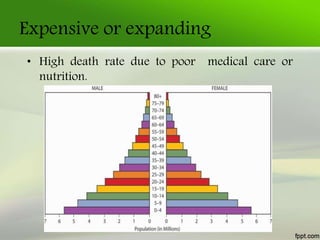
 Population pyramid have classical pyramid
shape. This wide base population pyramid
indicates the high birth rate & narrow top
indicates the high death rate.
 Generally it indicates the lower standard of
living.
 High birth rate due to poor access to birth
control; lack of education etc.
Expensive or expanding
• High death rate due to poor medical care or
nutrition.
Stationary or Stable
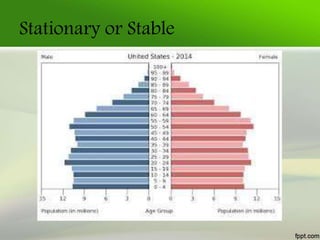
A population pyramid showing an unchanging pattern
of fertility and mortality. Pyramids display somewhat
equal numbers for almost all age groups.
Of course, smaller figures are still to be expected at the
oldest age groups. The age-sex distributions of some
European countries, especially Scandinavian ones, will
tend to fall into this category.
Stationary or Stable
Constrictive or Constricting
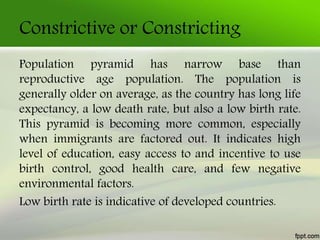
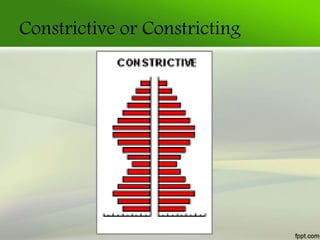
Population pyramid has narrow base than
reproductive age population. The population is
generally older on average, as the country has long life
expectancy, a low death rate, but also a low birth rate.
This pyramid is becoming more common, especially
when immigrants are factored out. It indicates high
level of education, easy access to and incentive to use
birth control, good health care, and few negative
environmental factors.
Low birth rate is indicative of developed countries.
Constrictive or Constricting
Population pyramid

Population pyramid

  • 2.
    Population Pyramid Presented By MuhammadIrfan Hussain(039) University of Sargodha, Sargodha Department of Statistics
  • 3.
    Objectives • Introduction • HowTo Read a Population Pyramid? • Types Of Population Pyramid.
  • 4.
    Introduction Definition: A population pyramidis a graphical illustration that shows the distribution of various age groups in a population which forms the shape of a pyramid when the population is growing. A Population Pyramid is a graph that shows the age-sex distribution of a given population.
  • 5.
    How To Reada Population Pyramid? • Read the title. For example Country or city etc. • Comment on the general shape of pyramid. • Note the proportion of the people in various age groups. • Note the sex ratio. • Interpret the data.
  • 6.
    Types Of PopulationPyramid • Expensive or Expanding Population Pyramid • Stationary or Stable Population Pyramid • Constrictive or Constricting Population Pyramid
  • 7.
    Expensive or expanding Population pyramid have classical pyramid shape. This wide base population pyramid indicates the high birth rate & narrow top indicates the high death rate.  Generally it indicates the lower standard of living.  High birth rate due to poor access to birth control; lack of education etc.
  • 8.
    Expensive or expanding •High death rate due to poor medical care or nutrition.
  • 9.
    Stationary or Stable Apopulation pyramid showing an unchanging pattern of fertility and mortality. Pyramids display somewhat equal numbers for almost all age groups. Of course, smaller figures are still to be expected at the oldest age groups. The age-sex distributions of some European countries, especially Scandinavian ones, will tend to fall into this category.
  • 10.
  • 11.
    Constrictive or Constricting Populationpyramid has narrow base than reproductive age population. The population is generally older on average, as the country has long life expectancy, a low death rate, but also a low birth rate. This pyramid is becoming more common, especially when immigrants are factored out. It indicates high level of education, easy access to and incentive to use birth control, good health care, and few negative environmental factors. Low birth rate is indicative of developed countries.
  • 12.