Population pyramid
(Population & Demography)
3 types
• Expansive (broad-based)
• Slow growth
• No growth (stationary)
Found in pyramids
• Sex information obtained from a census.
• A population pyramid is a graphical representation of the
composition of aa given population.
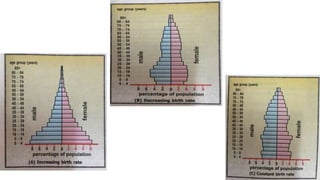
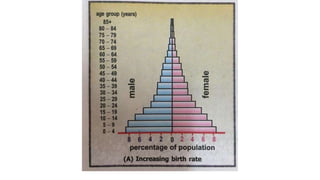
Pyramid A
• This pyramid represents a country with an increasing birth rate.
• This can be seen because the 0-4 year age group has a larger
population than any of the other age groups.
• This characteristic of a high birth rate is common to developing
countries such as the Caribbean.
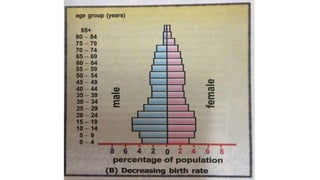
Pyramid B
• Represents a country where the birth rate is decreasing.
• This inference can be drawn by comparing the 0-4 year age group
with the other age groups just above it.
• A deceasing birth rate is characteristic of most developed countries.
• Such countries sometimes depend upon immigrants to fully utilise
their physical resources.
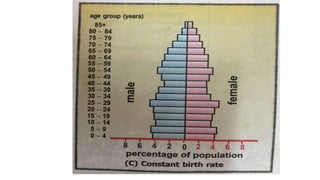
Pyramid C
• This pyramid represents a situation where the birth rate is neither
increasing nor decreasing significantly.
• The birth rate over the years is nearly constant.
Notes
• It will be seen that Pyramid A (developing countries with high birth
rate) has smaller percentages of population in these age groups than
Pyramids B and C.
• It is the responsibility of governments to make special provisions for
the aged.
• Governments of developed countries, where there is a higher
standard of living, have a larger population in these age groupsto
cater for than developing countries.
GLOSSARY
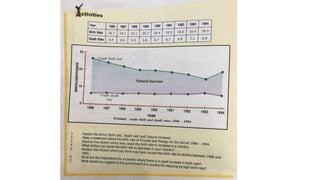
• Crude Birth Rate: the number of live births per 1000 persons in a population
within a given period of time, usually one year.
• Crude Death Rate: The number of deaths per 1000 persons occurring within a
period of a year in a particular population.
• Natural increase: The increase in population brought about when the birth rate
exceeds the death rate.
• Infant Mortality Rate: the annual number of deaths per 1,000 infants (under
the age of 1) in the population.
• Life Expectancy: the average number of years that persons in a given
population are expected to live.
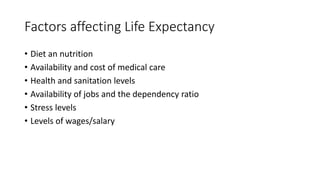
Factors affecting Life Expectancy
• Diet an nutrition
• Availability and cost of medical care
• Health and sanitation levels
• Availability of jobs and the dependency ratio
• Stress levels
• Levels of wages/salary
Population Pyramid

Population Pyramid

  • 1.
  • 2.
    3 types • Expansive(broad-based) • Slow growth • No growth (stationary)
  • 4.
    Found in pyramids •Sex information obtained from a census. • A population pyramid is a graphical representation of the composition of aa given population.
  • 5.
    Pyramid A • Thispyramid represents a country with an increasing birth rate. • This can be seen because the 0-4 year age group has a larger population than any of the other age groups. • This characteristic of a high birth rate is common to developing countries such as the Caribbean.
  • 7.
    Pyramid B • Representsa country where the birth rate is decreasing. • This inference can be drawn by comparing the 0-4 year age group with the other age groups just above it. • A deceasing birth rate is characteristic of most developed countries. • Such countries sometimes depend upon immigrants to fully utilise their physical resources.
  • 9.
    Pyramid C • Thispyramid represents a situation where the birth rate is neither increasing nor decreasing significantly. • The birth rate over the years is nearly constant.
  • 11.
    Notes • It willbe seen that Pyramid A (developing countries with high birth rate) has smaller percentages of population in these age groups than Pyramids B and C. • It is the responsibility of governments to make special provisions for the aged. • Governments of developed countries, where there is a higher standard of living, have a larger population in these age groupsto cater for than developing countries.
  • 12.
    GLOSSARY • Crude BirthRate: the number of live births per 1000 persons in a population within a given period of time, usually one year. • Crude Death Rate: The number of deaths per 1000 persons occurring within a period of a year in a particular population. • Natural increase: The increase in population brought about when the birth rate exceeds the death rate. • Infant Mortality Rate: the annual number of deaths per 1,000 infants (under the age of 1) in the population. • Life Expectancy: the average number of years that persons in a given population are expected to live.
  • 13.
    Factors affecting LifeExpectancy • Diet an nutrition • Availability and cost of medical care • Health and sanitation levels • Availability of jobs and the dependency ratio • Stress levels • Levels of wages/salary