EPIDEMIOLOGICAL METHODS
2nd Bsc (N) CHN, by Mrs.Jinchu Paul
• EPIDEMIOLOGY IS DEFINED AS THE STUDY OF
THE DISTRIBUTION & DETERMINANTS OF
HEALTH – RELATED STATES OF EVENTS IN
SPECIFIED POPULATION AND THE
APPLICATION OF THIS STUDY TO THE
CONTROL OF HEALTH PROBLEMS - by JOHN
M LAST,1988.
EPIDEMIOLOGICAL APPROACHES
THE EPIDEMIOLOGICAL APPROACH TO PROBLEMS OF
HEALTH AND DISEASE IS BASED ON TWO MAJOR
FOUNDATIONS:
1. ASKING QUESTIONS
2.MAKING COMPARISONS.
1.ASKING QUESTIONS
FOR FINDING OUT THE SOURCE OF INFECTION ,
COMMUNITY HEALTH NURSE NEEDS TO HAVE A
GUIDE IN THE FOLLOWING MANNER OF
QUESTIONING:
1. WHEN DID THE DISEASE OCCURE?
2. WHERE DID THE DISEASE OCCURE?
3. WHO WERE THE PEOPLE AFFECTED?
4. WHY SHOULD IT APPEAR?
5. WHAT SHOULD BE DONE TO PREVENT THE
SPREAD.
2. MAKING COMPARISONS
• THE BASIC APPROACH IN EPIDEMIOLOGY IS TO
MAKE COMPARISONS& DRAW INFERANCES.
• THIS MAY BE COMPARISON OF TWO OR
MORE GROUPS..{ EXPOSED AND NOT
EXPOSED}
EPIDEMIOLOGICAL METHODS
• - ARE APPLIED TO KNOW THE DISEASE
ETIOLOGY.
VARIOUS EPIDEMIOLOGICAL STUDIES
CAN BE CONDUCTED TO FIND OUT THE
OCCURANCE OF DISEASE IN PEOPLE , WHICH
MAY BE INVOVED IN PROCESS OF SPREADING
THE DISEASE.
EPIDEMIOLOGICAL METHODS
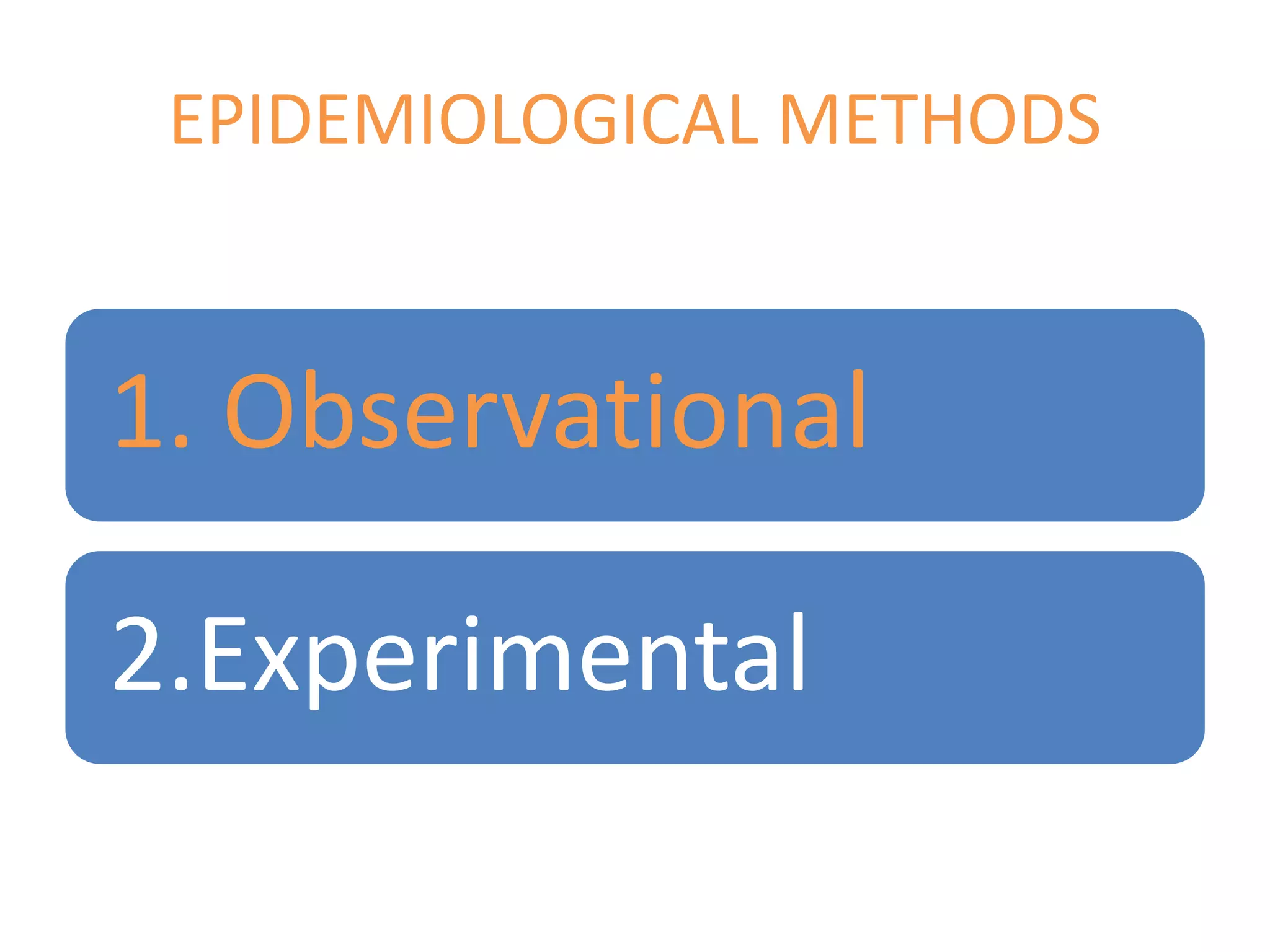
1. Observational
2.Experimental
1)Observational Metods- Investigator only
measures. Does not interfere.
--Descriptive studies.
--Analytical studies .
2)Experimental Methods. Also called Interventional
studies. – Active attempt by investigator.
9
Methods of Epidemiological Investigation
1.(a)DESCRIPTIVE METHOD
- DEALS WITH THE DISTRIBUTION OF HELTH
RELATED STATES AND EVENTS BY TIME, PLACE
AND PERSON.
Descriptive epidemiology
First phase of epidemiological investigation
The various procedures involved.
Defining the population to be studied
Defining the disease under study
Describing the disease by Time Place person
Measurement of disease
Comparing with known indices
Formulation of an etiological hypothesis
PURPOSE
•To provide a statical overview
•To provide information about diseases
•For planning, organizing and implementation of
health care services
• DATA COLLECTION IN DESCRIPTIVE METHOD
1.PERSONAL CHARACTERISTICS.
2. PLACE DISTRIBUTION OF CASES.
3.TIME DISTRIBUTION TRENDS.
Steps of Descriptive study
1. Defining the population to be studied
2. Defining the disease under study.
3. Describing the disease
Defining the population to be studied.
•Investigation of populations not individuals.
•It can be a whole population in the geographic
area or more often a representative sample.
•Can also be specially selected as sex groups,
occupational groups, hospital patients etc.
•Defined population should be large enough.
•The community chosen should be stable,
without migration in or out of the area.
2)Defining the disease under study.
Disease definition should be precise and valid
3)Defining the disease under study.
The primary objective of descriptive
epidemiology deals with the distribution of
health related states and events by time, place
and person.
Time distribution:
Three kinds of time trends or fluctuations in
disease occurrence.
1) Short term fluctuation(Epidemic trend)
2) Periodic fluctuations(Seasonal trend)
3) Long term fluctuation.(Secular trends)
• The best known short-term fluctuation in the
occurrence of a disease is an epidemic.
According to modern concepts an epidemic is
defined as "the occurrence in a community
/region of cases of an illness or other health-
related clearly in excess of normal
expectancy".
1)Short term fluctuation(Epidemic
trend)
• 2) Periodic fluctuations(Seasonal trend)
: Seasonal variation is a well-known
characteristic of many communicable
diseases, e., measles, varicella, cerebro-spinal
meningitis, upper respiratory infections,
malaria, etc.
• 3) Long term fluctuation.(Secular trends)
• The term "secular trend" implies changes in
the occurrence of disease (i.e., a progressive
increase or decrease) over a long period of
time, generally several years or decades.
• USES OF DESCRIPTIVE EPIDEMIOLOGY
• (a) provide data regarding magnitude of the disease
load and types of disease
• (b) provide clues to disease aetiology, and help in
formulation of an aetiological hypothesis.
• (c) provide background data for planning oganizing
and evaluating preventive and curative .
• (d) contribute to research by describing
2.ANALYTICAL METHOD
COMPRISE TWO DISTINCT TYPES OF
OBSERVATIONAL STUDIES:
1. CASE CONTROL STUDY
2.COHORT STUDY
1. CASE CONTROL STUDY
(RETROSPECTIVE STUDY)
-COMMON & FIRST APPROACHE TO TEST
HYPOTHESIS.
A CASE CONTROL STUDY IS A LONGITUDINAL,
OBSERVATIONAL ENQUIRY UNDERTAKEN TO
VARIFY THE EXISTENCE AS WELL AS THE
STRENGTH OF CAUSE-EFFECT ASSOCIATIONS
IN DISEASE PHENOMENA.
• CASE CONTROL STUDIES ARE USED FOR :
1. ESTIMATING THE RISK OF EXPOSURE TO
VARIOUS FACTORS ASSOCIATED WITH
DISEASE PHENOMENA.
2. EVOLVING RISK INTERVENTION STRATEGIES
FOR PREVENTION AND CONTROL OF PUBLIC
HEALTH PROBLEMS.
2. COHORT STUDY(PROSPECTIVE
STUDY)
• A TYPE OF ANALYTICAL STUDY , UNDERTAKEN
TO OBTAIN ADDITIONAL EVIDENCE TO REFUSE
OR SUPPORT THE EXISTENCE OF AN
ASSOCIATIONBETWEEN SUSPECTED CAUSE
AND DISEASE.

Methods of epidemiology 2nd yr Bsc Nursing

  • 1.
    EPIDEMIOLOGICAL METHODS 2nd Bsc(N) CHN, by Mrs.Jinchu Paul
  • 2.
    • EPIDEMIOLOGY ISDEFINED AS THE STUDY OF THE DISTRIBUTION & DETERMINANTS OF HEALTH – RELATED STATES OF EVENTS IN SPECIFIED POPULATION AND THE APPLICATION OF THIS STUDY TO THE CONTROL OF HEALTH PROBLEMS - by JOHN M LAST,1988.
  • 3.
    EPIDEMIOLOGICAL APPROACHES THE EPIDEMIOLOGICALAPPROACH TO PROBLEMS OF HEALTH AND DISEASE IS BASED ON TWO MAJOR FOUNDATIONS: 1. ASKING QUESTIONS 2.MAKING COMPARISONS.
  • 4.
    1.ASKING QUESTIONS FOR FINDINGOUT THE SOURCE OF INFECTION , COMMUNITY HEALTH NURSE NEEDS TO HAVE A GUIDE IN THE FOLLOWING MANNER OF QUESTIONING: 1. WHEN DID THE DISEASE OCCURE? 2. WHERE DID THE DISEASE OCCURE? 3. WHO WERE THE PEOPLE AFFECTED? 4. WHY SHOULD IT APPEAR? 5. WHAT SHOULD BE DONE TO PREVENT THE SPREAD.
  • 5.
    2. MAKING COMPARISONS •THE BASIC APPROACH IN EPIDEMIOLOGY IS TO MAKE COMPARISONS& DRAW INFERANCES. • THIS MAY BE COMPARISON OF TWO OR MORE GROUPS..{ EXPOSED AND NOT EXPOSED}
  • 6.
    EPIDEMIOLOGICAL METHODS • -ARE APPLIED TO KNOW THE DISEASE ETIOLOGY. VARIOUS EPIDEMIOLOGICAL STUDIES CAN BE CONDUCTED TO FIND OUT THE OCCURANCE OF DISEASE IN PEOPLE , WHICH MAY BE INVOVED IN PROCESS OF SPREADING THE DISEASE.
  • 7.
  • 9.
    1)Observational Metods- Investigatoronly measures. Does not interfere. --Descriptive studies. --Analytical studies . 2)Experimental Methods. Also called Interventional studies. – Active attempt by investigator. 9 Methods of Epidemiological Investigation
  • 10.
    1.(a)DESCRIPTIVE METHOD - DEALSWITH THE DISTRIBUTION OF HELTH RELATED STATES AND EVENTS BY TIME, PLACE AND PERSON.
  • 11.
    Descriptive epidemiology First phaseof epidemiological investigation The various procedures involved. Defining the population to be studied Defining the disease under study Describing the disease by Time Place person Measurement of disease Comparing with known indices Formulation of an etiological hypothesis
  • 12.
    PURPOSE •To provide astatical overview •To provide information about diseases •For planning, organizing and implementation of health care services
  • 13.
    • DATA COLLECTIONIN DESCRIPTIVE METHOD 1.PERSONAL CHARACTERISTICS. 2. PLACE DISTRIBUTION OF CASES. 3.TIME DISTRIBUTION TRENDS.
  • 14.
    Steps of Descriptivestudy 1. Defining the population to be studied 2. Defining the disease under study. 3. Describing the disease
  • 15.
    Defining the populationto be studied. •Investigation of populations not individuals. •It can be a whole population in the geographic area or more often a representative sample. •Can also be specially selected as sex groups, occupational groups, hospital patients etc. •Defined population should be large enough. •The community chosen should be stable, without migration in or out of the area.
  • 16.
    2)Defining the diseaseunder study. Disease definition should be precise and valid 3)Defining the disease under study. The primary objective of descriptive epidemiology deals with the distribution of health related states and events by time, place and person.
  • 17.
    Time distribution: Three kindsof time trends or fluctuations in disease occurrence. 1) Short term fluctuation(Epidemic trend) 2) Periodic fluctuations(Seasonal trend) 3) Long term fluctuation.(Secular trends)
  • 18.
    • The bestknown short-term fluctuation in the occurrence of a disease is an epidemic. According to modern concepts an epidemic is defined as "the occurrence in a community /region of cases of an illness or other health- related clearly in excess of normal expectancy". 1)Short term fluctuation(Epidemic trend)
  • 19.
    • 2) Periodicfluctuations(Seasonal trend) : Seasonal variation is a well-known characteristic of many communicable diseases, e., measles, varicella, cerebro-spinal meningitis, upper respiratory infections, malaria, etc.
  • 20.
    • 3) Longterm fluctuation.(Secular trends) • The term "secular trend" implies changes in the occurrence of disease (i.e., a progressive increase or decrease) over a long period of time, generally several years or decades.
  • 21.
    • USES OFDESCRIPTIVE EPIDEMIOLOGY • (a) provide data regarding magnitude of the disease load and types of disease • (b) provide clues to disease aetiology, and help in formulation of an aetiological hypothesis. • (c) provide background data for planning oganizing and evaluating preventive and curative . • (d) contribute to research by describing
  • 22.
    2.ANALYTICAL METHOD COMPRISE TWODISTINCT TYPES OF OBSERVATIONAL STUDIES: 1. CASE CONTROL STUDY 2.COHORT STUDY
  • 23.
    1. CASE CONTROLSTUDY (RETROSPECTIVE STUDY) -COMMON & FIRST APPROACHE TO TEST HYPOTHESIS. A CASE CONTROL STUDY IS A LONGITUDINAL, OBSERVATIONAL ENQUIRY UNDERTAKEN TO VARIFY THE EXISTENCE AS WELL AS THE STRENGTH OF CAUSE-EFFECT ASSOCIATIONS IN DISEASE PHENOMENA.
  • 24.
    • CASE CONTROLSTUDIES ARE USED FOR : 1. ESTIMATING THE RISK OF EXPOSURE TO VARIOUS FACTORS ASSOCIATED WITH DISEASE PHENOMENA. 2. EVOLVING RISK INTERVENTION STRATEGIES FOR PREVENTION AND CONTROL OF PUBLIC HEALTH PROBLEMS.
  • 25.
    2. COHORT STUDY(PROSPECTIVE STUDY) •A TYPE OF ANALYTICAL STUDY , UNDERTAKEN TO OBTAIN ADDITIONAL EVIDENCE TO REFUSE OR SUPPORT THE EXISTENCE OF AN ASSOCIATIONBETWEEN SUSPECTED CAUSE AND DISEASE.