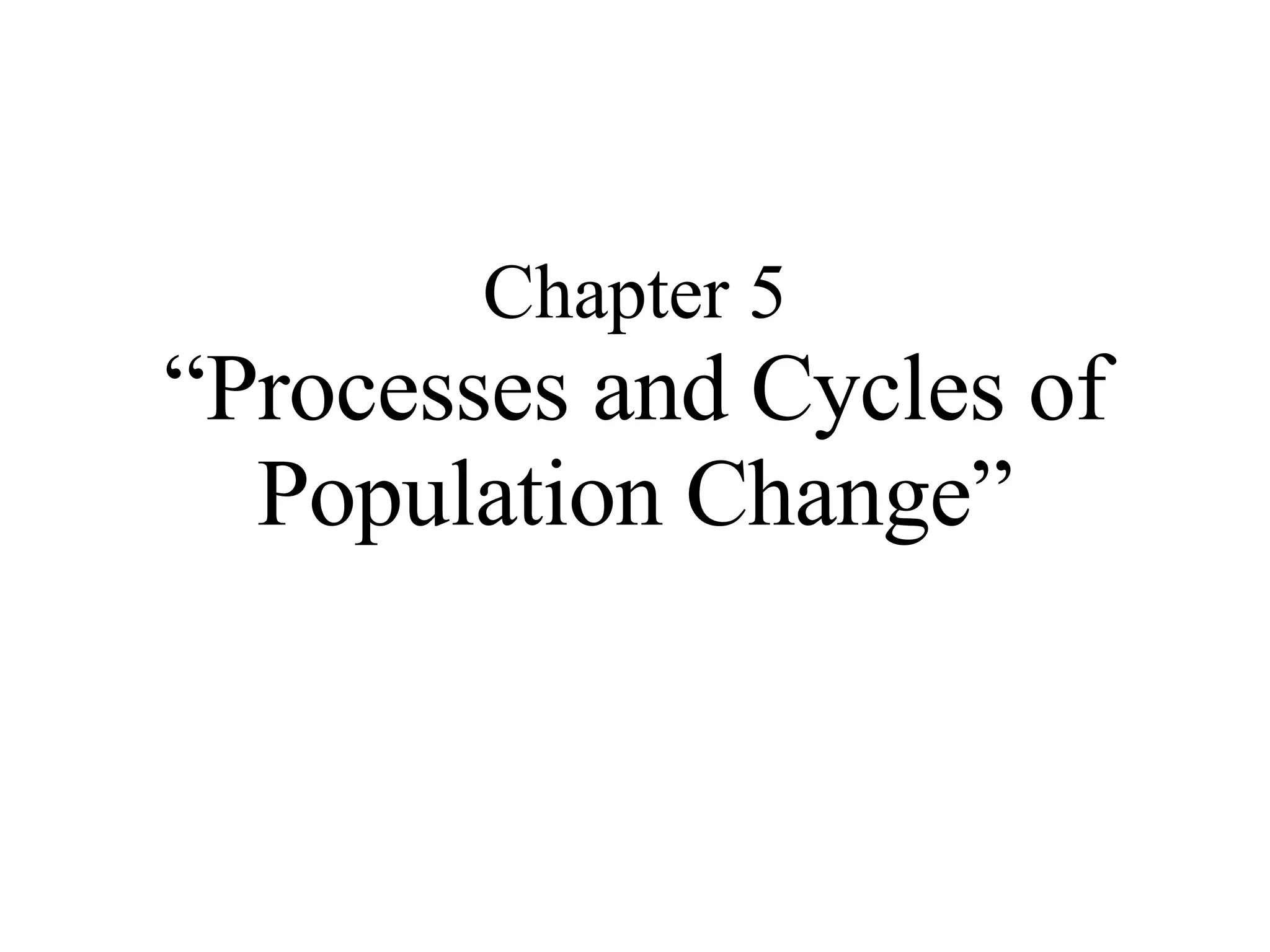
Chapter 5 “Processes and Cycles of Population Change”
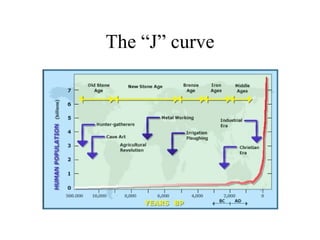
The “J” curve
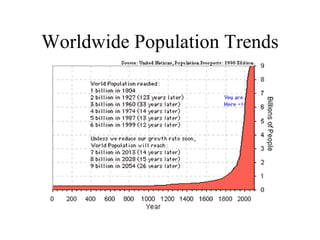
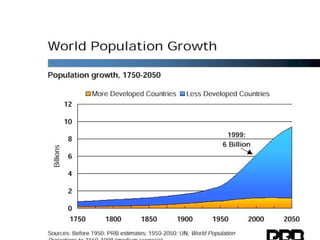
Worldwide Population Trends
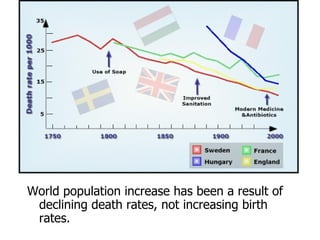
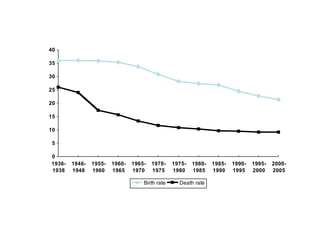
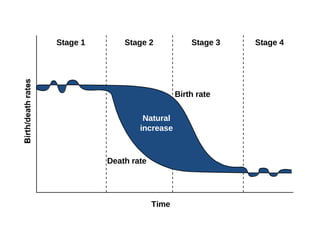
World population increase has been a result of declining death rates, not increasing birth rates.
 
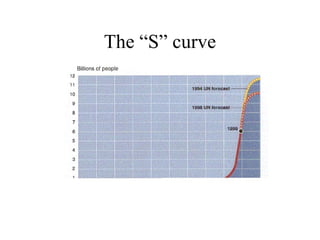
The “S” curve
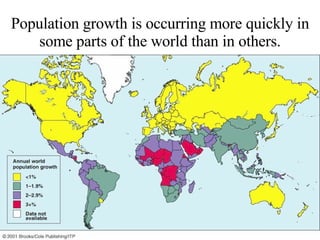
Population growth is occurring more quickly in some parts of the world than in others.
 
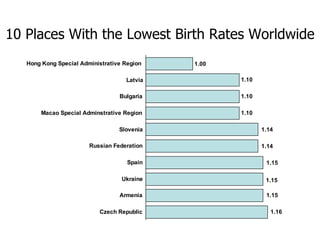
10 Places With the Lowest Birth Rates Worldwide
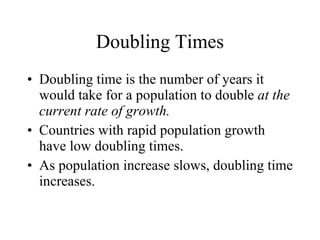
Doubling Times Doubling time is the number of years it would take for a population to double  at the current rate of growth. Countries with rapid population growth have low doubling times. As population increase slows, doubling time increases.
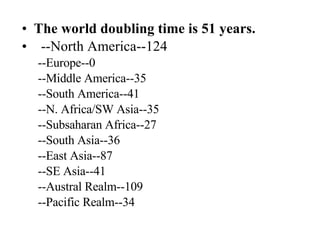
The world doubling time is 51 years. --North America--124 --Europe--0 --Middle America--35 --South America--41 --N. Africa/SW Asia--35 --Subsaharan Africa--27 --South Asia--36 --East Asia--87 --SE Asia--41 --Austral Realm--109 --Pacific Realm--34
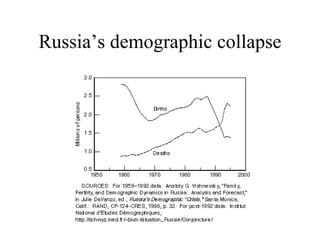
Russia’s demographic collapse
Why do women in some parts of the world have more babies than those in other parts of the world?
Economic Factors Affecting Fertility --agrarian society--children are economic assets --industrial societies--children are economic liabilities. --level of development--smaller family size is associated with a higher standard of living
Social Factors Affecting Fertility --traditional role of woman as a child-bearer --need for adult  children to care for the elderly --preference for male child --high infant mortality rate --low literacy rate  --access to birth control information --machismo factor --religion
Political factors affecting fertility --anti-natal policies. (China/India) --pro-natal policies -concern over changing  demographics  (France/Singapore) -a “civic duty” in some places
Possible solutions? Encourage development Broaden role of women in society Education Decrease infant mortality Establish pensions Incentives for one child
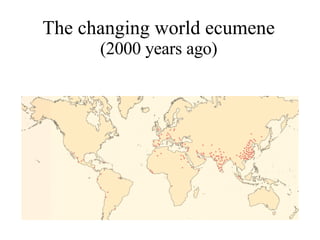
The changing world ecumene (2000 years ago)
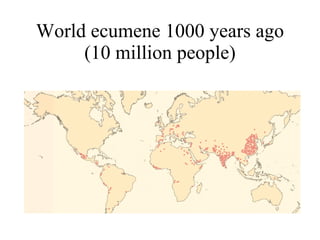
World ecumene 1000 years ago (10 million people)
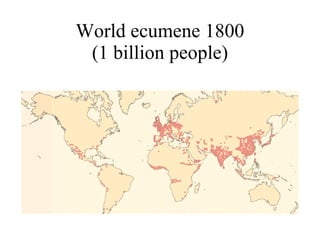
World ecumene 1800 (1 billion people)
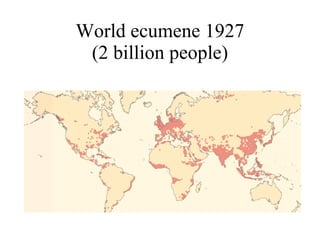
World ecumene 1927 (2 billion people)
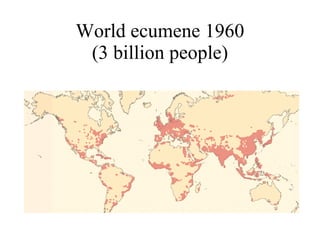
World ecumene 1960 (3 billion people)
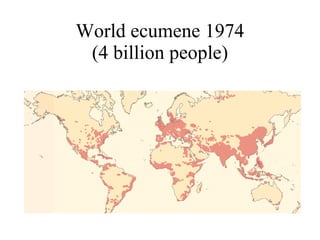
World ecumene 1974 (4 billion people)
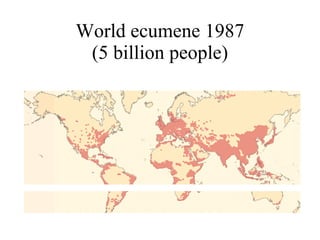
World ecumene 1987 (5 billion people)
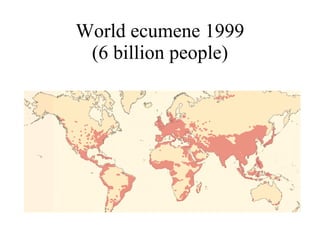
World ecumene 1999 (6 billion people)
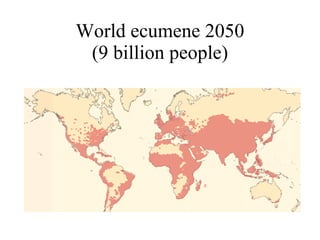
World ecumene 2050 (9 billion people)
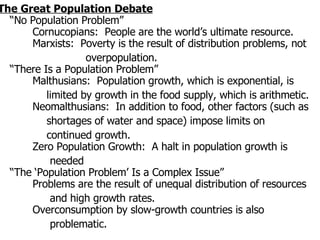
The Great Population Debate “No Population Problem”   Cornucopians:  People are the world’s ultimate resource.   Marxists:  Poverty is the result of distribution problems, not  overpopulation. “There Is a Population Problem”   Malthusians:  Population growth, which is exponential, is limited by growth in the food supply, which is arithmetic.   Neomalthusians:  In addition to food, other factors (such as shortages of water and space) impose limits on continued growth.   Zero Population Growth:  A halt in population growth is needed “The ‘Population Problem’ Is a Complex Issue”   Problems are the result of unequal distribution of resources and high growth rates.   Overconsumption by slow-growth countries is also problematic.
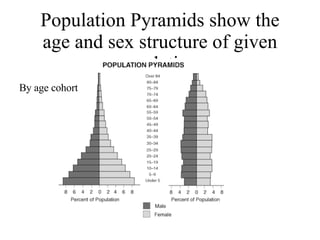
Population Pyramids show the age and sex structure of given populations By age cohort
 
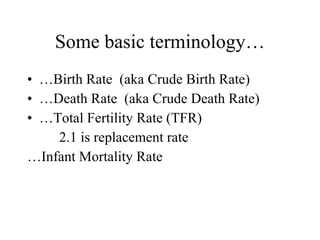
Some basic terminology… …Birth Rate  (aka Crude Birth Rate) …Death Rate  (aka Crude Death Rate) …Total Fertility Rate (TFR)  2.1 is replacement rate …Infant Mortality Rate
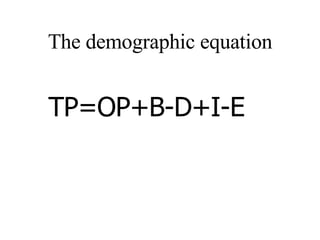
The demographic equation TP=OP+B-D+I-E

Population Ii

  • 1.
    Chapter 5 “Processesand Cycles of Population Change”
  • 2.
  • 3.
  • 4.
    World population increasehas been a result of declining death rates, not increasing birth rates.
  • 5.
  • 6.
  • 7.
    Population growth isoccurring more quickly in some parts of the world than in others.
  • 8.
  • 9.
    10 Places Withthe Lowest Birth Rates Worldwide
  • 10.
    Doubling Times Doublingtime is the number of years it would take for a population to double at the current rate of growth. Countries with rapid population growth have low doubling times. As population increase slows, doubling time increases.
  • 11.
    The world doublingtime is 51 years. --North America--124 --Europe--0 --Middle America--35 --South America--41 --N. Africa/SW Asia--35 --Subsaharan Africa--27 --South Asia--36 --East Asia--87 --SE Asia--41 --Austral Realm--109 --Pacific Realm--34
  • 12.
  • 13.
    Why do womenin some parts of the world have more babies than those in other parts of the world?
  • 14.
    Economic Factors AffectingFertility --agrarian society--children are economic assets --industrial societies--children are economic liabilities. --level of development--smaller family size is associated with a higher standard of living
  • 15.
    Social Factors AffectingFertility --traditional role of woman as a child-bearer --need for adult children to care for the elderly --preference for male child --high infant mortality rate --low literacy rate --access to birth control information --machismo factor --religion
  • 16.
    Political factors affectingfertility --anti-natal policies. (China/India) --pro-natal policies -concern over changing demographics (France/Singapore) -a “civic duty” in some places
  • 17.
    Possible solutions? Encouragedevelopment Broaden role of women in society Education Decrease infant mortality Establish pensions Incentives for one child
  • 18.
    The changing worldecumene (2000 years ago)
  • 19.
    World ecumene 1000years ago (10 million people)
  • 20.
    World ecumene 1800(1 billion people)
  • 21.
    World ecumene 1927(2 billion people)
  • 22.
    World ecumene 1960(3 billion people)
  • 23.
    World ecumene 1974(4 billion people)
  • 24.
    World ecumene 1987(5 billion people)
  • 25.
    World ecumene 1999(6 billion people)
  • 26.
    World ecumene 2050(9 billion people)
  • 27.
    The Great PopulationDebate “No Population Problem” Cornucopians: People are the world’s ultimate resource. Marxists: Poverty is the result of distribution problems, not overpopulation. “There Is a Population Problem” Malthusians: Population growth, which is exponential, is limited by growth in the food supply, which is arithmetic. Neomalthusians: In addition to food, other factors (such as shortages of water and space) impose limits on continued growth. Zero Population Growth: A halt in population growth is needed “The ‘Population Problem’ Is a Complex Issue” Problems are the result of unequal distribution of resources and high growth rates. Overconsumption by slow-growth countries is also problematic.
  • 28.
    Population Pyramids showthe age and sex structure of given populations By age cohort
  • 29.
  • 30.
    Some basic terminology……Birth Rate (aka Crude Birth Rate) …Death Rate (aka Crude Death Rate) …Total Fertility Rate (TFR) 2.1 is replacement rate …Infant Mortality Rate
  • 31.