ASGEOGRAPHYPOPULATION
BOOK RESOURCE
This presentation isThis presentation is
using the curriculausing the curricula
activities andactivities and
exercises from theexercises from the
following book:following book:
GEOGRAPHY – AnGEOGRAPHY – An
Integrated ApproachIntegrated Approach
by David Waugh,by David Waugh,
fourth edition.fourth edition.
Introduction
Answer the following from Ch13 (pg344)
What is ‘demography’?
Define the term ‘population distribution’.
Using fig 13.1 describe the population distribution
patterns shown (identify areas of high & low
distribution).
Why is fig 13.1 misleading?
Define the term ‘population density’ - quantify.
List what affects distribution at a Global and
Regional/Local scales.
Only 11% of the Earth’s land surface presents no
serious limitations to settlement and agriculture.
What prevents this on the other 89%?
Using figure 13.4 draw 2 star diagrams. One to
highlight factors affecting ‘Sparsely Populated
Areas’ and one to highlight factors of ‘Densely
Populated Areas’.
Using figure 13.5 describe and explain the
population distribution and densities of Brazil.
Population Growth
Read the extract from the Guardian newspaper from 14th
August 1999 and answer the following questions:
1. Briefly describe the main features of world population
since 1950.
2. Why should we be suspicious about the accuracy of
projections of future world population size?
3. What factors might explain the differences in the levels of
fertility between more economically developed countries
(MEDC’s) and less economically developed countries
(LEDC’s)?
4. What, according to the article, are the possible
consequences of future increases in the world’s
population?
The worlds population now stands at just over 6.5
billion people.
The world’s growth rate is determined by the simple
equation:
Births (fertility) – Deaths (mortality) = Growth Rate
Before the 18th
century the population growth was very
slow (almost zero) because the high birth rate was
cancelled out by widespread disease, wars and famines
(high death rate).
However since then due to rapid medical and
technological advances the death rate has fallen rapidly
while the birth rate has remained high = Population
Explosion.
Fertility
Fertility is measured by the Birth Rate (total number of
live births per year per 1000 people in the population).
The level of the birth rate is linked with economic
development, status of women, religion and social
customs & levels of health care.
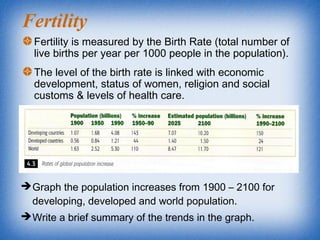
Graph the population increases from 1900 – 2100 for
developing, developed and world population.
Write a brief summary of the trends in the graph.
Global Fertility Rates
From the map we can clearly see the higher fertility rates in the
LEDC’s and the lower in the MEDC’s.
MEDC Fertility Rates
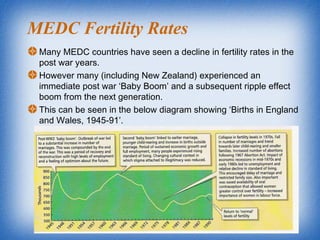
Many MEDC countries have seen a decline in fertility rates in the
post war years.
However many (including New Zealand) experienced an
immediate post war ‘Baby Boom’ and a subsequent ripple effect
boom from the next generation.
This can be seen in the below diagram showing ‘Births in England
and Wales, 1945-91’.
Mortality
Measurements of mortality indicate the rate at which
people are dying in a population.
The simplest measure is ‘death rate’ (the total number of
deaths per year for every 1000 people in the population).
As with birth rates, death rates can be linked to levels of
economic development.
Another measure is the standardised mortality ratio
(SMR) which compares the number of actual deaths for a
particular place with the expected in that place allowing
for different proportions of age and sex groupings.
How does population change over time?
Natural Increase (NI) = BR – DR
Birth rates and death rates have been closely linked to
the economic development of a country.
They point out that changes like industrialisation and
urbanisation lead to transition in which high BR & DR
are gradually replaced by low BR & DR.
This is shown in the 4 stage ‘Demographic Transition
Model’.
This model can be used to compare countries at a
particular time or track the transition of a single country
in its development history.
Copy diagram above and add stage names (pg350)
For each stage state the level of the BR & DR and the effect of
Natural Increase.
Detail the main causes for the BR & DR levels for each stage
From page 351 briefly explain the main factors that limit the models
effectiveness.
The Demographic Transition Model
Birth & Death Rates by Continent
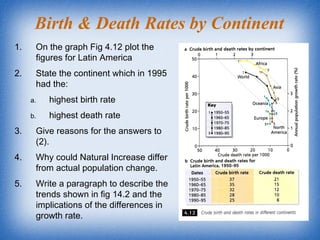
1. On the graph Fig 4.12 plot the
figures for Latin America
2. State the continent which in 1995
had the:
a. highest birth rate
b. highest death rate
3. Give reasons for the answers to
(2).
4. Why could Natural Increase differ
from actual population change.
5. Write a paragraph to describe the
trends shown in fig 14.2 and the
implications of the differences in
growth rate.
Population Structure
Answer the following from Ch13 (pg353)
Define the term ‘Life Expectancy’.
Describe how ‘Population or Age/Sex pyramids’ are
constructed.
Why is the use of ‘Population or Age/Sex pyramids’
useful for analysing population structure?
Copy the basic shape of the pyramid shown in figure
13.13 (1999 UK) then copy the bullet points noting the
features about its shape.
Copy fig 13.14: Characteristic pyramid shapes for each
stage of the DTM. Label with real world examples (Fig
13.15) – read 1st
column pg 354.
Dependency Ratio
Answer the following from Ch13 (pg354)
Who are described as ‘Economically
Active’?
Who are described as the ‘Non-
Economically Active’?
What does the Dependency Ratio tell us
about a population?
How can the Dependency Ratio be
expressed as an equation?
Trends in Population Growth
Read pgs355-360 and list the trends in
population growth under the following
headings:
Global Trends
Regional Trends
Birth Rates, Total Fertility Rates and
Replacement Rates
Death Rates and Life Expectancy
Japanese case study: Copy the text box
and Fig 13.27 (pyramid shapes only).
Comparing Population Pyramids
There are important differences in the shape of the
population pyramids for MEDC’s and LEDC’s, which
result from differences in their population structure.
In general a population pyramid for a developing
country has a wide base which indicates a youthful
population (as a result of high birth rates), and a
narrow top (less people in the older age groups
because average life expectancy is lower).
In contrast, the population pyramid for a developed
country has a narrower base (due to a lower birth
rate) and a wider top (reflecting a longer average life
expectancy).
Kenya: Rapid Growth
Kenya is typical of a LEDC
experiencing rapid
population growth.
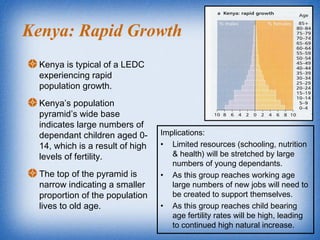
Kenya’s population
pyramid’s wide base
indicates large numbers of
dependant children aged 0-
14, which is a result of high
levels of fertility.
The top of the pyramid is
narrow indicating a smaller
proportion of the population
lives to old age.
Implications:
• Limited resources (schooling, nutrition
& health) will be stretched by large
numbers of young dependants.
• As this group reaches working age
large numbers of new jobs will need to
be created to support themselves.
• As this group reaches child bearing
age fertility rates will be high, leading
to continued high natural increase.
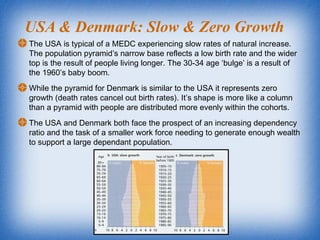
USA & Denmark: Slow & Zero Growth
The USA is typical of a MEDC experiencing slow rates of natural increase.
The population pyramid’s narrow base reflects a low birth rate and the wider
top is the result of people living longer. The 30-34 age ‘bulge’ is a result of
the 1960’s baby boom.
While the pyramid for Denmark is similar to the USA it represents zero
growth (death rates cancel out birth rates). It’s shape is more like a column
than a pyramid with people are distributed more evenly within the cohorts.
The USA and Denmark both face the prospect of an increasing dependency
ratio and the task of a smaller work force needing to generate enough wealth
to support a large dependant population.
Population and Resources
 The world’s
population is
growing very
rapidly.
 95% of
population
growth is
taking place
in LEDC’s.
 Population growth creates great pressures on
governments to provide for people; increased
pressures on the environment; increased risk of
famine and malnutrition; and greater differences
between the richer countries and the poorer
countries.
From page 376 define the terms ‘Optimum, Over
& Under population (give examples)
The Principles of Thomas Malthus
 In his ‘Essays on the Principle of Population
Growth’ 1798, the reverend Thomas Malthus
predicted that there was a finite population size
in relation to food supply.
 He stated that any increase in population beyond
this point would lead to a decline in the standard
of living and to “war, famine and disease”.
 His theory was based on two principles:
 Food supply at best only increases at an arithmetic rate, i.e.
1,2,3,4,5 etc.
 Population grows at a geometric or exponential rate, in the
absence of checks, i.e. 1,2,4,8,16 etc.
 Malthus suggested two ways in which population growth
could be reduced:
 Delayed age of marriage
 Abstinence from sex
From page 378 explain what is meant by ‘Carrying Capacity
of the Environment’ & copy & explain Figure 13.58
The Theories of Esther Boserup
 Esther Boserup, 1965, believed that people have the
resources of knowledge and technology to increase food
production. She suggested that in pre-industrial society,
an increase in population brought about a change in
agricultural techniques to allow for an increase in food
production. Thus population growth enabled agricultural
development to occur.
 Boserup assumed that people knew of the techniques
required by more intensive systems and used them when
the population grew. If knowledge was not available then
the agricultural system would regulate the population size
in a given area until people would find new ways of
increasing food production.
Increased Food Production
 There have been many ways since Malthus’s time that
people have increased food production – These include:
 Draining marshlands
 Reclaiming land from the sea
 Cross breeding of cattle
 Developing high yielding varieties of plants (HYV’s)
 Terracing of steep slopes
 Growing crops in greenhouses
 Using more sophisticated irrigation techniques
 Making new foods such as soya
 Making artificial fertilisers
 Farming native species of crops and animals
 Fish farming & aquaculture
Views of Population GrowthViews of Population Growth
Neo-Malthusist View
Boserup (Resource
Optimist) View
1. Why did population control become an urgent
necessity in China?
a) Development of the economy >>> increased standard of living
= increase in population growth (after revolution).
2. The Chinese census of 1982 saw the population reach
1008 million. What % was under 21 years of age?
a) 50% of China’s population was under 21 years of age.
3. Between 1982 – 2000 more than 11 million couples
reached child bearing age each year. How many new
babies were born every year?
a) At least 10 million new babies were born every year. (84.3
million have been born since 1/1/2000)
4. What are the benefits of the extended families in the rural
areas? Why have large families?
a) Provides labour for farms, support for young families, security in
old age etc.
4. Although the ‘One Child’ policy is not enforced in many
rural areas with national minority populations how many
children are they ‘advised’ to have?
a) 2 children – to maintain minority populations.
6. In Beijing what % of mothers work?
a) 97% of mothers in Beijing work.
6. How much of the world’s arable land does China have to
produce enough food for ¼ of the worlds population??
a) China has 7% of the world’s arable land area.
What actions have the Chinese government
implemented to reduce China’s growth rate?
 The ‘One Child’ Policy – mass propaganda campaign
 Family Planning (sex education, contraception)
 Birth control social ideology indoctrination (incl. social pressure).
 Preferential treatment for families with one child:
 Housing, schools, subsidised utilities, land, healthcare, employment
 Penalties for couples who have 2 or more children.
 Free abortions for unwanted pregnancies
 Raise marriage age, birth quota system.
 State kindergartens
 Worker peer pressure / community responsibilities system.
What are the effects of the ‘One Child Policy’?
 Society with no siblings >>> no aunties or uncles.
 Lack of security in old age for many citizens.
 Ageing population (fewer children)
 Increase in standard of living
 Reduce pressures on urban housing shortages
 Changing attitudes to family structure (extended to nuclear)
 Desire to have boys (female infanticide & future population
structure gender imbalance)
 Loss of rural labour force >> mechanisation
 Majority of children are only children >> behavioural problems
Exam Question on Population Control

AS GEOGRAPHY POPULATION

  • 1.
  • 2.
    BOOK RESOURCE This presentationisThis presentation is using the curriculausing the curricula activities andactivities and exercises from theexercises from the following book:following book: GEOGRAPHY – AnGEOGRAPHY – An Integrated ApproachIntegrated Approach by David Waugh,by David Waugh, fourth edition.fourth edition.
  • 3.
    Introduction Answer the followingfrom Ch13 (pg344) What is ‘demography’? Define the term ‘population distribution’. Using fig 13.1 describe the population distribution patterns shown (identify areas of high & low distribution). Why is fig 13.1 misleading? Define the term ‘population density’ - quantify.
  • 4.
    List what affectsdistribution at a Global and Regional/Local scales. Only 11% of the Earth’s land surface presents no serious limitations to settlement and agriculture. What prevents this on the other 89%? Using figure 13.4 draw 2 star diagrams. One to highlight factors affecting ‘Sparsely Populated Areas’ and one to highlight factors of ‘Densely Populated Areas’. Using figure 13.5 describe and explain the population distribution and densities of Brazil.
  • 5.
    Population Growth Read theextract from the Guardian newspaper from 14th August 1999 and answer the following questions: 1. Briefly describe the main features of world population since 1950. 2. Why should we be suspicious about the accuracy of projections of future world population size? 3. What factors might explain the differences in the levels of fertility between more economically developed countries (MEDC’s) and less economically developed countries (LEDC’s)? 4. What, according to the article, are the possible consequences of future increases in the world’s population?
  • 6.
    The worlds populationnow stands at just over 6.5 billion people. The world’s growth rate is determined by the simple equation: Births (fertility) – Deaths (mortality) = Growth Rate Before the 18th century the population growth was very slow (almost zero) because the high birth rate was cancelled out by widespread disease, wars and famines (high death rate). However since then due to rapid medical and technological advances the death rate has fallen rapidly while the birth rate has remained high = Population Explosion.
  • 7.
    Fertility Fertility is measuredby the Birth Rate (total number of live births per year per 1000 people in the population). The level of the birth rate is linked with economic development, status of women, religion and social customs & levels of health care. Graph the population increases from 1900 – 2100 for developing, developed and world population. Write a brief summary of the trends in the graph.
  • 8.
    Global Fertility Rates Fromthe map we can clearly see the higher fertility rates in the LEDC’s and the lower in the MEDC’s.
  • 9.
    MEDC Fertility Rates ManyMEDC countries have seen a decline in fertility rates in the post war years. However many (including New Zealand) experienced an immediate post war ‘Baby Boom’ and a subsequent ripple effect boom from the next generation. This can be seen in the below diagram showing ‘Births in England and Wales, 1945-91’.
  • 10.
    Mortality Measurements of mortalityindicate the rate at which people are dying in a population. The simplest measure is ‘death rate’ (the total number of deaths per year for every 1000 people in the population). As with birth rates, death rates can be linked to levels of economic development. Another measure is the standardised mortality ratio (SMR) which compares the number of actual deaths for a particular place with the expected in that place allowing for different proportions of age and sex groupings.
  • 11.
    How does populationchange over time? Natural Increase (NI) = BR – DR Birth rates and death rates have been closely linked to the economic development of a country. They point out that changes like industrialisation and urbanisation lead to transition in which high BR & DR are gradually replaced by low BR & DR. This is shown in the 4 stage ‘Demographic Transition Model’. This model can be used to compare countries at a particular time or track the transition of a single country in its development history.
  • 12.
    Copy diagram aboveand add stage names (pg350) For each stage state the level of the BR & DR and the effect of Natural Increase. Detail the main causes for the BR & DR levels for each stage From page 351 briefly explain the main factors that limit the models effectiveness. The Demographic Transition Model
  • 13.
    Birth & DeathRates by Continent 1. On the graph Fig 4.12 plot the figures for Latin America 2. State the continent which in 1995 had the: a. highest birth rate b. highest death rate 3. Give reasons for the answers to (2). 4. Why could Natural Increase differ from actual population change. 5. Write a paragraph to describe the trends shown in fig 14.2 and the implications of the differences in growth rate.
  • 14.
    Population Structure Answer thefollowing from Ch13 (pg353) Define the term ‘Life Expectancy’. Describe how ‘Population or Age/Sex pyramids’ are constructed. Why is the use of ‘Population or Age/Sex pyramids’ useful for analysing population structure? Copy the basic shape of the pyramid shown in figure 13.13 (1999 UK) then copy the bullet points noting the features about its shape. Copy fig 13.14: Characteristic pyramid shapes for each stage of the DTM. Label with real world examples (Fig 13.15) – read 1st column pg 354.
  • 15.
    Dependency Ratio Answer thefollowing from Ch13 (pg354) Who are described as ‘Economically Active’? Who are described as the ‘Non- Economically Active’? What does the Dependency Ratio tell us about a population? How can the Dependency Ratio be expressed as an equation?
  • 16.
    Trends in PopulationGrowth Read pgs355-360 and list the trends in population growth under the following headings: Global Trends Regional Trends Birth Rates, Total Fertility Rates and Replacement Rates Death Rates and Life Expectancy Japanese case study: Copy the text box and Fig 13.27 (pyramid shapes only).
  • 17.
    Comparing Population Pyramids Thereare important differences in the shape of the population pyramids for MEDC’s and LEDC’s, which result from differences in their population structure. In general a population pyramid for a developing country has a wide base which indicates a youthful population (as a result of high birth rates), and a narrow top (less people in the older age groups because average life expectancy is lower). In contrast, the population pyramid for a developed country has a narrower base (due to a lower birth rate) and a wider top (reflecting a longer average life expectancy).
  • 18.
    Kenya: Rapid Growth Kenyais typical of a LEDC experiencing rapid population growth. Kenya’s population pyramid’s wide base indicates large numbers of dependant children aged 0- 14, which is a result of high levels of fertility. The top of the pyramid is narrow indicating a smaller proportion of the population lives to old age. Implications: • Limited resources (schooling, nutrition & health) will be stretched by large numbers of young dependants. • As this group reaches working age large numbers of new jobs will need to be created to support themselves. • As this group reaches child bearing age fertility rates will be high, leading to continued high natural increase.
  • 19.
    USA & Denmark:Slow & Zero Growth The USA is typical of a MEDC experiencing slow rates of natural increase. The population pyramid’s narrow base reflects a low birth rate and the wider top is the result of people living longer. The 30-34 age ‘bulge’ is a result of the 1960’s baby boom. While the pyramid for Denmark is similar to the USA it represents zero growth (death rates cancel out birth rates). It’s shape is more like a column than a pyramid with people are distributed more evenly within the cohorts. The USA and Denmark both face the prospect of an increasing dependency ratio and the task of a smaller work force needing to generate enough wealth to support a large dependant population.
  • 20.
    Population and Resources The world’s population is growing very rapidly.  95% of population growth is taking place in LEDC’s.
  • 21.
     Population growthcreates great pressures on governments to provide for people; increased pressures on the environment; increased risk of famine and malnutrition; and greater differences between the richer countries and the poorer countries. From page 376 define the terms ‘Optimum, Over & Under population (give examples)
  • 22.
    The Principles ofThomas Malthus  In his ‘Essays on the Principle of Population Growth’ 1798, the reverend Thomas Malthus predicted that there was a finite population size in relation to food supply.  He stated that any increase in population beyond this point would lead to a decline in the standard of living and to “war, famine and disease”.  His theory was based on two principles:  Food supply at best only increases at an arithmetic rate, i.e. 1,2,3,4,5 etc.  Population grows at a geometric or exponential rate, in the absence of checks, i.e. 1,2,4,8,16 etc.
  • 23.
     Malthus suggestedtwo ways in which population growth could be reduced:  Delayed age of marriage  Abstinence from sex From page 378 explain what is meant by ‘Carrying Capacity of the Environment’ & copy & explain Figure 13.58
  • 24.
    The Theories ofEsther Boserup  Esther Boserup, 1965, believed that people have the resources of knowledge and technology to increase food production. She suggested that in pre-industrial society, an increase in population brought about a change in agricultural techniques to allow for an increase in food production. Thus population growth enabled agricultural development to occur.  Boserup assumed that people knew of the techniques required by more intensive systems and used them when the population grew. If knowledge was not available then the agricultural system would regulate the population size in a given area until people would find new ways of increasing food production.
  • 25.
    Increased Food Production There have been many ways since Malthus’s time that people have increased food production – These include:  Draining marshlands  Reclaiming land from the sea  Cross breeding of cattle  Developing high yielding varieties of plants (HYV’s)  Terracing of steep slopes  Growing crops in greenhouses  Using more sophisticated irrigation techniques  Making new foods such as soya  Making artificial fertilisers  Farming native species of crops and animals  Fish farming & aquaculture
  • 26.
    Views of PopulationGrowthViews of Population Growth Neo-Malthusist View Boserup (Resource Optimist) View
  • 27.
    1. Why didpopulation control become an urgent necessity in China? a) Development of the economy >>> increased standard of living = increase in population growth (after revolution). 2. The Chinese census of 1982 saw the population reach 1008 million. What % was under 21 years of age? a) 50% of China’s population was under 21 years of age. 3. Between 1982 – 2000 more than 11 million couples reached child bearing age each year. How many new babies were born every year? a) At least 10 million new babies were born every year. (84.3 million have been born since 1/1/2000)
  • 28.
    4. What arethe benefits of the extended families in the rural areas? Why have large families? a) Provides labour for farms, support for young families, security in old age etc. 4. Although the ‘One Child’ policy is not enforced in many rural areas with national minority populations how many children are they ‘advised’ to have? a) 2 children – to maintain minority populations. 6. In Beijing what % of mothers work? a) 97% of mothers in Beijing work. 6. How much of the world’s arable land does China have to produce enough food for ¼ of the worlds population?? a) China has 7% of the world’s arable land area.
  • 29.
    What actions havethe Chinese government implemented to reduce China’s growth rate?  The ‘One Child’ Policy – mass propaganda campaign  Family Planning (sex education, contraception)  Birth control social ideology indoctrination (incl. social pressure).  Preferential treatment for families with one child:  Housing, schools, subsidised utilities, land, healthcare, employment  Penalties for couples who have 2 or more children.  Free abortions for unwanted pregnancies  Raise marriage age, birth quota system.  State kindergartens  Worker peer pressure / community responsibilities system.
  • 30.
    What are theeffects of the ‘One Child Policy’?  Society with no siblings >>> no aunties or uncles.  Lack of security in old age for many citizens.  Ageing population (fewer children)  Increase in standard of living  Reduce pressures on urban housing shortages  Changing attitudes to family structure (extended to nuclear)  Desire to have boys (female infanticide & future population structure gender imbalance)  Loss of rural labour force >> mechanisation  Majority of children are only children >> behavioural problems
  • 31.
    Exam Question onPopulation Control