Human Population Dynamics


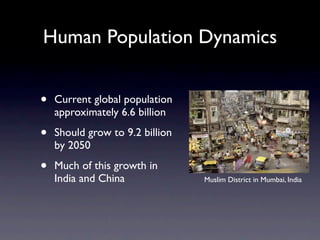
•   Current global population
    approximately 6.6 billion

•   Should grow to 9.2 billion
    by 2050

•   Much of this growth in
    India and China              Muslim District in Mumbai, India
Position #1...

 •   There are too many
     people in the less
     developed countries of
     the world

 •   They are degrading soil,
     air, water quality

 •   They are depleting           Near Lagos, Nigeria
     aspects of Earth’s natural
     capital
Position #2


 •   Resource
     consumption per
     person in the
     developed countries
     is the most serious
     problem

 •   Examples: energy,
     food
Position #3


 •   There is no problem

 •   Life expectancy on Earth is
     greater than ever

 •   Human ingenuity will
     overcome...

     •   Food, energy, resource
         problems
Position #4                           “The family is
                                      the natural and
                                      fundamental unit
                                      of society. It
                                      follows that any

•   Is population regulation a form   choice and
                                      decision with
    of genocide?                      regard to the size
                                      of the family
•   Does population regulation...     must irrevocably
                                      rest with the

    •   intrude on privacy            family and
                                      cannot be made

    •   intrude on personal           by anyone else.”
                                      --The UN
        freedom                       Universal
                                      Declaration of
                                      Human Rights
Who leaves the greatest
    footprint?

                  MDC    Category     LDC

                         Per Capita
                  $10K      GNP       $1K
                          % Global
                  20%                 80%
• A closer look   85%
                         Population
                          % Global
                           Wealth     15%
                         % Resource
                  88%       Use       12%
                          % Global
                  75%     Pollution   25%
Some population background...

•   for much of human history
    population grew slowly

•   during the past 200 years,
    however,

    •   exponential growth
        characterized by a J-
        shaped curve
Three reasons...

•   Humans live in diverse
    habitats

•   Emergence of
                                 Vaccinations
    agriculture

•   Medicine, sanitation,
    and energy resource

    •   allow birthrate to
        surpass death rate


                             Rice terraces in China
Present population growth rate


•   In 2006 overall growth rate 1.23%

    •   81 million new people

•   Developed countries 0.1% (1.2
    million)

•   Less developed 1.5% (79.5 million)
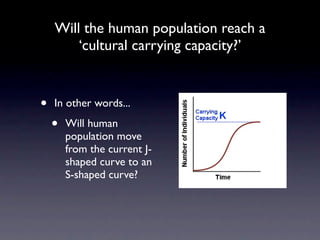
Will the human population reach a
        ‘cultural carrying capacity?’


•   In other words...

    •   Will human
        population move
        from the current J-
        shaped curve to an
        S-shaped curve?
Replacement Fertility Rate vs. Total
            Fertility Rate...


•   Replacement fertility rate

    •   # of children a couple needs to replace
        themselves

•   Total fertility rate

    •   # of children a woman has in her lifetime
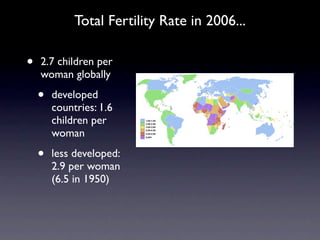
Total Fertility Rate in 2006...

•   2.7 children per
    woman globally

    •   developed
        countries: 1.6
        children per
        woman

    •   less developed:
        2.9 per woman
        (6.5 in 1950)
What about the US and Baby Boomers?


•   Right now 300 million-plus

    •   By 2050: 420 million

    •   Total fertility rate in US: less
        than 2.1

•   Baby Boomers 1946-64

    •   Total fertility rate: 3.7!
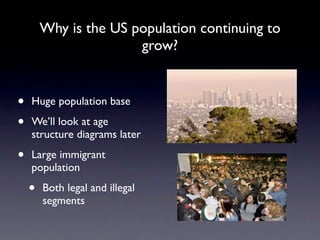
Why is the US population continuing to
                       grow?


•   Huge population base

•   We’ll look at age
    structure diagrams later

•   Large immigrant
    population

    •   Both legal and illegal
        segments
Factors affecting birthrate...


•   Children in the
    workforce

•   Cost of raising
    and educating
    children

•   Private/public
    pension plans

•   Urbanization             Shanghai, China
Additional factors...


•   Education/employment
    opportunities for
    women

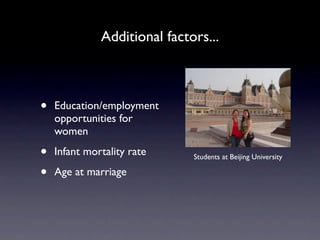
•   Infant mortality rate     Students at Beijing University

•   Age at marriage
Final considerations...


                                     The Blue Mosque

 •   Religious beliefs

 •   Availability of birth control

 •   Availability of legal abortions
What role does immigration play...

•   Counties that
    encourage immigration

    •   US, Canada,
        Australia, Israel, and
        New Zealand

    •   The US grants
        citizenship to
        700,000 annually

    •   In the US,
        immigrants tend to
        have larger families
Types of Immigration...

•   Legal and Illegal

•   Environmental and
    Political Refugees


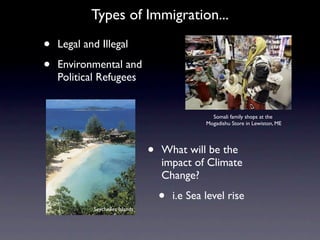
                                                   Somali family shops at the
                                                 Mogadishu Store in Lewiston, ME


                                 •   What will be the
                                     impact of Climate
                                     Change?

            Seychelles Islands
                                     •   i.e Sea level rise
Benefits and Costs of Immigrants...

•   Tradition in US    •   Displace US workers

•   Labor              •   Illegal aliens

•   Military           •   Strain on healthcare

•   Social Security    •   Strain on education

•   New ideas          •   Security issues

•   Other benefits?     •   Others?
What do Age Structure Diagrams tell us?

•   Pre-reproductive, Reproductive, Post-reproductive

•   Challenges for each model
Aging and Declining
Populations

•   Global aging             The population of the world will be
                             older.

    •   labor shortages      According to the 2006 Revision of
                             World Population Prospects, by 2045
    •   social security      the number of older persons in the
                             world (those aged 60 years or over)

    •   healthcare           will likely surpass, for the first time in
                             history, the number of children (i.e.,
                             persons under age 15). This
    •   military power vs.   crossover is the consequence of the
        diplomacy            long term reductions in fertility and
                             mortality that are leading to the
                             steady aging of the world population.
                             UN Population Division
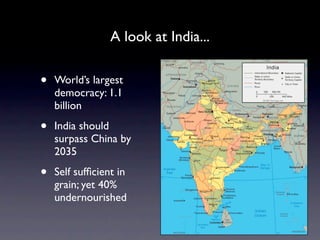
A look at India...


•   World’s largest
    democracy: 1.1
    billion

•   India should
    surpass China by
    2035

•   Self sufficient in
    grain; yet 40%
    undernourished
More on India...


•   Rapid economic
    growth
                                New Delhi marketplace
•   Critical resource and
    environmental
    problems

•   By 2050 could
    become the world’s
    economic leader
                            Desertification in southern India
Challenges to India’s population
                  planning...

•   At the the federal
    level

    •   Poor planning/
        disagreement
        over best
        policy

•   Best success at
    the local level

    •   Kerala
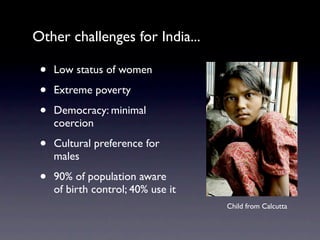
Other challenges for India...

 •   Low status of women

 •   Extreme poverty

 •   Democracy: minimal
     coercion

 •   Cultural preference for
     males

 •   90% of population aware
     of birth control; 40% use it
                                    Child from Calcutta
The State of Kerala-A promising model
               for India


•   Positive political leadership

•   High poverty, but life
    expectancy 70 yrs.

•   Social justice and economic
    redistribution

•   Literacy 100% (nationally       Trichur Pooram, an
                                     annual festival in
    47%)                                  Kerala
What about China...

•   Largest population: 1.3 billion

•   State controlled family policy
    since 1970

•   Coercive policy: draconian
    penalties

    •   one child or else

•   Modified in 2002; 2 children       Promoting the one-child policy
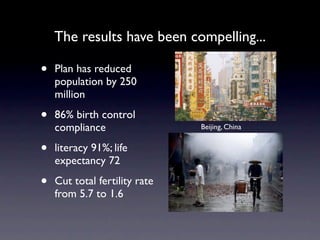
The results have been compelling...

•   Plan has reduced
    population by 250
    million

•   86% birth control
    compliance                 Beijing, China


•   literacy 91%; life
    expectancy 72

•   Cut total fertility rate
    from 5.7 to 1.6
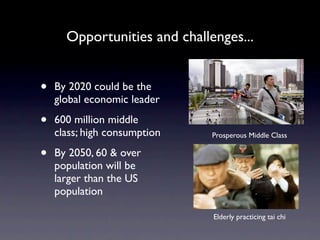
Opportunities and challenges...


•   By 2020 could be the
    global economic leader

•   600 million middle
    class; high consumption   Prosperous Middle Class

•   By 2050, 60 & over
    population will be
    larger than the US
    population

                              Elderly practicing tai chi
Final words on China...


 •   Cultural preference for
     males has led to a 118               Ad from Mail-order
                                             bride agency
     male to 100 female ratio

 •   Formidable resource
     depletion and
     environmental degradation
     problems

                                 Air pollution at the Olympic Stadium

Human Population Dynamics

  • 1.
    Human Population Dynamics • Current global population approximately 6.6 billion • Should grow to 9.2 billion by 2050 • Much of this growth in India and China Muslim District in Mumbai, India
  • 2.
    Position #1... • There are too many people in the less developed countries of the world • They are degrading soil, air, water quality • They are depleting Near Lagos, Nigeria aspects of Earth’s natural capital
  • 3.
    Position #2 • Resource consumption per person in the developed countries is the most serious problem • Examples: energy, food
  • 4.
    Position #3 • There is no problem • Life expectancy on Earth is greater than ever • Human ingenuity will overcome... • Food, energy, resource problems
  • 5.
    Position #4 “The family is the natural and fundamental unit of society. It follows that any • Is population regulation a form choice and decision with of genocide? regard to the size of the family • Does population regulation... must irrevocably rest with the • intrude on privacy family and cannot be made • intrude on personal by anyone else.” --The UN freedom Universal Declaration of Human Rights
  • 6.
    Who leaves thegreatest footprint? MDC Category LDC Per Capita $10K GNP $1K % Global 20% 80% • A closer look 85% Population % Global Wealth 15% % Resource 88% Use 12% % Global 75% Pollution 25%
  • 7.
    Some population background... • for much of human history population grew slowly • during the past 200 years, however, • exponential growth characterized by a J- shaped curve
  • 8.
    Three reasons... • Humans live in diverse habitats • Emergence of Vaccinations agriculture • Medicine, sanitation, and energy resource • allow birthrate to surpass death rate Rice terraces in China
  • 9.
    Present population growthrate • In 2006 overall growth rate 1.23% • 81 million new people • Developed countries 0.1% (1.2 million) • Less developed 1.5% (79.5 million)
  • 10.
    Will the humanpopulation reach a ‘cultural carrying capacity?’ • In other words... • Will human population move from the current J- shaped curve to an S-shaped curve?
  • 11.
    Replacement Fertility Ratevs. Total Fertility Rate... • Replacement fertility rate • # of children a couple needs to replace themselves • Total fertility rate • # of children a woman has in her lifetime
  • 12.
    Total Fertility Ratein 2006... • 2.7 children per woman globally • developed countries: 1.6 children per woman • less developed: 2.9 per woman (6.5 in 1950)
  • 13.
    What about theUS and Baby Boomers? • Right now 300 million-plus • By 2050: 420 million • Total fertility rate in US: less than 2.1 • Baby Boomers 1946-64 • Total fertility rate: 3.7!
  • 14.
    Why is theUS population continuing to grow? • Huge population base • We’ll look at age structure diagrams later • Large immigrant population • Both legal and illegal segments
  • 15.
    Factors affecting birthrate... • Children in the workforce • Cost of raising and educating children • Private/public pension plans • Urbanization Shanghai, China
  • 16.
    Additional factors... • Education/employment opportunities for women • Infant mortality rate Students at Beijing University • Age at marriage
  • 17.
    Final considerations... The Blue Mosque • Religious beliefs • Availability of birth control • Availability of legal abortions
  • 18.
    What role doesimmigration play... • Counties that encourage immigration • US, Canada, Australia, Israel, and New Zealand • The US grants citizenship to 700,000 annually • In the US, immigrants tend to have larger families
  • 19.
    Types of Immigration... • Legal and Illegal • Environmental and Political Refugees Somali family shops at the Mogadishu Store in Lewiston, ME • What will be the impact of Climate Change? Seychelles Islands • i.e Sea level rise
  • 20.
    Benefits and Costsof Immigrants... • Tradition in US • Displace US workers • Labor • Illegal aliens • Military • Strain on healthcare • Social Security • Strain on education • New ideas • Security issues • Other benefits? • Others?
  • 21.
    What do AgeStructure Diagrams tell us? • Pre-reproductive, Reproductive, Post-reproductive • Challenges for each model
  • 22.
    Aging and Declining Populations • Global aging The population of the world will be older. • labor shortages According to the 2006 Revision of World Population Prospects, by 2045 • social security the number of older persons in the world (those aged 60 years or over) • healthcare will likely surpass, for the first time in history, the number of children (i.e., persons under age 15). This • military power vs. crossover is the consequence of the diplomacy long term reductions in fertility and mortality that are leading to the steady aging of the world population. UN Population Division
  • 23.
    A look atIndia... • World’s largest democracy: 1.1 billion • India should surpass China by 2035 • Self sufficient in grain; yet 40% undernourished
  • 24.
    More on India... • Rapid economic growth New Delhi marketplace • Critical resource and environmental problems • By 2050 could become the world’s economic leader Desertification in southern India
  • 25.
    Challenges to India’spopulation planning... • At the the federal level • Poor planning/ disagreement over best policy • Best success at the local level • Kerala
  • 26.
    Other challenges forIndia... • Low status of women • Extreme poverty • Democracy: minimal coercion • Cultural preference for males • 90% of population aware of birth control; 40% use it Child from Calcutta
  • 27.
    The State ofKerala-A promising model for India • Positive political leadership • High poverty, but life expectancy 70 yrs. • Social justice and economic redistribution • Literacy 100% (nationally Trichur Pooram, an annual festival in 47%) Kerala
  • 28.
    What about China... • Largest population: 1.3 billion • State controlled family policy since 1970 • Coercive policy: draconian penalties • one child or else • Modified in 2002; 2 children Promoting the one-child policy
  • 29.
    The results havebeen compelling... • Plan has reduced population by 250 million • 86% birth control compliance Beijing, China • literacy 91%; life expectancy 72 • Cut total fertility rate from 5.7 to 1.6
  • 30.
    Opportunities and challenges... • By 2020 could be the global economic leader • 600 million middle class; high consumption Prosperous Middle Class • By 2050, 60 & over population will be larger than the US population Elderly practicing tai chi
  • 31.
    Final words onChina... • Cultural preference for males has led to a 118 Ad from Mail-order bride agency male to 100 female ratio • Formidable resource depletion and environmental degradation problems Air pollution at the Olympic Stadium