Chapter 6 “Where and Why People Move”
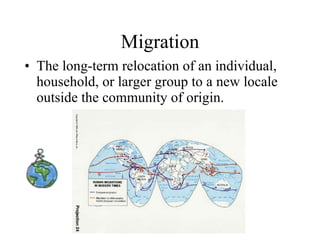
Migration The long-term relocation of an individual, household, or larger group to a new locale outside the community of origin.
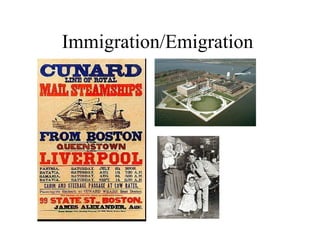
Immigration/Emigration
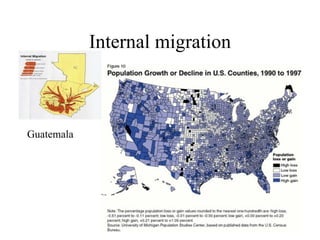
Internal migration Guatemala
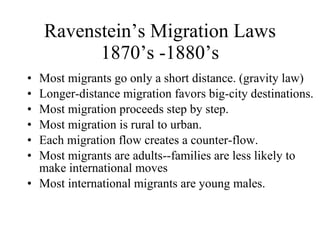
Ravenstein’s Migration Laws 1870’s -1880’s Most migrants go only a short distance. (gravity law) Longer-distance migration favors big-city destinations. Most migration proceeds step by step. Most migration is rural to urban. Each migration flow creates a counter-flow. Most migrants are adults--families are less likely to make international moves  Most international migrants are young males.
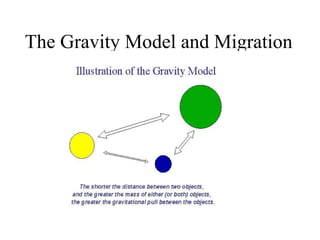
The Gravity Model and Migration
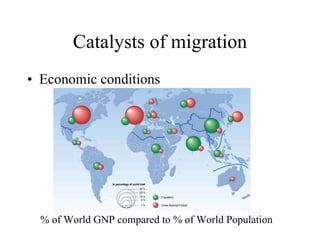
Catalysts of migration Economic conditions % of World GNP compared to % of World Population
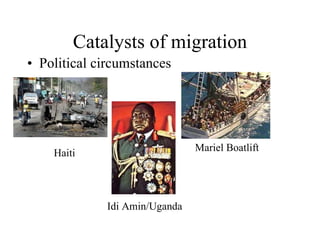
Catalysts of migration Political circumstances Haiti Mariel Boatlift Idi Amin/Uganda
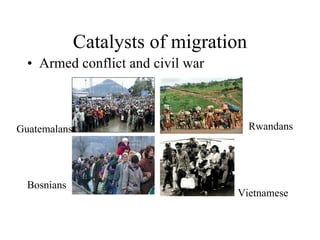
Catalysts of migration Armed conflict and civil war Guatemalans Vietnamese Rwandans Bosnians
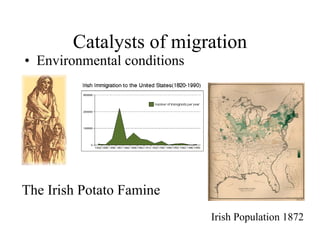
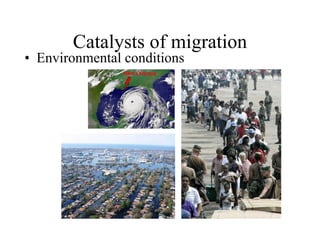
Catalysts of migration Environmental conditions Irish Population 1872 The Irish Potato Famine
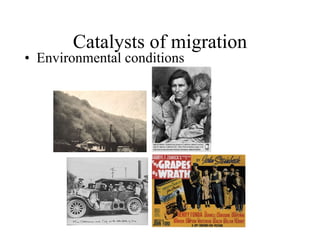
Catalysts of migration Environmental conditions
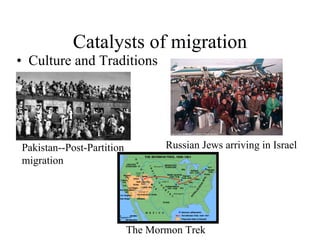
Catalysts of migration Culture and Traditions Pakistan--Post-Partition migration Russian Jews arriving in Israel The Mormon Trek
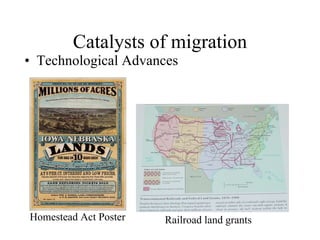
Catalysts of migration Technological Advances Railroad land grants Homestead Act Poster
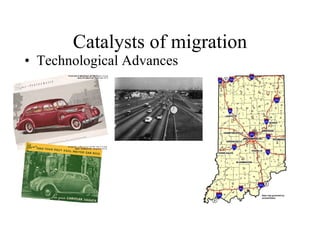
Catalysts of migration Technological Advances
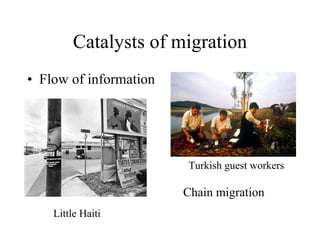
Catalysts of migration Flow of information Little Haiti Turkish guest workers  Chain migration
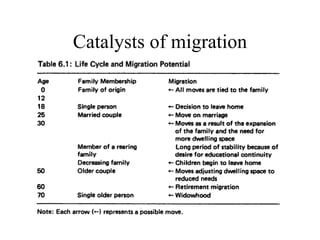
Catalysts of migration
 
Catalysts of migration “ Push”  Factors are events or conditions that impel an individual to move  from  a location. “ Pull” Factors are forces of attraction that influence migrants to move  to  a particular location. Most decisions to migrate are a combination of push and pull factors.
Distance decay --most moves are to closer and more familiar locations Step migration --an eventual long-distance migration is undertaken in stages--farm to village to small town to city. Catalysts of migration
Intervening opportunity --closer opportunities will reduce the attractiveness of interaction with more distant--even slightly better--alternatives. Catalysts of migration
Voluntary Migration Voluntary migration  has an element of choice based on some percieved opportunity.
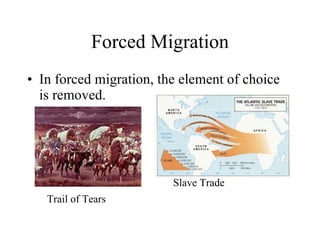
Forced Migration In forced migration, the element of choice is removed. Trail of Tears Slave Trade
Counter migration … or return migration…is the return of migrants to the regions from which they earlier emigrated. Every migration flow generates some counter-migration
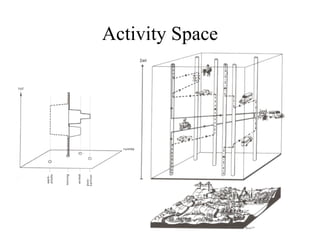
Types of Movement Cyclic Movement Activity Space--daily movement such as commuting Seasonal movement--snowbirds, agricultural workers Pastoral nomadism--a group moves with its livestock in search of forage.  This is controlled movement  (not random).
Activity Space
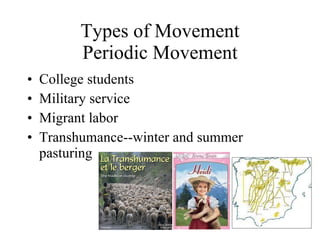
Types of Movement Periodic Movement College students Military service Migrant labor Transhumance--winter and summer pasturing
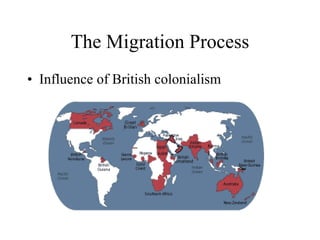
The Migration Process Influence of British colonialism
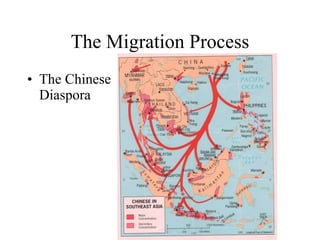
The Migration Process The Chinese Diaspora
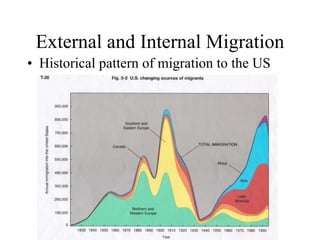
External and Internal Migration Historical pattern of migration to the US
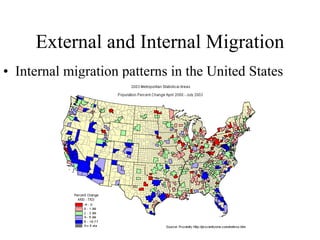
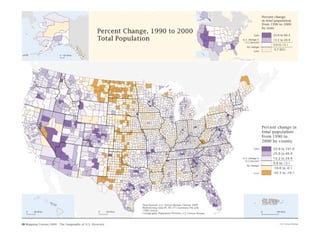
External and Internal Migration Internal migration patterns in the United States
 
Migration and Dislocation: The Refugee Problem What is a “refugee?” International/Intranational Refugees Permanent/Temporary Refugees

Ch6 Migration