Chapter 18 Traditional Livelihoods of Rural Peoples
Categories of Economic Activity 1. Harvest or extraction 2. “Value added” industries 3. “Service-sector” industries 4. “White-collar” information services 5. High-level decision making
Locational Factors for Primary Economic Activities --must be located close to the resource.
Locational Factors for Secondary Economic Activities --needs to be accessible to the resource, a source of energy, the market, and an appropriate labor force.
Why is Detroit located where it is?
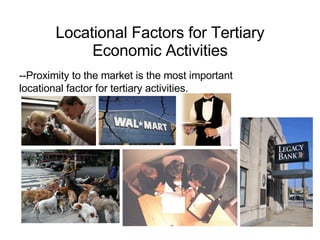
Locational Factors for Tertiary Economic Activities --Proximity to the market is the most important locational factor for tertiary activities.
 
Locational Factors for Quaternary Economic Activities --Access to good telecommunications infrastructure and a suitable work force is important.
Locational Factors for Quinary Economic Activities --Quinary economic activities tend to cluster. Research Triangle Park, NC
 
The sectors of the economy are tied together by its infrastrcture
 
The Geography of Agriculture Why study agriculture? Much of earth’s land surface is dedicated to agriculture Only 2% of Americans are engaged in farming, but half of all families in LDCs depend on farming to sustain them. Agriculture is a major contributor to environmental change.
The First Agricultural Revolution Occurred in the Fertile Crescent perhaps as early as 12,000 years ago.
 
Domestication of plants and animals probably emerged as an extension of food gathering activities of hunting and gathering societies.


Intensive vs.Extensive Agriculture Intensive agriculture  uses much labor and capital to increase productivity per unit of land. Extensive agriculture  expends less labor and capital per unit of land.
Systems of Agricultural Production Subsistence agriculture  is practiced by families and villages when they raise only enough  animals and crops to feed themselves.  There is very little trade. Commercial agriculture  produces goods for sale in the city or on the international market.
Types of Subsistence Agriculture Shifting cultivation  or swidden agriculture is a type of subsistence farming found in tropical rain forest areas. Also called slash-and-burn or milpa.
Types of Subsistence Agriculture Pastoral nomadism  is a form of extensive subsistence agriculture. Animal herds are moved from one forage area to another in a cyclical pattern of migration. Wodaabe of The Sahara Tibetan herdsmen
Types of Subsistence Agriculture Transhumance  is a form of pastoral nomadism wherein stock is moved to the lowlands in the winter and to the highlands in the summer (vertical nomadism).
Types of Subsistence Agriculture Problems faced by subsistence agriculturalists: Soil quality is often marginal. They generally lack the tools and technology that developed countries have had for nearly 100 years. It is difficult for them to accumulate the capital that would allow for an improvement in the standard of living. Poor countries must often turn to cash crops for export, leaving them without the food production needed to sustain their own population.
Second Agricultural Revolution Began in the late Middle Ages and included changes that brought more efficiency to farming during the 17th and 18th centuries.
Second Agricultural Revolution Open fields were enclosed by fences, hedges, walls. Crop rotation replaced the practice of fallowing fields. Seeds and breeding stock were improved. Farming implements were improved--the use of the heavy plow meant marginal lands could now be cultivated. Horse collar improved--horses replaced oxen for plowing.
Effect of the Industrial Revolution The advances of the Second Agricultural Revolution were sustained. Tractors and new farm machines were introduced. Commercial farming was extended--colonial production was needed to supply factories and feed new urban populations in the core.
Third Agricultural Revolution Intensive mechanization The use of biotechnology  (genetic engineering of higher-yielding crop strains) A blending of primary (production), secondary (processing), and tertiary (marketing) sectors in a new vertical organization of agriculture.
The Von Thünen Model
Von Thünen’s basic premises: Farmers select crops to cultivate and animals to raise based on market location. This decision is based on two factors (together called “ land rent ”): The cost of the land The cost of transporting goods to market Farms located closer to the market select crops with higher transportation costs while more distant farms select crops that can be transported less expensively.
Agricultural Location
Von Thünen’s assumptions: That the terrain is flat That there are no barriers to transportation to the market That soils and other environmental conditions are the same everywhere That social customs and government policies do not influence the attractiveness of certain products. That everyone is trying to maximize profits
Small, suburban market One main highway Grid highway network
 
Agricultural Location More intense use of land nearer the market Less intense use of land further from the market
… applying von Thunen’s basic assumptions … von Thunen’s model with Variations in climate factored  in--the north is colder than the  South.
 
Market gardens are close to urban centers.


Agricultural Productivity in the U.S. Corn for grain 3 118.7 1989-1992 34 39.4 1950-1959 108 26.1 1935-1939 Hours of labor/ 100 bushels Bushels/Acre
Agricultural Productivity in the U.S. Cotton 5 650 1989-1992 107 296 1950-1959 209 226 1935-1939 Hours of labor/ 500# bale Pounds/acre
Agricultural Productivity in the U.S. Wheat 7 36.5 1989-1992 27 17.3 1950-1959 67 13.2 1935-1939 Hours labor/ 100 bushels Pounds/acre
In 1870, half of the U.S. population was directly employed in agriculture. As of 2006, less than 1% of the U.S. population is employed in agriculture. Not because we are producing less, but because new technologies have reduced the amount of labor required.
 
What type of agricultural activity is depicted in each of the slides?
Cattle Grazing Labor intensive vs. capital intensive? Intensive vs extensive land use? Commercial vs. subsistence? Sedentary vs. nomadic?
Wheat Labor intensive vs. capital intensive? Intensive vs extensive land use? Commercial vs. subsistence? Sedentary vs. nomadic?
Rice Labor intensive vs. capital intensive? Intensive vs extensive land use? Commercial vs. subsistence? Sedentary vs. nomadic
Bananas Labor intensive vs. capital intensive? Intensive vs extensive land use? Commercial vs. subsistence? Sedentary vs. nomadic?
Vegetables Labor intensive vs. capital intensive? Intensive vs extensive land use? Commercial vs. subsistence? Sedentary vs. nomadic?
Fishing Labor intensive vs. capital intensive? Intensive vs extensive land use? Commercial vs. subsistence? Sedentary vs. nomadic?
Pigs Feed Lot Labor intensive vs. capital intensive? Intensive vs extensive land use? Commercial vs. subsistence? Sedentary vs. nomadic?

Ch18

  • 1.
    Chapter 18 TraditionalLivelihoods of Rural Peoples
  • 2.
    Categories of EconomicActivity 1. Harvest or extraction 2. “Value added” industries 3. “Service-sector” industries 4. “White-collar” information services 5. High-level decision making
  • 3.
    Locational Factors forPrimary Economic Activities --must be located close to the resource.
  • 4.
    Locational Factors forSecondary Economic Activities --needs to be accessible to the resource, a source of energy, the market, and an appropriate labor force.
  • 5.
    Why is Detroitlocated where it is?
  • 6.
    Locational Factors forTertiary Economic Activities --Proximity to the market is the most important locational factor for tertiary activities.
  • 7.
  • 8.
    Locational Factors forQuaternary Economic Activities --Access to good telecommunications infrastructure and a suitable work force is important.
  • 9.
    Locational Factors forQuinary Economic Activities --Quinary economic activities tend to cluster. Research Triangle Park, NC
  • 10.
  • 11.
    The sectors ofthe economy are tied together by its infrastrcture
  • 12.
  • 13.
    The Geography ofAgriculture Why study agriculture? Much of earth’s land surface is dedicated to agriculture Only 2% of Americans are engaged in farming, but half of all families in LDCs depend on farming to sustain them. Agriculture is a major contributor to environmental change.
  • 14.
    The First AgriculturalRevolution Occurred in the Fertile Crescent perhaps as early as 12,000 years ago.
  • 15.
  • 16.
    Domestication of plantsand animals probably emerged as an extension of food gathering activities of hunting and gathering societies.
  • 17.
  • 18.
  • 19.
  • 20.
    Intensive vs.Extensive AgricultureIntensive agriculture uses much labor and capital to increase productivity per unit of land. Extensive agriculture expends less labor and capital per unit of land.
  • 21.
    Systems of AgriculturalProduction Subsistence agriculture is practiced by families and villages when they raise only enough animals and crops to feed themselves. There is very little trade. Commercial agriculture produces goods for sale in the city or on the international market.
  • 22.
    Types of SubsistenceAgriculture Shifting cultivation or swidden agriculture is a type of subsistence farming found in tropical rain forest areas. Also called slash-and-burn or milpa.
  • 23.
    Types of SubsistenceAgriculture Pastoral nomadism is a form of extensive subsistence agriculture. Animal herds are moved from one forage area to another in a cyclical pattern of migration. Wodaabe of The Sahara Tibetan herdsmen
  • 24.
    Types of SubsistenceAgriculture Transhumance is a form of pastoral nomadism wherein stock is moved to the lowlands in the winter and to the highlands in the summer (vertical nomadism).
  • 25.
    Types of SubsistenceAgriculture Problems faced by subsistence agriculturalists: Soil quality is often marginal. They generally lack the tools and technology that developed countries have had for nearly 100 years. It is difficult for them to accumulate the capital that would allow for an improvement in the standard of living. Poor countries must often turn to cash crops for export, leaving them without the food production needed to sustain their own population.
  • 26.
    Second Agricultural RevolutionBegan in the late Middle Ages and included changes that brought more efficiency to farming during the 17th and 18th centuries.
  • 27.
    Second Agricultural RevolutionOpen fields were enclosed by fences, hedges, walls. Crop rotation replaced the practice of fallowing fields. Seeds and breeding stock were improved. Farming implements were improved--the use of the heavy plow meant marginal lands could now be cultivated. Horse collar improved--horses replaced oxen for plowing.
  • 28.
    Effect of theIndustrial Revolution The advances of the Second Agricultural Revolution were sustained. Tractors and new farm machines were introduced. Commercial farming was extended--colonial production was needed to supply factories and feed new urban populations in the core.
  • 29.
    Third Agricultural RevolutionIntensive mechanization The use of biotechnology (genetic engineering of higher-yielding crop strains) A blending of primary (production), secondary (processing), and tertiary (marketing) sectors in a new vertical organization of agriculture.
  • 30.
  • 31.
    Von Thünen’s basicpremises: Farmers select crops to cultivate and animals to raise based on market location. This decision is based on two factors (together called “ land rent ”): The cost of the land The cost of transporting goods to market Farms located closer to the market select crops with higher transportation costs while more distant farms select crops that can be transported less expensively.
  • 32.
  • 33.
    Von Thünen’s assumptions:That the terrain is flat That there are no barriers to transportation to the market That soils and other environmental conditions are the same everywhere That social customs and government policies do not influence the attractiveness of certain products. That everyone is trying to maximize profits
  • 34.
    Small, suburban marketOne main highway Grid highway network
  • 35.
  • 36.
    Agricultural Location Moreintense use of land nearer the market Less intense use of land further from the market
  • 37.
    … applying vonThunen’s basic assumptions … von Thunen’s model with Variations in climate factored in--the north is colder than the South.
  • 38.
  • 39.
    Market gardens areclose to urban centers.
  • 40.
  • 41.
  • 42.
  • 43.
  • 44.
  • 45.
  • 46.
    Agricultural Productivity inthe U.S. Corn for grain 3 118.7 1989-1992 34 39.4 1950-1959 108 26.1 1935-1939 Hours of labor/ 100 bushels Bushels/Acre
  • 47.
    Agricultural Productivity inthe U.S. Cotton 5 650 1989-1992 107 296 1950-1959 209 226 1935-1939 Hours of labor/ 500# bale Pounds/acre
  • 48.
    Agricultural Productivity inthe U.S. Wheat 7 36.5 1989-1992 27 17.3 1950-1959 67 13.2 1935-1939 Hours labor/ 100 bushels Pounds/acre
  • 49.
    In 1870, halfof the U.S. population was directly employed in agriculture. As of 2006, less than 1% of the U.S. population is employed in agriculture. Not because we are producing less, but because new technologies have reduced the amount of labor required.
  • 50.
  • 51.
    What type ofagricultural activity is depicted in each of the slides?
  • 52.
    Cattle Grazing Laborintensive vs. capital intensive? Intensive vs extensive land use? Commercial vs. subsistence? Sedentary vs. nomadic?
  • 53.
    Wheat Labor intensivevs. capital intensive? Intensive vs extensive land use? Commercial vs. subsistence? Sedentary vs. nomadic?
  • 54.
    Rice Labor intensivevs. capital intensive? Intensive vs extensive land use? Commercial vs. subsistence? Sedentary vs. nomadic
  • 55.
    Bananas Labor intensivevs. capital intensive? Intensive vs extensive land use? Commercial vs. subsistence? Sedentary vs. nomadic?
  • 56.
    Vegetables Labor intensivevs. capital intensive? Intensive vs extensive land use? Commercial vs. subsistence? Sedentary vs. nomadic?
  • 57.
    Fishing Labor intensivevs. capital intensive? Intensive vs extensive land use? Commercial vs. subsistence? Sedentary vs. nomadic?
  • 58.
    Pigs Feed LotLabor intensive vs. capital intensive? Intensive vs extensive land use? Commercial vs. subsistence? Sedentary vs. nomadic?