TRINITY INSTITUTE OF PROFESSIONAL STUDIES
Sector – 9, Dwarka Institutional Area, New Delhi-75
Affiliated Institution of G.G.S.IP.U, Delhi
B.Com (H) Indian Economy
888301
Population and Economic Development
By Dr Vandana Malviya…
TRINITY INSTITUTE OF PROFESSIONAL STUDIES
Sector – 9, Dwarka Institutional Area, New Delhi-75
Population
TRINITY INSTITUTE OF PROFESSIONAL STUDIES
Sector – 9, Dwarka Institutional Area, New Delhi-75
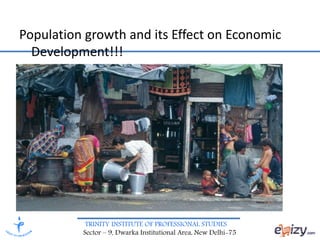
Population growth and its Effect on Economic
Development!!!
TRINITY INSTITUTE OF PROFESSIONAL STUDIES
Sector – 9, Dwarka Institutional Area, New Delhi-75
Population and Developed Countries
• Growing population positively affects
economic development:
– Increased labor force for increased production;
– Enhance demand for good and expands size of
market;
– Encourages capital formation
TRINITY INSTITUTE OF PROFESSIONAL STUDIES
Sector – 9, Dwarka Institutional Area, New Delhi-75
Population growth and
Underdeveloped countries- 2 lines of
thought
• Population growth as boon to economic
development:
TRINITY INSTITUTE OF PROFESSIONAL STUDIES
Sector – 9, Dwarka Institutional Area, New Delhi-75
Population growth an obstacle to
economic development
TRINITY INSTITUTE OF PROFESSIONAL STUDIES
Sector – 9, Dwarka Institutional Area, New Delhi-75
Relation between population growth
and other economic factors
• Population growth and production;
• Population growth and agricultural development;
• Population growth and labor force;
• Population growth and employment;
• Population growth and capital formation;
• Population growth and balance of payments;
• Population growth and vicious circle of poverty;
• Population growth and balanced growth
Why a growing population?
• India
• Lack of Migration
• Superstitious
• Lack of Education
• Desire for Male children
• Fertility rate declining
– Younger women having
children
TRINITY INSTITUTE OF PROFESSIONAL STUDIES
Sector – 9, Dwarka Institutional Area, New Delhi-75
Population growth in India
Census year Population ( in million)
1901 238.3
1911 252.0
1921 251.2
1931 278.8
1941 318.7
1951 360.9
1961 439.2
1971 548.1
1981 683.3
1991 846.4
2001 1028.7
2011 1210.1
TRINITY INSTITUTE OF PROFESSIONAL STUDIES
Sector – 9, Dwarka Institutional Area, New Delhi-75
Causes of High Birth Rate
• Economic Factors:
• Mass poverty;
• Predominance agriculture;
• Majority of rural population living in joint
families;
• Gradually rising per capita income of high
income group;
TRINITY INSTITUTE OF PROFESSIONAL STUDIES
Sector – 9, Dwarka Institutional Area, New Delhi-75
Causes of High Birth Rate
• Social Factors:
• Universality of marriage;
• Low age of marriage;
• Liking for male child;
• Religious beliefs;
• Illiteracy and ignorance;
• Low status of women in society;
• Prevalence of joint family system.
TRINITY INSTITUTE OF PROFESSIONAL STUDIES
Sector – 9, Dwarka Institutional Area, New Delhi-75
Reasons for low death rate
• Improved medical facilities;
• Effects of economic development;
• Control of famines and epidemics;
• Maternity hospitals and child care centers;
• Spread of facilities for female education.
TRINITY INSTITUTE OF PROFESSIONAL STUDIES
Sector – 9, Dwarka Institutional Area, New Delhi-75
Population growth’s effect on India’s
economic development
• Population and national income:
• Population and food problem:
• Population and burden of unproductive
population on productive population:
• Population and unemployment;
• Population and capital formation;
• Population and increasing social and economic
responsibility
TRINITY INSTITUTE OF PROFESSIONAL STUDIES
Sector – 9, Dwarka Institutional Area, New Delhi-75
Chief demographic features in India
• Life expectancy:
– It has risen in last few decades;
– In 1951 it was 45 years;
– In 1981-91 it was 58.2 years;
– In 2012-13 it was 64.6 years for males and 67.7
years for females.
TRINITY INSTITUTE OF PROFESSIONAL STUDIES
Sector – 9, Dwarka Institutional Area, New Delhi-75
Chief demographic features in India
• Density of population:
– It measures the number of persons living over an
area of 1 km radius;
– In 1951 it was 117 persons;
– In 2014 it rose to 382 persons.
TRINITY INSTITUTE OF PROFESSIONAL STUDIES
Sector – 9, Dwarka Institutional Area, New Delhi-75
Chief demographic features in India
• Infant mortality rate:
– It measures children who die before 5 years;
– In a report by US based organization Save the
Children more newborns die on the first day in
India;
– Every year over 3,09,300 children do not live
beyond 1st day in India.
– In 1951 it was 250 per thousand
– In 2014 it was 44 per thousand in 2011
TRINITY INSTITUTE OF PROFESSIONAL STUDIES
Sector – 9, Dwarka Institutional Area, New Delhi-75
Chief demographic features in India
• Composition of population:
– It refers to the distribution of population in
different age groups;
– (0-14) years, (14 to 60) years and above 60 years;
– At present age composition of India is young;
– 37% of population below 15 years in India.
TRINITY INSTITUTE OF PROFESSIONAL STUDIES
Sector – 9, Dwarka Institutional Area, New Delhi-75
Chief demographic features in India
• Male-Female ratio:
– Male population is more than females;
– In 1901 female to male ration was 962:1000;
– In 2011 female to male ration was 928:1000.
TRINITY INSTITUTE OF PROFESSIONAL STUDIES
Sector – 9, Dwarka Institutional Area, New Delhi-75
Chief demographic features in India
• Rural-urban population:
– Gandhi ji said “true India resides in villages”.
– In 1951 urban population was only 17% of total
population;
– In 2011 urban population rose to 22% because of
migration from rural to urban.
TRINITY INSTITUTE OF PROFESSIONAL STUDIES
Sector – 9, Dwarka Institutional Area, New Delhi-75
Population policy
• People in rural and urban to be educated to
adopt family planning techniques;
• Married couples need to be informed about
benefits of small families;
• After independence the main focus of
government has been on :
– Lowering the birth rate;
– Reducing infant mortality rate;
– Improving the quality of life
TRINITY INSTITUTE OF PROFESSIONAL STUDIES
Sector – 9, Dwarka Institutional Area, New Delhi-75
• During 1951-74 about 307.15 crore rupee was
spent on family planning programs;
• In June 1975 to March 1977, all sorts of
coercive measures were practiced to
propagate family planning.
TRINITY INSTITUTE OF PROFESSIONAL STUDIES
Sector – 9, Dwarka Institutional Area, New Delhi-75
In 1977 government announced New
National Policy
• Public should be educated, persuaded and
induced to adopt and practice various birth
control measures;
• No coercion should be practiced in
propagation of family planning;
• Education system to be formulated in such a
manner that would create awareness among
people on the importance of family planning;
TRINITY INSTITUTE OF PROFESSIONAL STUDIES
Sector – 9, Dwarka Institutional Area, New Delhi-75
In 1977 government announced New
National Policy
• Print media to be used for spreading message
of family planning to remotest areas of he
country;
• Registration of marriage to be mandatory;
• People opting for tubectomy to be
compensated monetarily;
• Some tax concessions were announced on the
expenditure incurred by business houses on
propagation of birth control measures.
TRINITY INSTITUTE OF PROFESSIONAL STUDIES
Sector – 9, Dwarka Institutional Area, New Delhi-75
National Policy on Population (2000)
• The objectives of the policy to be achieved by
2010. It is divided in 3 objectives.
• Short term objective: it aimed at looking after
the needs of contraception and infrastructure
with regard to health care;
• Medium term objective: one child per couple;
• Long term objective: it aimed at achieving a
stable population during next 40 years
TRINITY INSTITUTE OF PROFESSIONAL STUDIES
Sector – 9, Dwarka Institutional Area, New Delhi-75
Socio-demographic goals of NPP to be
achieved by 2010.
• Attend the unmet needs relating to child
health care services;
• Provide free education to children below 14
years of age;
• Complete immunization of children;
• Marriage of girls to be raised to 20 years and
none should get married before 16 years;
• 100% deliveries to be performed by
professionally trained staff.
TRINITY INSTITUTE OF PROFESSIONAL STUDIES
Sector – 9, Dwarka Institutional Area, New Delhi-75
Socio-demographic goals of NPP to be
achieved by 2010.
• Registration of marriage, pregnancy, birth and
death;
• Check and prevent spread of AIDS;
• Provide counseling regarding contraceptive
services;
• Popularize small family norms.
TRINITY INSTITUTE OF PROFESSIONAL STUDIES
Sector – 9, Dwarka Institutional Area, New Delhi-75
• BR and DR has declined in last 13 years;
• In 2015 projected Maternal Mortality Ratio
(MMR) is 149;
• In 2017 projected Maternal Mortality Ratio
(MMR) is 127;
• India projected Infant Mortality Rate (IMR) is
38 in 2015;
• India projected Infant Mortality Rate (IMR) is
34 in 2017;

Population and economic development

  • 1.
    TRINITY INSTITUTE OFPROFESSIONAL STUDIES Sector – 9, Dwarka Institutional Area, New Delhi-75 Affiliated Institution of G.G.S.IP.U, Delhi B.Com (H) Indian Economy 888301 Population and Economic Development By Dr Vandana Malviya…
  • 2.
    TRINITY INSTITUTE OFPROFESSIONAL STUDIES Sector – 9, Dwarka Institutional Area, New Delhi-75 Population
  • 3.
    TRINITY INSTITUTE OFPROFESSIONAL STUDIES Sector – 9, Dwarka Institutional Area, New Delhi-75 Population growth and its Effect on Economic Development!!!
  • 4.
    TRINITY INSTITUTE OFPROFESSIONAL STUDIES Sector – 9, Dwarka Institutional Area, New Delhi-75 Population and Developed Countries • Growing population positively affects economic development: – Increased labor force for increased production; – Enhance demand for good and expands size of market; – Encourages capital formation
  • 5.
    TRINITY INSTITUTE OFPROFESSIONAL STUDIES Sector – 9, Dwarka Institutional Area, New Delhi-75 Population growth and Underdeveloped countries- 2 lines of thought • Population growth as boon to economic development:
  • 6.
    TRINITY INSTITUTE OFPROFESSIONAL STUDIES Sector – 9, Dwarka Institutional Area, New Delhi-75 Population growth an obstacle to economic development
  • 7.
    TRINITY INSTITUTE OFPROFESSIONAL STUDIES Sector – 9, Dwarka Institutional Area, New Delhi-75 Relation between population growth and other economic factors • Population growth and production; • Population growth and agricultural development; • Population growth and labor force; • Population growth and employment; • Population growth and capital formation; • Population growth and balance of payments; • Population growth and vicious circle of poverty; • Population growth and balanced growth
  • 8.
    Why a growingpopulation? • India • Lack of Migration • Superstitious • Lack of Education • Desire for Male children • Fertility rate declining – Younger women having children
  • 9.
    TRINITY INSTITUTE OFPROFESSIONAL STUDIES Sector – 9, Dwarka Institutional Area, New Delhi-75 Population growth in India Census year Population ( in million) 1901 238.3 1911 252.0 1921 251.2 1931 278.8 1941 318.7 1951 360.9 1961 439.2 1971 548.1 1981 683.3 1991 846.4 2001 1028.7 2011 1210.1
  • 10.
    TRINITY INSTITUTE OFPROFESSIONAL STUDIES Sector – 9, Dwarka Institutional Area, New Delhi-75 Causes of High Birth Rate • Economic Factors: • Mass poverty; • Predominance agriculture; • Majority of rural population living in joint families; • Gradually rising per capita income of high income group;
  • 11.
    TRINITY INSTITUTE OFPROFESSIONAL STUDIES Sector – 9, Dwarka Institutional Area, New Delhi-75 Causes of High Birth Rate • Social Factors: • Universality of marriage; • Low age of marriage; • Liking for male child; • Religious beliefs; • Illiteracy and ignorance; • Low status of women in society; • Prevalence of joint family system.
  • 12.
    TRINITY INSTITUTE OFPROFESSIONAL STUDIES Sector – 9, Dwarka Institutional Area, New Delhi-75 Reasons for low death rate • Improved medical facilities; • Effects of economic development; • Control of famines and epidemics; • Maternity hospitals and child care centers; • Spread of facilities for female education.
  • 13.
    TRINITY INSTITUTE OFPROFESSIONAL STUDIES Sector – 9, Dwarka Institutional Area, New Delhi-75 Population growth’s effect on India’s economic development • Population and national income: • Population and food problem: • Population and burden of unproductive population on productive population: • Population and unemployment; • Population and capital formation; • Population and increasing social and economic responsibility
  • 14.
    TRINITY INSTITUTE OFPROFESSIONAL STUDIES Sector – 9, Dwarka Institutional Area, New Delhi-75 Chief demographic features in India • Life expectancy: – It has risen in last few decades; – In 1951 it was 45 years; – In 1981-91 it was 58.2 years; – In 2012-13 it was 64.6 years for males and 67.7 years for females.
  • 15.
    TRINITY INSTITUTE OFPROFESSIONAL STUDIES Sector – 9, Dwarka Institutional Area, New Delhi-75 Chief demographic features in India • Density of population: – It measures the number of persons living over an area of 1 km radius; – In 1951 it was 117 persons; – In 2014 it rose to 382 persons.
  • 16.
    TRINITY INSTITUTE OFPROFESSIONAL STUDIES Sector – 9, Dwarka Institutional Area, New Delhi-75 Chief demographic features in India • Infant mortality rate: – It measures children who die before 5 years; – In a report by US based organization Save the Children more newborns die on the first day in India; – Every year over 3,09,300 children do not live beyond 1st day in India. – In 1951 it was 250 per thousand – In 2014 it was 44 per thousand in 2011
  • 17.
    TRINITY INSTITUTE OFPROFESSIONAL STUDIES Sector – 9, Dwarka Institutional Area, New Delhi-75 Chief demographic features in India • Composition of population: – It refers to the distribution of population in different age groups; – (0-14) years, (14 to 60) years and above 60 years; – At present age composition of India is young; – 37% of population below 15 years in India.
  • 18.
    TRINITY INSTITUTE OFPROFESSIONAL STUDIES Sector – 9, Dwarka Institutional Area, New Delhi-75 Chief demographic features in India • Male-Female ratio: – Male population is more than females; – In 1901 female to male ration was 962:1000; – In 2011 female to male ration was 928:1000.
  • 19.
    TRINITY INSTITUTE OFPROFESSIONAL STUDIES Sector – 9, Dwarka Institutional Area, New Delhi-75 Chief demographic features in India • Rural-urban population: – Gandhi ji said “true India resides in villages”. – In 1951 urban population was only 17% of total population; – In 2011 urban population rose to 22% because of migration from rural to urban.
  • 20.
    TRINITY INSTITUTE OFPROFESSIONAL STUDIES Sector – 9, Dwarka Institutional Area, New Delhi-75 Population policy • People in rural and urban to be educated to adopt family planning techniques; • Married couples need to be informed about benefits of small families; • After independence the main focus of government has been on : – Lowering the birth rate; – Reducing infant mortality rate; – Improving the quality of life
  • 21.
    TRINITY INSTITUTE OFPROFESSIONAL STUDIES Sector – 9, Dwarka Institutional Area, New Delhi-75 • During 1951-74 about 307.15 crore rupee was spent on family planning programs; • In June 1975 to March 1977, all sorts of coercive measures were practiced to propagate family planning.
  • 22.
    TRINITY INSTITUTE OFPROFESSIONAL STUDIES Sector – 9, Dwarka Institutional Area, New Delhi-75 In 1977 government announced New National Policy • Public should be educated, persuaded and induced to adopt and practice various birth control measures; • No coercion should be practiced in propagation of family planning; • Education system to be formulated in such a manner that would create awareness among people on the importance of family planning;
  • 23.
    TRINITY INSTITUTE OFPROFESSIONAL STUDIES Sector – 9, Dwarka Institutional Area, New Delhi-75 In 1977 government announced New National Policy • Print media to be used for spreading message of family planning to remotest areas of he country; • Registration of marriage to be mandatory; • People opting for tubectomy to be compensated monetarily; • Some tax concessions were announced on the expenditure incurred by business houses on propagation of birth control measures.
  • 24.
    TRINITY INSTITUTE OFPROFESSIONAL STUDIES Sector – 9, Dwarka Institutional Area, New Delhi-75 National Policy on Population (2000) • The objectives of the policy to be achieved by 2010. It is divided in 3 objectives. • Short term objective: it aimed at looking after the needs of contraception and infrastructure with regard to health care; • Medium term objective: one child per couple; • Long term objective: it aimed at achieving a stable population during next 40 years
  • 25.
    TRINITY INSTITUTE OFPROFESSIONAL STUDIES Sector – 9, Dwarka Institutional Area, New Delhi-75 Socio-demographic goals of NPP to be achieved by 2010. • Attend the unmet needs relating to child health care services; • Provide free education to children below 14 years of age; • Complete immunization of children; • Marriage of girls to be raised to 20 years and none should get married before 16 years; • 100% deliveries to be performed by professionally trained staff.
  • 26.
    TRINITY INSTITUTE OFPROFESSIONAL STUDIES Sector – 9, Dwarka Institutional Area, New Delhi-75 Socio-demographic goals of NPP to be achieved by 2010. • Registration of marriage, pregnancy, birth and death; • Check and prevent spread of AIDS; • Provide counseling regarding contraceptive services; • Popularize small family norms.
  • 27.
    TRINITY INSTITUTE OFPROFESSIONAL STUDIES Sector – 9, Dwarka Institutional Area, New Delhi-75 • BR and DR has declined in last 13 years; • In 2015 projected Maternal Mortality Ratio (MMR) is 149; • In 2017 projected Maternal Mortality Ratio (MMR) is 127; • India projected Infant Mortality Rate (IMR) is 38 in 2015; • India projected Infant Mortality Rate (IMR) is 34 in 2017;