Poverty as  Severe Capability Deprivation Amartya Sen and the Evolution of the Concept of Poverty Leland Joseph R. de la Cruz Director, Development Studies Program
Limitations of the Basic Needs Approach Basic needs are just means to various ends. Different means have to be in place for various ends to be realized.  There is room for creativity in identifying the appropriate means for various ends. Focus on basic needs distracts from non-market ends.
Poverty and Income Basic Needs  are just means to various ends Ability to be Healthy Ability to be Educated Ability to Engage in Productive Activity
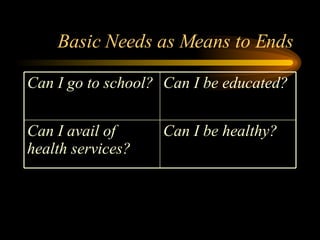
Basic Needs as Means to Ends Can I be healthy? Can I avail of health services? Can I be educated? Can I go to school?
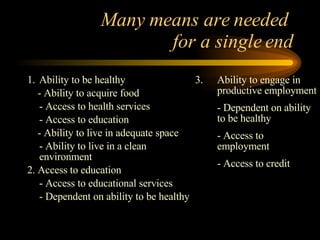
Many means are needed  for a single end 1. Ability to be healthy - Ability to acquire food - Access to health services - Access to education - Ability to live in adequate space - Ability to live in a clean environment 2. Access to education - Access to educational services - Dependent on ability to be healthy 3. Ability to engage in productive employment - Dependent on ability to be healthy  - Access to employment - Access to credit
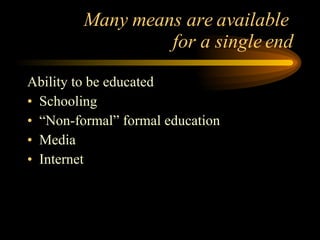
Many means are available  for a single end Ability to be educated Schooling “Non-formal” formal education Media Internet
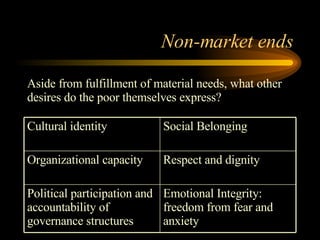
Non-market ends Aside from fulfillment of material needs, what other desires do the poor themselves express? Emotional Integrity: freedom from fear and anxiety Political participation and  accountability of governance structures Respect and dignity Organizational capacity Social Belonging Cultural identity
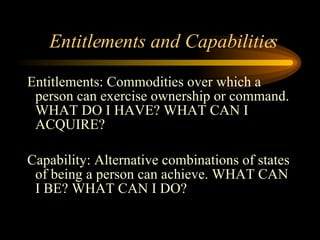
Entitlements and Capabilities Entitlements: Commodities over which a person can exercise ownership or command. WHAT DO I HAVE? WHAT CAN I ACQUIRE? Capability: Alternative combinations of states of being a person can achieve. WHAT CAN I BE? WHAT CAN I DO?
Poverty and Capabilities Poverty constitutes a severe failure of capabilities.
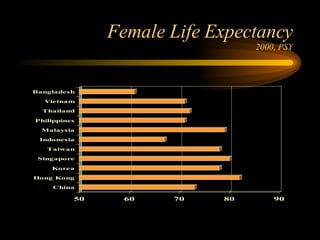
Female Life Expectancy 2000, PSY
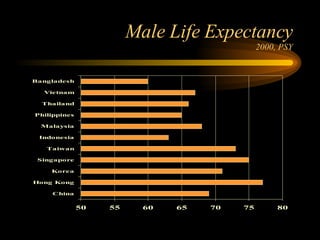
Male Life Expectancy 2000, PSY
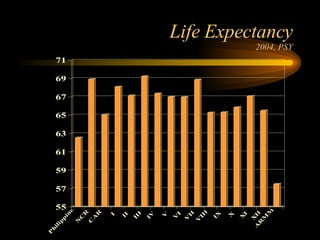
Life Expectancy 2004, PSY
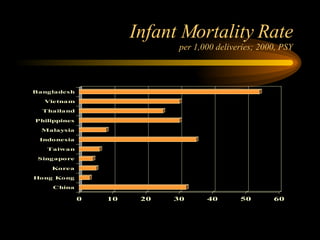
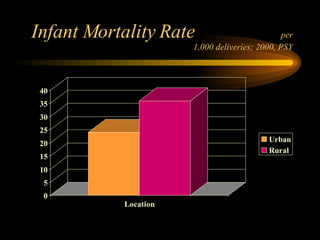
Infant Mortality Rate per 1,000 deliveries; 2000, PSY
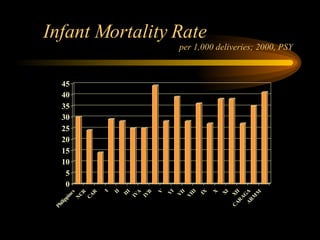
Infant Mortality Rate  per 1,000 deliveries; 2000, PSY
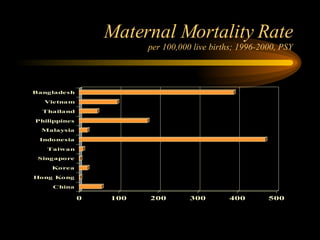
Maternal Mortality Rate per 100,000 live births; 1996-2000, PSY
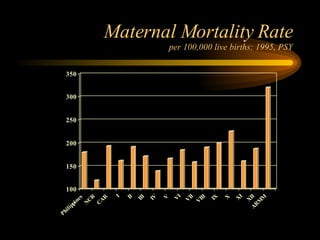
Maternal Mortality Rate per 100,000 live births; 1995, PSY
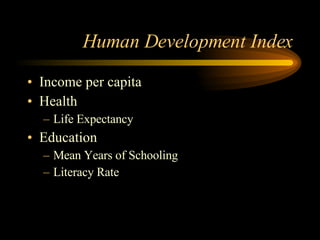
Human Development Index Income per capita Health Life Expectancy Education Mean Years of Schooling Literacy Rate
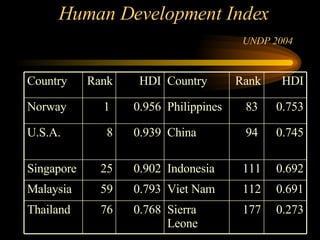
Human Development Index  UNDP 2004 HDI Rank Country HDI Rank Country 177 112 111 94  83  76 59 25 8 1  0.273 Sierra Leone 0.768 Thailand 0.691 Viet Nam 0.793 Malaysia 0.692 Indonesia 0.902 Singapore 0.745 China 0.939 U.S.A. 0.753 Philippines 0.956 Norway
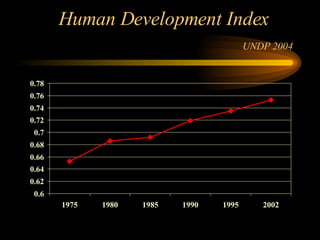
Human Development Index  UNDP 2004
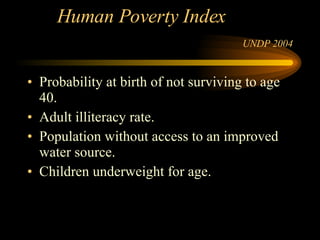
Human Poverty Index  UNDP 2004 Probability at birth of not surviving to age 40. Adult illiteracy rate. Population without access to an improved water source. Children underweight for age.
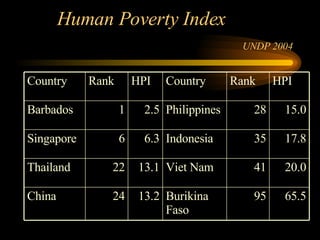
Human Poverty Index  UNDP 2004 65.5 95 Burikina Faso 13.2 24 China 20.0 41 Viet Nam 13.1 22 Thailand 17.8 35 Indonesia 6.3 6 Singapore 15.0 28 Philippines 2.5 1 Barbados HPI Rank Country HPI Rank Country
Data Sources Philippine Statistical Yearbook United Nations Development Program, Human Development Report, 2004
Poverty as  Severe Capability Deprivation Amartya Sen and the Evolution of the Concept of Poverty Leland Joseph R. de la Cruz Director, Development Studies Program

Sen Capabilities

  • 1.
    Poverty as Severe Capability Deprivation Amartya Sen and the Evolution of the Concept of Poverty Leland Joseph R. de la Cruz Director, Development Studies Program
  • 2.
    Limitations of theBasic Needs Approach Basic needs are just means to various ends. Different means have to be in place for various ends to be realized. There is room for creativity in identifying the appropriate means for various ends. Focus on basic needs distracts from non-market ends.
  • 3.
    Poverty and IncomeBasic Needs are just means to various ends Ability to be Healthy Ability to be Educated Ability to Engage in Productive Activity
  • 4.
    Basic Needs asMeans to Ends Can I be healthy? Can I avail of health services? Can I be educated? Can I go to school?
  • 5.
    Many means areneeded for a single end 1. Ability to be healthy - Ability to acquire food - Access to health services - Access to education - Ability to live in adequate space - Ability to live in a clean environment 2. Access to education - Access to educational services - Dependent on ability to be healthy 3. Ability to engage in productive employment - Dependent on ability to be healthy - Access to employment - Access to credit
  • 6.
    Many means areavailable for a single end Ability to be educated Schooling “Non-formal” formal education Media Internet
  • 7.
    Non-market ends Asidefrom fulfillment of material needs, what other desires do the poor themselves express? Emotional Integrity: freedom from fear and anxiety Political participation and accountability of governance structures Respect and dignity Organizational capacity Social Belonging Cultural identity
  • 8.
    Entitlements and CapabilitiesEntitlements: Commodities over which a person can exercise ownership or command. WHAT DO I HAVE? WHAT CAN I ACQUIRE? Capability: Alternative combinations of states of being a person can achieve. WHAT CAN I BE? WHAT CAN I DO?
  • 9.
    Poverty and CapabilitiesPoverty constitutes a severe failure of capabilities.
  • 10.
  • 11.
  • 12.
  • 13.
    Infant Mortality Rateper 1,000 deliveries; 2000, PSY
  • 14.
    Infant Mortality Rate per 1,000 deliveries; 2000, PSY
  • 15.
    Infant Mortality Rate per 1,000 deliveries; 2000, PSY
  • 16.
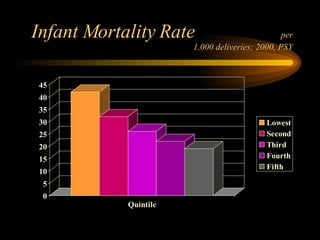
    Infant Mortality Rate per 1,000 deliveries; 2000, PSY
  • 17.
    Maternal Mortality Rateper 100,000 live births; 1996-2000, PSY
  • 18.
    Maternal Mortality Rateper 100,000 live births; 1995, PSY
  • 19.
    Human Development IndexIncome per capita Health Life Expectancy Education Mean Years of Schooling Literacy Rate
  • 20.
    Human Development Index UNDP 2004 HDI Rank Country HDI Rank Country 177 112 111 94 83 76 59 25 8 1 0.273 Sierra Leone 0.768 Thailand 0.691 Viet Nam 0.793 Malaysia 0.692 Indonesia 0.902 Singapore 0.745 China 0.939 U.S.A. 0.753 Philippines 0.956 Norway
  • 21.
  • 22.
    Human Poverty Index UNDP 2004 Probability at birth of not surviving to age 40. Adult illiteracy rate. Population without access to an improved water source. Children underweight for age.
  • 23.
    Human Poverty Index UNDP 2004 65.5 95 Burikina Faso 13.2 24 China 20.0 41 Viet Nam 13.1 22 Thailand 17.8 35 Indonesia 6.3 6 Singapore 15.0 28 Philippines 2.5 1 Barbados HPI Rank Country HPI Rank Country
  • 24.
    Data Sources PhilippineStatistical Yearbook United Nations Development Program, Human Development Report, 2004
  • 25.
    Poverty as Severe Capability Deprivation Amartya Sen and the Evolution of the Concept of Poverty Leland Joseph R. de la Cruz Director, Development Studies Program