Seminar on National
Population Policy
Presented by- Ms Alisha Talwar
M.Sc Nursing
Need for this presentation
 India with a population of more than one billion scattered in 29
states and 7 union territories provide a unique ground for
studying population programs management.
 There is a paradigm shift in population management from
exclusive contraceptive delivery to concurrent dealing of all
issues in the framework of reproductive health.
 The steps initiated under the influence of new philosophy at
country and state level may give certain clues to many other
countries, struggling for betterment of their population
programs.
Content
 Terminologies
 Introduction
 Population Policy
 Need of national population policy
 Five-Year Plans by the Government of India for population control
 Objectives of National population policy
 Goals of National population policy
 Strategic themes of National population policy
 Organizational Structure
 Motivational & Promotional measures
 Progress of milestones of national population policy
Terminology
 Population rate/ Birth rate- the total number of live births per
1,000 in a population in a year or period.
 Crude birth rate - the number of live births per year per 1,000
mid-year population
 Mortality rate/Death rate- is a measure of the number
of deaths (in general, or due to a specific cause) in a
particular population, scaled to the size of that population, per
unit of time.
 Mortality rate is typically expressed in units of deaths per 1,000
individuals per year
Contd…
 Crude death rate – the total number of deaths per year per
1,000 people.
 Perinatal mortality rate – the sum of neonatal deaths and
fetal deaths (stillbirths) per 1,000 births.
 Maternal mortality ratio – the number of maternal deaths
per 100,000 live births in same time period.
 Infant mortality rate – the number of deaths of children less
than 1 year old per 1,000 live births.
 Child mortality rate- the number of deaths of children less
than 5 years old per 1,000 live births
Death Rate
Contd…
 Sex-ratio- the number of females per 1000 of males
 Total fertility Rate- total number of children born or likely to
be born to a woman in her life time if she were subject to the
prevailing rate of age-specific fertility in the population.
 Net reproduction rate (NRR), which measures the number
of daughters a woman would have in her lifetime if she were
subject to prevailing age-specific fertility and mortality rates in
the given year.
Demographics of India
Population 1,281,935,911 (July 2017 est.)
Age structure 0-14 years: 27.34% (male 186,087,665/female 164,398,204)
15-24 years: 17.9% (male 121,879,786/female 107,583,437)
25-54 years: 41.08% (male 271,744,709/female 254,834,569)
55-64 years: 7.45% (male 47,846,122/female 47,632,532)
65 years and over: 6.24% (male 37,837,801/female
42,091,086) (2017 est.)
Dependency ratios total dependency ratio: 52.2
youth dependency ratio: 43.6
elderly dependency ratio: 8.6
potential support ratio: 11.7 (2015 est.)
Median age total: 27.9 years
male: 27.2 years
female: 28.6 years (2017 est.)
Population growth rate 1.17% (2017 est.)
Contd…
Birth rate 19 births/1,000 population (2017 est.)
Death rate 7.3 deaths/1,000 population (2017 est.)
Contd…
Urbanization urban population: 33.5% of total population (2017)
rate of urbanization: 2.28% annual rate of change (2015-20
est.)
Major cities - population NEW DELHI (capital) 25.703 million; Mumbai 21.043 million;
Kolkata 11.766 million; Bangalore 10.087 million; Chennai 9.62
million; Hyderabad 8.944 million (2015)
Sex ratio at birth: 1.12 male(s)/female
0-14 years: 1.13 male(s)/female
15-24 years: 1.13 male(s)/female
25-54 years: 1.06 male(s)/female
55-64 years: 1.01 male(s)/female
65 years and over: 0.9 male(s)/female
total population: 1.08 male(s)/female (2016 est.)
Contd…
Infant mortality rate total: 39.1 deaths/1,000 live births
male: 38 deaths/1,000 live births
female: 40.4 deaths/1,000 live births
(2017 est.)
Life expectancy at birth total population: 68.8 years
male: 67.6 years
female: 70.1 years (2017 est.)
Total fertility rate 2.43 children born/woman (2017 est.)
Contraceptive prevalence rate 53.5% (2015/16)
Contd….
Education expenditures 3.8% of GDP (2013)
Maternal mortality rate 174 deaths/100,000 live births (2015
est.)
Children under the age of 5 years
underweight
35.7% (2015)
Health expenditures 4.7% of GDP (2014)
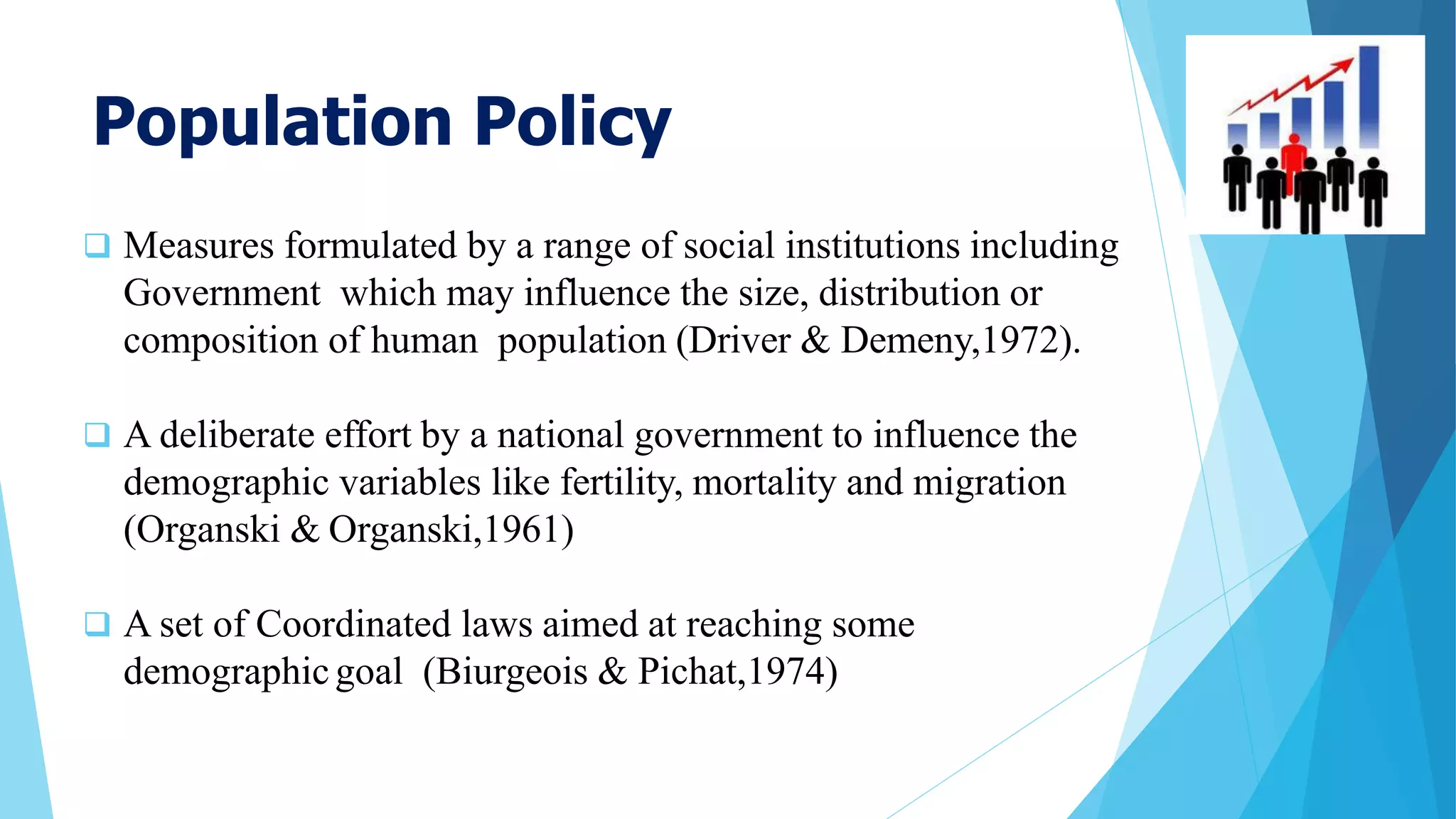
 Measures formulated by a range of social institutions including
Government which may influence the size, distribution or
composition of human population (Driver & Demeny,1972).
 A deliberate effort by a national government to influence the
demographic variables like fertility, mortality and migration
(Organski & Organski,1961)
 A set of Coordinated laws aimed at reaching some
demographicgoal (Biurgeois & Pichat,1974)
Population Policy
Need for population policy in India
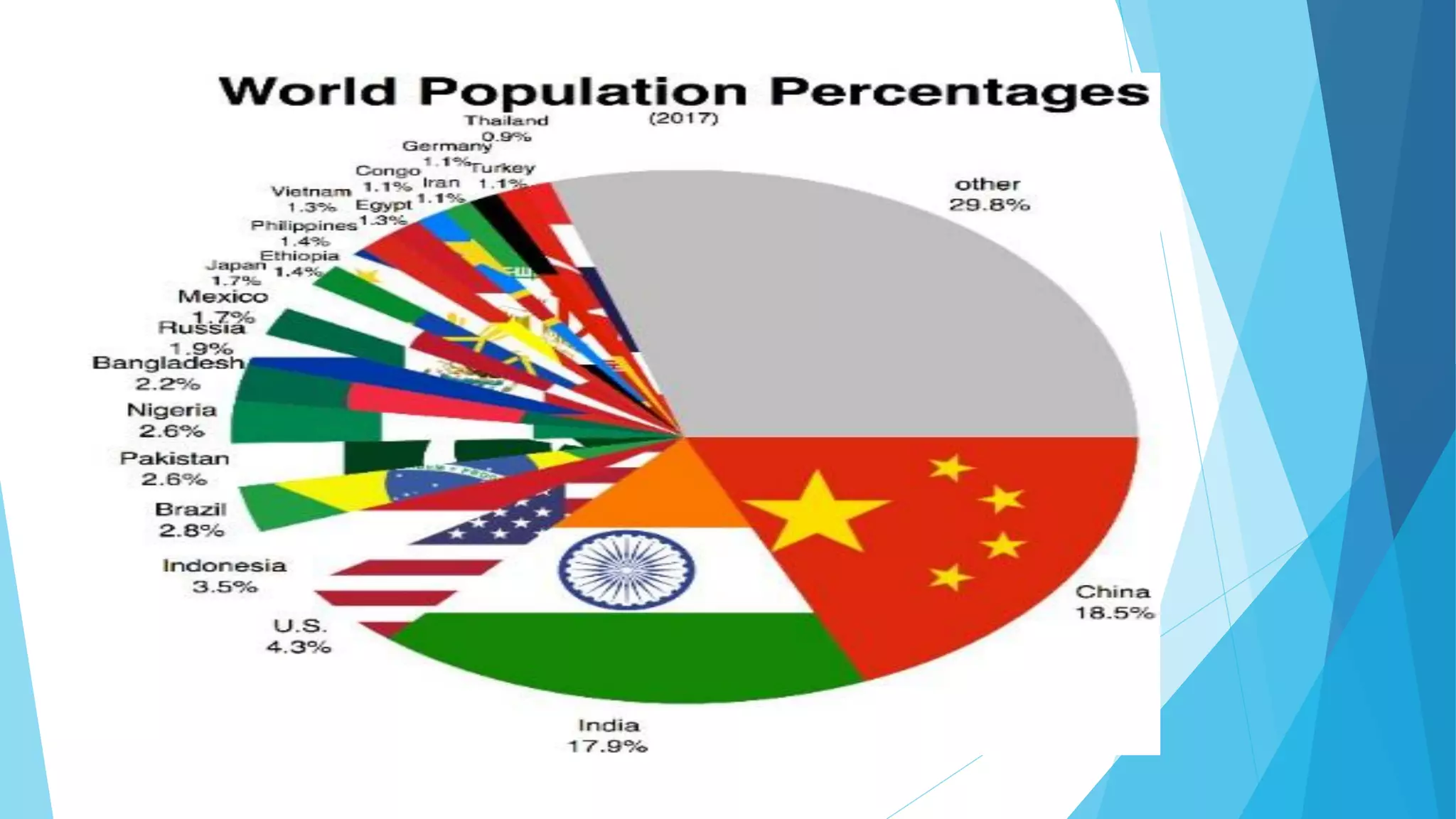
 On 11th May, 2000, India had 1.35 billion (>100 crores) people,
i.e., 16 % of the world’s population on 2.4 percent of the globe’s
land area.
 If current trends continue, India may overtake China by 2045, to
become the most populous country in the world.
 Global population : ↑3 folds during this century (from 2 to 6
billion)
 Population of India : ↑nearly 5 times (from 238 million to 1
billion), during the same period.
 Stabilizing population is an essential requirement for promoting
sustainable development with more equitable distribution .
2001
2011
Causes of high population growth
 A large size of population in the reproductive age group (58%).
 Higher fertility due to unmet needs of contraception (20%).
 High desire for fertility due to high infant mortality rate (20%) .
 Approximately 50 percent of the girls marry below the age of
18 years, resulting in a typical reproductive pattern of “too
early, too frequent, too many.”
 Preference for male child.
 More children are preferred by poor parents as more workforce.
Population Policies of India
 Formulated to address the unmet needs for
contraception, health care infrastructure, and health
personnel, and to provide integrated service delivery
for basic reproductive and child health care.
 The main objective is to achieve a stable population at
a level consistent with the requirements of sustainable
economic growth, social development, and
environmental protection.
Before Independence
Radha Kamal Mukherjee Committee, 1940
 In 1940, the Indian National Congress had appointed a committee
on population under the leadership of renowned social scientist
Radha Kamal Mukherjee to come up with suggestions to arrest
increasing population of the country. As a matter of fact, India’s
population started growing rapidly after 1921.
 The committee after deliberations suggested that population can
controlled by placing emphasis on self control; creating awareness
about the cheap and safe methods of birth control; opening
birth control clinics; increasing the age of marriage;
discouraging polygamy etc.
Contd…
Bhore Committee, 1943
 Government of India in 1943 appointed a Health
Survey and Development committee under the
chairmanship of Sir Joseph Bhore. This committee had
suggested ‘deliberate limitation of family’
approach as a way for controlling population, which
cannot be achieved through self control ‘to any
material extent’.
After Independence
 In 1951, India became the first among the developing
countries to come up with a state sponsored family planning
programme. The Planning Commission which was set up in
1950 was given the task to decide upon the contours of the
family planning programme.
 In 1952, a population policy committee was constituted. This
committee had recommended setting up of a Family Planning
Research and Programmes Committee. But the policies framed
in 1951-52 were ad-hoc in nature and was primarily based on
self-control. So it was not successful.
Contd…
 In 1956, a Central Family Planning Board was
established. This board focussed much on sterilization.
 But in 1960s a concrete policy on population control
was not adopted and the government was vacillating
as to what would be the best approach for controlling
the population of the country.
Five year plans
 First Five Year Plan: India was the first country in the
world to begin a population control programme in 1952. It
emphasized the use of natural devices for family planning.
 Second Five Year Plan: Work was done in the direction of
education and research and the clinical approach was
encouraged.
 Third Five Year Plan: In 1965, the sterilization technique
for both men and women was adopted under this plan. The
technique of copper- T was also adopted. An independent
department called the Family Planning Department was set
up.
Contd…
 Fourth Five-Year Plan: All kinds of birth control methods
(conventional and modern) were encouraged.
 Fifth Five Year Plan: NPP was announced on 16 April, 1976.
 In this policy, the minimum age for marriage determined by
the Sharda Act, 1929 was increased. It increased the age for
boys from 18 to 21 years and for girls from 14 to 18 years.
 The number of MPs and MLAs was fixed till the year 2001 on
the basis of the census 1971.
 Under this Plan, forced sterilization was permitted which was
later on given up.
 In 1977, the Janata Party government changed the name of
Family Planning Department to Family Welfare Department
Contd….
 In the Sixth, Seventh and Eighth Plans, efforts were
done to control population by determining long-term
demographic aims.
 Ninth Five-Year Plan: In 1993, the government had
established an expert group under the chairmanship of M.S.
Swaminathan for formulating national population policy.
 The Central Government formulated the 'new national
population policy' in February 2000
 Tenth Five-Year Plan: Emphasises on reduction of Infant
and Child mortality rates.
Contd…
 Eleventh Five Year Plan:- presents a comprehensive
strategy for strengthening the education sector
 Twelfth Five-Year Plan:- Government of India has
been decided to achieve a growth rate of 8.2%
National Population Policy 1976 &
1977
 In 1976, the government of India came up with its first National Population
policy. The policy came up with a number of measures to arrest the
population growth.
 Some of the measures are:
 Increasing the minimum legal age of marriage for girls and boys to 18 and
21 respectively.
 Monetary incentives for birth control.
 Improving the literacy levels of females both through the formal and non-
formal channels.
 Population was made as a factor for sharing central resources with that of
the states. Linking 8% of the central assistance to the State Plans by
weighing the performance of the states in the family welfare programmes.
Contd….
 Popularise family welfare programmes by using all forms of media.
 Inculcating population education into the formal education system.
 NPP-1976 was completely different from the earlier policies.
 1976 policy noted that – To wait for education and economic
development to bring out a drop in fertility is not a practical solution.
 The very increase in population makes economic development slow and
more difficult to achieve.
 During the Emergency period (1975-77), coercion and pressure were
used in implementing the family planning programme.
Contd…
 The Central assistance of 8 per cent was linked with
the family planning performance.
 For the first time the Union government allowed some
states to initiate legislation for compulsory sterilisation.
 In 1977, the new government ruled out the use of
force and coercion, and the family planning
programme was renamed as the ‘family welfare
programme’.
Demographic achievements of India
before NPP-2000
 Reduced Crude Birth Rate from 40.8 (1951) to 26.4 (1998,SRS)
 Halved the Infant Mortality Rate from 146 per 1000 live births (1951)
to 72 per 1000 live births (1998, SRS);
 Quadrupled the Couple Protection Rate from 10.4 percent (1971) to 44
percent (1999);
 Reduced Crude Death Rate from 25 (1951) to 9.0 (1998, SRS);
 Added 25 years to life-expectancy from 37 years to 62 years;
 Achieved nearly universal awareness of the need for and methods of
family planning, and ;
 Reduced Total Fertility Rate from 6.0 (1951) to 3.3 (1997, SRS)
National Population Policy-2000
 In February 2000, the government of India came up
with the second National Policy on Population.
 For the first time since independence, this document
comprehensively addressed the problem of population
growth in integration with issues such as child survival,
maternal health, women empowerment and
contraception.
Objectives of NPP-2000
 Temporary objective: The easy supply of birth control
devices was included in it. Besides, the development of
health protection framework and recruitment of health
workers were also made a part of it.
 Middle-term objective: the total fertility rate (TFR) had to
bring down to the replacement level of 2.1 by 2010.
 Long-term objective: Under it, the Objective of
population stabilization by 2045 is to be achieved.
NPP has listed the following
goals for 2010:
 Address the unmet needs for basic reproductive and child health
services, supplies, and infrastructure;
 Make school education up to age 14 free and compulsory, and reduce
dropouts at the primary and secondary school levels to below 20 per
cent for both boys and girls;
 Reduce the infant mortality rate to below 30 per 1,000 live births;
 Reduce the maternal mortality ratio to below 100 per 100,000 live
births;
 Achieve universal immunization of children against all vaccine
preventable diseases;
Contd….
 Promote delayed marriage for girls, not earlier than age 18 and
preferably after 20 years of age;
 Achieve 80 per cent institutional deliveries and 100 per cent deliveries
by trained persons;
 Achieve universal access to information/counseling, and services for
fertility regulation and contraception with a wide basket of choices;
 Achieve 100 per cent registration of births, deaths, marriages, and
pregnancy;
 Contain the spread of the Acquired Immuno-deficiency Syndrome
(AIDS) and promote greater integration between the management of
reproductive tract infections (RTIs) and sexually transmitted infections
(STIs) and the National AIDS Control Organization;
Contd….
 Prevent and control communicable diseases;
 Integrate Indian Systems of Medicine (ISM) in the provision
of reproductive and child health services, and in reaching
out to households; and
 Promote vigorously the small family norm to achieve
replacement levels of TFR.
 Bring about convergence in implementation of related
social-sector programmes so that family welfare becomes a
people-centered programme.
Strategic Themes
In order to achieve the national socio-demographic goals
for 2010, the following 12 strategies themes have also
been identified-
 Decentralized planning and program implementation
 Convergence of service delivery at village levels
 Empowering women for improved health and nutrition
 Child survival and child health
Contd….
 Meeting the unmet needs for family welfare services
 Under served population groups like urban slums,
tribal communities, hill area population, displaced and
migrant populations and adolescents with increased
participation of men in planned parenthood.
 Diverse health care providers
 Collaboration with and commitments from non
government organizations and the private sector.
Contd…
 Mainstreaming Indian Systems of Medicine and
Homeopathy
 Contraceptive Technology and research on
reproductive and child health
 Providing for the older population
 Information, Education and Communication
Organizational Structure
1. The appointment of a National Commission on
Population to be presided over by the Prime Minister. The
chief ministers of all States and related ministers will be
its members.
2. There will be a State Commission on Population in
every State headed by its chief minister.
3. The new policy will be implemented by the panchayats
and municipalities at the grassroot levels.
Promotional & Motivational
Strategies
 Panchayats and Zila Parishads will be rewarded and honoured for exemplary
performance in universalising small family norm, achieving reduction in IM
& BR.
 Balilka Samridhi Yojana (Department of Women and Child Development)
provide cash incentive of Rs.500 at the birth of the girl child of BR1 or 2.
 Maternity Benefit Scheme (Department of Rural Development) provide cash
incentive of Rs. 500 to mothers who have their first child after 19 years of
age, for BR 1 and 2 child only.
 A Family Welfare linked Health Insurance plan – Rs. 5000 (for
hospitalisation).
 Couples below the poverty line will be rewarded for their active
involvement in Family Planning activities.
Contd…
 A personal accident insurance cover – sterilized spouse.
 Creches and child care centers were opened in rural and urban slums.
 A wider and affordable choice of contraceptives- at diverse delivery point
 Strengthen the facilities of safe abortion.
 Products and services – affordable through innovative social marketing
schemes.
 Soft loans to local entrepreneurship & encouraged to run ambulance
services.
 Ensures mobility of the ANMs.
 Increased vocational training schemes for girls, leading to self-
employment will be encouraged.
Contd….
 Strict enforcement of the Child Marriage Restraint Act,
1976.
 Strict enforcement of the Pre-Natal Diagnostic Act, 1994.
 Reward for BPL couples for:
 For marriage after the legal age of marriage
 Register the marriage
 First child after the mother reaches the age of 21
 Accept the small family norm
 Adopt a terminal method after the birth of 2nd child.
Legislation
 The 42nd Constitutional amendment: Lok Sabha and
Rajya Sabha seats are frozen on the basis of 1971
census were valid up to 2001 that is further extended
till 2026.
 79th Amendment Bill of 1992 disqualify a person for
being a member of either house of legislature of a state,
if he/she has more than 2 children.
Public support
Strong support of political, community, business,
professional, religious leaders, media, film stars, sports
personalities, and opinion makers has been sought for
small family norms.
Funding
 National Population Policy expressed that the
programme, projects and schemes promised on the
goals and objectives of the policy 2000 will be
adequately funded.
Implementation
 Central Government has set up a National Commission
on Population (NCP) on 11 May 2000.
 It is presided over by the Prime Minister, with the Chief
Ministers of all States and UTs and the Central Minister,
in-charge of concerned Central Ministries and
Departments, reputed demographers, public health
professionals and non-government organisations as
members.
Functions of Commission
(i) To review, monitor and give direction for the implementation of
the NPP with a view to achieve the goals set by it;
(ii) To promote synergy between health, educational,
environmental and developmental programmes so as to hasten
population stabilisation;
(iii) To promote inter-sectoral coordination in planning and
implementation of the programmes through different agencies at
the Centre and in the States; and
(iv) To develop a vigorous people’s programme to support this
national effort.
2 steps
 The formation of an Empowered Action Group within the
Ministry of Health and Family Welfare to focus on those
States which are deficient in national socio-demographic
indices.
 Establishment of National Population Stabilisation Fund
(NPSF) with a seed money of Rs. 100 crore to provide a
window for channelising funds from national voluntary
sources.
Progress in the Milestones of
NPP
 Bhore Committee Report in 1946.
 Implementation of Family Planning Programme in 1952.
 National Population Policy Statement in 1976.
 Policy Statement of Family welfare Programme in 1977.
 National Health Policy was adopted in 1983,
 Committee on Population under the Chairmanship of Shri
Karunakaran was appointed by the National Development
Council in 1991.
Conclusion
 Need for population stabilization,
 Spread of literacy and education, increasing availability of
affordable reproductive and child health services, convergence
of service delivery at village levels, participation of women in
the paid work force, together with a steady, equitable
improvement in family incomes, will facilitate early
achievement of the socio- demographic goals.
 Success will be achieved if the Action Plan contained in the
NPP 2000 is pursued as a national movement.
References
 https://mohfw.gov.in/sites/default/files/26953755641410949469%20%281%29.pdf
 http://www.prsindia.org/theprsblog/?tag=national-population-policy
 http://pib.nic.in/newsite/PrintRelease.aspx?relid=133018
 https://www.india.gov.in/national-population-policy
 http://www.sociologydiscussion.com/population/national-population-policy-npp-india/3192
 https://www.jagranjosh.com/general-knowledge/population-policies-of-india-1448689756-1
 Manhas K.R. (2015). Population Policy in India. South asia journal of multidisciplinary studies 1(6) 14-3 Retrieved
on 26 September 2018 from
http://citeseerx.ist.psu.edu/viewdoc/download?doi=10.1.1.834.3375&rep=rep1&type=pd
 Gulani K.K. (2012) Community health nursing-Principles & Practices. 1st ed., (pp.322-325). India
 Driver A. & Demeny P. (1975). Population Council 1(1) Retrieved on 09 Oct. 18 from
https://www.jstor.org/journal/popudeverevi?refreqid=excelsior%3A3c5e6de55e67ecceca8dad5320c13aab
 Organski K. & Organski A.F.K. (1961). Population and World Power 41(1) 263 Retrieved on 09 Oct. 18 from
https://academic.oup.com/sf/article-abstract/41/1/97/2227897?redirectedFrom=fulltext
 Biurgeois J. & Pichat. (1974). Population: A English selection 3(1) 13 Retrieved on 09 Oct. 18 from
https://www.jstor.org/stable/2949129?seq=1#page_scan_tab_contents
National population policy  ppt

National population policy ppt

  • 2.
    Seminar on National PopulationPolicy Presented by- Ms Alisha Talwar M.Sc Nursing
  • 3.
    Need for thispresentation  India with a population of more than one billion scattered in 29 states and 7 union territories provide a unique ground for studying population programs management.  There is a paradigm shift in population management from exclusive contraceptive delivery to concurrent dealing of all issues in the framework of reproductive health.  The steps initiated under the influence of new philosophy at country and state level may give certain clues to many other countries, struggling for betterment of their population programs.
  • 7.
    Content  Terminologies  Introduction Population Policy  Need of national population policy  Five-Year Plans by the Government of India for population control  Objectives of National population policy  Goals of National population policy  Strategic themes of National population policy  Organizational Structure  Motivational & Promotional measures  Progress of milestones of national population policy
  • 8.
    Terminology  Population rate/Birth rate- the total number of live births per 1,000 in a population in a year or period.  Crude birth rate - the number of live births per year per 1,000 mid-year population  Mortality rate/Death rate- is a measure of the number of deaths (in general, or due to a specific cause) in a particular population, scaled to the size of that population, per unit of time.  Mortality rate is typically expressed in units of deaths per 1,000 individuals per year
  • 9.
    Contd…  Crude deathrate – the total number of deaths per year per 1,000 people.  Perinatal mortality rate – the sum of neonatal deaths and fetal deaths (stillbirths) per 1,000 births.  Maternal mortality ratio – the number of maternal deaths per 100,000 live births in same time period.  Infant mortality rate – the number of deaths of children less than 1 year old per 1,000 live births.  Child mortality rate- the number of deaths of children less than 5 years old per 1,000 live births Death Rate
  • 11.
    Contd…  Sex-ratio- thenumber of females per 1000 of males  Total fertility Rate- total number of children born or likely to be born to a woman in her life time if she were subject to the prevailing rate of age-specific fertility in the population.  Net reproduction rate (NRR), which measures the number of daughters a woman would have in her lifetime if she were subject to prevailing age-specific fertility and mortality rates in the given year.
  • 15.
    Demographics of India Population1,281,935,911 (July 2017 est.) Age structure 0-14 years: 27.34% (male 186,087,665/female 164,398,204) 15-24 years: 17.9% (male 121,879,786/female 107,583,437) 25-54 years: 41.08% (male 271,744,709/female 254,834,569) 55-64 years: 7.45% (male 47,846,122/female 47,632,532) 65 years and over: 6.24% (male 37,837,801/female 42,091,086) (2017 est.) Dependency ratios total dependency ratio: 52.2 youth dependency ratio: 43.6 elderly dependency ratio: 8.6 potential support ratio: 11.7 (2015 est.) Median age total: 27.9 years male: 27.2 years female: 28.6 years (2017 est.) Population growth rate 1.17% (2017 est.)
  • 16.
    Contd… Birth rate 19births/1,000 population (2017 est.) Death rate 7.3 deaths/1,000 population (2017 est.)
  • 17.
    Contd… Urbanization urban population:33.5% of total population (2017) rate of urbanization: 2.28% annual rate of change (2015-20 est.) Major cities - population NEW DELHI (capital) 25.703 million; Mumbai 21.043 million; Kolkata 11.766 million; Bangalore 10.087 million; Chennai 9.62 million; Hyderabad 8.944 million (2015) Sex ratio at birth: 1.12 male(s)/female 0-14 years: 1.13 male(s)/female 15-24 years: 1.13 male(s)/female 25-54 years: 1.06 male(s)/female 55-64 years: 1.01 male(s)/female 65 years and over: 0.9 male(s)/female total population: 1.08 male(s)/female (2016 est.)
  • 18.
    Contd… Infant mortality ratetotal: 39.1 deaths/1,000 live births male: 38 deaths/1,000 live births female: 40.4 deaths/1,000 live births (2017 est.) Life expectancy at birth total population: 68.8 years male: 67.6 years female: 70.1 years (2017 est.) Total fertility rate 2.43 children born/woman (2017 est.) Contraceptive prevalence rate 53.5% (2015/16)
  • 19.
    Contd…. Education expenditures 3.8%of GDP (2013) Maternal mortality rate 174 deaths/100,000 live births (2015 est.) Children under the age of 5 years underweight 35.7% (2015) Health expenditures 4.7% of GDP (2014)
  • 20.
     Measures formulatedby a range of social institutions including Government which may influence the size, distribution or composition of human population (Driver & Demeny,1972).  A deliberate effort by a national government to influence the demographic variables like fertility, mortality and migration (Organski & Organski,1961)  A set of Coordinated laws aimed at reaching some demographicgoal (Biurgeois & Pichat,1974) Population Policy
  • 21.
    Need for populationpolicy in India  On 11th May, 2000, India had 1.35 billion (>100 crores) people, i.e., 16 % of the world’s population on 2.4 percent of the globe’s land area.  If current trends continue, India may overtake China by 2045, to become the most populous country in the world.  Global population : ↑3 folds during this century (from 2 to 6 billion)  Population of India : ↑nearly 5 times (from 238 million to 1 billion), during the same period.  Stabilizing population is an essential requirement for promoting sustainable development with more equitable distribution .
  • 22.
  • 23.
  • 27.
    Causes of highpopulation growth  A large size of population in the reproductive age group (58%).  Higher fertility due to unmet needs of contraception (20%).  High desire for fertility due to high infant mortality rate (20%) .  Approximately 50 percent of the girls marry below the age of 18 years, resulting in a typical reproductive pattern of “too early, too frequent, too many.”  Preference for male child.  More children are preferred by poor parents as more workforce.
  • 33.
    Population Policies ofIndia  Formulated to address the unmet needs for contraception, health care infrastructure, and health personnel, and to provide integrated service delivery for basic reproductive and child health care.  The main objective is to achieve a stable population at a level consistent with the requirements of sustainable economic growth, social development, and environmental protection.
  • 34.
    Before Independence Radha KamalMukherjee Committee, 1940  In 1940, the Indian National Congress had appointed a committee on population under the leadership of renowned social scientist Radha Kamal Mukherjee to come up with suggestions to arrest increasing population of the country. As a matter of fact, India’s population started growing rapidly after 1921.  The committee after deliberations suggested that population can controlled by placing emphasis on self control; creating awareness about the cheap and safe methods of birth control; opening birth control clinics; increasing the age of marriage; discouraging polygamy etc.
  • 35.
    Contd… Bhore Committee, 1943 Government of India in 1943 appointed a Health Survey and Development committee under the chairmanship of Sir Joseph Bhore. This committee had suggested ‘deliberate limitation of family’ approach as a way for controlling population, which cannot be achieved through self control ‘to any material extent’.
  • 36.
    After Independence  In1951, India became the first among the developing countries to come up with a state sponsored family planning programme. The Planning Commission which was set up in 1950 was given the task to decide upon the contours of the family planning programme.  In 1952, a population policy committee was constituted. This committee had recommended setting up of a Family Planning Research and Programmes Committee. But the policies framed in 1951-52 were ad-hoc in nature and was primarily based on self-control. So it was not successful.
  • 37.
    Contd…  In 1956,a Central Family Planning Board was established. This board focussed much on sterilization.  But in 1960s a concrete policy on population control was not adopted and the government was vacillating as to what would be the best approach for controlling the population of the country.
  • 38.
    Five year plans First Five Year Plan: India was the first country in the world to begin a population control programme in 1952. It emphasized the use of natural devices for family planning.  Second Five Year Plan: Work was done in the direction of education and research and the clinical approach was encouraged.  Third Five Year Plan: In 1965, the sterilization technique for both men and women was adopted under this plan. The technique of copper- T was also adopted. An independent department called the Family Planning Department was set up.
  • 39.
    Contd…  Fourth Five-YearPlan: All kinds of birth control methods (conventional and modern) were encouraged.  Fifth Five Year Plan: NPP was announced on 16 April, 1976.  In this policy, the minimum age for marriage determined by the Sharda Act, 1929 was increased. It increased the age for boys from 18 to 21 years and for girls from 14 to 18 years.  The number of MPs and MLAs was fixed till the year 2001 on the basis of the census 1971.  Under this Plan, forced sterilization was permitted which was later on given up.  In 1977, the Janata Party government changed the name of Family Planning Department to Family Welfare Department
  • 40.
    Contd….  In theSixth, Seventh and Eighth Plans, efforts were done to control population by determining long-term demographic aims.  Ninth Five-Year Plan: In 1993, the government had established an expert group under the chairmanship of M.S. Swaminathan for formulating national population policy.  The Central Government formulated the 'new national population policy' in February 2000  Tenth Five-Year Plan: Emphasises on reduction of Infant and Child mortality rates.
  • 41.
    Contd…  Eleventh FiveYear Plan:- presents a comprehensive strategy for strengthening the education sector  Twelfth Five-Year Plan:- Government of India has been decided to achieve a growth rate of 8.2%
  • 42.
    National Population Policy1976 & 1977  In 1976, the government of India came up with its first National Population policy. The policy came up with a number of measures to arrest the population growth.  Some of the measures are:  Increasing the minimum legal age of marriage for girls and boys to 18 and 21 respectively.  Monetary incentives for birth control.  Improving the literacy levels of females both through the formal and non- formal channels.  Population was made as a factor for sharing central resources with that of the states. Linking 8% of the central assistance to the State Plans by weighing the performance of the states in the family welfare programmes.
  • 43.
    Contd….  Popularise familywelfare programmes by using all forms of media.  Inculcating population education into the formal education system.  NPP-1976 was completely different from the earlier policies.  1976 policy noted that – To wait for education and economic development to bring out a drop in fertility is not a practical solution.  The very increase in population makes economic development slow and more difficult to achieve.  During the Emergency period (1975-77), coercion and pressure were used in implementing the family planning programme.
  • 44.
    Contd…  The Centralassistance of 8 per cent was linked with the family planning performance.  For the first time the Union government allowed some states to initiate legislation for compulsory sterilisation.  In 1977, the new government ruled out the use of force and coercion, and the family planning programme was renamed as the ‘family welfare programme’.
  • 45.
    Demographic achievements ofIndia before NPP-2000  Reduced Crude Birth Rate from 40.8 (1951) to 26.4 (1998,SRS)  Halved the Infant Mortality Rate from 146 per 1000 live births (1951) to 72 per 1000 live births (1998, SRS);  Quadrupled the Couple Protection Rate from 10.4 percent (1971) to 44 percent (1999);  Reduced Crude Death Rate from 25 (1951) to 9.0 (1998, SRS);  Added 25 years to life-expectancy from 37 years to 62 years;  Achieved nearly universal awareness of the need for and methods of family planning, and ;  Reduced Total Fertility Rate from 6.0 (1951) to 3.3 (1997, SRS)
  • 46.
    National Population Policy-2000 In February 2000, the government of India came up with the second National Policy on Population.  For the first time since independence, this document comprehensively addressed the problem of population growth in integration with issues such as child survival, maternal health, women empowerment and contraception.
  • 47.
    Objectives of NPP-2000 Temporary objective: The easy supply of birth control devices was included in it. Besides, the development of health protection framework and recruitment of health workers were also made a part of it.  Middle-term objective: the total fertility rate (TFR) had to bring down to the replacement level of 2.1 by 2010.  Long-term objective: Under it, the Objective of population stabilization by 2045 is to be achieved.
  • 48.
    NPP has listedthe following goals for 2010:  Address the unmet needs for basic reproductive and child health services, supplies, and infrastructure;  Make school education up to age 14 free and compulsory, and reduce dropouts at the primary and secondary school levels to below 20 per cent for both boys and girls;  Reduce the infant mortality rate to below 30 per 1,000 live births;  Reduce the maternal mortality ratio to below 100 per 100,000 live births;  Achieve universal immunization of children against all vaccine preventable diseases;
  • 49.
    Contd….  Promote delayedmarriage for girls, not earlier than age 18 and preferably after 20 years of age;  Achieve 80 per cent institutional deliveries and 100 per cent deliveries by trained persons;  Achieve universal access to information/counseling, and services for fertility regulation and contraception with a wide basket of choices;  Achieve 100 per cent registration of births, deaths, marriages, and pregnancy;  Contain the spread of the Acquired Immuno-deficiency Syndrome (AIDS) and promote greater integration between the management of reproductive tract infections (RTIs) and sexually transmitted infections (STIs) and the National AIDS Control Organization;
  • 50.
    Contd….  Prevent andcontrol communicable diseases;  Integrate Indian Systems of Medicine (ISM) in the provision of reproductive and child health services, and in reaching out to households; and  Promote vigorously the small family norm to achieve replacement levels of TFR.  Bring about convergence in implementation of related social-sector programmes so that family welfare becomes a people-centered programme.
  • 51.
    Strategic Themes In orderto achieve the national socio-demographic goals for 2010, the following 12 strategies themes have also been identified-  Decentralized planning and program implementation  Convergence of service delivery at village levels  Empowering women for improved health and nutrition  Child survival and child health
  • 52.
    Contd….  Meeting theunmet needs for family welfare services  Under served population groups like urban slums, tribal communities, hill area population, displaced and migrant populations and adolescents with increased participation of men in planned parenthood.  Diverse health care providers  Collaboration with and commitments from non government organizations and the private sector.
  • 53.
    Contd…  Mainstreaming IndianSystems of Medicine and Homeopathy  Contraceptive Technology and research on reproductive and child health  Providing for the older population  Information, Education and Communication
  • 54.
    Organizational Structure 1. Theappointment of a National Commission on Population to be presided over by the Prime Minister. The chief ministers of all States and related ministers will be its members. 2. There will be a State Commission on Population in every State headed by its chief minister. 3. The new policy will be implemented by the panchayats and municipalities at the grassroot levels.
  • 55.
    Promotional & Motivational Strategies Panchayats and Zila Parishads will be rewarded and honoured for exemplary performance in universalising small family norm, achieving reduction in IM & BR.  Balilka Samridhi Yojana (Department of Women and Child Development) provide cash incentive of Rs.500 at the birth of the girl child of BR1 or 2.  Maternity Benefit Scheme (Department of Rural Development) provide cash incentive of Rs. 500 to mothers who have their first child after 19 years of age, for BR 1 and 2 child only.  A Family Welfare linked Health Insurance plan – Rs. 5000 (for hospitalisation).  Couples below the poverty line will be rewarded for their active involvement in Family Planning activities.
  • 56.
    Contd…  A personalaccident insurance cover – sterilized spouse.  Creches and child care centers were opened in rural and urban slums.  A wider and affordable choice of contraceptives- at diverse delivery point  Strengthen the facilities of safe abortion.  Products and services – affordable through innovative social marketing schemes.  Soft loans to local entrepreneurship & encouraged to run ambulance services.  Ensures mobility of the ANMs.  Increased vocational training schemes for girls, leading to self- employment will be encouraged.
  • 57.
    Contd….  Strict enforcementof the Child Marriage Restraint Act, 1976.  Strict enforcement of the Pre-Natal Diagnostic Act, 1994.  Reward for BPL couples for:  For marriage after the legal age of marriage  Register the marriage  First child after the mother reaches the age of 21  Accept the small family norm  Adopt a terminal method after the birth of 2nd child.
  • 58.
    Legislation  The 42ndConstitutional amendment: Lok Sabha and Rajya Sabha seats are frozen on the basis of 1971 census were valid up to 2001 that is further extended till 2026.  79th Amendment Bill of 1992 disqualify a person for being a member of either house of legislature of a state, if he/she has more than 2 children.
  • 59.
    Public support Strong supportof political, community, business, professional, religious leaders, media, film stars, sports personalities, and opinion makers has been sought for small family norms.
  • 60.
    Funding  National PopulationPolicy expressed that the programme, projects and schemes promised on the goals and objectives of the policy 2000 will be adequately funded.
  • 61.
    Implementation  Central Governmenthas set up a National Commission on Population (NCP) on 11 May 2000.  It is presided over by the Prime Minister, with the Chief Ministers of all States and UTs and the Central Minister, in-charge of concerned Central Ministries and Departments, reputed demographers, public health professionals and non-government organisations as members.
  • 62.
    Functions of Commission (i)To review, monitor and give direction for the implementation of the NPP with a view to achieve the goals set by it; (ii) To promote synergy between health, educational, environmental and developmental programmes so as to hasten population stabilisation; (iii) To promote inter-sectoral coordination in planning and implementation of the programmes through different agencies at the Centre and in the States; and (iv) To develop a vigorous people’s programme to support this national effort.
  • 63.
    2 steps  Theformation of an Empowered Action Group within the Ministry of Health and Family Welfare to focus on those States which are deficient in national socio-demographic indices.  Establishment of National Population Stabilisation Fund (NPSF) with a seed money of Rs. 100 crore to provide a window for channelising funds from national voluntary sources.
  • 64.
    Progress in theMilestones of NPP  Bhore Committee Report in 1946.  Implementation of Family Planning Programme in 1952.  National Population Policy Statement in 1976.  Policy Statement of Family welfare Programme in 1977.  National Health Policy was adopted in 1983,  Committee on Population under the Chairmanship of Shri Karunakaran was appointed by the National Development Council in 1991.
  • 66.
    Conclusion  Need forpopulation stabilization,  Spread of literacy and education, increasing availability of affordable reproductive and child health services, convergence of service delivery at village levels, participation of women in the paid work force, together with a steady, equitable improvement in family incomes, will facilitate early achievement of the socio- demographic goals.  Success will be achieved if the Action Plan contained in the NPP 2000 is pursued as a national movement.
  • 67.
    References  https://mohfw.gov.in/sites/default/files/26953755641410949469%20%281%29.pdf  http://www.prsindia.org/theprsblog/?tag=national-population-policy http://pib.nic.in/newsite/PrintRelease.aspx?relid=133018  https://www.india.gov.in/national-population-policy  http://www.sociologydiscussion.com/population/national-population-policy-npp-india/3192  https://www.jagranjosh.com/general-knowledge/population-policies-of-india-1448689756-1  Manhas K.R. (2015). Population Policy in India. South asia journal of multidisciplinary studies 1(6) 14-3 Retrieved on 26 September 2018 from http://citeseerx.ist.psu.edu/viewdoc/download?doi=10.1.1.834.3375&rep=rep1&type=pd  Gulani K.K. (2012) Community health nursing-Principles & Practices. 1st ed., (pp.322-325). India  Driver A. & Demeny P. (1975). Population Council 1(1) Retrieved on 09 Oct. 18 from https://www.jstor.org/journal/popudeverevi?refreqid=excelsior%3A3c5e6de55e67ecceca8dad5320c13aab  Organski K. & Organski A.F.K. (1961). Population and World Power 41(1) 263 Retrieved on 09 Oct. 18 from https://academic.oup.com/sf/article-abstract/41/1/97/2227897?redirectedFrom=fulltext  Biurgeois J. & Pichat. (1974). Population: A English selection 3(1) 13 Retrieved on 09 Oct. 18 from https://www.jstor.org/stable/2949129?seq=1#page_scan_tab_contents