DEVELOPMENT OF
INDIAN ECONOMY
INTRODUCTION
 India is today one of the six fastest growing
economies of the world.
 The country ranked fourth in terms of Purchasing
Power Parity (PPP) in 2001.
 The business and regulatory environment is
evolving and moving towards constant
improvement.
 A highly talented, skilled and English-speaking
human resource base forms its backbone.
CONT…….
 Agriculture, services and manufacturing
industries play a vital role in the development of
the Indian economy.
 Economic development in India still depends on
the various sectors that constitute the Indian
economy-
- Agriculture,
-Manufacturing industries
- Service industries.
MEANING OF ECONOMY
DEVELOEMENT
 Economic development means economic
growth along with the desired changes in the
distribution of national income an other technical
and institutional changes.
 It means increase in the efficiency of the factors
of production, better techniques of production,
positive changes in attitude towards work and life
increase in the importance of non-agriculture
sectors and so on.
HISTORY OF INDIAN
ECONOMY The history of Indian economy can be broadly
divided into three phases:
1. Pre- Colonial
2. Colonial
3. Post Colonial
COMPARISON B/W INDIA &
CHINA ECONOMY
Facts INDIA CHINA
GDP Around $1.209 trillion Around $7.8 trillion
GDP growth 6.7% 9.1%
Per capital GDP $1016 $6,100
Inflation 7..8% -1.2%
Labor force 523.5 million 807.7 million
Unemployment 6.8% 4.3%
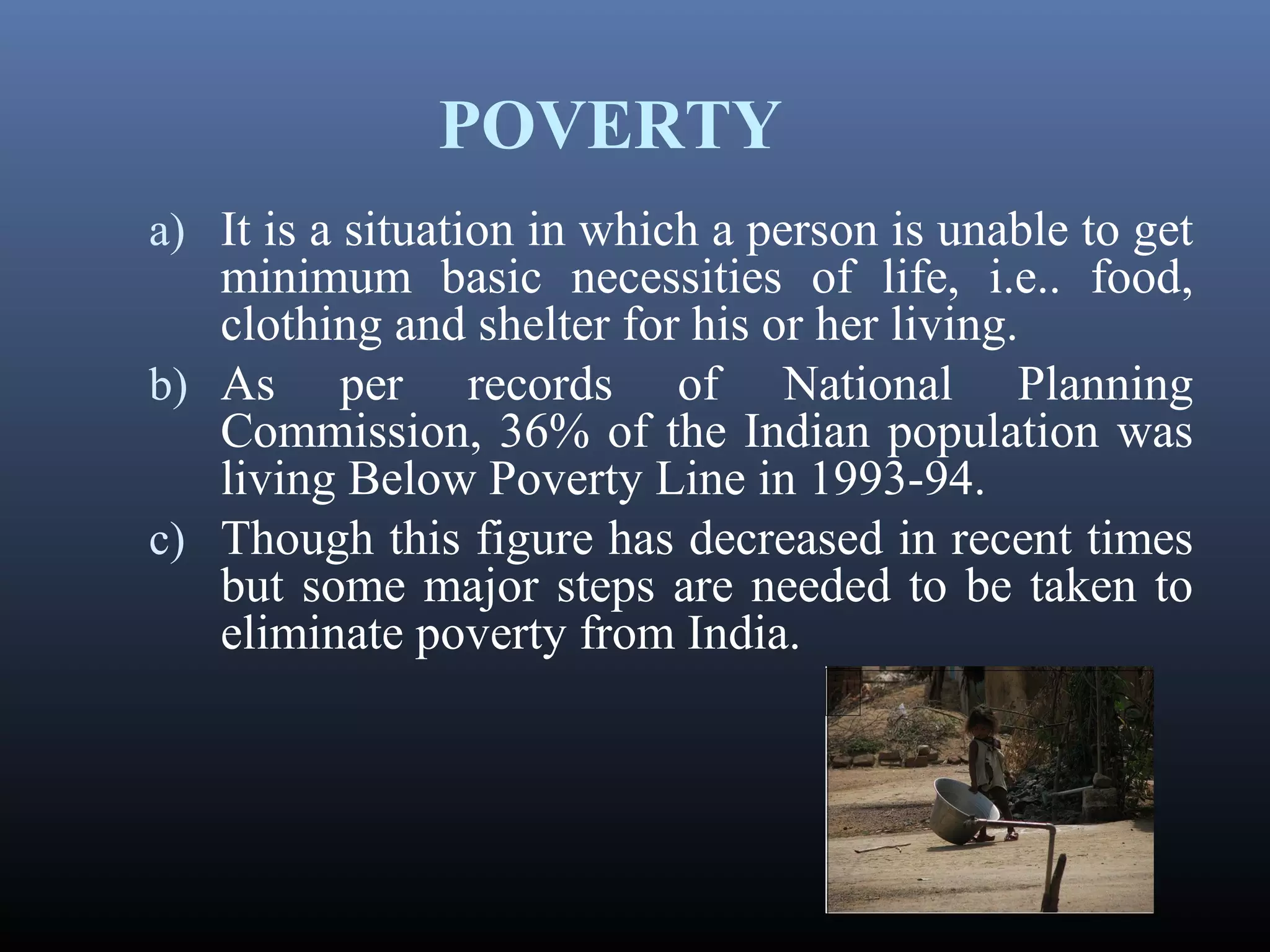
POVERTY
a) It is a situation in which a person is unable to get
minimum basic necessities of life, i.e.. food,
clothing and shelter for his or her living.
b) As per records of National Planning
Commission, 36% of the Indian population was
living Below Poverty Line in 1993-94.
c) Though this figure has decreased in recent times
but some major steps are needed to be taken to
eliminate poverty from India.
UNEMPLOYEMENT
a) A situation in which a section of people, who
are able and willing to work but do not find
gainful work .
b) The increasing population is pressing hard on
economic resources as well as job opportunities.
c) Indian government has started various schemes
such as Jawahar Rozgar Yojna, and Self
Employment Scheme for Educated Unemployed
Youth (SEEUY). But these are proving to be a
drop in an ocean.
POPULATION
EXPLOSION
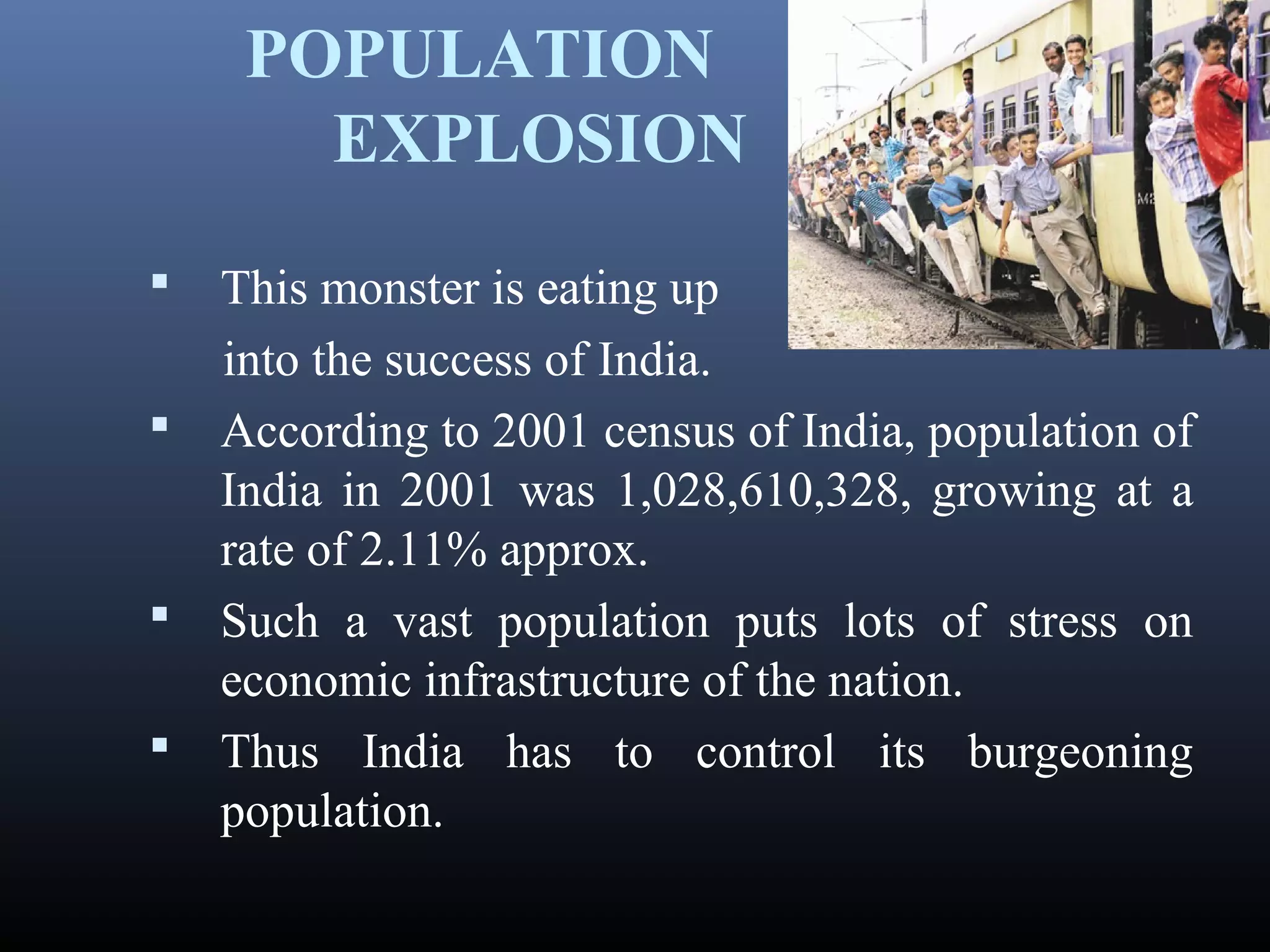
 This monster is eating up
into the success of India.
 According to 2001 census of India, population of
India in 2001 was 1,028,610,328, growing at a
rate of 2.11% approx.
 Such a vast population puts lots of stress on
economic infrastructure of the nation.
 Thus India has to control its burgeoning
population.
RURAL URBAN DIVIDE
 It is said that India lies in villages, even
today when there is lots of talk going about
migration to cities, 70% of the Indian
population still lives in villages.
 There is a very stark difference in pace of
rural and urban growth. Unless there isn't a
balanced development Indian economy
cannot grow.
OVERCOME OF
CHALLENGES
 Orientation of public expenditure such as on
health and education sectors.
 Introduction of reforms in labor laws to
generate more employment opportunities.
 Introduction of new technology.
 Reducing agriculture's dependence on
monsoon by developing means of irrigation.
 Introduction of financial reforms including
privatization of some public sector banks.
AGRICULTURE
 Two thirds of India 's population lives in rural
areas.
 Agriculture and related activities are the main
source of livelihood for them.
 Helping the country achieve a surplus in the food
grains production.
 With liberalization of trade in agricultural
commodities, India enjoys a competitive
advantage in a number of agricultural and
processed food products exports.
 Agriculture sector contributes 17.5% in GDP.
MANUFACTURING
 The manufacturing sector contributes around one
-fourth of total GDP.
 Companies in the manufacturing sector have
consolidated around their area of core competence
by tying up with foreign companies to acquire
new technologies, management expertise and
access to foreign markets.
 The cost benefits associated with manufacturing
in India , have positioned India as a preferred
destination for manufacturing and sourcing for
global markets.
SERVICES
 The services sector currently accounts for 62.6%,
almost half of the country's GDP.
 Expanding at the rate of 8-10 per cent per annum,
services is the fastest growing sector in the Indian
economy.
 Availability of highly skilled workers has
encouraged many international companies to
carry out their research and development
activities in India.
INFRASTRUCTURE
 The infrastructure sector in India , traditionally
reserved for the government, is progressively
being opened up for private sector participation.
 It constitutes factors like:-
- Ports
- Roads
- Airports
- Power
TELECOMMUNICATIONS
 India 's telecommunications network ranks among
the top ten countries in the world.
 One of the world's largest and fastest growing
telecom markets, the country has an investment
potential estimated at US$ 69 billion by 2010.
 Despite a strong base of a billion people, the
country has a low telephone density of
approximately 5 per cent, estimated to grow to 15
per cent by 2010.
FINANCIAL SECTORS
 The Indian financial sector reforms aim at
improving the productivity and efficiency of the
economy.
 The opening of the Indian financial market to
foreign and private Indian players, has resulted in
increased competition ,better product offerings.
 Banks and trade financiers have also played an
important role in promoting foreign trade of the
country.
ECONOMIC PROSPECTS FOR
2010
 The India’s national income statistics shows the
growth of 6.5 per cent in 2010
 The food grain production in 2010 is likely to
be 216.9 million tonne.
 The overall effect of the shortfall in agriculture
production would likely to seen on the economic
growth by nearly 2 per cent, as the sector accounts for
more than 18 per cent of the total GDP.
 In the FY2010-11, agriculture would contribute by
more than 17.6 per cent to the Indian Economy on the
expectations of strong output of Rabi Crop
 possibility of high interest rates, large fiscal
deficit, high inflation, in 2010 but it still believes
that the Indian economy would grow by 8.5 per
cent in 2010-11.
 Nearly 10 per cent in 2011-12 by taking higher
agricultural productivity, industrial and demand
for higher exports .
 The Service industry would grow by more than
8.7 per cent
India’s Economic Outlook Projection
2007 2008 2009 2010
GDP
Growth
9.40% 7.30% 5.40% 7.20%
CPI 6.4% 9.3% 5.50% 4.90%
 Recent announcement of IIP data, which shows
the 16 per cent growth over the last year’s data
 Strong output of natural gas, iron ore, and other
prominent minerals
 Output of crude oil ,coal and Construction related
cement has continued to show slackening growth
CONCLUSION
India will reach 8% Growth Rate in next 5 years
Economy will grow to between 10 – 12% between 2010
– 2015
Economists predict that by 2020, India will be
among the leading economies of the world.
QUOTE: “We can be a developed Nation by 2020 if we
make this our Mission Statement” – Dr A P J Abdul
Kalam, Indian
President
Will India fulfil the President’s Statement?
Development of indian economy

Development of indian economy

  • 1.
  • 2.
    INTRODUCTION  India istoday one of the six fastest growing economies of the world.  The country ranked fourth in terms of Purchasing Power Parity (PPP) in 2001.  The business and regulatory environment is evolving and moving towards constant improvement.  A highly talented, skilled and English-speaking human resource base forms its backbone.
  • 3.
    CONT…….  Agriculture, servicesand manufacturing industries play a vital role in the development of the Indian economy.  Economic development in India still depends on the various sectors that constitute the Indian economy- - Agriculture, -Manufacturing industries - Service industries.
  • 4.
    MEANING OF ECONOMY DEVELOEMENT Economic development means economic growth along with the desired changes in the distribution of national income an other technical and institutional changes.  It means increase in the efficiency of the factors of production, better techniques of production, positive changes in attitude towards work and life increase in the importance of non-agriculture sectors and so on.
  • 6.
    HISTORY OF INDIAN ECONOMYThe history of Indian economy can be broadly divided into three phases: 1. Pre- Colonial 2. Colonial 3. Post Colonial
  • 7.
    COMPARISON B/W INDIA& CHINA ECONOMY Facts INDIA CHINA GDP Around $1.209 trillion Around $7.8 trillion GDP growth 6.7% 9.1% Per capital GDP $1016 $6,100 Inflation 7..8% -1.2% Labor force 523.5 million 807.7 million Unemployment 6.8% 4.3%
  • 9.
    POVERTY a) It isa situation in which a person is unable to get minimum basic necessities of life, i.e.. food, clothing and shelter for his or her living. b) As per records of National Planning Commission, 36% of the Indian population was living Below Poverty Line in 1993-94. c) Though this figure has decreased in recent times but some major steps are needed to be taken to eliminate poverty from India.
  • 10.
    UNEMPLOYEMENT a) A situationin which a section of people, who are able and willing to work but do not find gainful work . b) The increasing population is pressing hard on economic resources as well as job opportunities. c) Indian government has started various schemes such as Jawahar Rozgar Yojna, and Self Employment Scheme for Educated Unemployed Youth (SEEUY). But these are proving to be a drop in an ocean.
  • 11.
    POPULATION EXPLOSION  This monsteris eating up into the success of India.  According to 2001 census of India, population of India in 2001 was 1,028,610,328, growing at a rate of 2.11% approx.  Such a vast population puts lots of stress on economic infrastructure of the nation.  Thus India has to control its burgeoning population.
  • 12.
    RURAL URBAN DIVIDE It is said that India lies in villages, even today when there is lots of talk going about migration to cities, 70% of the Indian population still lives in villages.  There is a very stark difference in pace of rural and urban growth. Unless there isn't a balanced development Indian economy cannot grow.
  • 13.
    OVERCOME OF CHALLENGES  Orientationof public expenditure such as on health and education sectors.  Introduction of reforms in labor laws to generate more employment opportunities.  Introduction of new technology.  Reducing agriculture's dependence on monsoon by developing means of irrigation.  Introduction of financial reforms including privatization of some public sector banks.
  • 15.
    AGRICULTURE  Two thirdsof India 's population lives in rural areas.  Agriculture and related activities are the main source of livelihood for them.  Helping the country achieve a surplus in the food grains production.  With liberalization of trade in agricultural commodities, India enjoys a competitive advantage in a number of agricultural and processed food products exports.  Agriculture sector contributes 17.5% in GDP.
  • 16.
    MANUFACTURING  The manufacturingsector contributes around one -fourth of total GDP.  Companies in the manufacturing sector have consolidated around their area of core competence by tying up with foreign companies to acquire new technologies, management expertise and access to foreign markets.  The cost benefits associated with manufacturing in India , have positioned India as a preferred destination for manufacturing and sourcing for global markets.
  • 17.
    SERVICES  The servicessector currently accounts for 62.6%, almost half of the country's GDP.  Expanding at the rate of 8-10 per cent per annum, services is the fastest growing sector in the Indian economy.  Availability of highly skilled workers has encouraged many international companies to carry out their research and development activities in India.
  • 18.
    INFRASTRUCTURE  The infrastructuresector in India , traditionally reserved for the government, is progressively being opened up for private sector participation.  It constitutes factors like:- - Ports - Roads - Airports - Power
  • 19.
    TELECOMMUNICATIONS  India 'stelecommunications network ranks among the top ten countries in the world.  One of the world's largest and fastest growing telecom markets, the country has an investment potential estimated at US$ 69 billion by 2010.  Despite a strong base of a billion people, the country has a low telephone density of approximately 5 per cent, estimated to grow to 15 per cent by 2010.
  • 20.
    FINANCIAL SECTORS  TheIndian financial sector reforms aim at improving the productivity and efficiency of the economy.  The opening of the Indian financial market to foreign and private Indian players, has resulted in increased competition ,better product offerings.  Banks and trade financiers have also played an important role in promoting foreign trade of the country.
  • 21.
    ECONOMIC PROSPECTS FOR 2010 The India’s national income statistics shows the growth of 6.5 per cent in 2010  The food grain production in 2010 is likely to be 216.9 million tonne.  The overall effect of the shortfall in agriculture production would likely to seen on the economic growth by nearly 2 per cent, as the sector accounts for more than 18 per cent of the total GDP.  In the FY2010-11, agriculture would contribute by more than 17.6 per cent to the Indian Economy on the expectations of strong output of Rabi Crop
  • 22.
     possibility ofhigh interest rates, large fiscal deficit, high inflation, in 2010 but it still believes that the Indian economy would grow by 8.5 per cent in 2010-11.  Nearly 10 per cent in 2011-12 by taking higher agricultural productivity, industrial and demand for higher exports .  The Service industry would grow by more than 8.7 per cent India’s Economic Outlook Projection 2007 2008 2009 2010 GDP Growth 9.40% 7.30% 5.40% 7.20% CPI 6.4% 9.3% 5.50% 4.90%
  • 23.
     Recent announcementof IIP data, which shows the 16 per cent growth over the last year’s data  Strong output of natural gas, iron ore, and other prominent minerals  Output of crude oil ,coal and Construction related cement has continued to show slackening growth
  • 24.
    CONCLUSION India will reach8% Growth Rate in next 5 years Economy will grow to between 10 – 12% between 2010 – 2015 Economists predict that by 2020, India will be among the leading economies of the world. QUOTE: “We can be a developed Nation by 2020 if we make this our Mission Statement” – Dr A P J Abdul Kalam, Indian President Will India fulfil the President’s Statement?