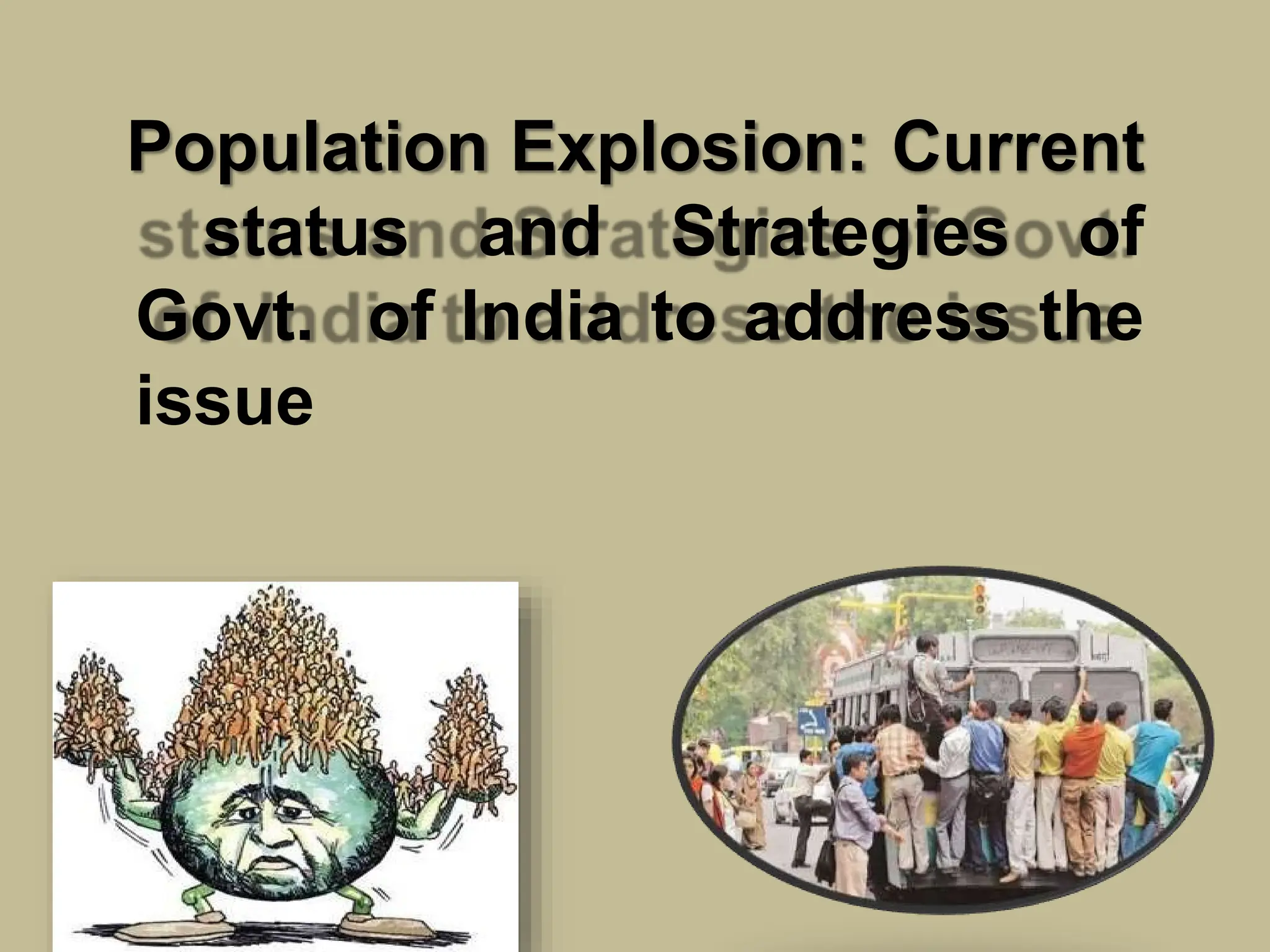
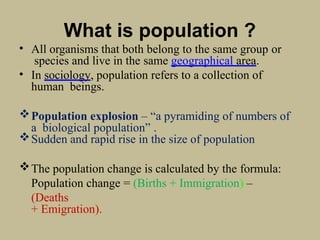
Population Explosion: Current
status and Strategies of
Govt. of India to address the
issue
What is population ?
• All organisms that both belong to the same group or
species and live in the same geographical area.
• In sociology, population refers to a collection of
human beings.
Population explosion – “a pyramiding of numbers of
a biological population” .
Sudden and rapid rise in the size of population
The population change is calculated by the formula:
Population change = (Births + Immigration) –
(Deaths
+ Emigration).
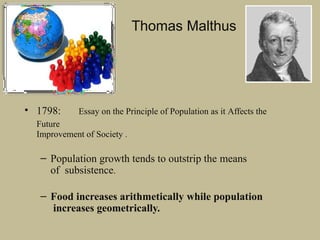
Thomas Malthus
• 1798: Essay on the Principle of Population as it Affects the
Future
Improvement of Society .
– Population growth tends to outstrip the means
of subsistence.
– Food increases arithmetically while population
increases geometrically.
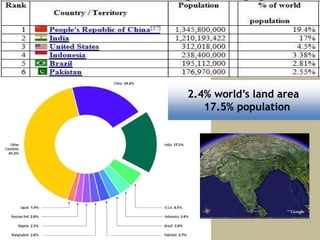
2.4% world’s land area
17.5% population
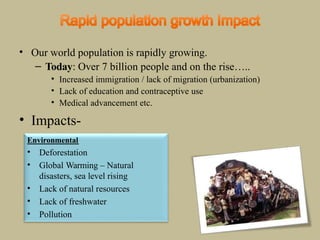
• Our world population is rapidly growing.
– Today: Over 7 billion people and on the rise…..
• Increased immigration / lack of migration (urbanization)
• Lack of education and contraceptive use
• Medical advancement etc.
• Impacts-
Environmental
• Deforestation
• Global Warming – Natural
disasters, sea level rising
• Lack of natural resources
• Lack of freshwater
• Pollution
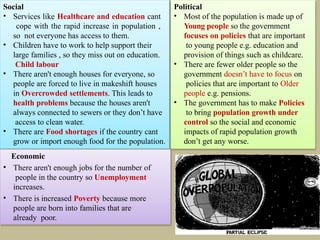
Social
• Services like Healthcare and education cant
cope with the rapid increase in population ,
so not everyone has access to them.
• Children have to work to help support their
large families , so they miss out on education.
Child labour
• There aren't enough houses for everyone, so
people are forced to live in makeshift houses
in Overcrowded settlements. This leads to
health problems because the houses aren't
always connected to sewers or they don’t have
access to clean water.
• There are Food shortages if the country cant
grow or import enough food for the population.
Political
• Most of the population is made up of
Young people so the government
focuses on policies that are important
to young people e.g. education and
provision of things such as childcare.
• There are fewer older people so the
government doesn’t have to focus on
policies that are important to Older
people e.g. pensions.
• The government has to make Policies
to bring population growth under
control so the social and economic
impacts of rapid population growth
don’t get any worse.
Economic
• There aren't enough jobs for the number of
people in the country so Unemployment
increases.
• There is increased Poverty because more
people are born into families that are
already poor.
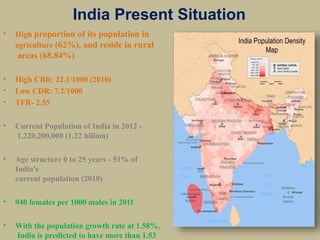
India Present Situation
• High proportion of its population in
agriculture (62%), and reside in rural
areas (68.84%)
• High CBR: 22.1/1000 (2010)
• Low CDR: 7.2/1000
• TFR- 2.55
• Current Population of India in 2012 -
1,220,200,000 (1.22 billion)
• Age structure 0 to 25 years - 51% of
India's
current population (2010)
• 940 females per 1000 males in 2011
• With the population growth rate at 1.58%,
India is predicted to have more than 1.53
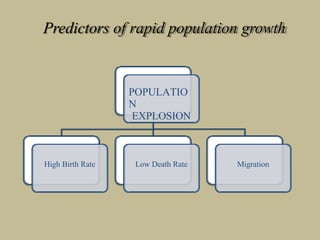
POPULATIO
N
EXPLOSION
High Birth Rate Low Death Rate Migration
Predictors of rapid population growth
High Birth rate
The current rate of population growth in India is 1.58%
and the total fertility rate is 2.55. (2013)
Unmet need for family planning- < 20ys (27.1%), 20-24
(21.1.%)
Around 50 % of population lie in reproductive age bracket.
Early puberty (12-14yrs)
Low female literacy rate (65.5%)
POVERTY:
“More than 300 million Indians earn less than RS.50/-
everyday and about 130 million people are jobless.”
Low standards of living
High fertility
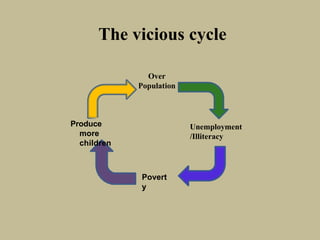
The vicious cycle
Over
Population
Unemployment
/Illiteracy
Povert
y
Produce
more
children
High Birth rate
Religious beliefs, Traditions and Cultural Norms:
In Islam, one of the leading religions of India, children are
considered to be gifts of God, and so the more children a woman
has, the more she is respected in her family and society.
A lot of families prefer having a son rather than a daughter. As a
result, a lot of families have more children than they actually
want or can afford, resulting in increased poverty, lack of
resources, and most importantly, an increased population.
India’s cultural norms is Universal Marriage and girl
to get married at an early age. In most of the rural areas and
in some urban areas as well, families prefer to get their girls
Early married at the age of 14 or 15.
High population growth
• The current high population growth rate is due to:
(1)the large size in the Reproductive age-group (estimated
contribution 60%);
(2)higher fertility due to Unmet need for contraception
(estimated contribution 20%); and
(3)High wanted fertility due to prevailing high IMR (estimated
contribution about 20%).
• Approximately 50 percent of the girls marry below the age
of 18 years, resulting in a typical reproductive pattern of –
• “too early, too frequent, too many.”
• More children are preferred by poor parents as
more workforce.
Low Death rate
o The crude death rate in India in 1981 was approximately
12.5, and that decreased to approximately 7.4 deaths/1,000
population (2013).
o Also, the infant mortality rate in India decreased from 129
in 1981 to approximately 44.6 (2013).
o The average life expectancy of people in India has increased
from 52.9 in 1975-80 to 68.7 years (2013).
o Better public health, medical advances, improved living
standards etc.
https://www.cia.gov/library/publications/the-world-factbook/
Migration
The migration in India currently is -0.05
migrant(s)/1,000 population (2013 est.), and
is decreasing further.
However in large countries like- India, immigration
plays a very small role in the population change.
People from neighbouring countries like Bangladesh,
Pakistan and Nepal, migrate to India; at the same time
Indians migrate to other countries like the U.S.,
Australia, and the U.K.
Internal migration : Urbanisation
Why population control ??
• A quickly regenerating population
exacerbates shortages of food
and water
• the nation’s long-term growth will be
hampered by a less healthy therefore
less productive work force,
• greater demand for natural resource
consumption,
• a higher level of environmental
degradation resulting from such
consumption.
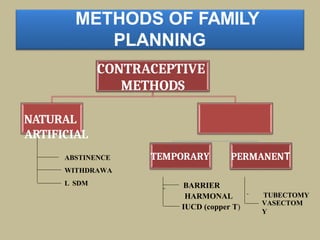
METHODS OF FAMILY
PLANNING
CONTRACEPTIVE
METHODS
NATURAL
ARTIFICIAL
PERMANENT
TEMPORARY
VASECTOM
Y
ABSTINENCE
WITHDRAWA
L SDM BARRIER
TUBECTOMY
HARMONAL
IUCD (copper T)
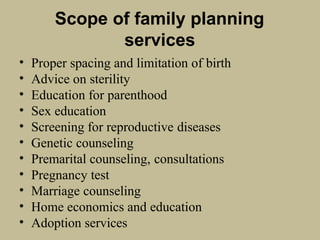
Scope of family planning
services
• Proper spacing and limitation of birth
• Advice on sterility
• Education for parenthood
• Sex education
• Screening for reproductive diseases
• Genetic counseling
• Premarital counseling, consultations
• Pregnancy test
• Marriage counseling
• Home economics and education
• Adoption services
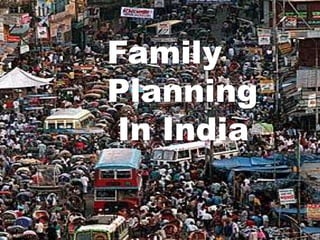
Family
Planning
In India
India - Family
Planning
• India tried unsuccessfully in the 70s to use compulsory
sterilization one of the causes for Mrs Gandhi's defeat at the polls in 1977.
• In the 1980’s, India began focusing on the sterilization of
women. Today, this is the most widely practiced form of
family planning.
Basic premises of the Family Welfare Programme are:
1. • Acceptance of FW services is voluntary,
2. • Integrated Maternal and Child Health (MCH) & FP services
3. • Effective IEC to improve awareness
4. • Ensure easy and convenient access to FW services free of
cost
Elements of success in family
welfare programme
1. Accessible services
2. Affordable
3. Client centered care
4. Evidence based technical
guidelines
5. Effective communication
6. Efficient logistics
7. Work for supportive
policies
8. Coordination and
integration
9. High performing staff
and environment
10.Adequate budget and
spending
11.Evidence based decision
making
12.Strong leadership and
management
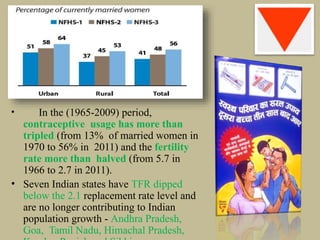
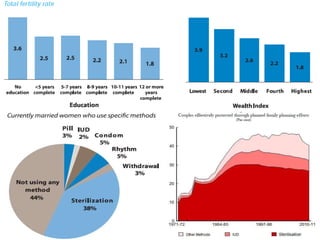
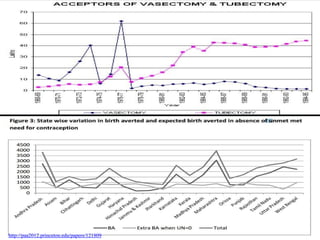
• In the (1965-2009) period,
contraceptive usage has more than
tripled (from 13% of married women in
1970 to 56% in 2011) and the fertility
rate more than halved (from 5.7 in
1966 to 2.7 in 2011).
• Seven Indian states have TFR dipped
below the 2.1 replacement rate level and
are no longer contributing to Indian
population growth - Andhra Pradesh,
Goa, Tamil Nadu, Himachal Pradesh,
Current scenario India
http://paa2012.princeton.edu/papers/121809
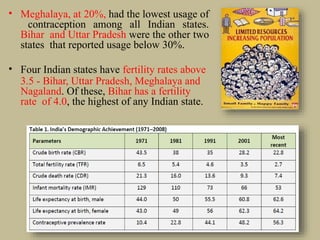
• Meghalaya, at 20%, had the lowest usage of
contraception among all Indian states.
Bihar and Uttar Pradesh were the other two
states that reported usage below 30%.
• Four Indian states have fertility rates above
3.5 - Bihar, Uttar Pradesh, Meghalaya and
Nagaland. Of these, Bihar has a fertility
rate of 4.0, the highest of any Indian state.
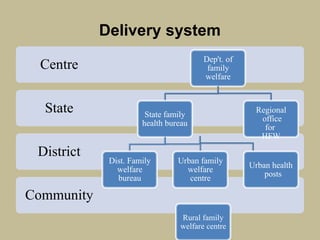
Delivery system
Community
District
State
Centre Dep't. of
family
welfare
State family
health bureau
Dist. Family
welfare
bureau
Urban family
welfare
centre
Regional
office
for
HFW
Urban health
posts
Rural family
welfare centre
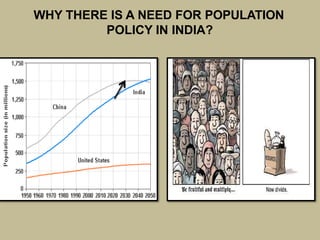
WHY THERE IS A NEED FOR POPULATION
POLICY IN INDIA?
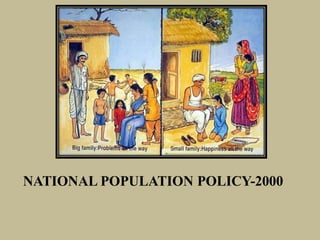
NATIONAL POPULATION POLICY-2000
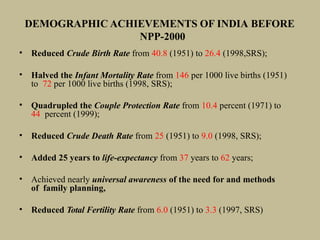
DEMOGRAPHIC ACHIEVEMENTS OF INDIA BEFORE
NPP-2000
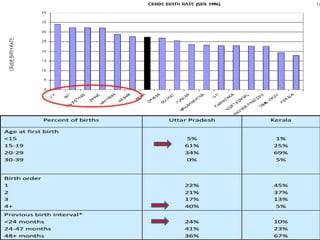
• Reduced Crude Birth Rate from 40.8 (1951) to 26.4 (1998,SRS);
• Halved the Infant Mortality Rate from 146 per 1000 live births (1951)
to 72 per 1000 live births (1998, SRS);
• Quadrupled the Couple Protection Rate from 10.4 percent (1971) to
44 percent (1999);
• Reduced Crude Death Rate from 25 (1951) to 9.0 (1998, SRS);
• Added 25 years to life-expectancy from 37 years to 62 years;
• Achieved nearly universal awareness of the need for and methods
of family planning,
• Reduced Total Fertility Rate from 6.0 (1951) to 3.3 (1997, SRS)
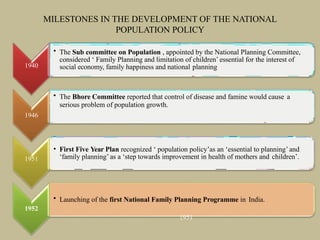
MILESTONES IN THE DEVELOPMENT OF THE NATIONAL
POPULATION POLICY
1940
• The Sub committee on Population , appointed by the National Planning Committee,
considered ‘ Family Planning and limitation of children’ essential for the interest of
social economy, family happiness and national planning
• The Bhore Committee reported that control of disease and famine would cause a
serious problem of population growth.
1946
1951
• First Five Year Plan recognized ‘ population policy’as an ‘essential to planning’ and
‘family planning’ as a ‘step towards improvement in health of mothers and children’.
• Launching of the first National Family Planning Programme in India.
1952
1951
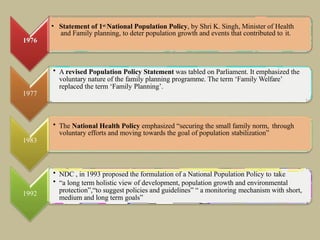
• Statement of 1st National Population Policy, by Shri K. Singh, Minister of Health
and Family planning, to deter population growth and events that contributed to it.
1976
• A revised Population Policy Statement was tabled on Parliament. It emphasized the
voluntary nature of the family planning programme. The term ‘Family Welfare’
replaced the term ‘Family Planning’.
1977
• The National Health Policy emphasized “securing the small family norm, through
voluntary efforts and moving towards the goal of population stabilization”
1983
1992
• NDC , in 1993 proposed the formulation of a National Population Policy to take
• “a long term holistic view of development, population growth and environmental
protection”,“to suggest policies and guidelines” “ a monitoring mechanism with short,
medium and long term goals”
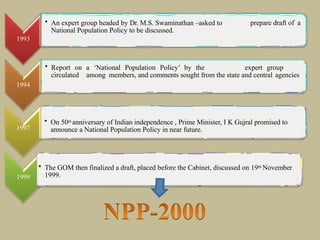
1993
prepare draft of a
• An expert group headed by Dr. M.S. Swaminathan –asked to
National Population Policy to be discussed.
• Report on a ‘National Population Policy’ by the expert group
circulated among members, and comments sought from the state and central agencies
1994
1997
• On 50th anniversary of Indian independence , Prime Minister, I K Gujral promised to
announce a National Population Policy in near future.
1999
• The GOM then finalized a draft, placed before the Cabinet, discussed on 19th November
1999.



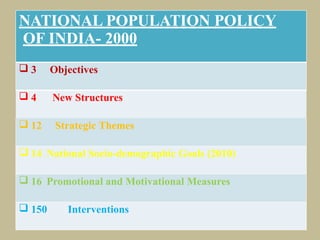
NATIONAL POPULATION POLICY
OF INDIA- 2000
 3 Objectives
 4 New Structures
 12 Strategic Themes
 14 National Socio-demographic Goals (2010)
 16 Promotional and Motivational Measures
 150 Interventions
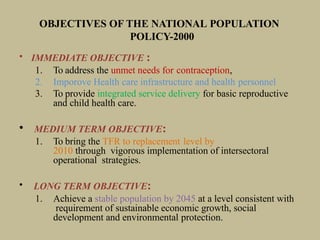
OBJECTIVES OF THE NATIONAL POPULATION
POLICY-2000
• IMMEDIATE OBJECTIVE :
1. To address the unmet needs for contraception,
2. Imporove Health care infrastructure and health personnel
3. To provide integrated service delivery for basic reproductive
and child health care.
• MEDIUM TERM OBJECTIVE:
1. To bring the TFR to replacement level by
2010 through vigorous implementation of intersectoral
operational strategies.
• LONG TERM OBJECTIVE:
1. Achieve a stable population by 2045 at a level consistent with
requirement of sustainable economic growth, social
development and environmental protection.
NATIONAL SOCIO-DEMOGRAPHIC GOALS
FOR 2010
 Address the unmet needs for basic RCH services.
 Make school education up to age 14 years free and compulsory, and reduce
drop outs rate from primary and secondary school levels to below 20 percent
for both boys and girls.
 Promote delayed marriage for girls, at age not less than 18,and preferable after
20 years.
 Achieve universal access to information/ counseling services for fertility
regulation and contraceptive with wide basket of choices
 Promote small family norm to achieve replacement level of Total Fertility
Rate
2.1.
 Bring about convergence in implementation of related social sector programmes so
that family welfare become people centered programmed
 Diverse health care providers, Collaboration with the commitments from private
agencies and NGOs and Involvement of Indian system of medicine in delivery of
RCH services
 Contraceptive technology and research in RCH
 Providing health care and support for the older population
 Information, Education and Communication .
NATIONAL SOCIO-DEMOGRAPHIC GOALS
FOR 2010
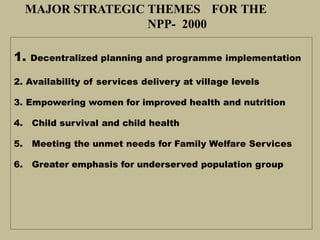
MAJOR STRATEGIC THEMES FOR THE
NPP- 2000
1. Decentralized planning and programme implementation
2. Availability of services delivery at village levels
3. Empowering women for improved health and nutrition
4. Child survival and child health
5. Meeting the unmet needs for Family Welfare Services
6. Greater emphasis for underserved population group
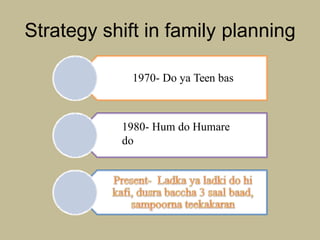
Strategy shift in family planning
1970- Do ya Teen bas
1980- Hum do Humare
do
PROMOTIONALAND MOTIVATIONAL MEASURES
FOR ADOPTION OF THE SMALL FAMILY NORM:
• Panchayats and Zila Parishads are rewarded and honoured for exemplary
performance.
• Balilka Samridhi Yojana (Department of Women and Child Development) provide
cash incentive of Rs.500 at the birth of the girl child of birth order 1 or 2.
• Maternity Benefit Scheme (Department of Rural Development) provide cash
incentive to mothers who have their first child after 19 years of age, for birth of the
1 and 2 child only.
• Couples below the poverty line are rewarded for their active involvement in
Family Planning activities.
• Village- level self help groups & NGO ( janani, pathfinder, parivar seva
sanstha etc)
• Creches and child care centers in rural and urban slums.
• A wider and affordable choice of contraceptives made accessible.
• Facilities for safe abortion be strengthened under MTP act.
• Innovative social marketing schemes be promoted.
• Increased vocational training schemes for girls, leading to
self- employment be encouraged.
• Strict enforcement of the Child Marriage Restraint Act, 1976.
• Strict enforcement of the Pre-Natal Diagnostic Act, 1994.
• 9th Amendment Bill of 1992 disqualify a person for being a member
of either house of legislature of a state, if he/she has more than 2
children.
PROMOTIONALAND MOTIVATIONAL MEASURES
FOR ADOPTION OF THE SMALL FAMILY NORM:
PROMOTIONAL AND MOTIVATIONAL
MEASURES FOR ADOPTION OF THE SMALL
FAMILY NORM:
• A Family Welfare linked Health Insurance plan. – for acceptors
and indemnity cover(Rs 2 lac) for doctors in accredited facilities.
Compensation Death : < 7 days (Rs 2 lac), 8-30 (Rs 50,000),
<60 days (Rs 25,000) in Failure (Rs 30,000)
• All India Hospital postpartum programme (AIHPP)
• Cash Incentives – for acceptors- tubectomy [Rs 600, 145(lap)],
vasectomy (Rs 1100), IUD (Rs 75). For motivators – tubectomy
(Rs 150), vasectomy (Rs 200).
• State/ central govt. Employees get special increments
after sterilization with special leaves.
OPERATIONAL STRATEGIES
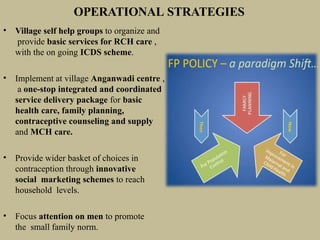
• Village self help groups to organize and
provide basic services for RCH care ,
with the on going ICDS scheme.
• Implement at village Anganwadi centre ,
a one-stop integrated and coordinated
service delivery package for basic
health care, family planning,
contraceptive counseling and supply
and MCH care.
• Provide wider basket of choices in
contraception through innovative
social marketing schemes to reach
household levels.
• Focus attention on men to promote
the small family norm.
PROPOSED ACTIVITIES AND INTERVENTIONS
1. Compulsory acceptance of two child norm for individual benefits in
government jobs . For subsidies , Condition for government
jobs, Medical claims.
2. Performance of family welfare in their area to be part of
officer’s assessment at various levels.
3. Organization of FW camps with financial assistance from
cooperative societies, sugar factories & other industrial
establishments.
4. Strict implementation of existing acts and policies such as
child marriage act, prenatal sex determination act, birth and
death registration act.
5. Acceptance of small family norm as a condition for qualifying for
elections to various bodies such as Zilla Parishad, Panchayat
Samiti, Cooperative societies etc
National Commission on
Population
 Formulated on 11th May 2000, Reconstituted on Feb 2005
Members
 Chairman, Deputy Chairman, 2 vice Chairman, Secretary.
 First Meeting-23rd July 2005- Survey of all District to identify
the weakness in Health Care Delivery System.
 State Population Commission
 Janasankhya Sthirata Kosh
Aims & objectives
• To review, monitor and give directions for the
implementation of the National Population
Policy
• To promote synergy between demographic, educational,
environmental and developmental programmes.
• To promote intersectoral co-ordination in planning and
implementation.
 To facilitate goals, support projects, schemes, initiatives and to
introduce innovative ideas, both in government and voluntary
sectors.
Jansankhya Sthirata Kosh
(Population Stabilisation Fund)
• Jansankhya Sthirata Kosh (JSK), also known as National
Population Stabilisation Fund, is an autonomous body under the
Ministry of Health and Family Welfare (MoHFW), created in 2003
on the recommendations of the National Commission of
Population.
• It has been formed to ensure that population stabilization
remains an important area of focus in the national agenda. To
enable this, GOI has provided Rs. 100 crore as corpus fund to
signify its commitment to the activities of the Kosh.
• JSK’s work is managed by a Governing Board, the members
of which include both government and non-government
representatives.
• The main areas of JSK’s advocacy efforts are addressing social
norms on son preference, age at marriage and birth of first
child, spacing between children, as well as ensuring state
prioritization of family planning and reproductive health.
RMNCH+A
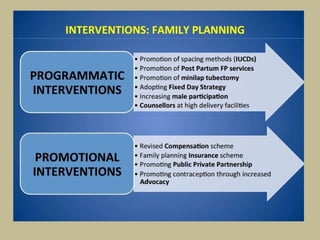
• Under the National Rural Health Mission, a new
comprehensive strategy, called the Reproductive
Maternal Newborn and Child Health plus Adolescent
Health (RMNCH+A), has been launched recently.
• Family planning is an integral and cross-cutting
component of this strategy that covers adolescent,
maternal and child health.
•
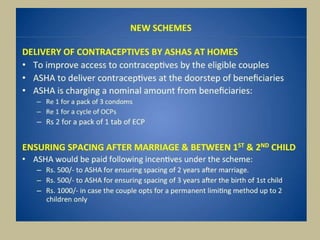
• In order to operationalise this strategy, GOI has launched
many schemes to strengthen the family planning
component, such as the delivery of contraceptives by
ASHAs at the doorstep, for which the ASHAs receive
compensation for promoting spacing methods too.
Voluntary organizations
• National-
• FPAI, FP foundation, Population council of India,
Indian red cross, IMA, Rotary club, Lions club,
Christian missionaries and Pvt. Hospitals.
• International-
• International planned parenthood foundation,
UNFPA,USAID, The population council, Ford
foundation, Path finder fund, WHO, UNICEF and
World bank.
GOI new strategies family planning
Key strategies
a. Sterilization services
b. ‘Quality Assurance Committees’ (QACs) in states
and districts to ensure quality of services
c. Increasing Male Participation In Planned
Parenthood, including ‘No Scalpel Vasectomy’
(NSV):
d. Promotion of IUD-380-A as a long-term and short-term
spacing method:
e. Operationalising ‘Fixed Day Static’ (FDS) services
f. Promotion of emergency contraceptive pills
g. Promotion of Post Partum Family Planning
h. Strengthening contraceptive logistics
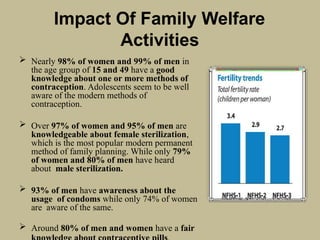
Impact Of Family Welfare
Activities
 Nearly 98% of women and 99% of men in
the age group of 15 and 49 have a good
knowledge about one or more methods of
contraception. Adolescents seem to be well
aware of the modern methods of
contraception.
 Over 97% of women and 95% of men are
knowledgeable about female sterilization,
which is the most popular modern permanent
method of family planning. While only 79%
of women and 80% of men have heard
about male sterilization.
 93% of men have awareness about the
usage of condoms while only 74% of women
are aware of the same.
 Around 80% of men and women have a fair
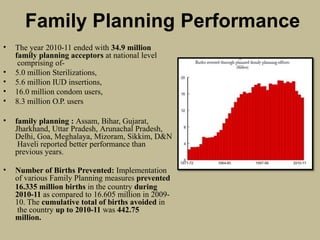
Family Planning Performance
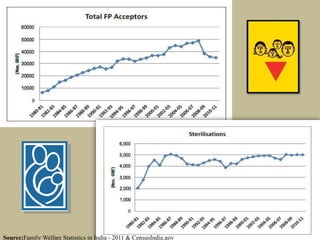
• The year 2010-11 ended with 34.9 million
family planning acceptors at national level
comprising of-
• 5.0 million Sterilizations,
• 5.6 million IUD insertions,
• 16.0 million condom users,
• 8.3 million O.P. users
• family planning : Assam, Bihar, Gujarat,
Jharkhand, Uttar Pradesh, Arunachal Pradesh,
Delhi, Goa, Meghalaya, Mizoram, Sikkim, D&N
Haveli reported better performance than
previous years.
• Number of Births Prevented: Implementation
of various Family Planning measures prevented
16.335 million births in the country during
2010-11 as compared to 16.605 million in 2009-
10. The cumulative total of births avoided in
the country up to 2010-11 was 442.75
million.
Source:Family Welfare Statistics in India - 2011 & CensusIndia.gov
Strengths
 Availability of services delivery at village levels through ASHA,
AWW etc.
Greater
emphasis
for
underserve
d
population
and high
risk group
Collaborati
on with the
commitme
nts from
private
Weaknesses
1. 49% of the increase in projected population in India
will be contributed by the six major states of North India
(UP, Bihar, MP, Rajasthan, Chhattisgarh and Jharkhand) ,
2. Contraceptive prevalence rate (for any modern
contraceptive) India average is 46.2% .
3. Non availability of trained service providers at peripheral
health facility to provide regular quality FP services.
4. Lack of motivation of the staff to provide Family planning
services.
5. Less focus on Post partum family planning services.
Weaknesses
1. Health care centers are inaccessible to rural areas and poor
infrastructure .
2. Urban areas lack of organized public health services delivery
system
3. Pre-acceptance and post-acceptance check-ups are infrequent
4. Early sterilizations.
5. Unavailability of sufficient supply of contraceptives at the
peripheral facilities.
6. Early marriage and teenage pregnancy
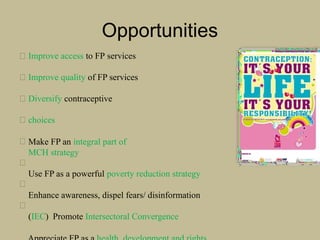
Opportunities
Improve access to FP services
Improve quality of FP services
Diversify contraceptive
choices
Make FP an integral part of
MCH strategy
Use FP as a powerful poverty reduction strategy
Enhance awareness, dispel fears/ disinformation
(IEC) Promote Intersectoral Convergence
Opportunities
 Strong political will and advocacy at the highest levels, e.g. Chief
Ministers, parliamentarians, religious leaders and opinion leaders, for
achieving population stabilization.
 Fixed day static services at all facilities round the year by
ensuring availability of trained service provider (Minilap, NSV,
IUCD).
 Revitalising Postpartum Family Planning services for all
institutional deliveries.
 Community Based Distribution of Contraceptives (Condoms, OCPs,
EC Pills) through ASHAs and at VHNDs.
 Increasing basket of choices in contraceptives e.g. injectables, male
contraceptives
Opportunities
 Train more MBBS doctors in Minilap to augment service providers pool
– focus on States with high unmet need. Involve AYUSH doctors in FP
initiative – incentivize them.
 Integrate FP training into pre service education for doctors
including AYUSH, ANMs, GNMs and pharmacists.
 Decentralizing procurement of contraceptives to ensure regular,
adequate and need based supply.
 Strengthening monitoring and providing performance based incentives
 Private sector involvement for increasing provider base e.g. voucher
& electronic transfer of incentive money; re-evaluating their
incentive structure.
 Renewed emphasis on IEC/BCC for generating demand for FP. Involving
ICTCs for educating and counselling adolescents on reproductive health
and contraception
Opportunities
 Launch the Adolescent initiative – make reproductive and sexual
health, and pre- marriage and contraception counseling important
components.
 Make FP progress an important conditionality for NRHM
releases
(e.g. upto 10%).
 Sensitization meetings of all the stakeholders.
 For 12th Plan, get FP included in Education, WCD,YA , HRD
policies and plans.
 Constitute a National Steering Group under HFM with HRD, WCD,
and YAas members for effective convergence; and State Steering
Committees under CMs.
Threats
Uneducated Women: Success of family planning – depends on
women – need to be educated – to decide – number of children –
aware of available family planning programs. But in India –
educating women – very difficult – due to – family problems –
religious and social norms
Religious influences: As told before – in Islam – children are
considered – gift of god – don’t believe – birth control measures. In
Catholics – abortion – considered a sin – don’t follow family
planning.
Deficient IEC: Most population – rural areas – family planning – not
advertised – also religious and social norms – more in rural areas –
as a result – above mentioned problems – more intense – in addition
– lack of family planning facilities.
Thank
you
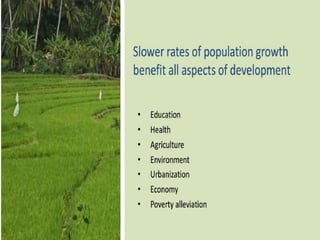
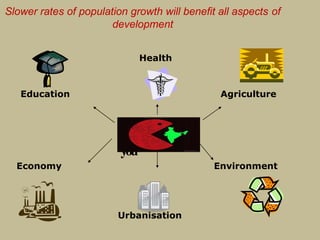
Slower rates of population growth will benefit all aspects of
development
Agriculture
Health
Education
Economy
Urbanisation
Environment
Threats
• Widely differing rates of population growth in different
parts of the country ( state dependency )
• High cost and expenditure : The expenditure of the
Department of Family Welfare was about Rs 6 per eligible
couple protected in 1974-75 which increased to Rs 718 in
2010-11 at the current prices. Average real expenditure per
new acceptor is Rs 2789 (2010-11)
• National population Commission is largely dysfunctional
and subsumed with MOHFW and Today, family
planning efforts are just one of the many activities under
the reproductive and child health component of the
National Rural Health Mission
References
• Butler C. 1994. Overpopulation, overconsumption, and economics. Lancet, 343: 582-
584.
• http://www.colby.edu/personal/t/thtieten/Famplan.htm
• National Health Policy Document, New Delhi, 2000. Govt. of India. Ministry of Health
and Family Welfare.
• Eleventh Five Year Plan 2007-2012. Planning Commission,Govt. of India, New Delhi.
• www.censusindia.gov.in/2011-common/CensusDataSummary.html
• Agarwal S. Public Health and Community Medicine Related Policies in India. Textbook
of Public Health and Community Medicine, Dept of Community Medicine, AFMC, Pune
in collaboration with WHO, India office, New Delhi; 1st edition,2009
• Rapid population growth. Consequences and policy implications vol II UNFPA
• Park’s Text book preventive and social medicine. 21st ed.
• India and Family Planning: An Overview, Department of Family and Community
Health, World Health Organization, retrieved 2009-11-25.
• https://www.cia.gov/library/publications/the-world-factbook/
• Strategy Paper on Family Welfare – Gupta. A, Nair. L
• THANK YOU
!!
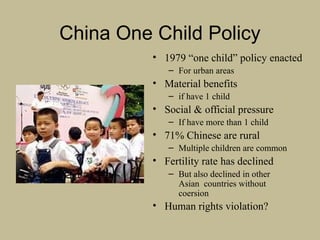
China One Child Policy
• 1979 “one child” policy enacted
– For urban areas
• Material benefits
– if have 1 child
• Social & official pressure
– If have more than 1 child
• 71% Chinese are rural
– Multiple children are common
• Fertility rate has declined
– But also declined in other
Asian countries without
coersion
• Human rights violation?
monetary incentive if they decide to
postpone plans for a child for at least two
years after marriage. The government is
offering Rs5000 or $106, a significant sum
in India’s rural areas, if they agree to its
rules. Dubbed ‘honeymoon packages,’ the
program was first launched in Satara,
Maharashtra, a state in Western India, with
already more than 2000 couples reported to
have enrolled for the program, according
to The New York Times.

population POWERPOINT PRESENTATION IN SOCIOLOGY

  • 1.
    Population Explosion: Current statusand Strategies of Govt. of India to address the issue
  • 2.
    What is population? • All organisms that both belong to the same group or species and live in the same geographical area. • In sociology, population refers to a collection of human beings. Population explosion – “a pyramiding of numbers of a biological population” . Sudden and rapid rise in the size of population The population change is calculated by the formula: Population change = (Births + Immigration) – (Deaths + Emigration).
  • 3.
    Thomas Malthus • 1798:Essay on the Principle of Population as it Affects the Future Improvement of Society . – Population growth tends to outstrip the means of subsistence. – Food increases arithmetically while population increases geometrically.
  • 4.
    2.4% world’s landarea 17.5% population
  • 5.
    • Our worldpopulation is rapidly growing. – Today: Over 7 billion people and on the rise….. • Increased immigration / lack of migration (urbanization) • Lack of education and contraceptive use • Medical advancement etc. • Impacts- Environmental • Deforestation • Global Warming – Natural disasters, sea level rising • Lack of natural resources • Lack of freshwater • Pollution
  • 6.
    Social • Services likeHealthcare and education cant cope with the rapid increase in population , so not everyone has access to them. • Children have to work to help support their large families , so they miss out on education. Child labour • There aren't enough houses for everyone, so people are forced to live in makeshift houses in Overcrowded settlements. This leads to health problems because the houses aren't always connected to sewers or they don’t have access to clean water. • There are Food shortages if the country cant grow or import enough food for the population. Political • Most of the population is made up of Young people so the government focuses on policies that are important to young people e.g. education and provision of things such as childcare. • There are fewer older people so the government doesn’t have to focus on policies that are important to Older people e.g. pensions. • The government has to make Policies to bring population growth under control so the social and economic impacts of rapid population growth don’t get any worse. Economic • There aren't enough jobs for the number of people in the country so Unemployment increases. • There is increased Poverty because more people are born into families that are already poor.
  • 7.
    India Present Situation •High proportion of its population in agriculture (62%), and reside in rural areas (68.84%) • High CBR: 22.1/1000 (2010) • Low CDR: 7.2/1000 • TFR- 2.55 • Current Population of India in 2012 - 1,220,200,000 (1.22 billion) • Age structure 0 to 25 years - 51% of India's current population (2010) • 940 females per 1000 males in 2011 • With the population growth rate at 1.58%, India is predicted to have more than 1.53
  • 8.
    POPULATIO N EXPLOSION High Birth RateLow Death Rate Migration Predictors of rapid population growth
  • 9.
    High Birth rate Thecurrent rate of population growth in India is 1.58% and the total fertility rate is 2.55. (2013) Unmet need for family planning- < 20ys (27.1%), 20-24 (21.1.%) Around 50 % of population lie in reproductive age bracket. Early puberty (12-14yrs) Low female literacy rate (65.5%) POVERTY: “More than 300 million Indians earn less than RS.50/- everyday and about 130 million people are jobless.” Low standards of living High fertility
  • 10.
  • 11.
    High Birth rate Religiousbeliefs, Traditions and Cultural Norms: In Islam, one of the leading religions of India, children are considered to be gifts of God, and so the more children a woman has, the more she is respected in her family and society. A lot of families prefer having a son rather than a daughter. As a result, a lot of families have more children than they actually want or can afford, resulting in increased poverty, lack of resources, and most importantly, an increased population. India’s cultural norms is Universal Marriage and girl to get married at an early age. In most of the rural areas and in some urban areas as well, families prefer to get their girls Early married at the age of 14 or 15.
  • 12.
    High population growth •The current high population growth rate is due to: (1)the large size in the Reproductive age-group (estimated contribution 60%); (2)higher fertility due to Unmet need for contraception (estimated contribution 20%); and (3)High wanted fertility due to prevailing high IMR (estimated contribution about 20%). • Approximately 50 percent of the girls marry below the age of 18 years, resulting in a typical reproductive pattern of – • “too early, too frequent, too many.” • More children are preferred by poor parents as more workforce.
  • 14.
    Low Death rate oThe crude death rate in India in 1981 was approximately 12.5, and that decreased to approximately 7.4 deaths/1,000 population (2013). o Also, the infant mortality rate in India decreased from 129 in 1981 to approximately 44.6 (2013). o The average life expectancy of people in India has increased from 52.9 in 1975-80 to 68.7 years (2013). o Better public health, medical advances, improved living standards etc. https://www.cia.gov/library/publications/the-world-factbook/
  • 15.
    Migration The migration inIndia currently is -0.05 migrant(s)/1,000 population (2013 est.), and is decreasing further. However in large countries like- India, immigration plays a very small role in the population change. People from neighbouring countries like Bangladesh, Pakistan and Nepal, migrate to India; at the same time Indians migrate to other countries like the U.S., Australia, and the U.K. Internal migration : Urbanisation
  • 16.
    Why population control?? • A quickly regenerating population exacerbates shortages of food and water • the nation’s long-term growth will be hampered by a less healthy therefore less productive work force, • greater demand for natural resource consumption, • a higher level of environmental degradation resulting from such consumption.
  • 18.
  • 19.
    Scope of familyplanning services • Proper spacing and limitation of birth • Advice on sterility • Education for parenthood • Sex education • Screening for reproductive diseases • Genetic counseling • Premarital counseling, consultations • Pregnancy test • Marriage counseling • Home economics and education • Adoption services
  • 20.
  • 21.
    India - Family Planning •India tried unsuccessfully in the 70s to use compulsory sterilization one of the causes for Mrs Gandhi's defeat at the polls in 1977. • In the 1980’s, India began focusing on the sterilization of women. Today, this is the most widely practiced form of family planning. Basic premises of the Family Welfare Programme are: 1. • Acceptance of FW services is voluntary, 2. • Integrated Maternal and Child Health (MCH) & FP services 3. • Effective IEC to improve awareness 4. • Ensure easy and convenient access to FW services free of cost
  • 22.
    Elements of successin family welfare programme 1. Accessible services 2. Affordable 3. Client centered care 4. Evidence based technical guidelines 5. Effective communication 6. Efficient logistics 7. Work for supportive policies 8. Coordination and integration 9. High performing staff and environment 10.Adequate budget and spending 11.Evidence based decision making 12.Strong leadership and management
  • 23.
    • In the(1965-2009) period, contraceptive usage has more than tripled (from 13% of married women in 1970 to 56% in 2011) and the fertility rate more than halved (from 5.7 in 1966 to 2.7 in 2011). • Seven Indian states have TFR dipped below the 2.1 replacement rate level and are no longer contributing to Indian population growth - Andhra Pradesh, Goa, Tamil Nadu, Himachal Pradesh,
  • 24.
  • 25.
  • 26.
    • Meghalaya, at20%, had the lowest usage of contraception among all Indian states. Bihar and Uttar Pradesh were the other two states that reported usage below 30%. • Four Indian states have fertility rates above 3.5 - Bihar, Uttar Pradesh, Meghalaya and Nagaland. Of these, Bihar has a fertility rate of 4.0, the highest of any Indian state.
  • 27.
    Delivery system Community District State Centre Dep't.of family welfare State family health bureau Dist. Family welfare bureau Urban family welfare centre Regional office for HFW Urban health posts Rural family welfare centre
  • 28.
    WHY THERE ISA NEED FOR POPULATION POLICY IN INDIA?
  • 29.
  • 30.
    DEMOGRAPHIC ACHIEVEMENTS OFINDIA BEFORE NPP-2000 • Reduced Crude Birth Rate from 40.8 (1951) to 26.4 (1998,SRS); • Halved the Infant Mortality Rate from 146 per 1000 live births (1951) to 72 per 1000 live births (1998, SRS); • Quadrupled the Couple Protection Rate from 10.4 percent (1971) to 44 percent (1999); • Reduced Crude Death Rate from 25 (1951) to 9.0 (1998, SRS); • Added 25 years to life-expectancy from 37 years to 62 years; • Achieved nearly universal awareness of the need for and methods of family planning, • Reduced Total Fertility Rate from 6.0 (1951) to 3.3 (1997, SRS)
  • 31.
    MILESTONES IN THEDEVELOPMENT OF THE NATIONAL POPULATION POLICY 1940 • The Sub committee on Population , appointed by the National Planning Committee, considered ‘ Family Planning and limitation of children’ essential for the interest of social economy, family happiness and national planning • The Bhore Committee reported that control of disease and famine would cause a serious problem of population growth. 1946 1951 • First Five Year Plan recognized ‘ population policy’as an ‘essential to planning’ and ‘family planning’ as a ‘step towards improvement in health of mothers and children’. • Launching of the first National Family Planning Programme in India. 1952 1951
  • 32.
    • Statement of1st National Population Policy, by Shri K. Singh, Minister of Health and Family planning, to deter population growth and events that contributed to it. 1976 • A revised Population Policy Statement was tabled on Parliament. It emphasized the voluntary nature of the family planning programme. The term ‘Family Welfare’ replaced the term ‘Family Planning’. 1977 • The National Health Policy emphasized “securing the small family norm, through voluntary efforts and moving towards the goal of population stabilization” 1983 1992 • NDC , in 1993 proposed the formulation of a National Population Policy to take • “a long term holistic view of development, population growth and environmental protection”,“to suggest policies and guidelines” “ a monitoring mechanism with short, medium and long term goals”
  • 33.
    1993 prepare draft ofa • An expert group headed by Dr. M.S. Swaminathan –asked to National Population Policy to be discussed. • Report on a ‘National Population Policy’ by the expert group circulated among members, and comments sought from the state and central agencies 1994 1997 • On 50th anniversary of Indian independence , Prime Minister, I K Gujral promised to announce a National Population Policy in near future. 1999 • The GOM then finalized a draft, placed before the Cabinet, discussed on 19th November 1999.
  • 34.
       NATIONAL POPULATION POLICY OFINDIA- 2000  3 Objectives  4 New Structures  12 Strategic Themes  14 National Socio-demographic Goals (2010)  16 Promotional and Motivational Measures  150 Interventions
  • 35.
    OBJECTIVES OF THENATIONAL POPULATION POLICY-2000 • IMMEDIATE OBJECTIVE : 1. To address the unmet needs for contraception, 2. Imporove Health care infrastructure and health personnel 3. To provide integrated service delivery for basic reproductive and child health care. • MEDIUM TERM OBJECTIVE: 1. To bring the TFR to replacement level by 2010 through vigorous implementation of intersectoral operational strategies. • LONG TERM OBJECTIVE: 1. Achieve a stable population by 2045 at a level consistent with requirement of sustainable economic growth, social development and environmental protection.
  • 36.
    NATIONAL SOCIO-DEMOGRAPHIC GOALS FOR2010  Address the unmet needs for basic RCH services.  Make school education up to age 14 years free and compulsory, and reduce drop outs rate from primary and secondary school levels to below 20 percent for both boys and girls.  Promote delayed marriage for girls, at age not less than 18,and preferable after 20 years.  Achieve universal access to information/ counseling services for fertility regulation and contraceptive with wide basket of choices  Promote small family norm to achieve replacement level of Total Fertility Rate 2.1.
  • 37.
     Bring aboutconvergence in implementation of related social sector programmes so that family welfare become people centered programmed  Diverse health care providers, Collaboration with the commitments from private agencies and NGOs and Involvement of Indian system of medicine in delivery of RCH services  Contraceptive technology and research in RCH  Providing health care and support for the older population  Information, Education and Communication . NATIONAL SOCIO-DEMOGRAPHIC GOALS FOR 2010
  • 38.
    MAJOR STRATEGIC THEMESFOR THE NPP- 2000 1. Decentralized planning and programme implementation 2. Availability of services delivery at village levels 3. Empowering women for improved health and nutrition 4. Child survival and child health 5. Meeting the unmet needs for Family Welfare Services 6. Greater emphasis for underserved population group
  • 39.
    Strategy shift infamily planning 1970- Do ya Teen bas 1980- Hum do Humare do
  • 40.
    PROMOTIONALAND MOTIVATIONAL MEASURES FORADOPTION OF THE SMALL FAMILY NORM: • Panchayats and Zila Parishads are rewarded and honoured for exemplary performance. • Balilka Samridhi Yojana (Department of Women and Child Development) provide cash incentive of Rs.500 at the birth of the girl child of birth order 1 or 2. • Maternity Benefit Scheme (Department of Rural Development) provide cash incentive to mothers who have their first child after 19 years of age, for birth of the 1 and 2 child only. • Couples below the poverty line are rewarded for their active involvement in Family Planning activities. • Village- level self help groups & NGO ( janani, pathfinder, parivar seva sanstha etc)
  • 41.
    • Creches andchild care centers in rural and urban slums. • A wider and affordable choice of contraceptives made accessible. • Facilities for safe abortion be strengthened under MTP act. • Innovative social marketing schemes be promoted. • Increased vocational training schemes for girls, leading to self- employment be encouraged. • Strict enforcement of the Child Marriage Restraint Act, 1976. • Strict enforcement of the Pre-Natal Diagnostic Act, 1994. • 9th Amendment Bill of 1992 disqualify a person for being a member of either house of legislature of a state, if he/she has more than 2 children. PROMOTIONALAND MOTIVATIONAL MEASURES FOR ADOPTION OF THE SMALL FAMILY NORM:
  • 42.
    PROMOTIONAL AND MOTIVATIONAL MEASURESFOR ADOPTION OF THE SMALL FAMILY NORM: • A Family Welfare linked Health Insurance plan. – for acceptors and indemnity cover(Rs 2 lac) for doctors in accredited facilities. Compensation Death : < 7 days (Rs 2 lac), 8-30 (Rs 50,000), <60 days (Rs 25,000) in Failure (Rs 30,000) • All India Hospital postpartum programme (AIHPP) • Cash Incentives – for acceptors- tubectomy [Rs 600, 145(lap)], vasectomy (Rs 1100), IUD (Rs 75). For motivators – tubectomy (Rs 150), vasectomy (Rs 200). • State/ central govt. Employees get special increments after sterilization with special leaves.
  • 43.
    OPERATIONAL STRATEGIES • Villageself help groups to organize and provide basic services for RCH care , with the on going ICDS scheme. • Implement at village Anganwadi centre , a one-stop integrated and coordinated service delivery package for basic health care, family planning, contraceptive counseling and supply and MCH care. • Provide wider basket of choices in contraception through innovative social marketing schemes to reach household levels. • Focus attention on men to promote the small family norm.
  • 44.
    PROPOSED ACTIVITIES ANDINTERVENTIONS 1. Compulsory acceptance of two child norm for individual benefits in government jobs . For subsidies , Condition for government jobs, Medical claims. 2. Performance of family welfare in their area to be part of officer’s assessment at various levels. 3. Organization of FW camps with financial assistance from cooperative societies, sugar factories & other industrial establishments. 4. Strict implementation of existing acts and policies such as child marriage act, prenatal sex determination act, birth and death registration act. 5. Acceptance of small family norm as a condition for qualifying for elections to various bodies such as Zilla Parishad, Panchayat Samiti, Cooperative societies etc
  • 45.
    National Commission on Population Formulated on 11th May 2000, Reconstituted on Feb 2005 Members  Chairman, Deputy Chairman, 2 vice Chairman, Secretary.  First Meeting-23rd July 2005- Survey of all District to identify the weakness in Health Care Delivery System.  State Population Commission  Janasankhya Sthirata Kosh
  • 46.
    Aims & objectives •To review, monitor and give directions for the implementation of the National Population Policy • To promote synergy between demographic, educational, environmental and developmental programmes. • To promote intersectoral co-ordination in planning and implementation.  To facilitate goals, support projects, schemes, initiatives and to introduce innovative ideas, both in government and voluntary sectors.
  • 47.
    Jansankhya Sthirata Kosh (PopulationStabilisation Fund) • Jansankhya Sthirata Kosh (JSK), also known as National Population Stabilisation Fund, is an autonomous body under the Ministry of Health and Family Welfare (MoHFW), created in 2003 on the recommendations of the National Commission of Population. • It has been formed to ensure that population stabilization remains an important area of focus in the national agenda. To enable this, GOI has provided Rs. 100 crore as corpus fund to signify its commitment to the activities of the Kosh. • JSK’s work is managed by a Governing Board, the members of which include both government and non-government representatives. • The main areas of JSK’s advocacy efforts are addressing social norms on son preference, age at marriage and birth of first child, spacing between children, as well as ensuring state prioritization of family planning and reproductive health.
  • 48.
    RMNCH+A • Under theNational Rural Health Mission, a new comprehensive strategy, called the Reproductive Maternal Newborn and Child Health plus Adolescent Health (RMNCH+A), has been launched recently. • Family planning is an integral and cross-cutting component of this strategy that covers adolescent, maternal and child health. • • In order to operationalise this strategy, GOI has launched many schemes to strengthen the family planning component, such as the delivery of contraceptives by ASHAs at the doorstep, for which the ASHAs receive compensation for promoting spacing methods too.
  • 49.
    Voluntary organizations • National- •FPAI, FP foundation, Population council of India, Indian red cross, IMA, Rotary club, Lions club, Christian missionaries and Pvt. Hospitals. • International- • International planned parenthood foundation, UNFPA,USAID, The population council, Ford foundation, Path finder fund, WHO, UNICEF and World bank.
  • 50.
    GOI new strategiesfamily planning Key strategies a. Sterilization services b. ‘Quality Assurance Committees’ (QACs) in states and districts to ensure quality of services c. Increasing Male Participation In Planned Parenthood, including ‘No Scalpel Vasectomy’ (NSV): d. Promotion of IUD-380-A as a long-term and short-term spacing method: e. Operationalising ‘Fixed Day Static’ (FDS) services f. Promotion of emergency contraceptive pills g. Promotion of Post Partum Family Planning h. Strengthening contraceptive logistics
  • 53.
    Impact Of FamilyWelfare Activities  Nearly 98% of women and 99% of men in the age group of 15 and 49 have a good knowledge about one or more methods of contraception. Adolescents seem to be well aware of the modern methods of contraception.  Over 97% of women and 95% of men are knowledgeable about female sterilization, which is the most popular modern permanent method of family planning. While only 79% of women and 80% of men have heard about male sterilization.  93% of men have awareness about the usage of condoms while only 74% of women are aware of the same.  Around 80% of men and women have a fair
  • 54.
    Family Planning Performance •The year 2010-11 ended with 34.9 million family planning acceptors at national level comprising of- • 5.0 million Sterilizations, • 5.6 million IUD insertions, • 16.0 million condom users, • 8.3 million O.P. users • family planning : Assam, Bihar, Gujarat, Jharkhand, Uttar Pradesh, Arunachal Pradesh, Delhi, Goa, Meghalaya, Mizoram, Sikkim, D&N Haveli reported better performance than previous years. • Number of Births Prevented: Implementation of various Family Planning measures prevented 16.335 million births in the country during 2010-11 as compared to 16.605 million in 2009- 10. The cumulative total of births avoided in the country up to 2010-11 was 442.75 million.
  • 55.
    Source:Family Welfare Statisticsin India - 2011 & CensusIndia.gov
  • 57.
    Strengths  Availability ofservices delivery at village levels through ASHA, AWW etc. Greater emphasis for underserve d population and high risk group Collaborati on with the commitme nts from private
  • 58.
    Weaknesses 1. 49% ofthe increase in projected population in India will be contributed by the six major states of North India (UP, Bihar, MP, Rajasthan, Chhattisgarh and Jharkhand) , 2. Contraceptive prevalence rate (for any modern contraceptive) India average is 46.2% . 3. Non availability of trained service providers at peripheral health facility to provide regular quality FP services. 4. Lack of motivation of the staff to provide Family planning services. 5. Less focus on Post partum family planning services.
  • 59.
    Weaknesses 1. Health carecenters are inaccessible to rural areas and poor infrastructure . 2. Urban areas lack of organized public health services delivery system 3. Pre-acceptance and post-acceptance check-ups are infrequent 4. Early sterilizations. 5. Unavailability of sufficient supply of contraceptives at the peripheral facilities. 6. Early marriage and teenage pregnancy
  • 60.
    Opportunities Improve access toFP services Improve quality of FP services Diversify contraceptive choices Make FP an integral part of MCH strategy Use FP as a powerful poverty reduction strategy Enhance awareness, dispel fears/ disinformation (IEC) Promote Intersectoral Convergence
  • 61.
    Opportunities  Strong politicalwill and advocacy at the highest levels, e.g. Chief Ministers, parliamentarians, religious leaders and opinion leaders, for achieving population stabilization.  Fixed day static services at all facilities round the year by ensuring availability of trained service provider (Minilap, NSV, IUCD).  Revitalising Postpartum Family Planning services for all institutional deliveries.  Community Based Distribution of Contraceptives (Condoms, OCPs, EC Pills) through ASHAs and at VHNDs.  Increasing basket of choices in contraceptives e.g. injectables, male contraceptives
  • 62.
    Opportunities  Train moreMBBS doctors in Minilap to augment service providers pool – focus on States with high unmet need. Involve AYUSH doctors in FP initiative – incentivize them.  Integrate FP training into pre service education for doctors including AYUSH, ANMs, GNMs and pharmacists.  Decentralizing procurement of contraceptives to ensure regular, adequate and need based supply.  Strengthening monitoring and providing performance based incentives  Private sector involvement for increasing provider base e.g. voucher & electronic transfer of incentive money; re-evaluating their incentive structure.  Renewed emphasis on IEC/BCC for generating demand for FP. Involving ICTCs for educating and counselling adolescents on reproductive health and contraception
  • 63.
    Opportunities  Launch theAdolescent initiative – make reproductive and sexual health, and pre- marriage and contraception counseling important components.  Make FP progress an important conditionality for NRHM releases (e.g. upto 10%).  Sensitization meetings of all the stakeholders.  For 12th Plan, get FP included in Education, WCD,YA , HRD policies and plans.  Constitute a National Steering Group under HFM with HRD, WCD, and YAas members for effective convergence; and State Steering Committees under CMs.
  • 64.
    Threats Uneducated Women: Successof family planning – depends on women – need to be educated – to decide – number of children – aware of available family planning programs. But in India – educating women – very difficult – due to – family problems – religious and social norms Religious influences: As told before – in Islam – children are considered – gift of god – don’t believe – birth control measures. In Catholics – abortion – considered a sin – don’t follow family planning. Deficient IEC: Most population – rural areas – family planning – not advertised – also religious and social norms – more in rural areas – as a result – above mentioned problems – more intense – in addition – lack of family planning facilities.
  • 65.
    Thank you Slower rates ofpopulation growth will benefit all aspects of development Agriculture Health Education Economy Urbanisation Environment
  • 66.
    Threats • Widely differingrates of population growth in different parts of the country ( state dependency ) • High cost and expenditure : The expenditure of the Department of Family Welfare was about Rs 6 per eligible couple protected in 1974-75 which increased to Rs 718 in 2010-11 at the current prices. Average real expenditure per new acceptor is Rs 2789 (2010-11) • National population Commission is largely dysfunctional and subsumed with MOHFW and Today, family planning efforts are just one of the many activities under the reproductive and child health component of the National Rural Health Mission
  • 67.
    References • Butler C.1994. Overpopulation, overconsumption, and economics. Lancet, 343: 582- 584. • http://www.colby.edu/personal/t/thtieten/Famplan.htm • National Health Policy Document, New Delhi, 2000. Govt. of India. Ministry of Health and Family Welfare. • Eleventh Five Year Plan 2007-2012. Planning Commission,Govt. of India, New Delhi. • www.censusindia.gov.in/2011-common/CensusDataSummary.html • Agarwal S. Public Health and Community Medicine Related Policies in India. Textbook of Public Health and Community Medicine, Dept of Community Medicine, AFMC, Pune in collaboration with WHO, India office, New Delhi; 1st edition,2009 • Rapid population growth. Consequences and policy implications vol II UNFPA • Park’s Text book preventive and social medicine. 21st ed. • India and Family Planning: An Overview, Department of Family and Community Health, World Health Organization, retrieved 2009-11-25. • https://www.cia.gov/library/publications/the-world-factbook/ • Strategy Paper on Family Welfare – Gupta. A, Nair. L
  • 68.
  • 69.
    China One ChildPolicy • 1979 “one child” policy enacted – For urban areas • Material benefits – if have 1 child • Social & official pressure – If have more than 1 child • 71% Chinese are rural – Multiple children are common • Fertility rate has declined – But also declined in other Asian countries without coersion • Human rights violation?
  • 70.
    monetary incentive ifthey decide to postpone plans for a child for at least two years after marriage. The government is offering Rs5000 or $106, a significant sum in India’s rural areas, if they agree to its rules. Dubbed ‘honeymoon packages,’ the program was first launched in Satara, Maharashtra, a state in Western India, with already more than 2000 couples reported to have enrolled for the program, according to The New York Times.