DR. SUKHVIR KAUR
ASSISTANT PROFESSOR IN ECONOMICS
POPULATION GROWTH
AND
ECONOMIC DEVELOPENT
IN INDIA
Introduction
 Overpopulation is a growing problem throughout the
world.
 There will, of course, be significant increases in the
demand for food, water, and energy in developing
countries.
 Rapid population growth impedes development.
 India and many third world countries are now passing
through the phase of population explosion.
 It is being argued that this situation has arisen because
development in these countries has failed to maintain
pace with population growth.
 Rapid growth of population causes poverty and proves to
be a barrier to development.
Concepts & Definitions
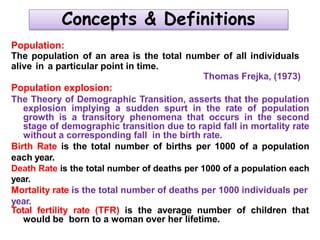
Population:
The population of an area is the total number of all individuals
alive in a particular point in time.
Thomas Frejka, (1973)
Population explosion:
The Theory of Demographic Transition, asserts that the population
explosion implying a sudden spurt in the rate of population
growth is a transitory phenomena that occurs in the second
stage of demographic transition due to rapid fall in mortality rate
without a corresponding fall in the birth rate.
Birth Rate is the total number of births per 1000 of a population
each year.
Death Rate is the total number of deaths per 1000 of a population each
year.
Mortality rate is the total number of deaths per 1000 individuals per
year.
Total fertility rate (TFR) is the average number of children that
would be born to a woman over her lifetime.
TheTheoryofDemographicTransition
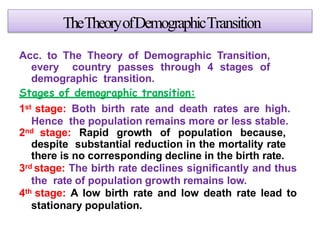
Acc. to The Theory of Demographic Transition,
every country passes through 4 stages of
demographic transition.
Stages of demographic transition:
1st stage: Both birth rate and death rates are high.
Hence the population remains more or less stable.
2nd stage: Rapid growth of population because,
despite substantial reduction in the mortality rate
there is no corresponding decline in the birth rate.
3rd stage: The birth rate declines significantly and thus
the rate of population growth remains low.
4th stage: A low birth rate and low death rate lead to
stationary population.
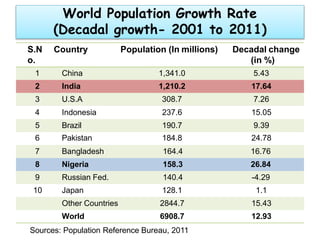
World Population Growth Rate
(Decadal growth- 2001 to 2011)
Sources: Population Reference Bureau, 2011
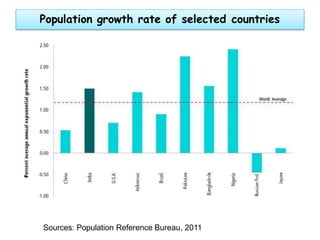
1 China 1,341.0 5.43
2 India 1,210.2 17.64
3 U.S.A 308.7 7.26
4 Indonesia 237.6 15.05
5 Brazil 190.7 9.39
6 Pakistan 184.8 24.78
7 Bangladesh 164.4 16.76
8 Nigeria 158.3 26.84
9 Russian Fed. 140.4 -4.29
10 Japan 128.1 1.1
Other Countries 2844.7 15.43
World 6908.7 12.93
S.N
o.
Country Population (In millions) Decadal change
(in %)
Population growth rate of selected countries
Sources: Population Reference Bureau, 2011
Country wise share in world population
Sources: Population Reference Bureau, 2011
Causes of increase in population
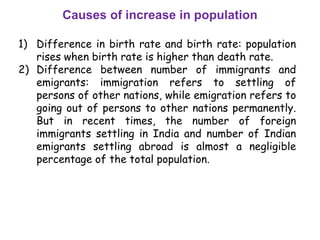
1) Difference in birth rate and birth rate: population
rises when birth rate is higher than death rate.
2) Difference between number of immigrants and
emigrants: immigration refers to settling of
persons of other nations, while emigration refers to
going out of persons to other nations permanently.
But in recent times, the number of foreign
immigrants settling in India and number of Indian
emigrants settling abroad is almost a negligible
percentage of the total population.
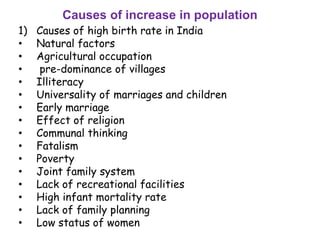
Causes of increase in population
1) Causes of high birth rate in India
• Natural factors
• Agricultural occupation
• pre-dominance of villages
• Illiteracy
• Universality of marriages and children
• Early marriage
• Effect of religion
• Communal thinking
• Fatalism
• Poverty
• Joint family system
• Lack of recreational facilities
• High infant mortality rate
• Lack of family planning
• Low status of women
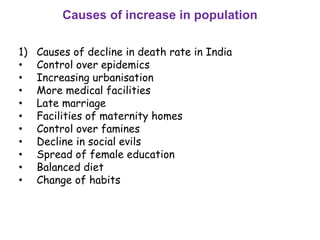
Causes of increase in population
1) Causes of decline in death rate in India
• Control over epidemics
• Increasing urbanisation
• More medical facilities
• Late marriage
• Facilities of maternity homes
• Control over famines
• Decline in social evils
• Spread of female education
• Balanced diet
• Change of habits
Population growth & Economic
development in india
India’s population is large and growing.
The rapidly growing population affect India’s
impressive economic growth and commitment to
improving the living standards of its citizens.
The economic growth primarily due to a huge
increase in the size of the middle class consumer
population, a large workforce comprising skilled
workers, good education standards and
considerable foreign investments.
Impact of population on Eco. Development
1) Increase in population is a growth promoting factor
• Increase in production
• Increase in labour supply
• Increase in demand
• Increase in labour productivity
• Indirectly helps in capital formation
2) Increase in population is an obstacle to eco. dev,.
• Low per capita income
• Reduces the rate of capital formation
• Food problem
• Unemployment
• Housing problem
• Poor quality of human resources
• Problem of social overhead facilities
• Vicious circle of poverty
• Imbalanced development
• Increase in prices
• Adverse effect on environment
Impact of Eco. Development on population
1) Consciousness about standard of living
2) Increase in number of working women
3) Nuclear families
4) Busyness and long working hours
5) Increase in awareness
How to reduce rapid population growth?
1.Expansion of industrial sector: Industrial workers
are aware of difficulties in getting the employment & are
interested in restricting the size of their family.
2. Creation of employment opportunities in urban
areas:
The housing problem and the cost of upbringing of children in
urban areas are the two factors which usually deter people from
having big families
3. Equitable distribution of income and removal of poverty: Poor
people have virtually no interest in limiting the size of the family.
4. Increase education, employment and wages for women: Education
often changes the attitude if a person towards family, marriage number
of children.
6.Provide better old-age social security: To reduce the
dependency on the children.
7.Raising the minimum age of marriage
India should try to draw some lesson from the experiences of
China, Malaysia and Sri Lanka where fertility decline has
occurred largely through an increase in age at marriage.
5. Increase the minimum-age child labor
8. Improve child health to reduce infant mortality
9.Implementation of family- planning programs
10.Monetary subsidies to small families
11. Urbanisation
12. Recreational facilities
13. Social security
14. Promoting Eco. dev.
Population Policy in
India
• It is difficult to decide as what is optimum size of population for India
under the
existing conditions.
• There has been complete reliance on family planning in order to
reduce population explosion.
• The national family planning program was launched in 1951, and was the
world's first governmental population stabilization program.
• Low female literacy levels and the lack of widespread availability of
birth-control methods is hampering the use of contraception in India.
• Family planning accepted & practiced effectively in some of the states in
India.
• Education and awareness needed about Family Planning.
New National Population Policy of 2020
Policy announced on Feb. 15, 2000.
It provides a policy framework to meet the reproductive and child
health needs of the people al India for the next ten year.
Target:
•to achieve zero growth rate of population by 2045.
•To reduce infant mortality rate to below 30 per 1000 live births by
2010 and below 28 per 1000 live births by 2012.
•To reduce MMR to below 1 per 1000 by 2010.
•To reduce birth rate to 21 per 1000 by 2010.
•To reduce total fertility rate to replacement level at 2.1 by 2010.
Main Features of New Population Policy
•Voluntary policy
•Wider scope
•Reduction in birth rate
•Propaganda
•Freezing Lok Sabha and Rajya Sabha seats
•Improvement in health care infra.

Populationindia

  • 1.
    DR. SUKHVIR KAUR ASSISTANTPROFESSOR IN ECONOMICS POPULATION GROWTH AND ECONOMIC DEVELOPENT IN INDIA
  • 2.
    Introduction  Overpopulation isa growing problem throughout the world.  There will, of course, be significant increases in the demand for food, water, and energy in developing countries.  Rapid population growth impedes development.  India and many third world countries are now passing through the phase of population explosion.  It is being argued that this situation has arisen because development in these countries has failed to maintain pace with population growth.  Rapid growth of population causes poverty and proves to be a barrier to development.
  • 3.
    Concepts & Definitions Population: Thepopulation of an area is the total number of all individuals alive in a particular point in time. Thomas Frejka, (1973) Population explosion: The Theory of Demographic Transition, asserts that the population explosion implying a sudden spurt in the rate of population growth is a transitory phenomena that occurs in the second stage of demographic transition due to rapid fall in mortality rate without a corresponding fall in the birth rate. Birth Rate is the total number of births per 1000 of a population each year. Death Rate is the total number of deaths per 1000 of a population each year. Mortality rate is the total number of deaths per 1000 individuals per year. Total fertility rate (TFR) is the average number of children that would be born to a woman over her lifetime.
  • 4.
    TheTheoryofDemographicTransition Acc. to TheTheory of Demographic Transition, every country passes through 4 stages of demographic transition. Stages of demographic transition: 1st stage: Both birth rate and death rates are high. Hence the population remains more or less stable. 2nd stage: Rapid growth of population because, despite substantial reduction in the mortality rate there is no corresponding decline in the birth rate. 3rd stage: The birth rate declines significantly and thus the rate of population growth remains low. 4th stage: A low birth rate and low death rate lead to stationary population.
  • 6.
    World Population GrowthRate (Decadal growth- 2001 to 2011) Sources: Population Reference Bureau, 2011 1 China 1,341.0 5.43 2 India 1,210.2 17.64 3 U.S.A 308.7 7.26 4 Indonesia 237.6 15.05 5 Brazil 190.7 9.39 6 Pakistan 184.8 24.78 7 Bangladesh 164.4 16.76 8 Nigeria 158.3 26.84 9 Russian Fed. 140.4 -4.29 10 Japan 128.1 1.1 Other Countries 2844.7 15.43 World 6908.7 12.93 S.N o. Country Population (In millions) Decadal change (in %)
  • 7.
    Population growth rateof selected countries Sources: Population Reference Bureau, 2011
  • 8.
    Country wise sharein world population Sources: Population Reference Bureau, 2011
  • 9.
    Causes of increasein population 1) Difference in birth rate and birth rate: population rises when birth rate is higher than death rate. 2) Difference between number of immigrants and emigrants: immigration refers to settling of persons of other nations, while emigration refers to going out of persons to other nations permanently. But in recent times, the number of foreign immigrants settling in India and number of Indian emigrants settling abroad is almost a negligible percentage of the total population.
  • 10.
    Causes of increasein population 1) Causes of high birth rate in India • Natural factors • Agricultural occupation • pre-dominance of villages • Illiteracy • Universality of marriages and children • Early marriage • Effect of religion • Communal thinking • Fatalism • Poverty • Joint family system • Lack of recreational facilities • High infant mortality rate • Lack of family planning • Low status of women
  • 11.
    Causes of increasein population 1) Causes of decline in death rate in India • Control over epidemics • Increasing urbanisation • More medical facilities • Late marriage • Facilities of maternity homes • Control over famines • Decline in social evils • Spread of female education • Balanced diet • Change of habits
  • 12.
    Population growth &Economic development in india India’s population is large and growing. The rapidly growing population affect India’s impressive economic growth and commitment to improving the living standards of its citizens. The economic growth primarily due to a huge increase in the size of the middle class consumer population, a large workforce comprising skilled workers, good education standards and considerable foreign investments.
  • 13.
    Impact of populationon Eco. Development 1) Increase in population is a growth promoting factor • Increase in production • Increase in labour supply • Increase in demand • Increase in labour productivity • Indirectly helps in capital formation 2) Increase in population is an obstacle to eco. dev,. • Low per capita income • Reduces the rate of capital formation • Food problem • Unemployment • Housing problem • Poor quality of human resources • Problem of social overhead facilities • Vicious circle of poverty • Imbalanced development • Increase in prices • Adverse effect on environment
  • 14.
    Impact of Eco.Development on population 1) Consciousness about standard of living 2) Increase in number of working women 3) Nuclear families 4) Busyness and long working hours 5) Increase in awareness
  • 15.
    How to reducerapid population growth? 1.Expansion of industrial sector: Industrial workers are aware of difficulties in getting the employment & are interested in restricting the size of their family. 2. Creation of employment opportunities in urban areas: The housing problem and the cost of upbringing of children in urban areas are the two factors which usually deter people from having big families 3. Equitable distribution of income and removal of poverty: Poor people have virtually no interest in limiting the size of the family. 4. Increase education, employment and wages for women: Education often changes the attitude if a person towards family, marriage number of children.
  • 16.
    6.Provide better old-agesocial security: To reduce the dependency on the children. 7.Raising the minimum age of marriage India should try to draw some lesson from the experiences of China, Malaysia and Sri Lanka where fertility decline has occurred largely through an increase in age at marriage. 5. Increase the minimum-age child labor 8. Improve child health to reduce infant mortality 9.Implementation of family- planning programs 10.Monetary subsidies to small families 11. Urbanisation 12. Recreational facilities 13. Social security 14. Promoting Eco. dev.
  • 17.
    Population Policy in India •It is difficult to decide as what is optimum size of population for India under the existing conditions. • There has been complete reliance on family planning in order to reduce population explosion. • The national family planning program was launched in 1951, and was the world's first governmental population stabilization program. • Low female literacy levels and the lack of widespread availability of birth-control methods is hampering the use of contraception in India. • Family planning accepted & practiced effectively in some of the states in India. • Education and awareness needed about Family Planning.
  • 18.
    New National PopulationPolicy of 2020 Policy announced on Feb. 15, 2000. It provides a policy framework to meet the reproductive and child health needs of the people al India for the next ten year. Target: •to achieve zero growth rate of population by 2045. •To reduce infant mortality rate to below 30 per 1000 live births by 2010 and below 28 per 1000 live births by 2012. •To reduce MMR to below 1 per 1000 by 2010. •To reduce birth rate to 21 per 1000 by 2010. •To reduce total fertility rate to replacement level at 2.1 by 2010. Main Features of New Population Policy •Voluntary policy •Wider scope •Reduction in birth rate •Propaganda •Freezing Lok Sabha and Rajya Sabha seats •Improvement in health care infra.