Polynomials and Partial Fractions Objectives In this lesson, you will learn how to perform arithmetic operations on polynomials. 4.1 Polynomials
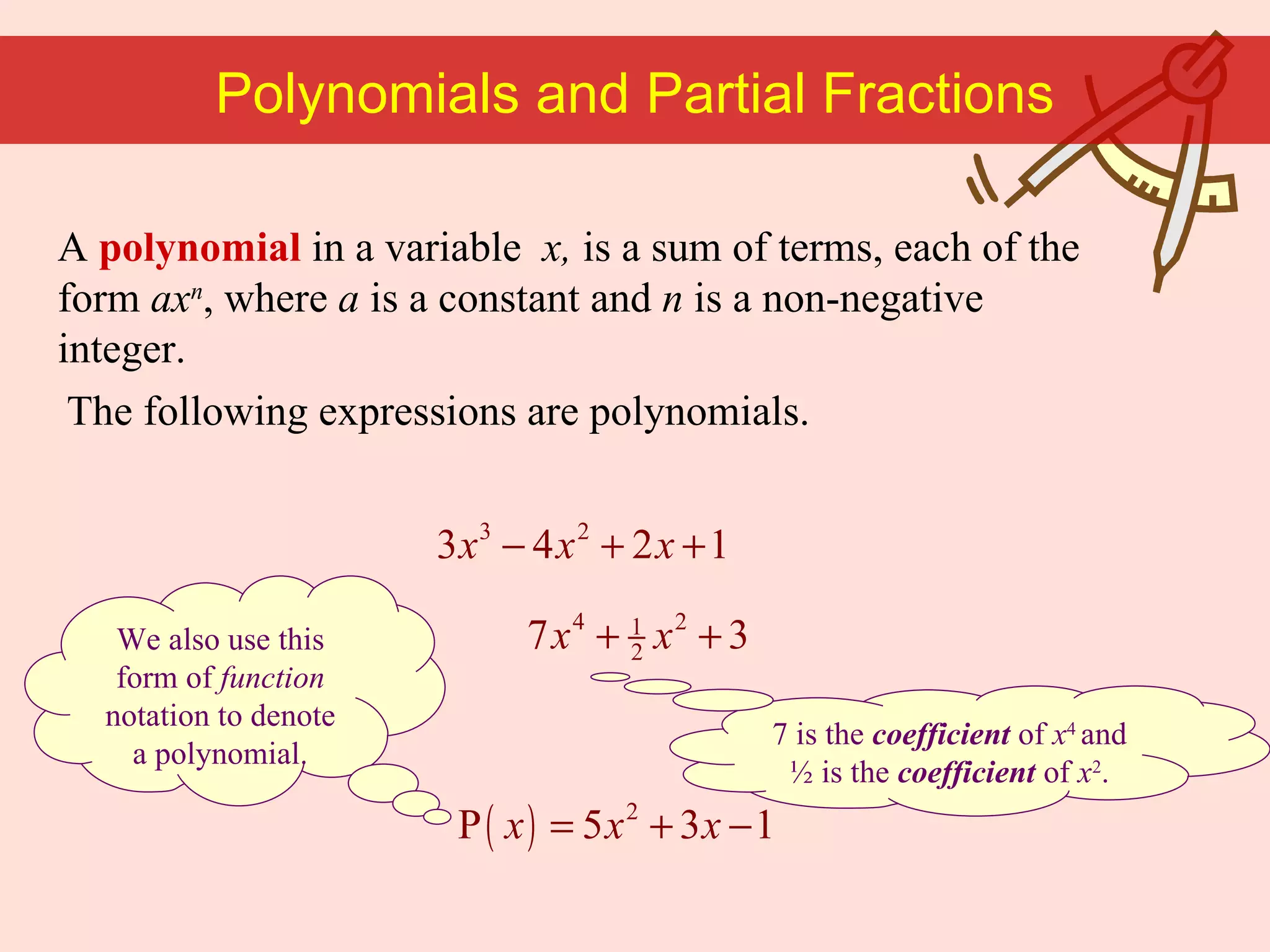
The following expressions are polynomials. We also use this form of  function  notation to denote a polynomial. 7 is the  coefficient  of  x 4  and  ½ is the  coefficient  of  x 2 . A  polynomial   in a variable  x,  is a sum of terms, each of the form  ax n , where  a  is a constant and  n  is a non-negative integer. Polynomials and Partial Fractions
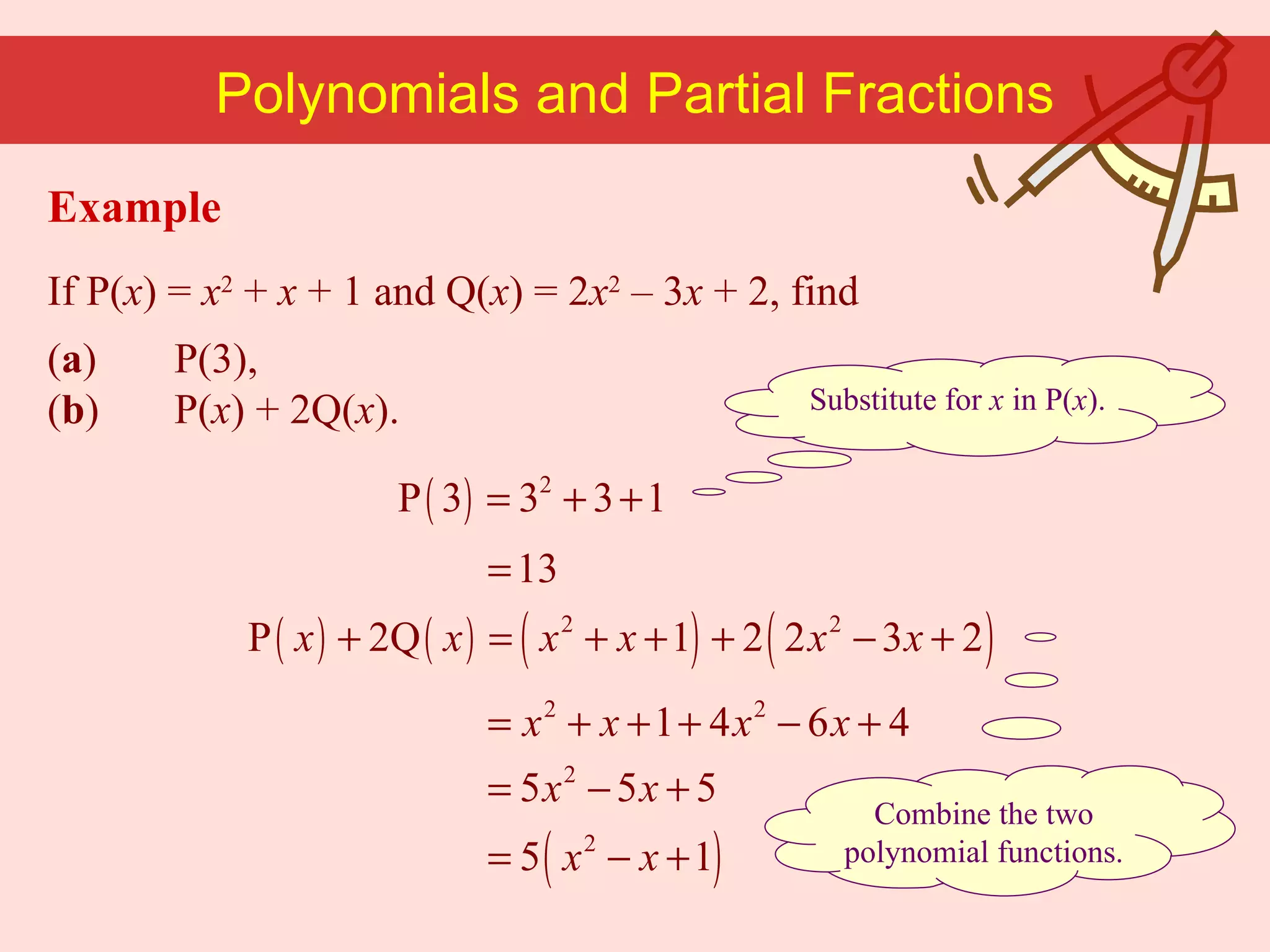
Substitute for  x  in P( x ). Combine the two polynomial functions. If P( x ) =  x 2  +  x  + 1 and Q( x ) = 2 x 2  – 3 x  + 2, find Polynomials and Partial Fractions Example ( a ) P(3), ( b ) P( x ) + 2Q( x ).
Polynomials and Partial Fractions In this lesson, you will learn how to find unknown constants in a polynomial identity. 4.2 Identities Objectives
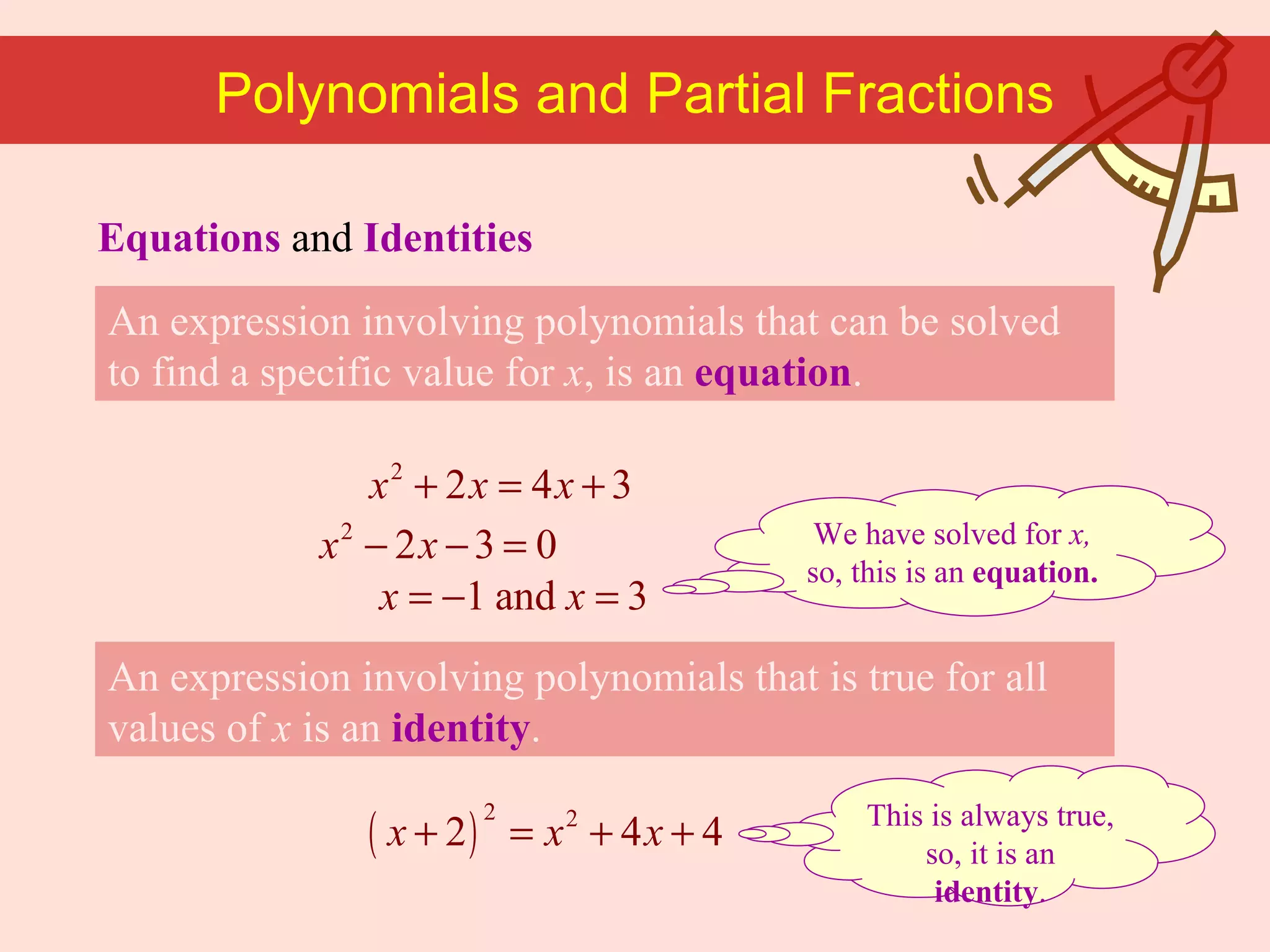
An expression involving polynomials that can be solved to find a specific value for  x , is an  equation . This is always true, so, it is an  identity . We have solved for  x,  so, this is an  equation. Equations  and  Identities Polynomials and Partial Fractions An expression involving polynomials that is true for all values of  x  is an  identity .
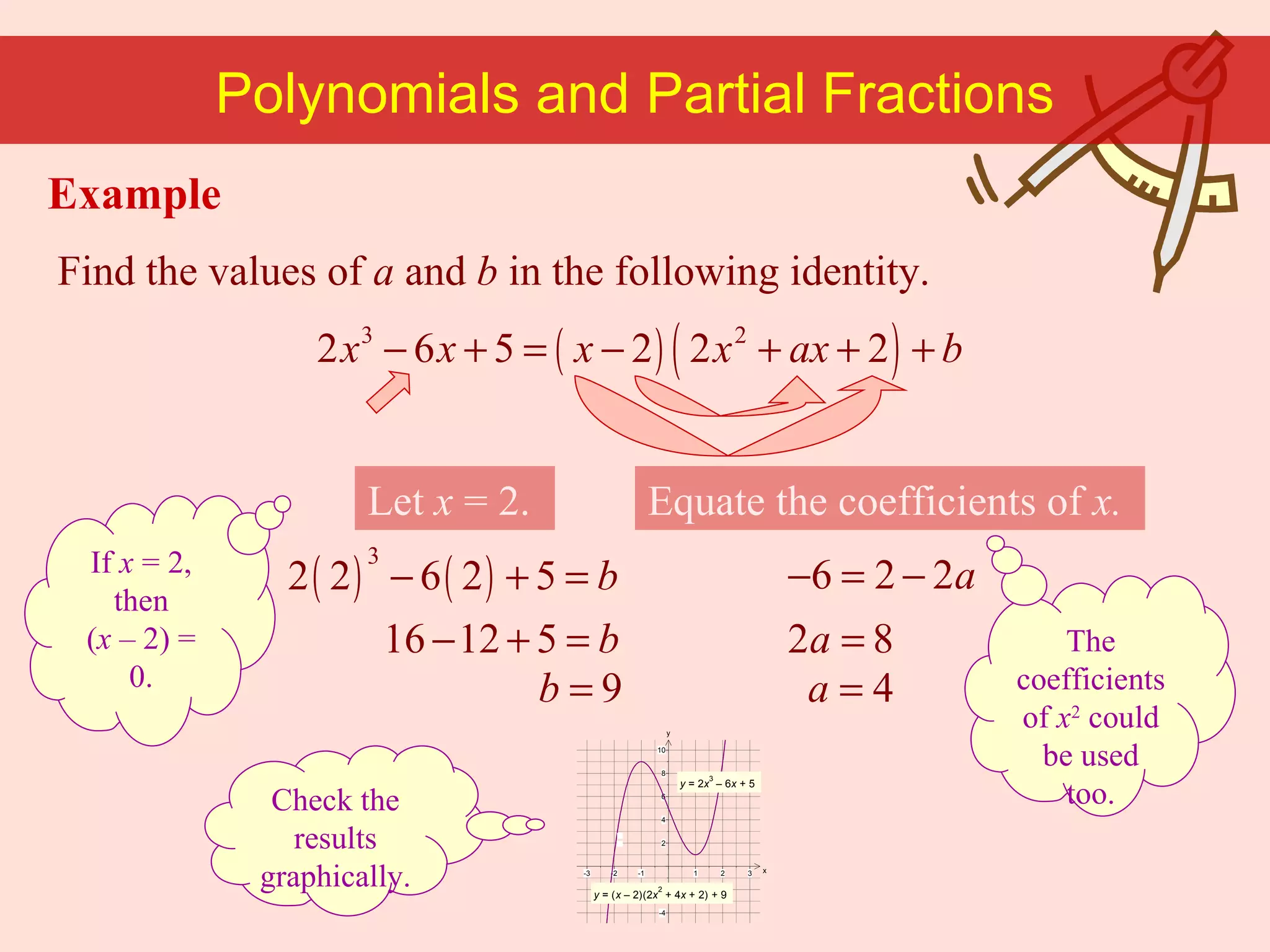
If  x  = 2, then ( x  – 2) = 0. The coefficients of  x 2  could be used too. Find the values of  a  and  b  in the following identity. Polynomials and Partial Fractions Let  x  = 2. Equate the coefficients of  x. Check the results graphically. Example
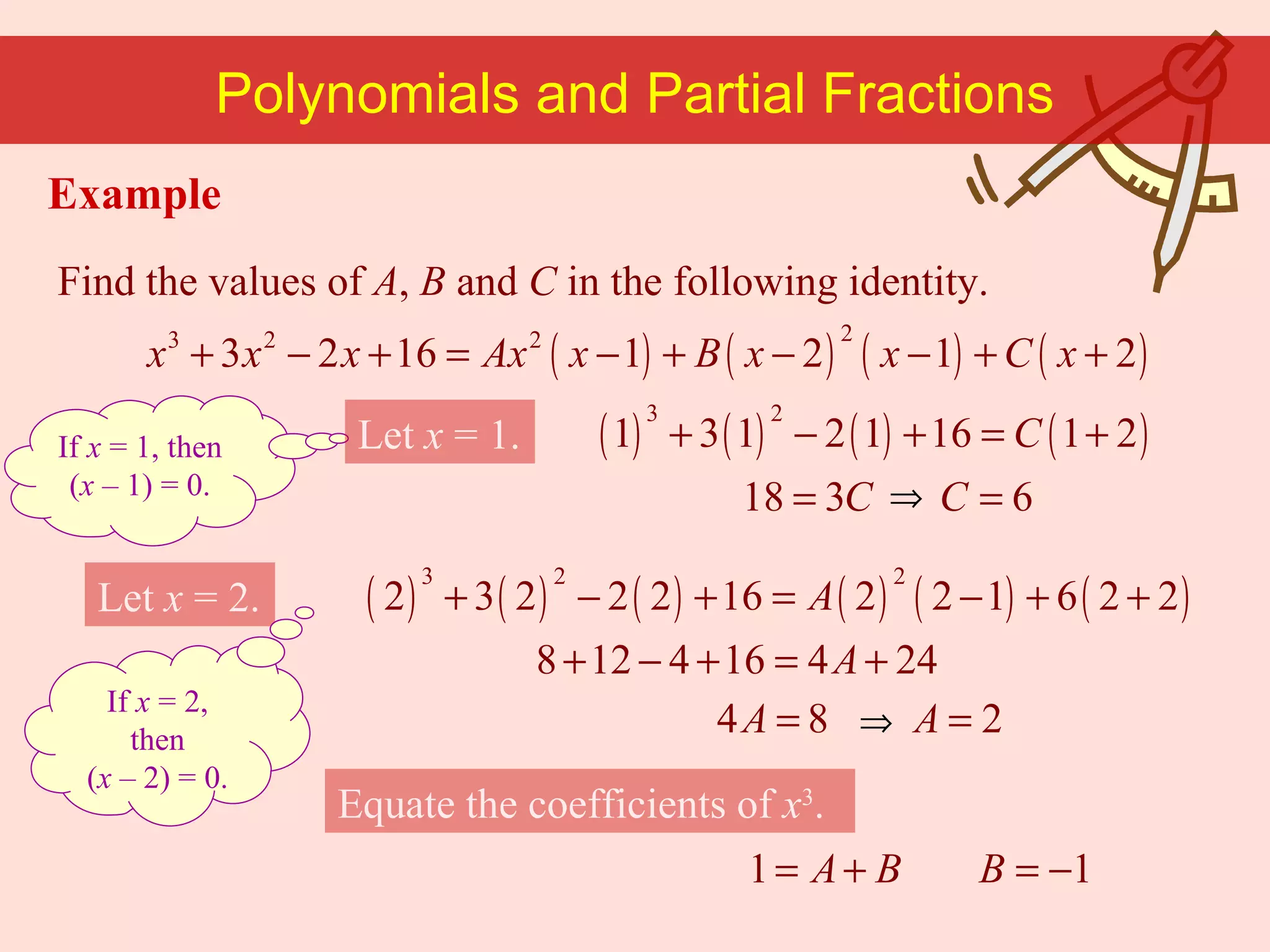
If  x  = 1, then ( x  – 1) = 0. Find the values of  A ,  B  and  C  in the following identity. Polynomials and Partial Fractions Let  x  = 1. Let  x  = 2. If  x  = 2, then ( x  – 2) = 0. Equate the coefficients of  x 3 . Example
Polynomials and Partial Fractions In this lesson, you will learn how to divide one polynomial by another. 4.3 Dividing Polynomials Objectives
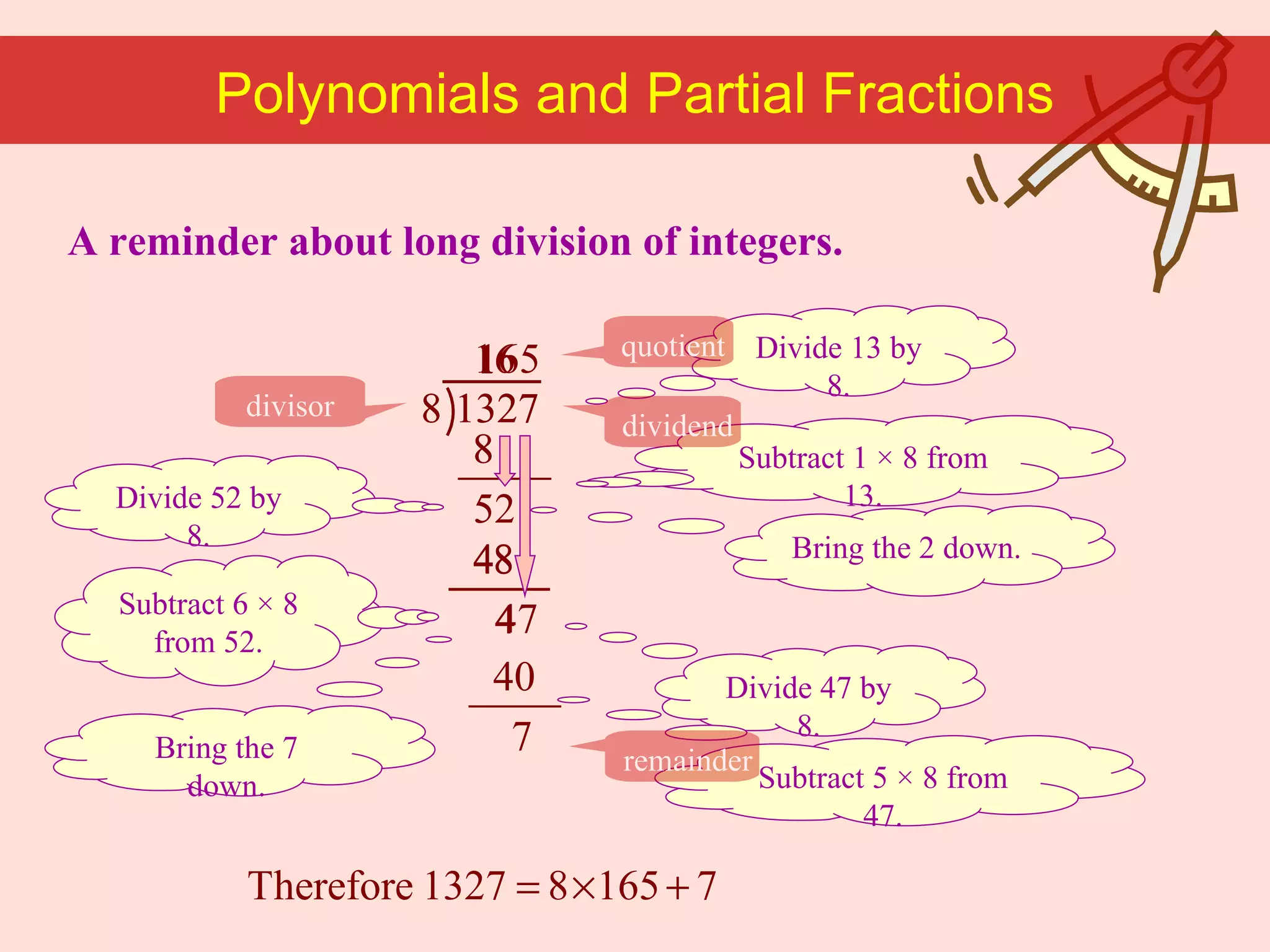
Subtract 1  × 8 from 13. Divide 13 by 8. A reminder about long division of integers. Polynomials and Partial Fractions Bring the 2 down. Divide 52 by 8. Subtract 6  × 8 from 52. Bring the 7 down. Divide 47 by 8. Subtract 5  × 8 from 47. divisor dividend quotient remainder
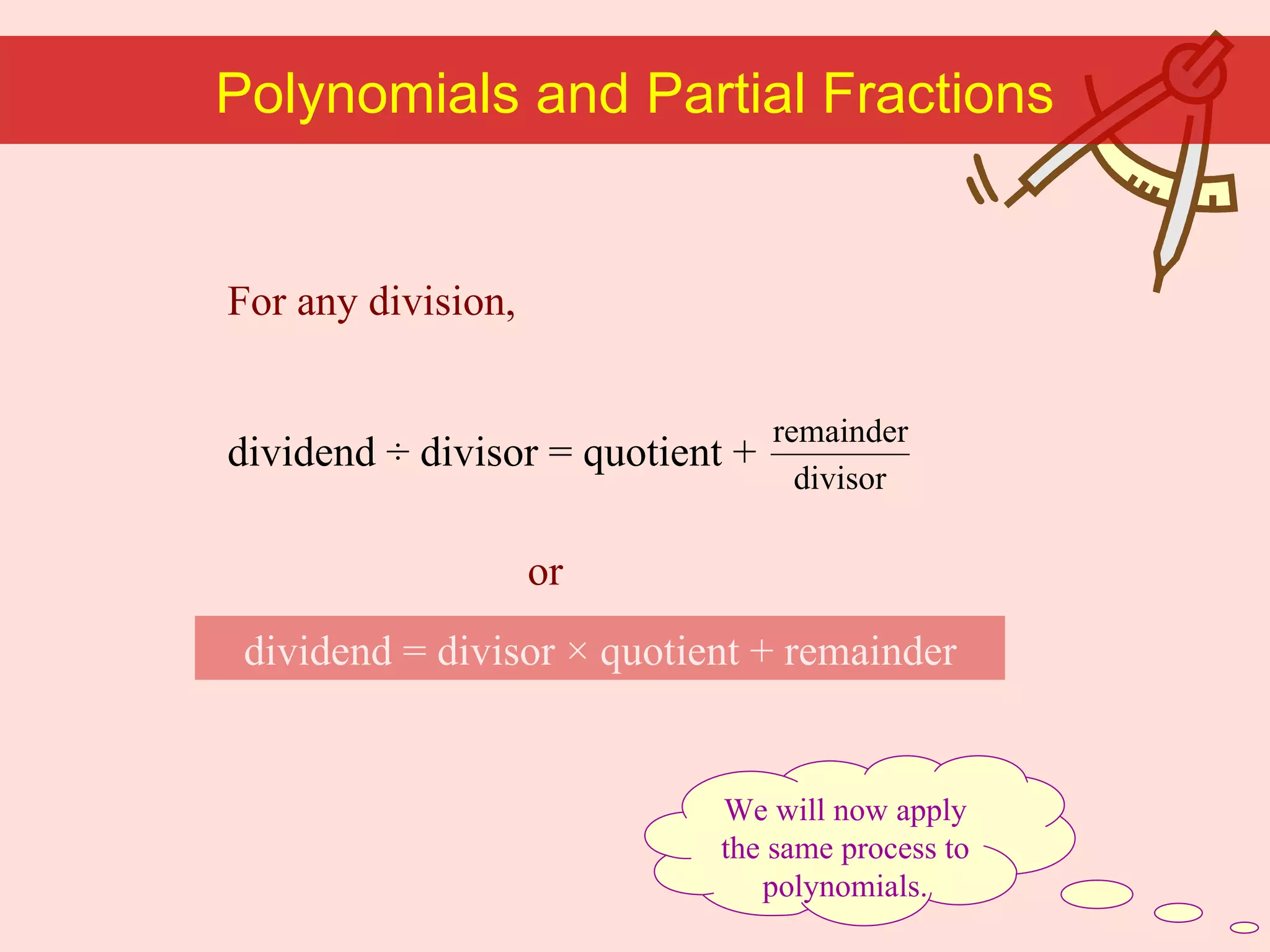
We will now apply the same process to polynomials. For any division, Polynomials and Partial Fractions dividend  = divisor × quotient + remainder or dividend  ÷ divisor = quotient +
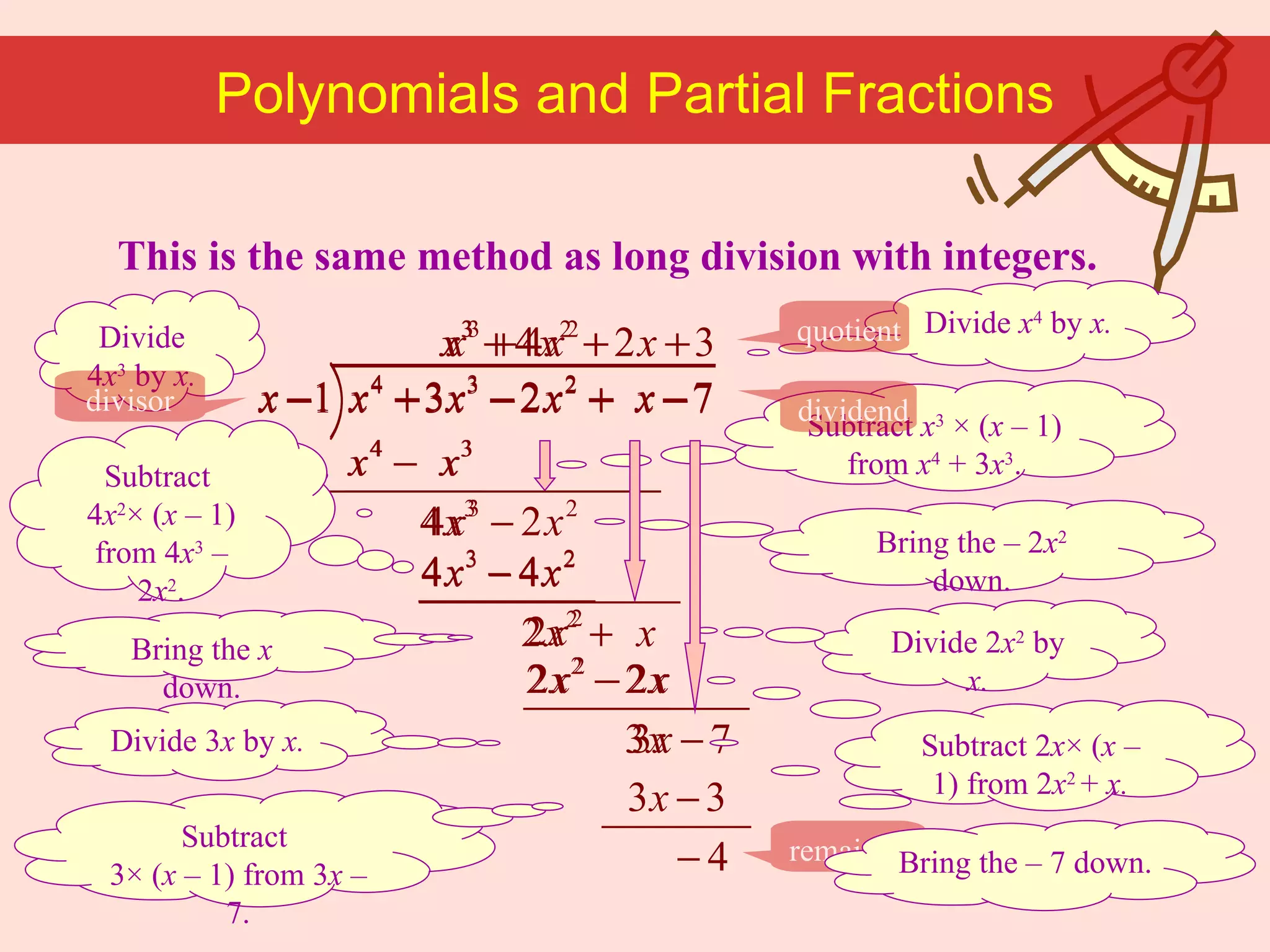
Subtract  x 3   × ( x  – 1) from  x 4  + 3 x 3 . Divide  x 4  by  x. This is the same method as long division with integers. Polynomials and Partial Fractions Bring the  –   2 x 2  down. Divide 4 x 3  by  x. Subtract  4 x 2 × ( x   –   1) from 4 x 3  – 2 x 2 . Bring the  x  down. Divide 2 x 2  by  x. Subtract 2 x × ( x  – 1) from 2 x 2  +  x. divisor dividend quotient remainder Divide 3 x  by  x. Subtract  3 × ( x   –   1) from 3 x  – 7. Bring the  –   7 down.
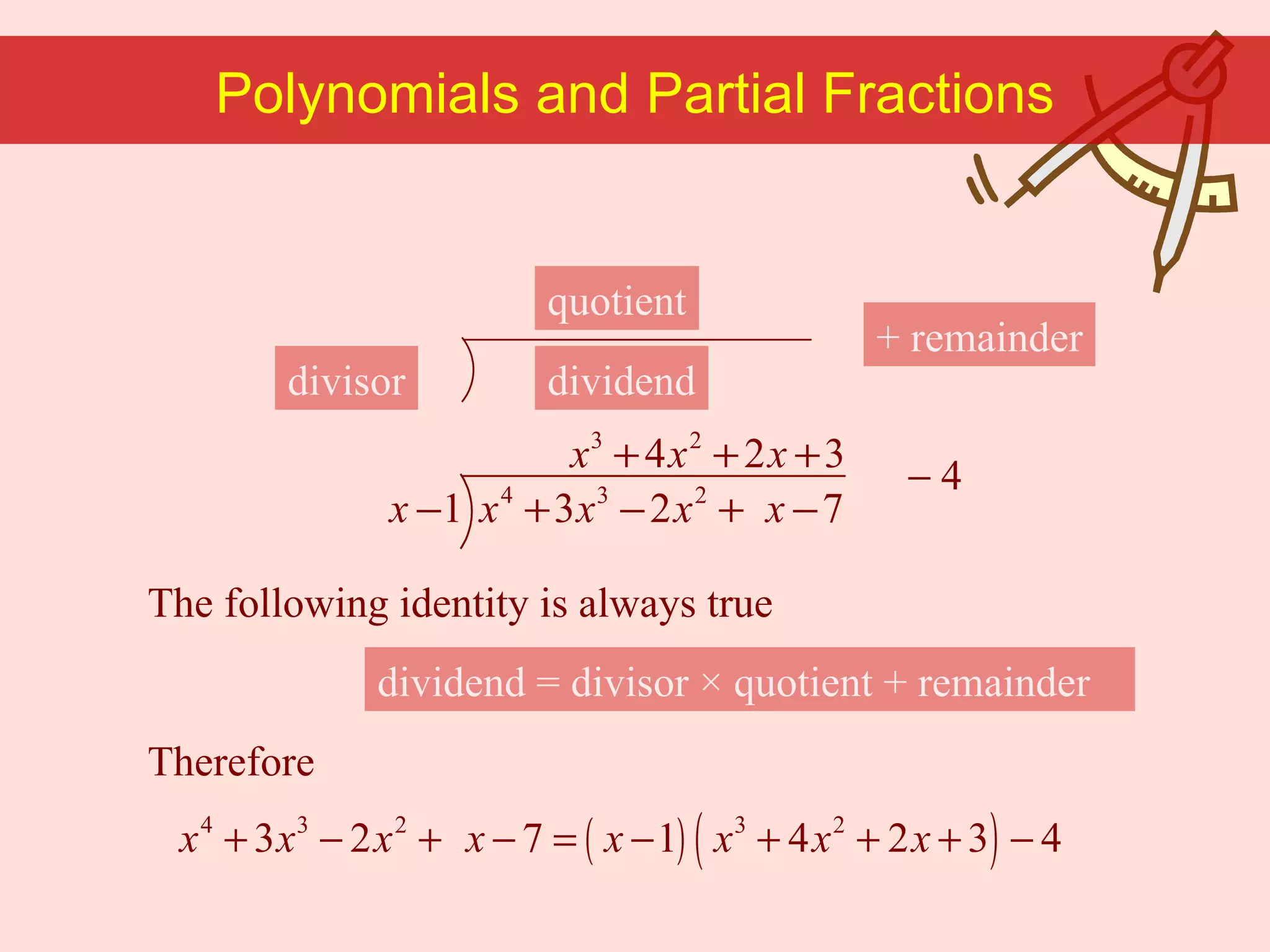
The following identity is always true Polynomials and Partial Fractions dividend  = divisor × quotient + remainder Therefore + remainder quotient divisor dividend
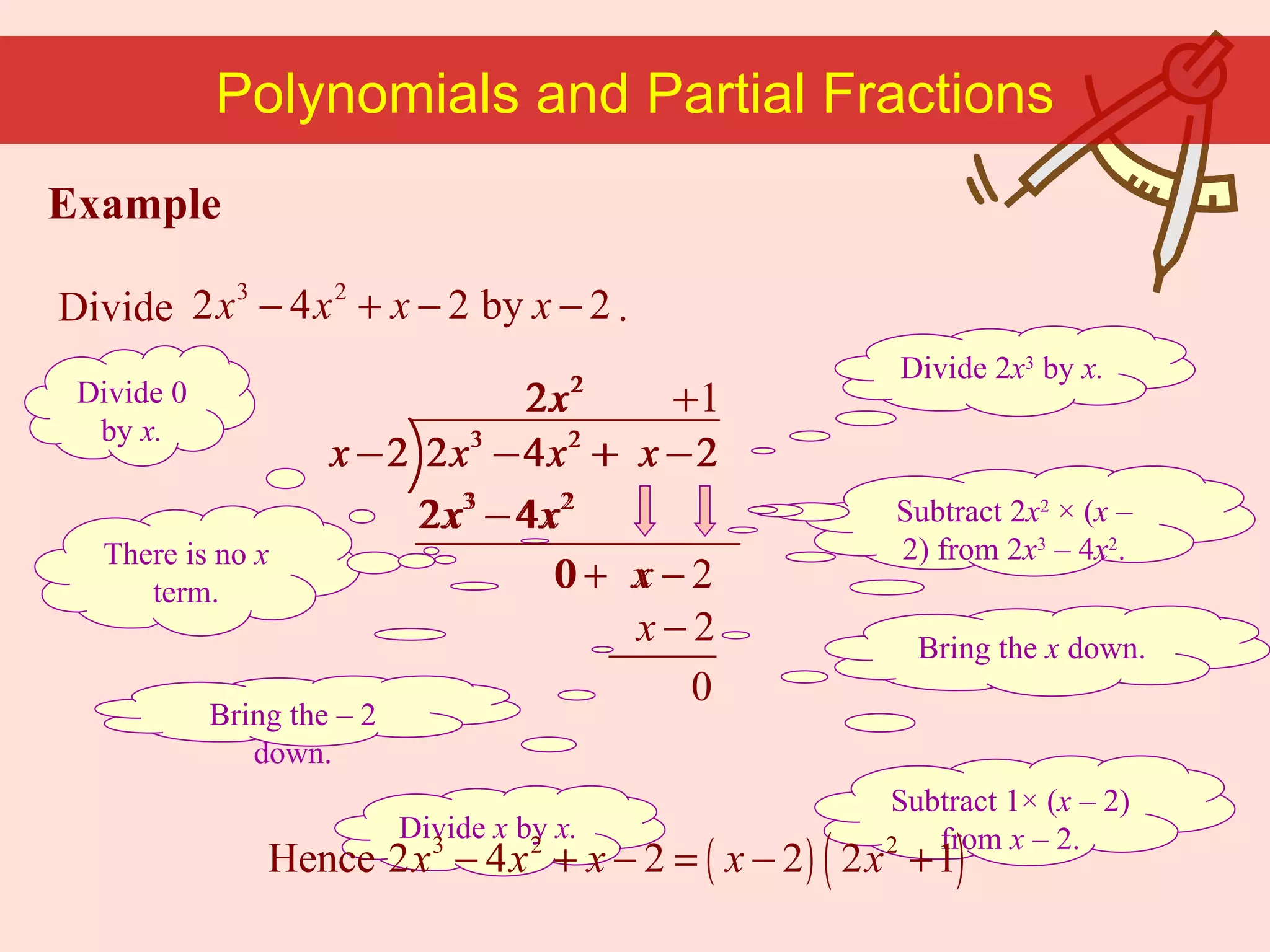
Example Divide  . Subtract 2 x 2   × ( x  – 2) from 2 x 3   –  4 x 2 . Divide 2 x 3  by  x. Polynomials and Partial Fractions Bring the  x  down. Divide 0 by  x. There is no  x  term. Bring the  –   2 down. Divide  x  by  x. Subtract 1 × ( x  – 2) from  x   –  2.
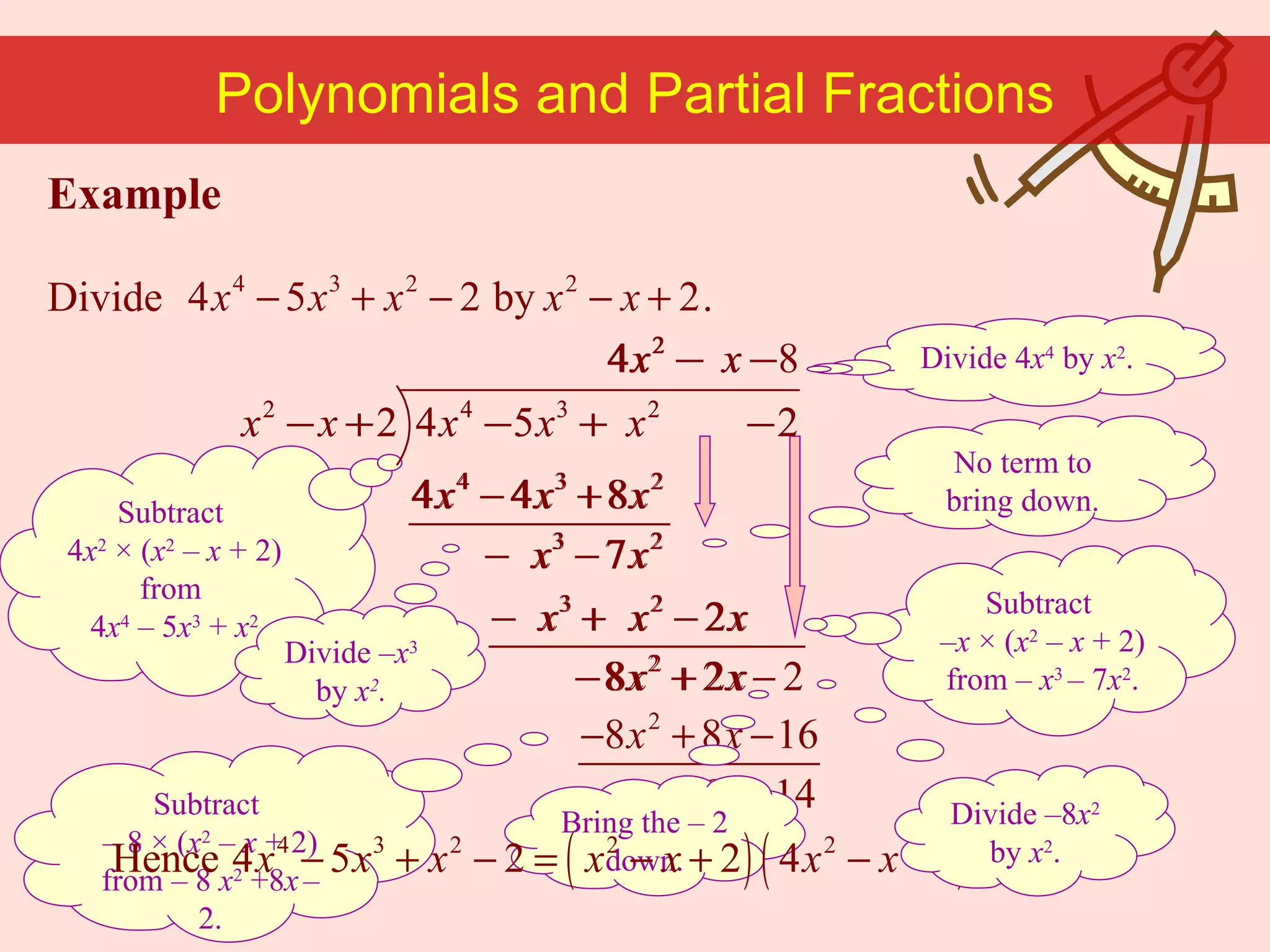
Example Divide  . Subtract  4 x 2  × ( x 2  –  x  + 2) from  4 x 4   –   5 x 3  +  x 2 Divide 4 x 4  by  x 2 . Polynomials and Partial Fractions No term to bring down. Divide – x 3  by  x 2 . Subtract   – x   × ( x 2   –  x  + 2) from  –   x 3  –   7 x 2 . Bring the  –   2 down. Subtract  –   8   × ( x 2   –  x  + 2) from  –   8   x 2   +8 x   –   2. Divide –8 x 2  by  x 2 .

Polynomial identities division

  • 1.
    Polynomials and PartialFractions Objectives In this lesson, you will learn how to perform arithmetic operations on polynomials. 4.1 Polynomials
  • 2.
    The following expressionsare polynomials. We also use this form of function notation to denote a polynomial. 7 is the coefficient of x 4 and ½ is the coefficient of x 2 . A polynomial in a variable x, is a sum of terms, each of the form ax n , where a is a constant and n is a non-negative integer. Polynomials and Partial Fractions
  • 3.
    Substitute for x in P( x ). Combine the two polynomial functions. If P( x ) = x 2 + x + 1 and Q( x ) = 2 x 2 – 3 x + 2, find Polynomials and Partial Fractions Example ( a ) P(3), ( b ) P( x ) + 2Q( x ).
  • 4.
    Polynomials and PartialFractions In this lesson, you will learn how to find unknown constants in a polynomial identity. 4.2 Identities Objectives
  • 5.
    An expression involvingpolynomials that can be solved to find a specific value for x , is an equation . This is always true, so, it is an identity . We have solved for x, so, this is an equation. Equations and Identities Polynomials and Partial Fractions An expression involving polynomials that is true for all values of x is an identity .
  • 6.
    If x = 2, then ( x – 2) = 0. The coefficients of x 2 could be used too. Find the values of a and b in the following identity. Polynomials and Partial Fractions Let x = 2. Equate the coefficients of x. Check the results graphically. Example
  • 7.
    If x = 1, then ( x – 1) = 0. Find the values of A , B and C in the following identity. Polynomials and Partial Fractions Let x = 1. Let x = 2. If x = 2, then ( x – 2) = 0. Equate the coefficients of x 3 . Example
  • 8.
    Polynomials and PartialFractions In this lesson, you will learn how to divide one polynomial by another. 4.3 Dividing Polynomials Objectives
  • 9.
    Subtract 1 × 8 from 13. Divide 13 by 8. A reminder about long division of integers. Polynomials and Partial Fractions Bring the 2 down. Divide 52 by 8. Subtract 6 × 8 from 52. Bring the 7 down. Divide 47 by 8. Subtract 5 × 8 from 47. divisor dividend quotient remainder
  • 10.
    We will nowapply the same process to polynomials. For any division, Polynomials and Partial Fractions dividend = divisor × quotient + remainder or dividend ÷ divisor = quotient +
  • 11.
    Subtract x3 × ( x – 1) from x 4 + 3 x 3 . Divide x 4 by x. This is the same method as long division with integers. Polynomials and Partial Fractions Bring the – 2 x 2 down. Divide 4 x 3 by x. Subtract 4 x 2 × ( x – 1) from 4 x 3 – 2 x 2 . Bring the x down. Divide 2 x 2 by x. Subtract 2 x × ( x – 1) from 2 x 2 + x. divisor dividend quotient remainder Divide 3 x by x. Subtract 3 × ( x – 1) from 3 x – 7. Bring the – 7 down.
  • 12.
    The following identityis always true Polynomials and Partial Fractions dividend = divisor × quotient + remainder Therefore + remainder quotient divisor dividend
  • 13.
    Example Divide . Subtract 2 x 2 × ( x – 2) from 2 x 3 – 4 x 2 . Divide 2 x 3 by x. Polynomials and Partial Fractions Bring the x down. Divide 0 by x. There is no x term. Bring the – 2 down. Divide x by x. Subtract 1 × ( x – 2) from x – 2.
  • 14.
    Example Divide . Subtract 4 x 2 × ( x 2 – x + 2) from 4 x 4 – 5 x 3 + x 2 Divide 4 x 4 by x 2 . Polynomials and Partial Fractions No term to bring down. Divide – x 3 by x 2 . Subtract – x × ( x 2 – x + 2) from – x 3 – 7 x 2 . Bring the – 2 down. Subtract – 8 × ( x 2 – x + 2) from – 8 x 2 +8 x – 2. Divide –8 x 2 by x 2 .

Editor's Notes

  • #2 4.1 Polynomials Objectives In this lesson you will learn how to perform arithmetic operations on polynomials.
  • #3 Example of solution of simultaneous linear equations – part 1
  • #4 Exercise 4.1, Page 80, Question 3 (a), (b)
  • #5 4.2 Identities Objectives In this lesson you will learn how to find unknown constants in a polynomial identity.
  • #7 Exercise 4.2, Page 82, Question 2
  • #8 Exercise 4.2, Page 82, Question 6
  • #9 4.3 Dividing Polynomials Objectives In this lesson you will learn how to divide one polynomial by another.
  • #12 Example
  • #13 Example
  • #14 Exercise 4.3, Page 86, Question 1 (a)
  • #15 Exercise 4.3, Page 86, Question 1 (c)