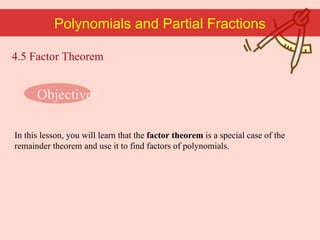
Polynomials and Partial Fractions In this lesson, you will learn that the  factor theorem  is a special case of the remainder theorem and use it to find factors of polynomials. 4.5 Factor Theorem Objectives
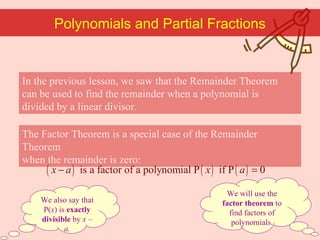
In the previous lesson, we saw that the Remainder Theorem  can be used to find the remainder when a polynomial is divided by a linear divisor. We will use the  factor theorem  to find factors of polynomials. Polynomials and Partial Fractions The Factor Theorem is a special case of the Remainder Theorem when the remainder is zero: We also say that P( x ) is  exactly divisible  by  x   –  a.
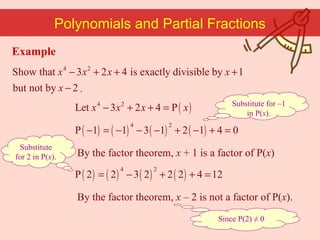
Since P(2)  ≠ 0 Polynomials and Partial Fractions By the factor theorem,  x  + 1 is a factor of P( x ) Substitute for  – 1 in P( x ). By the factor theorem,  x  –  2 is not a factor of P( x ). Substitute for  2  in P( x ). Example .
Equate coefficients to find the third factor. Polynomials and Partial Fractions Factorise the quadratic equation. Multiply the second equation by 16 and subtract. P(4) = 0; P( – 1) = 0. Substitute  x  = 4 and  x  =  – 1. Example
Polynomials and Partial Fractions In this lesson, you will learn to apply the factor theorem to solving cubic equations of the form  px 3   + qx 2   + rx + s  = 0, where  p ,  q ,  r  and  s  are constants.  4.6 Solving Cubic Equations Objectives
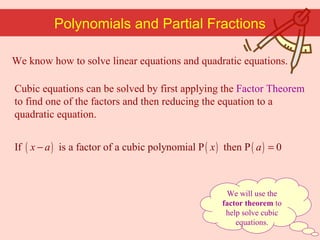
We know how to solve linear equations and quadratic equations. We will use the  factor theorem  to help solve cubic equations. Polynomials and Partial Fractions Cubic equations can be solved by first applying the  Factor Theorem  to find one of the factors and then reducing the equation to a quadratic equation.
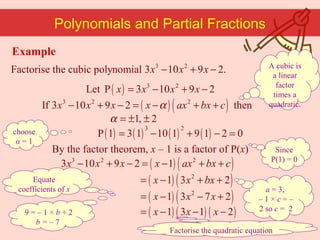
Polynomials and Partial Fractions By the factor theorem,  x  –  1 is a factor of P( x ) a  = 3,  –  1 ×  c  =  – 2  so  c  =  2 A cubic is a linear factor times a quadratic. choose   α  = 1 Since P(1) = 0 Equate coefficients of  x 9 =  – 1 ×  b   + 2   b =  – 7   Factorise the quadratic equation Example
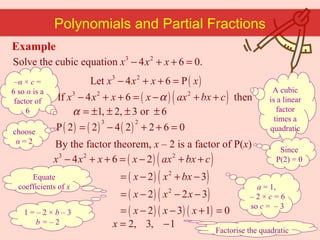
a  = 1,  –  2 ×  c  = 6 so  c  =  – 3 Polynomials and Partial Fractions By the factor theorem,  x  –  2 is a factor of P( x ) A cubic is a linear factor times a quadratic – α   ×  c  = 6 so   α  is a factor of 6 choose   α  = 2 Since P(2) = 0 Equate coefficients of  x 1 =  – 2 ×  b   – 3   b =  – 2   Factorise the quadratic Example

Factor theorem solving cubic equations

  • 1.
    Polynomials and PartialFractions In this lesson, you will learn that the factor theorem is a special case of the remainder theorem and use it to find factors of polynomials. 4.5 Factor Theorem Objectives
  • 2.
    In the previouslesson, we saw that the Remainder Theorem can be used to find the remainder when a polynomial is divided by a linear divisor. We will use the factor theorem to find factors of polynomials. Polynomials and Partial Fractions The Factor Theorem is a special case of the Remainder Theorem when the remainder is zero: We also say that P( x ) is exactly divisible by x – a.
  • 3.
    Since P(2) ≠ 0 Polynomials and Partial Fractions By the factor theorem, x + 1 is a factor of P( x ) Substitute for – 1 in P( x ). By the factor theorem, x – 2 is not a factor of P( x ). Substitute for 2 in P( x ). Example .
  • 4.
    Equate coefficients tofind the third factor. Polynomials and Partial Fractions Factorise the quadratic equation. Multiply the second equation by 16 and subtract. P(4) = 0; P( – 1) = 0. Substitute x = 4 and x = – 1. Example
  • 5.
    Polynomials and PartialFractions In this lesson, you will learn to apply the factor theorem to solving cubic equations of the form px 3 + qx 2 + rx + s = 0, where p , q , r and s are constants. 4.6 Solving Cubic Equations Objectives
  • 6.
    We know howto solve linear equations and quadratic equations. We will use the factor theorem to help solve cubic equations. Polynomials and Partial Fractions Cubic equations can be solved by first applying the Factor Theorem to find one of the factors and then reducing the equation to a quadratic equation.
  • 7.
    Polynomials and PartialFractions By the factor theorem, x – 1 is a factor of P( x ) a = 3, – 1 × c = – 2 so c = 2 A cubic is a linear factor times a quadratic. choose α = 1 Since P(1) = 0 Equate coefficients of x 9 = – 1 × b + 2 b = – 7 Factorise the quadratic equation Example
  • 8.
    a =1, – 2 × c = 6 so c = – 3 Polynomials and Partial Fractions By the factor theorem, x – 2 is a factor of P( x ) A cubic is a linear factor times a quadratic – α × c = 6 so α is a factor of 6 choose α = 2 Since P(2) = 0 Equate coefficients of x 1 = – 2 × b – 3 b = – 2 Factorise the quadratic Example

Editor's Notes

  • #2 4.5 Factor Theorem Objectives In this lesson you will learn that the factor theorem is a special case of the remainder theorem and use it to find factors of polynomials.
  • #4 Exercise 4.5, Page 90, Question 1
  • #5 Exercise 4.5, Page 90, Question 5
  • #6 4.6 Solving Cubic Equations Objectives In this lesson you will learn to apply the factor theorem to solving cubic equations of the form px 3 + qx 2 + rx + s = 0, where p , q , r and s are constants.
  • #8 Exercise 4.6, Page 93, Question 1
  • #9 Exercise 4.6, Page 93, Question 3 (a)