Polynomials and Partial Fractions Objectives In this lesson, you will learn how to find the remainder when a polynomial is divided by a linear divisor, by an elegant method - using the  remainder theorem . 4.4 Remainder Theorem
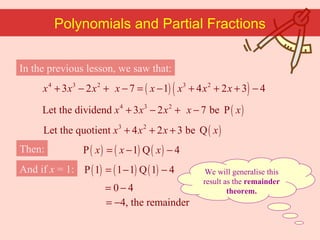
In the previous lesson, we saw that: We will generalise this result as the  remainder theorem. Polynomials and Partial Fractions Then: And if  x  = 1:
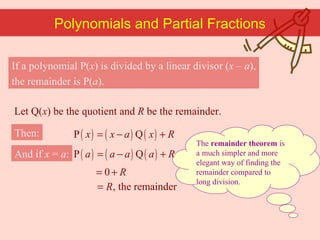
If a polynomial P( x ) is divided by a linear divisor ( x  –  a ), the remainder is P( a ). The  remainder theorem  is a much simpler and more elegant way of finding the remainder compared to long division. Polynomials and Partial Fractions Then: And if  x  =  a : Let Q( x ) be the quotient and  R  be the remainder.
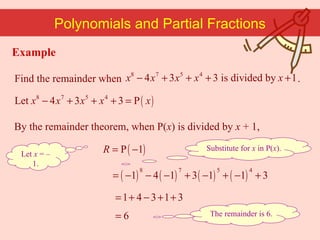
Let  x  =  –  1. The remainder is 6. Find the remainder when  . Polynomials and Partial Fractions By the remainder theorem, when P( x ) is divided by  x  + 1, Substitute for  x  in P( x ). Example
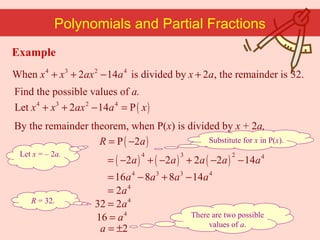
Let  x  =  –  2 a. Polynomials and Partial Fractions Find the possible values of  a. Substitute for  x  in P( x ). By the remainder theorem, when P( x ) is divided by  x  + 2 a, R  = 32. There are two possible values of  a . Example
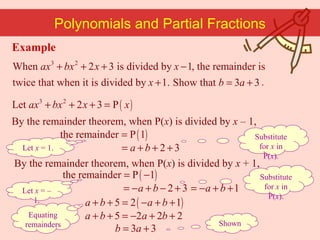
Let  x  =  1. Polynomials and Partial Fractions Substitute for  x  in P( x ). By the remainder theorem, when P( x ) is divided by  x  –  1, Equating remainders Shown By the remainder theorem, when P( x ) is divided by  x  +  1, Substitute for  x  in P( x ). Let  x  =  –  1. Example .

Remainder theorem

  • 1.
    Polynomials and PartialFractions Objectives In this lesson, you will learn how to find the remainder when a polynomial is divided by a linear divisor, by an elegant method - using the remainder theorem . 4.4 Remainder Theorem
  • 2.
    In the previouslesson, we saw that: We will generalise this result as the remainder theorem. Polynomials and Partial Fractions Then: And if x = 1:
  • 3.
    If a polynomialP( x ) is divided by a linear divisor ( x – a ), the remainder is P( a ). The remainder theorem is a much simpler and more elegant way of finding the remainder compared to long division. Polynomials and Partial Fractions Then: And if x = a : Let Q( x ) be the quotient and R be the remainder.
  • 4.
    Let x = – 1. The remainder is 6. Find the remainder when . Polynomials and Partial Fractions By the remainder theorem, when P( x ) is divided by x + 1, Substitute for x in P( x ). Example
  • 5.
    Let x = – 2 a. Polynomials and Partial Fractions Find the possible values of a. Substitute for x in P( x ). By the remainder theorem, when P( x ) is divided by x + 2 a, R = 32. There are two possible values of a . Example
  • 6.
    Let x = 1. Polynomials and Partial Fractions Substitute for x in P( x ). By the remainder theorem, when P( x ) is divided by x – 1, Equating remainders Shown By the remainder theorem, when P( x ) is divided by x + 1, Substitute for x in P( x ). Let x = – 1. Example .

Editor's Notes

  • #2 4.4 Remainder Theorem Objectives In this lesson you will learn how to find the remainder when a polynomial is divided by a linear divisor by an elegant method using the remainder theorem .
  • #5 Exercise 4.4, Page 88, Question 1 (a)
  • #6 Exercise 4.4, Page 88, Question 3
  • #7 Exercise 4.4, Page 89, Question 8