Topic:
Fermentation of vinegar
Subject:
Food and Dairy Micro biology
Submitted To:
Dr Zeeshan Nawaz
Submitted by:
4th Stars
Introduction
• Vinegar may be defined as a condiment made from
various sugary and starchy materials by alcoholic and
subsequent acetic fermentation (Cruess 1958).
• Vinegar can be produced by different methods and from
various raw materials. Wine (white, red, and sherry wine),
cider, fruit musts, malted barley, or pure alcohol
• are used as substrates.
Background
• Vinegar is the product made from the conversion of
ethyl alcohol to acetic acid by a genus of bacteria,
Acetobacter. Therefore, vinegar can be produced from
any alcoholic material from alcohol-water mixtures to
various fruit wines (Peppler and Beaman 1967). Its
color and aroma are greatly dependent on the
material from which it is made (Kehrer 1921).
Vineger history
• Vinegar is the world's oldest cooking ingredient and food
preservation method. According to the Vinegar Institute
(Vinegar Institute 2005), vinegar's use can be traced back
over 10,000 years. In fact, flavored vinegars have been
manufactured and sold for almost 5,000 years. The wide
variety of vinegars available today is nothing new. Until
the six century BC, the Babylonians were making and
selling vinegars flavored with fruit, honey, malt, etc. to
gourmets of the time. In addition, the Old Testament and
Hippocrates recorded the use of vinegar for medicinal
purposes.
Types of vineger
• The predominant type of vinegar in the United
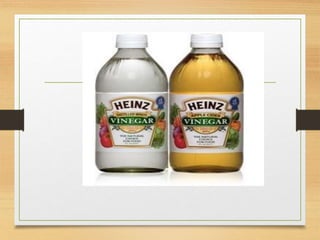
States is white or distilled vinegar. Vinegar is usually
described in terms of grain strength, the grain being
ten times the acid percentage. For example 10% acid
is referred to as 100 grain (Cruess 1958).
• Balsamic vinegar is brown in color with a sweet-sour flavor. It is
made from the white Trebbiano grape and aged in barrels of
various woods. Some gourmet Balsamic vinegars are over 100
years old.
• Cane vinegar is made from fermented sugarcane and has a very
mild, rich-sweet flavor. It is most commonly used in Philippine
cooking.
• Champagne vinegar has no bubbles. It's made from a still, dry
white wine made from Chardonnay or Pinot Noir grapes (both
of which are used to make Champagne).
• Cider vinegar is made from apples and is the most popular
vinegar used for cooking in the United States.
• Coconut vinegar is low in acidity, with a musty flavor and a
unique aftertaste. It is used in many Thai dishes.
• Distilled vinegar is harsh vinegar made from grains and is usually
colorless. It is best used only for pickling.
• Malt vinegar is very popular in England. It's made from
fermented barley and grain mash, and flavored with woods such
as beech or birch. It has a hearty flavor and is often served with
fish and chips.
• Rice wine vinegar has been made by the Chinese for over 5,000
years. There are three kinds of rice wine vinegar: red (used as a
dip for foods and as a condiment in soups), white (used mostly in
sweet and sour dishes), and black (common in stir-fries and
dressings).
• Sherry vinegar is aged under the full heat of the sun in wooden
barrels and has a nutty-sweet taste.
• Wine vinegar can be made from white, red, or rose wine. These
vinegars make the best salad dressings.
• Vinegar Qualities Characteristics
• The vinegar qualities depend on process conditions including
acetification speed.
• The rate of fermentation influences the sensory properties of
the final vinegar, but
• some believe there are no differences between vinegars obtained
at different
• fermentation speeds. Experts usually detect important sensory
differences between
• vinegar manufactured by the submerged and generator processes
(Nieto et al 1993).
Vinegar Aroma
• The characterization of vinegar includes a wide range of values
obtained from
• physicochemical and sensory parameters (Carnacini and Gerbi
1992). Various
• researches characterized the quality of vinegars using different
analytical parameters
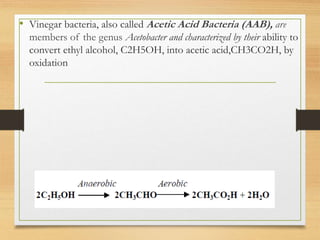
• Vinegar bacteria, also called Acetic Acid Bacteria (AAB), are
members of the genus Acetobacter and characterized by their ability to
convert ethyl alcohol, C2H5OH, into acetic acid,CH3CO2H, by
oxidation
production
• Vinegar is made from a variety of diluted alcohol
products, the most common being wine, beer, and rice.
• Acetobacters are microscopic bacteria that live on oxygen
bubbles. Whereas the fermentation of grapes to make
wine or beer occurs in the absence of oxygen, the process
of making vinegars relies on its presence.
• In the natural processes, the acetobacters are allowed to
grow over time. In the vinegar factory, this process is
induced by feeding acetozym nutrients into the tanks of
alcohol.
Mother of vinegar
• is the gooey film that appears on the surface of the alcohol
product as it is converted to vinegar.
• It is a natural carbohydrates called cellulose. This film holds the
highest concentration of acetobacters. It is skimmed off the top
and added to subsequent batches of alcohol to speed the
formation of vinegar. Acetozym nutrients are manmade mother
of vinegar in a powdered form.
• Herbs and fruits are often used to flavor vinegar. Commonly
used herbs include garlic, and basil. Popular fruits include
raspberries, cherries, and lemons
The Orleans method
• Wooden barrels are laid on their sides. Bungholes are drilled into the
top side and plugged with stoppers. Holes are also drilled into the ends
of the barrels.
• The alcohol is poured into the barrel via long-necked funnels inserted
into the bungholes. Mother of vinegar is added at this point. The barrel
is filled to a level just below the holes on the ends. Netting or screens
are placed over the holes to prevent insects from getting into the
barrels.
• The filled barrels are allowed to sit for several months. The room
temperature is kept at approximately 85°F (29°C). Samples are taken
periodically by inserting a spigot into the side holes and drawing liquid
off. When the alcohol has converted to vinegar, it is drawn off through
the spigot. About 15% of the liquid is left in the barrel to blend with
the next batch
submerged fermentation
method
• The submerged fermentation method is commonly used in the production of
wine vinegars. Production plants are filled with large stainless steel tanks called
acetators. The acetators are fitted with centrifugal pumps in the bottom that
pump air bubbles into the tank in much the same way that an aquarium pump
does.
• As the pump stirs the alcohol, acetozym nutrients are piped into the tank. The
nutrients spur the growth of acetobacters on the oxygen bubbles. A heater in
the tank keeps the temperature between 80 and 100°F (26-38°C).
• Within a matter of hours, the alcohol product has been converted into
vinegar. The vinegar is piped from the acetators to a plate-and-frame filtering
machine. The stainless steel plates press the alcohol through paper filters to
remove any sediment, usually about 3% of the total product. The sediment is
flushed into a drain while the filtered vinegar moves to the dilution station
The generator method
• Distilled and industrial vinegars are often produced via the generator method.
Tall oak vats are filled with vinegar-moistened beechwood shavings, charcoal,
or grape pulp. The alcohol product is poured into the top of the vat and
slowly drips down through the fillings.
• Oxygen is allowed into the vats in two ways. One is through bungholes that
have been punched into the sides of the vats. The second is through the
perforated bottoms of the vats. An air compressor blows air through the
holes.
• When the alcohol product reaches the bottom of the vat, usually within in a
span of several days to several weeks, it has converted to vinegar. It is poured
off from the bottom of the vat into storage tanks. The vinegar produced in
this method has a very high acetic acid content, often as high as 14%, and
must be diluted with water to bring its acetic acid content to a range of 5-6%.
Bascsamic vinegar
• The production of balsamic vinegar most closely resembles the
production of fine wine. In order to bear the name balsamic, the
vinegar must be made from the juices of the Trebbiano and
Lambrusco grapes. The juice is blended and boiled over a fire. It is
then poured into barrels of oak, chestnut, cherry, mulberry, and
ash.
• The juice is allowed to age, ferment, and condense for five years. At
the beginning of each year, the aging liquid is mixed with younger
vinegars and placed in a series of smaller barrels. The finished
product absorbs aroma from the oak and color from the chestnut.
Applications
• The use of vinegar to fight infections and other acute conditions dates back to
Hippocrates , who recommended a vinegar preparation for cleaning ulcerations and
for the treatment of sores.
• Oxymel, a popular ancient medicine composed of honey and vinegar, was
prescribed for persistent coughs by Hippocrates and his contemporaries, and by
physicians up to modern day.
Antitumor activity
• In vitro,sugar cane vinegar (Kibizu)induced apoptosis in human leukemiacells, and a
traditionalJapanese rice vinegar (Kurosu) inhibitedthe proliferationof human cancer cells in
a dose-dependent manner.
• In the human colonic adenocarcinoma cell lineCaco-2, acetate treatment,as well as treatment
with the other short-chain fatty acids (SCFA) n-butyrate and propionate, significantly
prolonged cell doubling time,promoted cell differentiation,and inhibitedcell motility.
• Vinegars are also a dietarysource of polyphenols, compoundssynthesizedby plantsto defend
against oxidative stress.
• Ingestionof polyphenols in humans enhancesin vivo antioxidantprotectionand reducescancer
risk
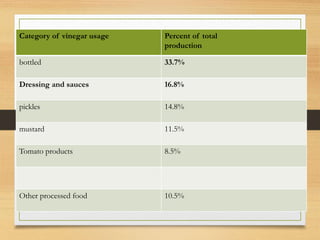
Category of vinegar usage Percent of total
production
bottled 33.7%
Dressing and sauces 16.8%
pickles 14.8%
mustard 11.5%
Tomato products 8.5%
Other processed food 10.5%
Fermentation of vineger

Fermentation of vineger

  • 2.
    Topic: Fermentation of vinegar Subject: Foodand Dairy Micro biology Submitted To: Dr Zeeshan Nawaz Submitted by: 4th Stars
  • 4.
    Introduction • Vinegar maybe defined as a condiment made from various sugary and starchy materials by alcoholic and subsequent acetic fermentation (Cruess 1958). • Vinegar can be produced by different methods and from various raw materials. Wine (white, red, and sherry wine), cider, fruit musts, malted barley, or pure alcohol • are used as substrates.
  • 5.
    Background • Vinegar isthe product made from the conversion of ethyl alcohol to acetic acid by a genus of bacteria, Acetobacter. Therefore, vinegar can be produced from any alcoholic material from alcohol-water mixtures to various fruit wines (Peppler and Beaman 1967). Its color and aroma are greatly dependent on the material from which it is made (Kehrer 1921).
  • 6.
    Vineger history • Vinegaris the world's oldest cooking ingredient and food preservation method. According to the Vinegar Institute (Vinegar Institute 2005), vinegar's use can be traced back over 10,000 years. In fact, flavored vinegars have been manufactured and sold for almost 5,000 years. The wide variety of vinegars available today is nothing new. Until the six century BC, the Babylonians were making and selling vinegars flavored with fruit, honey, malt, etc. to gourmets of the time. In addition, the Old Testament and Hippocrates recorded the use of vinegar for medicinal purposes.
  • 7.
    Types of vineger •The predominant type of vinegar in the United States is white or distilled vinegar. Vinegar is usually described in terms of grain strength, the grain being ten times the acid percentage. For example 10% acid is referred to as 100 grain (Cruess 1958).
  • 8.
    • Balsamic vinegaris brown in color with a sweet-sour flavor. It is made from the white Trebbiano grape and aged in barrels of various woods. Some gourmet Balsamic vinegars are over 100 years old. • Cane vinegar is made from fermented sugarcane and has a very mild, rich-sweet flavor. It is most commonly used in Philippine cooking. • Champagne vinegar has no bubbles. It's made from a still, dry white wine made from Chardonnay or Pinot Noir grapes (both of which are used to make Champagne).
  • 9.
    • Cider vinegaris made from apples and is the most popular vinegar used for cooking in the United States. • Coconut vinegar is low in acidity, with a musty flavor and a unique aftertaste. It is used in many Thai dishes. • Distilled vinegar is harsh vinegar made from grains and is usually colorless. It is best used only for pickling. • Malt vinegar is very popular in England. It's made from fermented barley and grain mash, and flavored with woods such as beech or birch. It has a hearty flavor and is often served with fish and chips.
  • 10.
    • Rice winevinegar has been made by the Chinese for over 5,000 years. There are three kinds of rice wine vinegar: red (used as a dip for foods and as a condiment in soups), white (used mostly in sweet and sour dishes), and black (common in stir-fries and dressings). • Sherry vinegar is aged under the full heat of the sun in wooden barrels and has a nutty-sweet taste. • Wine vinegar can be made from white, red, or rose wine. These vinegars make the best salad dressings.
  • 11.
    • Vinegar QualitiesCharacteristics • The vinegar qualities depend on process conditions including acetification speed. • The rate of fermentation influences the sensory properties of the final vinegar, but • some believe there are no differences between vinegars obtained at different • fermentation speeds. Experts usually detect important sensory differences between • vinegar manufactured by the submerged and generator processes (Nieto et al 1993).
  • 12.
    Vinegar Aroma • Thecharacterization of vinegar includes a wide range of values obtained from • physicochemical and sensory parameters (Carnacini and Gerbi 1992). Various • researches characterized the quality of vinegars using different analytical parameters
  • 13.
    • Vinegar bacteria,also called Acetic Acid Bacteria (AAB), are members of the genus Acetobacter and characterized by their ability to convert ethyl alcohol, C2H5OH, into acetic acid,CH3CO2H, by oxidation
  • 14.
    production • Vinegar ismade from a variety of diluted alcohol products, the most common being wine, beer, and rice. • Acetobacters are microscopic bacteria that live on oxygen bubbles. Whereas the fermentation of grapes to make wine or beer occurs in the absence of oxygen, the process of making vinegars relies on its presence. • In the natural processes, the acetobacters are allowed to grow over time. In the vinegar factory, this process is induced by feeding acetozym nutrients into the tanks of alcohol.
  • 15.
    Mother of vinegar •is the gooey film that appears on the surface of the alcohol product as it is converted to vinegar. • It is a natural carbohydrates called cellulose. This film holds the highest concentration of acetobacters. It is skimmed off the top and added to subsequent batches of alcohol to speed the formation of vinegar. Acetozym nutrients are manmade mother of vinegar in a powdered form. • Herbs and fruits are often used to flavor vinegar. Commonly used herbs include garlic, and basil. Popular fruits include raspberries, cherries, and lemons
  • 16.
    The Orleans method •Wooden barrels are laid on their sides. Bungholes are drilled into the top side and plugged with stoppers. Holes are also drilled into the ends of the barrels. • The alcohol is poured into the barrel via long-necked funnels inserted into the bungholes. Mother of vinegar is added at this point. The barrel is filled to a level just below the holes on the ends. Netting or screens are placed over the holes to prevent insects from getting into the barrels. • The filled barrels are allowed to sit for several months. The room temperature is kept at approximately 85°F (29°C). Samples are taken periodically by inserting a spigot into the side holes and drawing liquid off. When the alcohol has converted to vinegar, it is drawn off through the spigot. About 15% of the liquid is left in the barrel to blend with the next batch
  • 17.
    submerged fermentation method • Thesubmerged fermentation method is commonly used in the production of wine vinegars. Production plants are filled with large stainless steel tanks called acetators. The acetators are fitted with centrifugal pumps in the bottom that pump air bubbles into the tank in much the same way that an aquarium pump does. • As the pump stirs the alcohol, acetozym nutrients are piped into the tank. The nutrients spur the growth of acetobacters on the oxygen bubbles. A heater in the tank keeps the temperature between 80 and 100°F (26-38°C). • Within a matter of hours, the alcohol product has been converted into vinegar. The vinegar is piped from the acetators to a plate-and-frame filtering machine. The stainless steel plates press the alcohol through paper filters to remove any sediment, usually about 3% of the total product. The sediment is flushed into a drain while the filtered vinegar moves to the dilution station
  • 18.
    The generator method •Distilled and industrial vinegars are often produced via the generator method. Tall oak vats are filled with vinegar-moistened beechwood shavings, charcoal, or grape pulp. The alcohol product is poured into the top of the vat and slowly drips down through the fillings. • Oxygen is allowed into the vats in two ways. One is through bungholes that have been punched into the sides of the vats. The second is through the perforated bottoms of the vats. An air compressor blows air through the holes. • When the alcohol product reaches the bottom of the vat, usually within in a span of several days to several weeks, it has converted to vinegar. It is poured off from the bottom of the vat into storage tanks. The vinegar produced in this method has a very high acetic acid content, often as high as 14%, and must be diluted with water to bring its acetic acid content to a range of 5-6%.
  • 19.
    Bascsamic vinegar • Theproduction of balsamic vinegar most closely resembles the production of fine wine. In order to bear the name balsamic, the vinegar must be made from the juices of the Trebbiano and Lambrusco grapes. The juice is blended and boiled over a fire. It is then poured into barrels of oak, chestnut, cherry, mulberry, and ash. • The juice is allowed to age, ferment, and condense for five years. At the beginning of each year, the aging liquid is mixed with younger vinegars and placed in a series of smaller barrels. The finished product absorbs aroma from the oak and color from the chestnut.
  • 20.
    Applications • The useof vinegar to fight infections and other acute conditions dates back to Hippocrates , who recommended a vinegar preparation for cleaning ulcerations and for the treatment of sores. • Oxymel, a popular ancient medicine composed of honey and vinegar, was prescribed for persistent coughs by Hippocrates and his contemporaries, and by physicians up to modern day.
  • 21.
    Antitumor activity • Invitro,sugar cane vinegar (Kibizu)induced apoptosis in human leukemiacells, and a traditionalJapanese rice vinegar (Kurosu) inhibitedthe proliferationof human cancer cells in a dose-dependent manner. • In the human colonic adenocarcinoma cell lineCaco-2, acetate treatment,as well as treatment with the other short-chain fatty acids (SCFA) n-butyrate and propionate, significantly prolonged cell doubling time,promoted cell differentiation,and inhibitedcell motility.
  • 22.
    • Vinegars arealso a dietarysource of polyphenols, compoundssynthesizedby plantsto defend against oxidative stress. • Ingestionof polyphenols in humans enhancesin vivo antioxidantprotectionand reducescancer risk
  • 23.
    Category of vinegarusage Percent of total production bottled 33.7% Dressing and sauces 16.8% pickles 14.8% mustard 11.5% Tomato products 8.5% Other processed food 10.5%