PNEUMONIA
Nursing Path
www.drjayeshpatidar.blogspot.com
Definition:
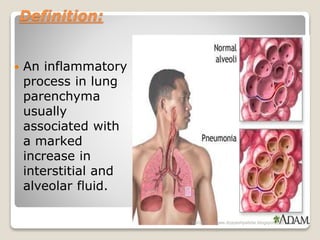
 An inflammatory
process in lung
parenchyma
usually
associated with
a marked
increase in
interstitial and
alveolar fluid.
6/6/2018 2www.drjayeshpatidar.blogspot.com
6/6/2018 3www.drjayeshpatidar.blogspot.com
Etiology & Risk factors:
Etiology:
 Bacteria, viruses, mycoplasmas, fungal
agents & protozoa.
 Aspiration of food, fluids, / vomitus.
 Inhalation of toxic/caustic chemicals, smoke,
dusts/gases.
 Influenza.
6/6/2018 4www.drjayeshpatidar.blogspot.com
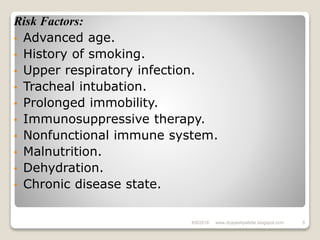
Risk Factors:
• Advanced age.
• History of smoking.
• Upper respiratory infection.
• Tracheal intubation.
• Prolonged immobility.
• Immunosuppressive therapy.
• Nonfunctional immune system.
• Malnutrition.
• Dehydration.
• Chronic disease state.
6/6/2018 5www.drjayeshpatidar.blogspot.com
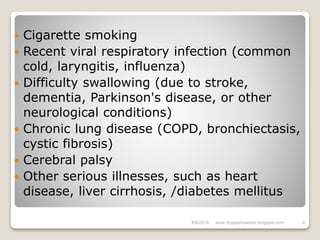
 Cigarette smoking
 Recent viral respiratory infection (common
cold, laryngitis, influenza)
 Difficulty swallowing (due to stroke,
dementia, Parkinson's disease, or other
neurological conditions)
 Chronic lung disease (COPD, bronchiectasis,
cystic fibrosis)
 Cerebral palsy
 Other serious illnesses, such as heart
disease, liver cirrhosis, /diabetes mellitus
6/6/2018 6www.drjayeshpatidar.blogspot.com
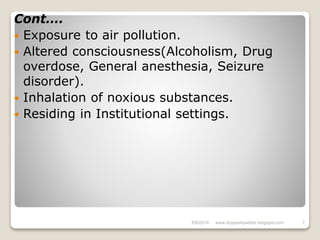
Cont….
 Exposure to air pollution.
 Altered consciousness(Alcoholism, Drug
overdose, General anesthesia, Seizure
disorder).
 Inhalation of noxious substances.
 Residing in Institutional settings.
6/6/2018 7www.drjayeshpatidar.blogspot.com
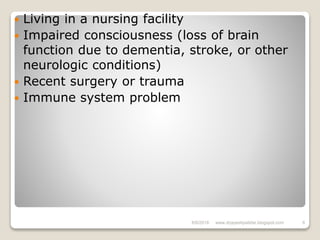
 Living in a nursing facility
 Impaired consciousness (loss of brain
function due to dementia, stroke, or other
neurologic conditions)
 Recent surgery or trauma
 Immune system problem
6/6/2018 8www.drjayeshpatidar.blogspot.com
Path-physiology:
Offending organism/agent.
Inflammatory pulmonary response.
Lose defense mechanisms of the lungs.
Allow organisms to penetrate the sterile LRT.
Develop inflammation.
6/6/2018 9www.drjayeshpatidar.blogspot.com
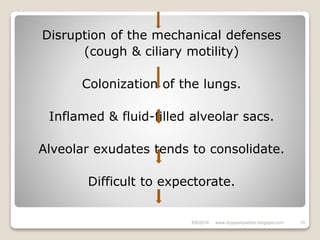
Disruption of the mechanical defenses
(cough & ciliary motility)
Colonization of the lungs.
Inflamed & fluid-filled alveolar sacs.
Alveolar exudates tends to consolidate.
Difficult to expectorate.
6/6/2018 10www.drjayeshpatidar.blogspot.com
Types:
1. Pneumococcal pneumonia:
 Caused by Streptococcus pneumonia.
 C/M:- high fever.
- stabbing pleuritic chest pain.
- malaise.
- weakness.
- elevated WBC count.
- tachypnea.
- dyspnea.
- blood-streaked purulent sputum.
6/6/2018 11www.drjayeshpatidar.blogspot.com
2. Staphylococcal pneumonia:
 Caused by Staphylococcus aureus.
 C/M:- fever with multiple chills.
- pleuritic pain.
- rales.
- decreased breath sounds.
- elevated WBC count.
- dyspnea.
- blood-streaked purulent sputum.
6/6/2018 12www.drjayeshpatidar.blogspot.com
3. Influenzal pneumonia:
 Caused by Haemophilus influenza.
 C/M:- high fever.
- stabbing pleuritic chest pain.
- malaise.
- weakness.
- elevated WBC count.
- tachypnea.
- dyspnea.
- blood-tinged purulent sputum.
6/6/2018 13www.drjayeshpatidar.blogspot.com
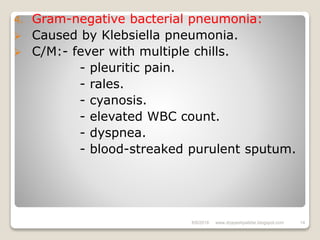
4. Gram-negative bacterial pneumonia:
 Caused by Klebsiella pneumonia.
 C/M:- fever with multiple chills.
- pleuritic pain.
- rales.
- cyanosis.
- elevated WBC count.
- dyspnea.
- blood-streaked purulent sputum.
6/6/2018 14www.drjayeshpatidar.blogspot.com
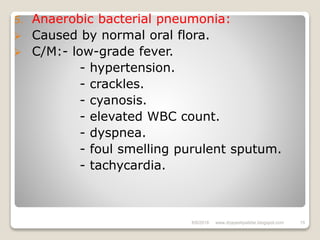
5. Anaerobic bacterial pneumonia:
 Caused by normal oral flora.
 C/M:- low-grade fever.
- hypertension.
- crackles.
- cyanosis.
- elevated WBC count.
- dyspnea.
- foul smelling purulent sputum.
- tachycardia.
6/6/2018 15www.drjayeshpatidar.blogspot.com
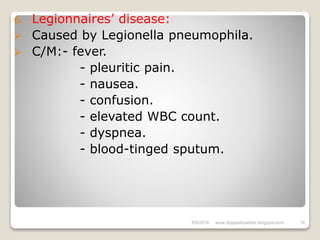
6. Legionnaires’ disease:
 Caused by Legionella pneumophila.
 C/M:- fever.
- pleuritic pain.
- nausea.
- confusion.
- elevated WBC count.
- dyspnea.
- blood-tinged sputum.
6/6/2018 16www.drjayeshpatidar.blogspot.com
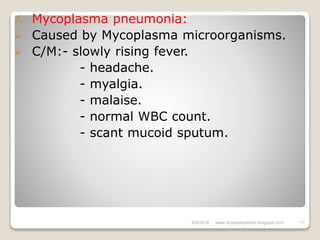
7. Mycoplasma pneumonia:
 Caused by Mycoplasma microorganisms.
 C/M:- slowly rising fever.
- headache.
- myalgia.
- malaise.
- normal WBC count.
- scant mucoid sputum.
6/6/2018 17www.drjayeshpatidar.blogspot.com
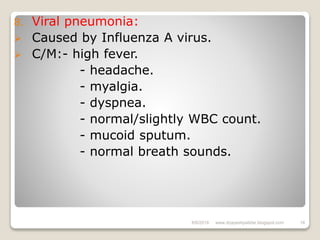
8. Viral pneumonia:
 Caused by Influenza A virus.
 C/M:- high fever.
- headache.
- myalgia.
- dyspnea.
- normal/slightly WBC count.
- mucoid sputum.
- normal breath sounds.
6/6/2018 18www.drjayeshpatidar.blogspot.com
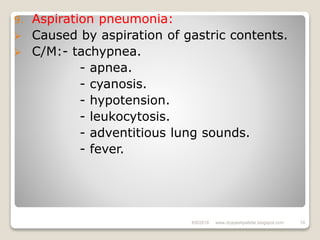
9. Aspiration pneumonia:
 Caused by aspiration of gastric contents.
 C/M:- tachypnea.
- apnea.
- cyanosis.
- hypotension.
- leukocytosis.
- adventitious lung sounds.
- fever.
6/6/2018 19www.drjayeshpatidar.blogspot.com
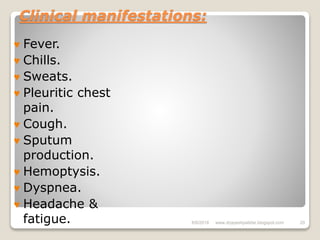
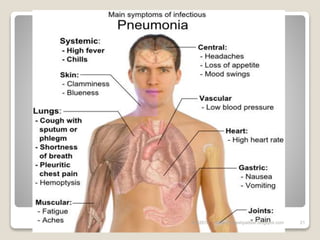
Clinical manifestations:
♥ Fever.
♥ Chills.
♥ Sweats.
♥ Pleuritic chest
pain.
♥ Cough.
♥ Sputum
production.
♥ Hemoptysis.
♥ Dyspnea.
♥ Headache &
fatigue. 6/6/2018 20www.drjayeshpatidar.blogspot.com
6/6/2018 21www.drjayeshpatidar.blogspot.com
Diagnostic evaluation:
Chest auscultation.
Sputum culture analysis & sensitivity/
serologic testing.
Fiber optic bronchoscopy/ Transcutaneous
needle aspiration/ biopsy.
Skin tests.
Blood & urine cultures.
Transcutaneous oxygen level analysis/ ABG
measurements.
Chest X-ray examination.
6/6/2018 22www.drjayeshpatidar.blogspot.com
Classification:
i. Based on area affected:
Segmental pneumonia.
Lobar pneumonia.
Bilateral pneumonia.
ii. Basis of location & radiologic appearance:
Bronchopneumonia.
Interstitial(reticular) pneumonia.
Alveolar(acinar) pneumonia.
Necrotizing pneumonia.
6/6/2018 23www.drjayeshpatidar.blogspot.com
Medical Management:
☻Specific antibiotic therapy: Broad spectrum
antibiotics.
☻Respiratory support:
 Administer oxygen.
 Bronchodilator medications.
 Postural drainage.
 Chest physiotherapy.
 Tracheal suctioning.
☻Nutritional support.
☻Fluid & electrolyte management.
6/6/2018 24www.drjayeshpatidar.blogspot.com
Nursing management:
Ineffective airway clearance R/t excessive
secretions & weak cough.
Ineffective breathing pattern R/t tachypnea.
Activity intolerance R/t decreased oxygen
levels for metabolic demands.
Deficient fluid volume R/t fever, diaphoresis,
& mouth breathing.
Imbalanced nutrition: less than body
requirements R/t dyspnea.
Pain R/t frequent coughing.
6/6/2018 25www.drjayeshpatidar.blogspot.com
Cont….
Impaired oral mucous membrane R/t mouth
breathing & frequent cough.
6/6/2018 26www.drjayeshpatidar.blogspot.com
Possible complications:
 Respiratory failure.
 Empyema or lung abscesses. These are
infrequent, but serious, complications of
pneumonia. They occur when pockets of pus
form inside or around the lung. These may
sometimes need to be drained with surgery.
 Sepsis, a condition in which there is
uncontrolled swelling (inflammation) in the
body, which may lead to organ failure
 Acute respiratory distress syndrome (ARDS),
a severe form of respiratory failure
6/6/2018 27www.drjayeshpatidar.blogspot.com
Pneumonia At A Glance:
Pneumonia is a lung infection that can be caused by
different types of microorganisms, including bacteria,
viruses, and fungi.
Symptoms of pneumonia include cough with sputum
production, fever, and sharp chest pain on inspiration
(breathing in).
Pneumonia is suspected when a doctor hears abnormal
sounds in the chest, and the diagnosis is confirmed by a
chest x-ray.
Bacteria causing pneumonia can be identified by sputum
culture.
6/6/2018 28www.drjayeshpatidar.blogspot.com
Thank You
6/6/2018 29www.drjayeshpatidar.blogspot.com

Pneumonia

  • 1.
  • 2.
    Definition:  An inflammatory processin lung parenchyma usually associated with a marked increase in interstitial and alveolar fluid. 6/6/2018 2www.drjayeshpatidar.blogspot.com
  • 3.
  • 4.
    Etiology & Riskfactors: Etiology:  Bacteria, viruses, mycoplasmas, fungal agents & protozoa.  Aspiration of food, fluids, / vomitus.  Inhalation of toxic/caustic chemicals, smoke, dusts/gases.  Influenza. 6/6/2018 4www.drjayeshpatidar.blogspot.com
  • 5.
    Risk Factors: • Advancedage. • History of smoking. • Upper respiratory infection. • Tracheal intubation. • Prolonged immobility. • Immunosuppressive therapy. • Nonfunctional immune system. • Malnutrition. • Dehydration. • Chronic disease state. 6/6/2018 5www.drjayeshpatidar.blogspot.com
  • 6.
     Cigarette smoking Recent viral respiratory infection (common cold, laryngitis, influenza)  Difficulty swallowing (due to stroke, dementia, Parkinson's disease, or other neurological conditions)  Chronic lung disease (COPD, bronchiectasis, cystic fibrosis)  Cerebral palsy  Other serious illnesses, such as heart disease, liver cirrhosis, /diabetes mellitus 6/6/2018 6www.drjayeshpatidar.blogspot.com
  • 7.
    Cont….  Exposure toair pollution.  Altered consciousness(Alcoholism, Drug overdose, General anesthesia, Seizure disorder).  Inhalation of noxious substances.  Residing in Institutional settings. 6/6/2018 7www.drjayeshpatidar.blogspot.com
  • 8.
     Living ina nursing facility  Impaired consciousness (loss of brain function due to dementia, stroke, or other neurologic conditions)  Recent surgery or trauma  Immune system problem 6/6/2018 8www.drjayeshpatidar.blogspot.com
  • 9.
    Path-physiology: Offending organism/agent. Inflammatory pulmonaryresponse. Lose defense mechanisms of the lungs. Allow organisms to penetrate the sterile LRT. Develop inflammation. 6/6/2018 9www.drjayeshpatidar.blogspot.com
  • 10.
    Disruption of themechanical defenses (cough & ciliary motility) Colonization of the lungs. Inflamed & fluid-filled alveolar sacs. Alveolar exudates tends to consolidate. Difficult to expectorate. 6/6/2018 10www.drjayeshpatidar.blogspot.com
  • 11.
    Types: 1. Pneumococcal pneumonia: Caused by Streptococcus pneumonia.  C/M:- high fever. - stabbing pleuritic chest pain. - malaise. - weakness. - elevated WBC count. - tachypnea. - dyspnea. - blood-streaked purulent sputum. 6/6/2018 11www.drjayeshpatidar.blogspot.com
  • 12.
    2. Staphylococcal pneumonia: Caused by Staphylococcus aureus.  C/M:- fever with multiple chills. - pleuritic pain. - rales. - decreased breath sounds. - elevated WBC count. - dyspnea. - blood-streaked purulent sputum. 6/6/2018 12www.drjayeshpatidar.blogspot.com
  • 13.
    3. Influenzal pneumonia: Caused by Haemophilus influenza.  C/M:- high fever. - stabbing pleuritic chest pain. - malaise. - weakness. - elevated WBC count. - tachypnea. - dyspnea. - blood-tinged purulent sputum. 6/6/2018 13www.drjayeshpatidar.blogspot.com
  • 14.
    4. Gram-negative bacterialpneumonia:  Caused by Klebsiella pneumonia.  C/M:- fever with multiple chills. - pleuritic pain. - rales. - cyanosis. - elevated WBC count. - dyspnea. - blood-streaked purulent sputum. 6/6/2018 14www.drjayeshpatidar.blogspot.com
  • 15.
    5. Anaerobic bacterialpneumonia:  Caused by normal oral flora.  C/M:- low-grade fever. - hypertension. - crackles. - cyanosis. - elevated WBC count. - dyspnea. - foul smelling purulent sputum. - tachycardia. 6/6/2018 15www.drjayeshpatidar.blogspot.com
  • 16.
    6. Legionnaires’ disease: Caused by Legionella pneumophila.  C/M:- fever. - pleuritic pain. - nausea. - confusion. - elevated WBC count. - dyspnea. - blood-tinged sputum. 6/6/2018 16www.drjayeshpatidar.blogspot.com
  • 17.
    7. Mycoplasma pneumonia: Caused by Mycoplasma microorganisms.  C/M:- slowly rising fever. - headache. - myalgia. - malaise. - normal WBC count. - scant mucoid sputum. 6/6/2018 17www.drjayeshpatidar.blogspot.com
  • 18.
    8. Viral pneumonia: Caused by Influenza A virus.  C/M:- high fever. - headache. - myalgia. - dyspnea. - normal/slightly WBC count. - mucoid sputum. - normal breath sounds. 6/6/2018 18www.drjayeshpatidar.blogspot.com
  • 19.
    9. Aspiration pneumonia: Caused by aspiration of gastric contents.  C/M:- tachypnea. - apnea. - cyanosis. - hypotension. - leukocytosis. - adventitious lung sounds. - fever. 6/6/2018 19www.drjayeshpatidar.blogspot.com
  • 20.
    Clinical manifestations: ♥ Fever. ♥Chills. ♥ Sweats. ♥ Pleuritic chest pain. ♥ Cough. ♥ Sputum production. ♥ Hemoptysis. ♥ Dyspnea. ♥ Headache & fatigue. 6/6/2018 20www.drjayeshpatidar.blogspot.com
  • 21.
  • 22.
    Diagnostic evaluation: Chest auscultation. Sputumculture analysis & sensitivity/ serologic testing. Fiber optic bronchoscopy/ Transcutaneous needle aspiration/ biopsy. Skin tests. Blood & urine cultures. Transcutaneous oxygen level analysis/ ABG measurements. Chest X-ray examination. 6/6/2018 22www.drjayeshpatidar.blogspot.com
  • 23.
    Classification: i. Based onarea affected: Segmental pneumonia. Lobar pneumonia. Bilateral pneumonia. ii. Basis of location & radiologic appearance: Bronchopneumonia. Interstitial(reticular) pneumonia. Alveolar(acinar) pneumonia. Necrotizing pneumonia. 6/6/2018 23www.drjayeshpatidar.blogspot.com
  • 24.
    Medical Management: ☻Specific antibiotictherapy: Broad spectrum antibiotics. ☻Respiratory support:  Administer oxygen.  Bronchodilator medications.  Postural drainage.  Chest physiotherapy.  Tracheal suctioning. ☻Nutritional support. ☻Fluid & electrolyte management. 6/6/2018 24www.drjayeshpatidar.blogspot.com
  • 25.
    Nursing management: Ineffective airwayclearance R/t excessive secretions & weak cough. Ineffective breathing pattern R/t tachypnea. Activity intolerance R/t decreased oxygen levels for metabolic demands. Deficient fluid volume R/t fever, diaphoresis, & mouth breathing. Imbalanced nutrition: less than body requirements R/t dyspnea. Pain R/t frequent coughing. 6/6/2018 25www.drjayeshpatidar.blogspot.com
  • 26.
    Cont…. Impaired oral mucousmembrane R/t mouth breathing & frequent cough. 6/6/2018 26www.drjayeshpatidar.blogspot.com
  • 27.
    Possible complications:  Respiratoryfailure.  Empyema or lung abscesses. These are infrequent, but serious, complications of pneumonia. They occur when pockets of pus form inside or around the lung. These may sometimes need to be drained with surgery.  Sepsis, a condition in which there is uncontrolled swelling (inflammation) in the body, which may lead to organ failure  Acute respiratory distress syndrome (ARDS), a severe form of respiratory failure 6/6/2018 27www.drjayeshpatidar.blogspot.com
  • 28.
    Pneumonia At AGlance: Pneumonia is a lung infection that can be caused by different types of microorganisms, including bacteria, viruses, and fungi. Symptoms of pneumonia include cough with sputum production, fever, and sharp chest pain on inspiration (breathing in). Pneumonia is suspected when a doctor hears abnormal sounds in the chest, and the diagnosis is confirmed by a chest x-ray. Bacteria causing pneumonia can be identified by sputum culture. 6/6/2018 28www.drjayeshpatidar.blogspot.com
  • 29.