Isolation
Facility
Nursing
Path
Scope of the session
• Guidance to establish an isolation facility at the level of district
hospital
08-04-2020www.nursingpath.in 2
Cluster containment
• Active surveillance
• Early detection
• Isolation & case management
• Contact tracing and prevention of onward transmission by quarantine
of contacts
Isolation of cases and quarantine of contacts are the mainstay of
outbreak containment
08-04-2020www.nursingpath.in 3
Quarantine & Isolation
• Presence of Illness
• Presence of exposure
• Type of patient
08-04-2020www.nursingpath.in 4
Isolation
• All suspect cases detected in the containment/buffer zones (till a
diagnosis is made), will be hospitalized and kept in isolation in a
designated facility till such time they are tested negative.
• Persons testing positive for COVID-19 will remain to be hospitalized till
such time 2 of their samples are tested negative.
• About 15% of the patients are likely to develop pneumonia, 5 % of
whom requires ventilator management.
08-04-2020www.nursingpath.in 5
Isolation Facility
• Separate isolation for ‘Confirmed’ and ‘Suspected’ cases. Under no
circumstances suspected & confirmed cases should be mixed up.
• Separate Intensive Care Unit and High Dependency Unit with facility
manage multiorgan failure (CCU).
• If such facilities are not available in the containment zone, nearest
tertiary care facility in Government / private sector needs to be
identified.
08-04-2020www.nursingpath.in 6
Isolation Facility
• Ideally, patients can be isolated in individual isolation rooms or
negative pressure rooms with 12 or more air-changes per hour (ACH) =
High Risk Setting
• In resource constrained settings, all positive COVID-19 cases can be
cohorted in a ward with good ventilation (natural) = Typical Health
Care Settings (can provide up to 6 ACH)
• How to ascertain?
08-04-2020www.nursingpath.in 7
Isolation Facility
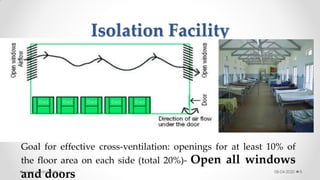
Goal for effective cross-ventilation: openings for at least 10% of
the floor area on each side (total 20%)- Open all windows
and doors 08-04-2020www.nursingpath.in 8
Isolation Facility
• A minimum distance of 1 meter needs to be maintained between
adjacent beds.(In ICU it is 3 meter)
• All patients need to wear a triple layer surgical mask at all times.
(Source isolation)
08-04-2020www.nursingpath.in 9
Isolation Facility
• Nosocomial infection in fellow patients and attending healthcare
personnel are well documented in the current COVID-19 outbreak.
• Strict adherence to infection prevention control practices.
• IPC committees would be formed (if not already in place).
• All healthcare personnel are well aware of IPC practices and
suitable arrangements for requisite PPE and other logistic (hand
sanitizer, soap, water etc.) are in place.
08-04-2020www.nursingpath.in 10
Isolation Facility
• Ensure that all healthcare staff is trained in
- washing of hands,
- respiratory etiquettes,
- donning/doffing & proper disposal of PPEs and bio-medical waste
management
08-04-2020www.nursingpath.in 11
Isolation Facility
• At all times doctors, nurses and para-medics working in the clinical
areas will wear three layered surgical mask and gloves.
• The medical personnel working in isolation and critical care facilities
will wear full complement of PPE (including N95 masks).
• The support staff engaged in cleaning and disinfection will also
wear full complement of PPE.
• Environmental cleaning should be done twice daily and consist of
damp dusting and floor mopping with Lysol or other phenolic
disinfectants and cleaning of surfaces with sodium hypochlorite
solution. 08-04-2020www.nursingpath.in 12
Setting up an Isolation Facility
• It should be in a segregated area which is not frequented by outsiders.
• Post signages on the door indicating that the space is an isolation area.
• Remove all non-essential furniture and ensure that the remaining furniture is
easy to clean and does not conceal or retain dirt or moisture within or
around it.
• COVID-19 patients should be housed in single rooms. However, if sufficient
single rooms are not available, beds could be put with a spatial separation
of at least 1 meter (3 feet) from one another.
08-04-2020www.nursingpath.in 13
Setting up an Isolation Facility
• The isolation ward should have a separate entry/exit and should not
be co-located with any other patients care settings.
• The access to isolation ward should be through dedicated
lift/guarded stairs.
• There should be double door entry with changing room and nursing
station. Enough PPE should be available in the changing room with
waste disposal bins to collect used PPEs. Used PPEs should be disposed
as per the BMWM guidelines.
08-04-2020www.nursingpath.in 14
Setting up an Isolation Facility
• Stock the PPE supply and linen outside the isolation room or area (e.g.
in the change room). Setup a trolley outside the door to hold PPE. A
checklist may be useful to ensure that all equipment is available.
• Place appropriate waste bags in a bin. If possible, use a touch-free
bin. Ensure that used (i.e. dirty) bins remain inside the isolation rooms.
• Place a puncture-proof container for sharps disposal inside the
isolation room/area and bio-medical waste should be managed as
per the BMWM guidelines.
08-04-2020www.nursingpath.in 15
Setting up an Isolation Facility
• Keep the patient’s personal belongings to a minimum. Keep water
pitchers and cups, tissue wipes, and all items necessary for attending
to personal hygiene within the patient’s reach.
• Non-critical patient-care equipment (e.g. stethoscope, thermometer,
blood pressure cuff, and sphygmomanometer) should be dedicated
for the patient, if possible. Any patient-care equipment that is required
for use by other patients should be thoroughly cleaned and
disinfected before use.
08-04-2020www.nursingpath.in 16
Setting up an Isolation Facility
• Ensure that appropriate hand washing facilities and hand-hygiene
supplies are available. Stock the sink area with suitable supplies for
hand washing, and with alcohol-based hand rub, near the point of
care and the room door.
• The isolation ward should have a separate toilet with proper cleaning
and supplies.
• Ensure regular cleaning and proper disinfection of common areas,
and adequate hand hygiene by patients, visitors and care givers.
08-04-2020www.nursingpath.in 17
Setting up an Isolation Facility
• Visitors to the isolation facility should be restricted /disallowed. For
unavoidable entries, they should use PPE according to the hospital
guidance, and should be instructed on its proper use and in hand
hygiene practices prior to entry into the isolation room/area.
• Ensure that visitors consult the health-care worker in charge (who is
also responsible for keeping a visitor record) before being allowed into
the isolation areas.
08-04-2020www.nursingpath.in 18
Setting up an Isolation Facility
• Doctors, nurses and paramedics posted to isolation facility need to be
dedicated and not allowed to work in other patient-care areas.
• Consider having designated portable X-ray and portable ultrasound
equipment.
• Corridors with frequent patient transport should be well-ventilated.
• Set up a telephone or other method of communication in the isolation
room or area to enable patients, family members or visitors to
communicate with health-care workers.
08-04-2020www.nursingpath.in 19
08-04-2020www.nursingpath.in 20
08-04-2020www.nursingpath.in 21
Thank you
08-04-2020www.nursingpath.in 22

Isolation facility for covid-19

  • 1.
  • 2.
    Scope of thesession • Guidance to establish an isolation facility at the level of district hospital 08-04-2020www.nursingpath.in 2
  • 3.
    Cluster containment • Activesurveillance • Early detection • Isolation & case management • Contact tracing and prevention of onward transmission by quarantine of contacts Isolation of cases and quarantine of contacts are the mainstay of outbreak containment 08-04-2020www.nursingpath.in 3
  • 4.
    Quarantine & Isolation •Presence of Illness • Presence of exposure • Type of patient 08-04-2020www.nursingpath.in 4
  • 5.
    Isolation • All suspectcases detected in the containment/buffer zones (till a diagnosis is made), will be hospitalized and kept in isolation in a designated facility till such time they are tested negative. • Persons testing positive for COVID-19 will remain to be hospitalized till such time 2 of their samples are tested negative. • About 15% of the patients are likely to develop pneumonia, 5 % of whom requires ventilator management. 08-04-2020www.nursingpath.in 5
  • 6.
    Isolation Facility • Separateisolation for ‘Confirmed’ and ‘Suspected’ cases. Under no circumstances suspected & confirmed cases should be mixed up. • Separate Intensive Care Unit and High Dependency Unit with facility manage multiorgan failure (CCU). • If such facilities are not available in the containment zone, nearest tertiary care facility in Government / private sector needs to be identified. 08-04-2020www.nursingpath.in 6
  • 7.
    Isolation Facility • Ideally,patients can be isolated in individual isolation rooms or negative pressure rooms with 12 or more air-changes per hour (ACH) = High Risk Setting • In resource constrained settings, all positive COVID-19 cases can be cohorted in a ward with good ventilation (natural) = Typical Health Care Settings (can provide up to 6 ACH) • How to ascertain? 08-04-2020www.nursingpath.in 7
  • 8.
    Isolation Facility Goal foreffective cross-ventilation: openings for at least 10% of the floor area on each side (total 20%)- Open all windows and doors 08-04-2020www.nursingpath.in 8
  • 9.
    Isolation Facility • Aminimum distance of 1 meter needs to be maintained between adjacent beds.(In ICU it is 3 meter) • All patients need to wear a triple layer surgical mask at all times. (Source isolation) 08-04-2020www.nursingpath.in 9
  • 10.
    Isolation Facility • Nosocomialinfection in fellow patients and attending healthcare personnel are well documented in the current COVID-19 outbreak. • Strict adherence to infection prevention control practices. • IPC committees would be formed (if not already in place). • All healthcare personnel are well aware of IPC practices and suitable arrangements for requisite PPE and other logistic (hand sanitizer, soap, water etc.) are in place. 08-04-2020www.nursingpath.in 10
  • 11.
    Isolation Facility • Ensurethat all healthcare staff is trained in - washing of hands, - respiratory etiquettes, - donning/doffing & proper disposal of PPEs and bio-medical waste management 08-04-2020www.nursingpath.in 11
  • 12.
    Isolation Facility • Atall times doctors, nurses and para-medics working in the clinical areas will wear three layered surgical mask and gloves. • The medical personnel working in isolation and critical care facilities will wear full complement of PPE (including N95 masks). • The support staff engaged in cleaning and disinfection will also wear full complement of PPE. • Environmental cleaning should be done twice daily and consist of damp dusting and floor mopping with Lysol or other phenolic disinfectants and cleaning of surfaces with sodium hypochlorite solution. 08-04-2020www.nursingpath.in 12
  • 13.
    Setting up anIsolation Facility • It should be in a segregated area which is not frequented by outsiders. • Post signages on the door indicating that the space is an isolation area. • Remove all non-essential furniture and ensure that the remaining furniture is easy to clean and does not conceal or retain dirt or moisture within or around it. • COVID-19 patients should be housed in single rooms. However, if sufficient single rooms are not available, beds could be put with a spatial separation of at least 1 meter (3 feet) from one another. 08-04-2020www.nursingpath.in 13
  • 14.
    Setting up anIsolation Facility • The isolation ward should have a separate entry/exit and should not be co-located with any other patients care settings. • The access to isolation ward should be through dedicated lift/guarded stairs. • There should be double door entry with changing room and nursing station. Enough PPE should be available in the changing room with waste disposal bins to collect used PPEs. Used PPEs should be disposed as per the BMWM guidelines. 08-04-2020www.nursingpath.in 14
  • 15.
    Setting up anIsolation Facility • Stock the PPE supply and linen outside the isolation room or area (e.g. in the change room). Setup a trolley outside the door to hold PPE. A checklist may be useful to ensure that all equipment is available. • Place appropriate waste bags in a bin. If possible, use a touch-free bin. Ensure that used (i.e. dirty) bins remain inside the isolation rooms. • Place a puncture-proof container for sharps disposal inside the isolation room/area and bio-medical waste should be managed as per the BMWM guidelines. 08-04-2020www.nursingpath.in 15
  • 16.
    Setting up anIsolation Facility • Keep the patient’s personal belongings to a minimum. Keep water pitchers and cups, tissue wipes, and all items necessary for attending to personal hygiene within the patient’s reach. • Non-critical patient-care equipment (e.g. stethoscope, thermometer, blood pressure cuff, and sphygmomanometer) should be dedicated for the patient, if possible. Any patient-care equipment that is required for use by other patients should be thoroughly cleaned and disinfected before use. 08-04-2020www.nursingpath.in 16
  • 17.
    Setting up anIsolation Facility • Ensure that appropriate hand washing facilities and hand-hygiene supplies are available. Stock the sink area with suitable supplies for hand washing, and with alcohol-based hand rub, near the point of care and the room door. • The isolation ward should have a separate toilet with proper cleaning and supplies. • Ensure regular cleaning and proper disinfection of common areas, and adequate hand hygiene by patients, visitors and care givers. 08-04-2020www.nursingpath.in 17
  • 18.
    Setting up anIsolation Facility • Visitors to the isolation facility should be restricted /disallowed. For unavoidable entries, they should use PPE according to the hospital guidance, and should be instructed on its proper use and in hand hygiene practices prior to entry into the isolation room/area. • Ensure that visitors consult the health-care worker in charge (who is also responsible for keeping a visitor record) before being allowed into the isolation areas. 08-04-2020www.nursingpath.in 18
  • 19.
    Setting up anIsolation Facility • Doctors, nurses and paramedics posted to isolation facility need to be dedicated and not allowed to work in other patient-care areas. • Consider having designated portable X-ray and portable ultrasound equipment. • Corridors with frequent patient transport should be well-ventilated. • Set up a telephone or other method of communication in the isolation room or area to enable patients, family members or visitors to communicate with health-care workers. 08-04-2020www.nursingpath.in 19
  • 20.
  • 21.
  • 22.