PNEUMONIA
Dr Muhammed Aslam
MBBS , MD Pulmonary Medicine
KUHS Exam - Model Question
Essay Question- 10 Marks (1+2+3+2+2=10)
60 yrs old male smoker with DM presented
to OPD with high grade fever , right sided chest pain and cough with
rusty sputum for 1 week ?
•Give your provisional diagnosis ?
•How will you diagnose?
•What are the causes and pathogenesis ?
•How will you Manage?
•What are the complications ?
Outline
•Introduction
•Risk factors
•Pathogenesis
•Types
•Etiology
•Clinical features
•Investigation
•Treatment
•Complication
•Prevention
Pneumonia
Pneumonia is an infection
in one or both lungs.
Pneumonia causes
inflammation in the alveoli.
The alveoli are filled with
fluid or pus, making it
difficult to breathe.

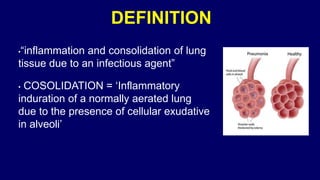
DEFINITION
•“inflammation and consolidation of lung
tissue due to an infectious agent”
• COSOLIDATION = ‘Inflammatory
induration of a normally aerated lung
due to the presence of cellular exudative
in alveoli’
How does Pneumonia develop?
•Most of the time, the body filters organisms.
•This keeps the lungs from becoming infected.
•But organisms sometimes enter the lungs and
cause infections.
•This is more likely to occur when:
•immune system is weak.
•organism is very strong.
•body fails to filter the organisms.
•
•
Factors that predispose to Pneumonia
Cigarette smoking
Upper respiratory tract infections
Alcohol
Corticosteroid therapy
Old age
Recent influenza infection
Pre-existing lung disease
Factors that predispose to Pneumonia
Reduced host defences against bacteria
•Reduced immune defences (e.g. corticosteroid treatment,
diabetes, malignancy)
•Reduced cough reflex (e.g. post-operative)
•Disordered mucociliary clearance (e.g. anaesthetic agents)
•Bulbar or vocal cord palsy
Factors that predispose to Pneumonia
Aspiration of nasopharyngeal or gastric secretions
•Immobility or reduced conscious level
•Vomiting, dysphagia, achalasia or severe reflux
•Nasogastric intubation
Bacteria introduced into lower respiratory tract
•Endotracheal intubation/tracheostomy
•Infected ventilators/nebulisers/bronchoscopes
•Dental or sinus infection
Factors that predispose to Pneumonia
Bacteraemia
Abdominal sepsis
Intravenous cannula infection
Infected emboli
How does Pneumonia develop?
PATHOLOGY
Congestion
•Presence of a proteinaceous
exudate—and often of bacteria—in
the alveoli
RED HEPATIZATION
•Presence of erythrocytes in the cellular
intraalveolar exudate
•Neutrophils are also present
•Bacteria are occasionally seen in
cultures of alveolar specimens collected
Normal Lung Red Hepatization
GRAY HEPATIZATION
•No new erythrocytes are extravasating, and those
already present have been lysed and degraded
•Neutrophil is the predominant cell
•Fibrin deposition is abundant
•Bacteria have disappeared
•Corresponds with successful containment of the
infection and improvement in gas exchange
RESOLUTION
Macrophage is the dominant cell type in the alveolar space
Debris of neutrophils, bacteria, and fibrin has been cleared
Types of Pneumonia
ANATOMICAL CLASSIFICATION
1.Bronchopneumonia affects the lungs in
patches around bronchi
1.Lobar pneumonia is an infection that
only involves a single lobe, or section, of
a lung.
1.Interstitial pneumonia involves the
areas in between the alveoli
CLINICAL CLASSIFICATION
1)Community Acquired - Typical/Atypical/Aspiration
1)Pneumonia in Elderly
1)Nosocomial- HAP,VAP,HCAP
1)Pneumonia in Immunocompromised host
Community Acquired Pneumonia (CAP)
DEFINITION:
•An infection of the pulmonary parenchyma
•Associated with symptoms of a/c infection
•Presence of a/c infiltrates on CXR or auscultatory findings
consistent with Pneumonia
•In a patient not hospitalized or residing in LTC facility for >
14 days prior
•
Hospital Acquired pneumonia - HAP
•HAP is defined as pneumonia that occurs 48 hours or more
after admission, which was not incubating at the time of
admission.
•
Ventilator Associated Pneumonia- VAP
•VAP refers to pneumonia that arises
more than 48–72 hours after
endotracheal intubation .
•
Health Care Associated Pneumonia HCAP
HCAP includes any patient
•Who was hospitalized in an acute care hospital for 2 or more days
within 90 days of the infection
•Resided in a nursing home or long-term care facility
•Received recent i.v antibiotic therapy, chemotherapy, or wound care
within the past 30 days of the current infection
•Attended a hospital or hemodialysis clinic
•
ATYPICAL PNEUMONIA - Why ‘Atypical’?
Clinically
•Subacute onset
•Fever less common or intense
•Minimal sputum
Microbiologically
•Sputum does not reveal a predominant microbial etiology
on routine smears (Gram’s stain, Ziehl-Neelsen) or cultures
•
ATYPICAL PNEUMONIA - Why ‘Atypical’?
Radiologically
•Patchy infiltrates or
•Interstitial pattern
Haemogram
•Peripheral leukocytosis are less common or intense
Causes of Atypical Pneumonia
Aspiration pneumonia
•Overt episode of aspiration or
bronchial obstruction by a foreign body.
•Seen in - alcoholism, nocturnal
esophageal reflux, a prolonged session
in the dental chair, epilepsy
•Usually Anaerobes
ELDERLY
•Infection has a more gradual onset, with
less fever and cough
•often with a decline in mental status or
confusion and generalized weakness
•often with less readily elicited signs of
consolidation
MICROBIOLOGY
Etiology
Bacterial
Viral
mycobacterial
Fungal
parasitic
Etiology
Microbiological diagnosis - 40-71%
Streptococcus pneumoniae most common
Viruses – 10-36%
In India - Streptococci pneumonia (35.3%)
Staphylococcus aureus (23.5%)
Klebsiella pneumonia (20.5%)
Haemophilus influenzae (8.8%)
Mycoplasma pneumoniae
Legionella pneumophila
VAP Micro
Harrison's Principles of Internal Medicine
GENERAL SYMPTOMS
•High grade fever
•Cough-productive
•Pleuritic chest pain
•Breathlessness
Additional symptoms
•Sharp or stabbing chest pain
•Headache
•
•Excessive sweating and clammy skin
•
•Loss of appetite and fatigue
•
•Confusion, especially in older people
•
•
General Signs
•Febrile
•Tachypnoea
•Tachycardia
•Cyanosis-central
•Hypotension
•Altered sensorium
•Use of accessory muscles of respiration
•Confusion- advanced cases
SIGNS OF CONSOLIDATION
•Percussion-dull
•Bronchial Breath sounds
•Crackles
•
•Increased VF & VR
•
•Aegophony & Whispering Pectoriloquy
•
•Pleural Rub
INVESTIGATIONS
SPUTUM
•Gram Staining
•AFB
•Giemsa or methenamine silver stain
•KOH mount
•Culture
X Ray
Homogenous opacity with air
bronchogram
LOBAR PNEUMONIA
•Peripheral airspace consolidation pneumonia
•Without prominent involvement of the bronchial tree
RUL Consolidation
RML Consolidation
RLL Consolidation
BRONCHOPNEUMONIA
•Centrilobular and
Peribronchiolar opacity
pneumonia
•Tends to be multifocal
•Patchy in distribution
rather than localized to any
one lung region
INTERSTITIAL PNEUMONIA
•Peribronchovascular
Infiltrate
•Mycoplasma , viral
CT THORAX
Seldom used
INVESTIGATIONS
•Complete white blood count
•Blood Sugar
•Electrolytes
•Creatinine
•Blood culture
•Screening for retro(ICTC)
•Oxygen saturation by pulse
oximetry
•ABG
•USG Chest
•Mantaux
INVASIVE
•Bronchoscopy
•Thoracoscopy
•Percutaneous aspiration/biopsy
•Open lung biopsy
•Pleural aspiration
OTHER TESTS
•Bacterial antigen in sputum and urine
•Rapid viral antigen detection in respiratory secretion
•Serological- mainly for atypical
•Molecular study
•C-reactive Protein, serum procalcitonin, and neopterin
TREATMENT
CURB 65
Outpatients Treatment(empirical)
Previously healthy and no antibiotics in past 3 months
•A macrolide (clarithromycin or azithromycin or
Doxycycline )
Comorbidities or antibiotics in past 3 months:
•Respiratory fluoroquinolone [moxifloxacin ,levofloxacin ] or β-
lactam ( high-dose amoxicillin or amoxicillin/clavulanate)
Inpatients, non-ICU
•A respiratory fluoroquinolone [moxifloxacin ,levofloxacin ]
•β -lactam [cefotaxime ,ceftriaxone ,ampicillin] plus a
macrolide [oral clarithromycin or azithromycin)
Inpatients, ICU
•β -lactam plus Azithromycin or a fluoroquinolone
Pseudomonas
•An antipneumococcal, antipseudomonal β-lactam
[piperacillin/tazobactam, cefepime , imipenem , meropenem plus
flouroquinolons
•Above β-lactams plus an aminoglycoside and azithromycin
•Above β-lactams plus an aminoglycoside plus an
antipneumococcal fluoroquinolone
Methicillin-resistant Staphylococcus
aureus
If MRSA , add linezolid or vancomycin
COMPLICATIONS
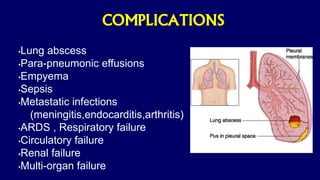
•Lung abscess
•Para-pneumonic effusions
•Empyema
•Sepsis
•Metastatic infections
(meningitis,endocarditis,arthritis)
•ARDS , Respiratory failure
•Circulatory failure
•Renal failure
•Multi-organ failure
Pneumonia complications
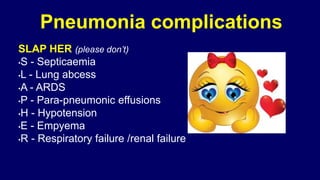
SLAP HER (please don’t)
•S - Septicaemia
•L - Lung abcess
•A - ARDS
•P - Para-pneumonic effusions
•H - Hypotension
•E - Empyema
•R - Respiratory failure /renal failure
Course
Most healthy people recover from pneumonia in one to
three weeks, but pneumonia can be life-threatening.
The mortality rate associated with community-acquired
pneumonia (CAP) is very low in most ambulatory patients
and higher in patients requiring hospitalization, being as
high as 37 percent in patients admitted to the intensive care
unit (ICU).
Prevention
•Smoking cessation
•Better Nutrition
•Respiratory hygiene measures
•Pneumococcal polysaccharide vaccine
•Inactivated influenza vaccine
•Live attenuated influenza vaccine
Conclusion
•The presence of an infiltrate on plain chest radiograph is considered the
"gold standard" for diagnosing pneumonia when clinical and
microbiologic features are supportive
•Most initial treatment regimens for hospitalized patients with
community-acquired pneumonia (CAP) are empiric
•The mortality rate associated with community-acquired pneumonia
(CAP) is very low in most ambulatory patients and higher in patients
requiring hospitalization
THANK YOU !!!
Please Visit my blog
medicalppt.blogspot.com ,
contains more than thousand
Presentations and lecture notes
in most fields of medicine.
92,651 FB Page Likes till today

Pneumonia