Risk Management
Martin Sillaots
2019
# 10
Risk Definition
An uncertain event or condition that, if occurs
has a positive or negative effect on project
duration, cost, scope or quality
www.projektor.ee/pm/#risk
Purpose of the Risk Management
• Identification, analysis, responses, monitoring and
control of risks
• Increase the probability and impact of positive events
• Decrease the probability and impact of negative events
www.projektor.ee/pm/#risk
Risk Management
• Risk management planning
• Risk identification
• Qualitative risk analysis
• Quantitative risk analysis
• Risk response planning
• Risk monitoring and control
www.projektor.ee/pm/#risk
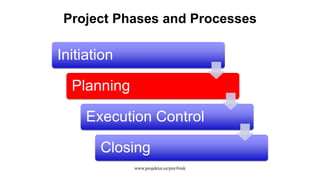
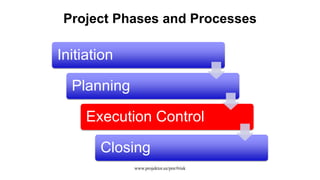
Project Phases and Processes
Initiation
Planning
Execution Control
Closing
www.projektor.ee/pm/#risk
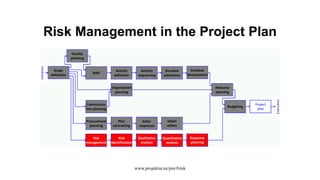
Risk Management in the Project Plan
Scope
definition
Quality
planning
Activity
definition
Activity
sequencing
Duration
estimation
Schedule
development
Organization
planning
Resource
planning
Communica-
tion planning
Procurement
planning
Plan
contracting
Select
sellers
Seller
responses
Risk
management
Risk
identification
Qualitative
analysis
Quantitative
analysis
Response
planning
Budgeting
Project
plan
Initiation
Execution
WBS
www.projektor.ee/pm/#risk
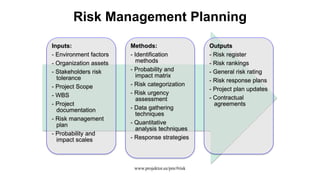
Inputs:
- Environment factors
- Organization assets
- Stakeholders risk
tolerance
- Project Scope
- WBS
- Project
documentation
- Risk management
plan
- Probability and
impact scales
Methods:
- Identification
methods
- Probability and
impact matrix
- Risk categorization
- Risk urgency
assessment
- Data gathering
techniques
- Quantitative
analysis techniques
- Response strategies
Outputs
- Risk register
- Risk rankings
- General risk rating
- Risk response plans
- Project plan updates
- Contractual
agreements
Risk Management Planning
www.projektor.ee/pm/#risk
Inputs
Risk Management Planning
www.projektor.ee/pm/#risk
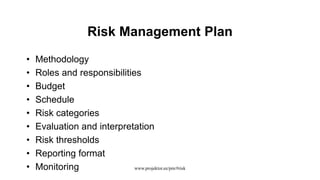
Risk Management Plan
• Methodology
• Roles and responsibilities
• Budget
• Schedule
• Risk categories
• Evaluation and interpretation
• Risk thresholds
• Reporting format
• Monitoring www.projektor.ee/pm/#risk
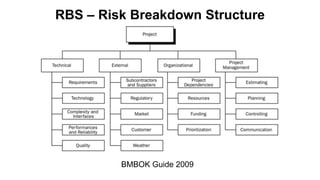
RBS – Risk Breakdown Structure
BMBOK Guide 2009
Methods
Risk Management Planning
www.projektor.ee/pm/#risk
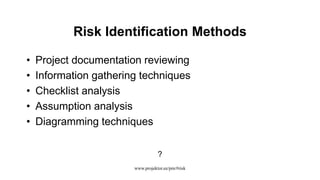
Risk Identification Methods
• Project documentation reviewing
• Information gathering techniques
• Checklist analysis
• Assumption analysis
• Diagramming techniques
?
www.projektor.ee/pm/#risk
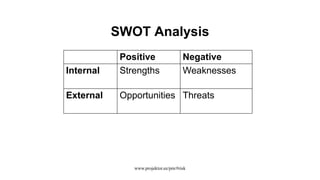
SWOT Analysis
Positive Negative
Internal Strengths Weaknesses
External Opportunities Threats
www.projektor.ee/pm/#risk
Exercise
Project SWOT analysis
www.projektor.ee/pm/#risk
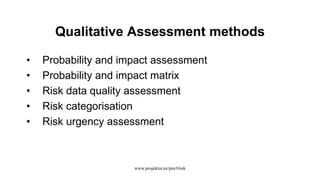
Qualitative Assessment methods
• Probability and impact assessment
• Probability and impact matrix
• Risk data quality assessment
• Risk categorisation
• Risk urgency assessment
www.projektor.ee/pm/#risk
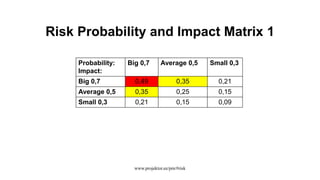
Risk Probability and Impact Matrix 1
Probability:
Impact:
Big 0,7 Average 0,5 Small 0,3
Big 0,7 0,49 0,35 0,21
Average 0,5 0,35 0,25 0,15
Small 0,3 0,21 0,15 0,09
www.projektor.ee/pm/#risk
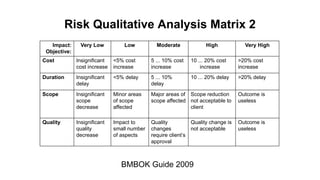
Risk Qualitative Analysis Matrix 2
Impact:
Objective:
Very Low Low Moderate High Very High
Cost Insignificant
cost increase
<5% cost
increase
5 ... 10% cost
increase
10 ... 20% cost
increase
>20% cost
increase
Duration Insignificant
delay
<5% delay 5 ... 10%
delay
10 ... 20% delay >20% delay
Scope Insignificant
scope
decrease
Minor areas
of scope
affected
Major areas of
scope affected
Scope reduction
not acceptable to
client
Outcome is
useless
Quality Insignificant
quality
decrease
Impact to
small number
of aspects
Quality
changes
require client’s
approval
Quality change is
not acceptable
Outcome is
useless
BMBOK Guide 2009
Exercise
Probability and impact matrix of project risks
www.projektor.ee/pm/#risk
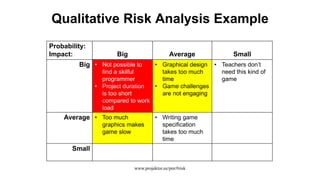
Qualitative Risk Analysis Example
Probability:
Impact: Big Average Small
Big • Not possible to
find a skilful
programmer
• Project duration
is too short
compared to work
load
• Graphical design
takes too much
time
• Game challenges
are not engaging
• Teachers don’t
need this kind of
game
Average • Too much
graphics makes
game slow
• Writing game
specification
takes too much
time
Small
www.projektor.ee/pm/#risk
Quantitative Analysis Methods
• Probability analysis
• Sensitivity analysis
• Decision tree
• Simulations and modelling
www.projektor.ee/pm/#risk
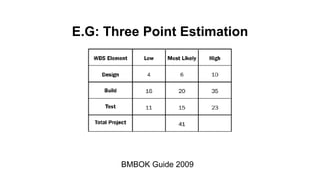
E.G: Three Point Estimation
BMBOK Guide 2009
Risk Response Strategies
• Avoiding – additional planning
• Mitigation – additional planning
• Transferring – e.g. insurance, subcontracting
• Accepting:
– Plan B
– Fallback plan
www.projektor.ee/pm/#risk
Outputs
Risk Management Planning
www.projektor.ee/pm/#risk
Risk Identification Results
• Outlined list of risks with triggers
www.projektor.ee/pm/#risk
Outcomes of Qualitative Risk Analysis
• Ordered list of risks
• General risk rating
• List of risks that require additional investigation
• Trends of risk analysis
www.projektor.ee/pm/#risk
Outcomes of Quantitative Risk Analysis
• Updated ordered list of risks
• Probability analysis results – possible durations and
costs with confidence intervals
• General probability for duration and cost estimation
accuracy
• Updated risk analysis trends
www.projektor.ee/pm/#risk
Risk Response Planning Results
• Risk responses
• Residual risk
• Secondary risks
• Contractual agreements
• Project plan updates
www.projektor.ee/pm/#risk
Risk Response Plan
• List of risks
• Risk takers and supervisors
• Risk analysis results
• Response per every risk
• Residual risk level
• Schedule and budget
• Alternative and backup plans
www.projektor.ee/pm/#risk
Exercise
Plan response for critical risks
www.projektor.ee/pm/#risk
Risk Monitoring and Control
www.projektor.ee/pm/#risk
Project Phases and Processes
Initiation
Planning
Execution Control
Closing
www.projektor.ee/pm/#risk
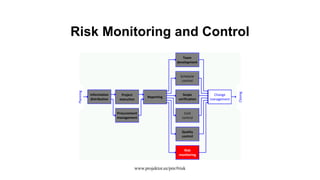
Risk Monitoring and Control
Information
distribution
Project
execution
Procurement
management
Reporting
Team
development
Schedule
control
Scope
verification
Cost
control
Quality
control
Risk
monitoring
Change
management
Planning
Closing
www.projektor.ee/pm/#risk
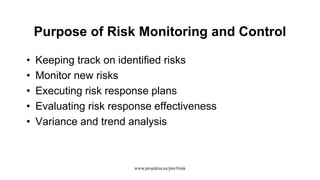
Purpose of Risk Monitoring and Control
• Keeping track on identified risks
• Monitor new risks
• Executing risk response plans
• Evaluating risk response effectiveness
• Variance and trend analysis
www.projektor.ee/pm/#risk
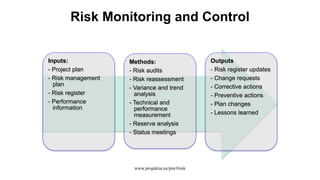
Inputs:
- Project plan
- Risk management
plan
- Risk register
- Performance
information
Methods:
- Risk audits
- Risk reassessment
- Variance and trend
analysis
- Technical and
performance
measurement
- Reserve analysis
- Status meetings
Outputs
- Risk register updates
- Change requests
- Corrective actions
- Preventive actions
- Plan changes
- Lessons learned
Risk Monitoring and Control
www.projektor.ee/pm/#risk
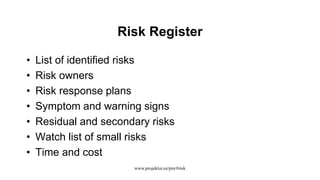
Risk Register
• List of identified risks
• Risk owners
• Risk response plans
• Symptom and warning signs
• Residual and secondary risks
• Watch list of small risks
• Time and cost
www.projektor.ee/pm/#risk
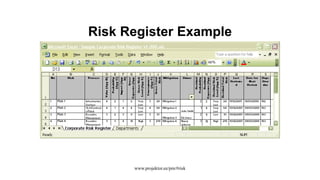
Risk Register Example
www.projektor.ee/pm/#risk
The end of the Risk
martinsillaots@gmail.com

Project Risk Management

  • 1.
  • 2.
    Risk Definition An uncertainevent or condition that, if occurs has a positive or negative effect on project duration, cost, scope or quality www.projektor.ee/pm/#risk
  • 3.
    Purpose of theRisk Management • Identification, analysis, responses, monitoring and control of risks • Increase the probability and impact of positive events • Decrease the probability and impact of negative events www.projektor.ee/pm/#risk
  • 4.
    Risk Management • Riskmanagement planning • Risk identification • Qualitative risk analysis • Quantitative risk analysis • Risk response planning • Risk monitoring and control www.projektor.ee/pm/#risk
  • 5.
    Project Phases andProcesses Initiation Planning Execution Control Closing www.projektor.ee/pm/#risk
  • 6.
    Risk Management inthe Project Plan Scope definition Quality planning Activity definition Activity sequencing Duration estimation Schedule development Organization planning Resource planning Communica- tion planning Procurement planning Plan contracting Select sellers Seller responses Risk management Risk identification Qualitative analysis Quantitative analysis Response planning Budgeting Project plan Initiation Execution WBS www.projektor.ee/pm/#risk
  • 7.
    Inputs: - Environment factors -Organization assets - Stakeholders risk tolerance - Project Scope - WBS - Project documentation - Risk management plan - Probability and impact scales Methods: - Identification methods - Probability and impact matrix - Risk categorization - Risk urgency assessment - Data gathering techniques - Quantitative analysis techniques - Response strategies Outputs - Risk register - Risk rankings - General risk rating - Risk response plans - Project plan updates - Contractual agreements Risk Management Planning www.projektor.ee/pm/#risk
  • 8.
  • 9.
    Risk Management Plan •Methodology • Roles and responsibilities • Budget • Schedule • Risk categories • Evaluation and interpretation • Risk thresholds • Reporting format • Monitoring www.projektor.ee/pm/#risk
  • 10.
    RBS – RiskBreakdown Structure BMBOK Guide 2009
  • 11.
  • 12.
    Risk Identification Methods •Project documentation reviewing • Information gathering techniques • Checklist analysis • Assumption analysis • Diagramming techniques ? www.projektor.ee/pm/#risk
  • 13.
    SWOT Analysis Positive Negative InternalStrengths Weaknesses External Opportunities Threats www.projektor.ee/pm/#risk
  • 14.
  • 16.
    Qualitative Assessment methods •Probability and impact assessment • Probability and impact matrix • Risk data quality assessment • Risk categorisation • Risk urgency assessment www.projektor.ee/pm/#risk
  • 17.
    Risk Probability andImpact Matrix 1 Probability: Impact: Big 0,7 Average 0,5 Small 0,3 Big 0,7 0,49 0,35 0,21 Average 0,5 0,35 0,25 0,15 Small 0,3 0,21 0,15 0,09 www.projektor.ee/pm/#risk
  • 18.
    Risk Qualitative AnalysisMatrix 2 Impact: Objective: Very Low Low Moderate High Very High Cost Insignificant cost increase <5% cost increase 5 ... 10% cost increase 10 ... 20% cost increase >20% cost increase Duration Insignificant delay <5% delay 5 ... 10% delay 10 ... 20% delay >20% delay Scope Insignificant scope decrease Minor areas of scope affected Major areas of scope affected Scope reduction not acceptable to client Outcome is useless Quality Insignificant quality decrease Impact to small number of aspects Quality changes require client’s approval Quality change is not acceptable Outcome is useless BMBOK Guide 2009
  • 19.
    Exercise Probability and impactmatrix of project risks www.projektor.ee/pm/#risk
  • 20.
    Qualitative Risk AnalysisExample Probability: Impact: Big Average Small Big • Not possible to find a skilful programmer • Project duration is too short compared to work load • Graphical design takes too much time • Game challenges are not engaging • Teachers don’t need this kind of game Average • Too much graphics makes game slow • Writing game specification takes too much time Small www.projektor.ee/pm/#risk
  • 21.
    Quantitative Analysis Methods •Probability analysis • Sensitivity analysis • Decision tree • Simulations and modelling www.projektor.ee/pm/#risk
  • 22.
    E.G: Three PointEstimation BMBOK Guide 2009
  • 23.
    Risk Response Strategies •Avoiding – additional planning • Mitigation – additional planning • Transferring – e.g. insurance, subcontracting • Accepting: – Plan B – Fallback plan www.projektor.ee/pm/#risk
  • 24.
  • 25.
    Risk Identification Results •Outlined list of risks with triggers www.projektor.ee/pm/#risk
  • 26.
    Outcomes of QualitativeRisk Analysis • Ordered list of risks • General risk rating • List of risks that require additional investigation • Trends of risk analysis www.projektor.ee/pm/#risk
  • 27.
    Outcomes of QuantitativeRisk Analysis • Updated ordered list of risks • Probability analysis results – possible durations and costs with confidence intervals • General probability for duration and cost estimation accuracy • Updated risk analysis trends www.projektor.ee/pm/#risk
  • 28.
    Risk Response PlanningResults • Risk responses • Residual risk • Secondary risks • Contractual agreements • Project plan updates www.projektor.ee/pm/#risk
  • 29.
    Risk Response Plan •List of risks • Risk takers and supervisors • Risk analysis results • Response per every risk • Residual risk level • Schedule and budget • Alternative and backup plans www.projektor.ee/pm/#risk
  • 30.
    Exercise Plan response forcritical risks www.projektor.ee/pm/#risk
  • 31.
    Risk Monitoring andControl www.projektor.ee/pm/#risk
  • 32.
    Project Phases andProcesses Initiation Planning Execution Control Closing www.projektor.ee/pm/#risk
  • 33.
    Risk Monitoring andControl Information distribution Project execution Procurement management Reporting Team development Schedule control Scope verification Cost control Quality control Risk monitoring Change management Planning Closing www.projektor.ee/pm/#risk
  • 34.
    Purpose of RiskMonitoring and Control • Keeping track on identified risks • Monitor new risks • Executing risk response plans • Evaluating risk response effectiveness • Variance and trend analysis www.projektor.ee/pm/#risk
  • 35.
    Inputs: - Project plan -Risk management plan - Risk register - Performance information Methods: - Risk audits - Risk reassessment - Variance and trend analysis - Technical and performance measurement - Reserve analysis - Status meetings Outputs - Risk register updates - Change requests - Corrective actions - Preventive actions - Plan changes - Lessons learned Risk Monitoring and Control www.projektor.ee/pm/#risk
  • 36.
    Risk Register • Listof identified risks • Risk owners • Risk response plans • Symptom and warning signs • Residual and secondary risks • Watch list of small risks • Time and cost www.projektor.ee/pm/#risk
  • 37.
  • 38.
  • 39.
    The end ofthe Risk martinsillaots@gmail.com

Editor's Notes

  • #11 Categories
  • #13 What information gathering techniques you know? Creative techniques: brainstorming, Delphi, SWOT Classical: Questionnaire, Interview, …
  • #21 Progeja - Võib olal ei tasuks sellist projekti tehagi Graafika – vähendada Õpetajad – osalusdisain, vajaduste analüüs Spec – pole oluline
  • #22 Quantify the possible outcomes for the project and probability Assess the probability to achieve objectives Identify biggest risks Identify cost and schedule for in order to avoid the risk Determine best solutions Modeling: Sensitivity analysis Expected monetary value analysis
  • #24 Positive risks and opportunities: Exploitation – make opportunity definitely happen Sharing – ownership to a 3d party who is best Enhance - increasing probability and impact
  • #36 SOW - Statement of Work