6.Quality Management
Project Management Training,
Qais Ur Rehman Rasooli, PMP
What is Quality ?
• Quality is the defined as
“the degree to which project fulfills requirements”
• Quality is customer driven, Customers are demanding
- Higher performance requirements,
- Shorter product development timeframes,
- Use of latest technology,
- Use of best materials and processes,
- Lower Contractor profit Margins,
- Fewer Defect and thus rejects,
• Quality is affected by market expectations
Project Quality Management -
Introduction
• Includes processes and activities that,
Determine quality policies, procedures and responsibilities
So project will satisfy the need for which the project was
undertaken
• Supports continuous improvement,
• Ensures project and product requirements are met,
• Includes Planning, Performing QA, Controlling Quality
Project Quality Management -
Introduction
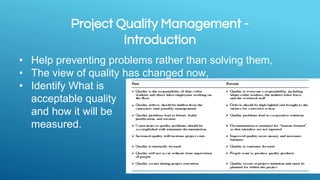
• Help preventing problems rather than solving them,
• The view of quality has changed now,
• Identify What is
acceptable quality
and how it will be
measured.
Quality Theorists
• Joseph Juran: 80/20 principle, advocated
top management involvement and “fitness
for use”
• W.Edward Deming: 14 points of Total
quality management, advocated Plan-Do-
Check-Act as a the basis of quality
improvement,
• Philip Crosby: Cost of poor quality, zero
defects ,prevention over inspection, Quality
is conformance to requirements
Quality related PMI-isms
• Recommend improvements to current quality standards,
policies and procedures,
• Quality to be consider whenever there is change to project
constraints,
• Check quality before an activity completes,
• PM spends time to improve quality,
• PM must plan continuous quality improvement,
• PM focuses on following authorized approaches and
processes
Quality related PMI-isms – Cont’d…
• Some activities are related to quality control/assurance
department,
• PM determines quality metrics before the project work starts,
• Go to page 295 of Rita PMP Exam prep and skim through the
list
Quality related Terms
• Gold Platting,
• Prevention over inspection,
• Marginal Analysis: looking for the point where the revenue to
equals the incremental cost to achieve that quality,
• Continuous improvement (Kaizen)
• Just in time
• Total Quality Management (TQM),
• Responsibility for Quality
• Impact of Poor quality
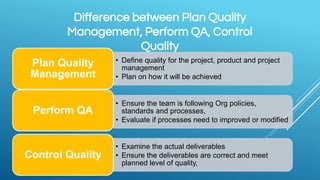
Difference between Plan Quality
Management, Perform QA, Control
Quality
• Define quality for the project, product and project
management
• Plan on how it will be achieved
Plan Quality
Management
• Ensure the team is following Org policies,
standards and processes,
• Evaluate if processes need to improved or modified
Perform QA
• Examine the actual deliverables
• Ensure the deliverables are correct and meet
planned level of quality,
Control Quality
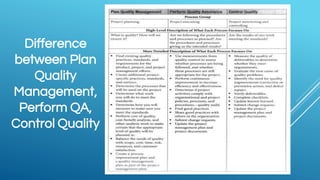
Difference
between Plan
Quality
Management,
Perform QA,
Control Quality
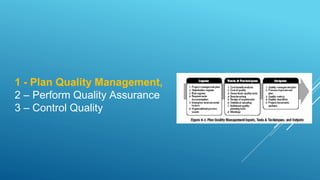
1 - Plan Quality Management,
2 – Perform Quality Assurance
3 – Control Quality
Plan Quality Management
• Process of identifying org/industry practices, quality
requirements or standards for the project and deliverables,
• Document and plan how the project will demonstrate
complaiance with relevant quality requirements/standards,
• Look for available external and internal standards and
practices
• Find out what Customer quality standards are?,
• Are additional project specific standards or procedures req?
• Inputs: Project MP, Stakeholder register, risk register, Req
documentation, OPA, EEF
Plan Quality Management
• Once standard and procedures are identified
-determine the work needed to meet standards,
-determine the specific measurements and frequency
• Determine the level of quality efforts appropriate to the needs
of the project
• Output is a Quality management Plan
Plan Quality Management –
Tools and techniques
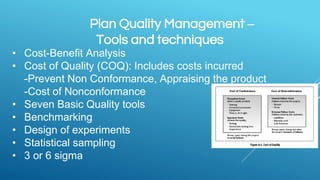
• Cost-Benefit Analysis
• Cost of Quality (COQ): Includes costs incurred
-Prevent Non Conformance, Appraising the product
-Cost of Nonconformance
• Seven Basic Quality tools
• Benchmarking
• Design of experiments
• Statistical sampling
• 3 or 6 sigma
Seven Basic Quality Tools
• Help clarify stakeholder requirements and expectations,
• Helps clarify acceptance criteria,
• Manage stakeholders expectations,
• Identify which tool we will use in QA and QC work,
• Cause and effect diagram
• Flowchart
• Check sheet
• Pareto diagram
• Histogram
• Control chart
• Scatter diagram
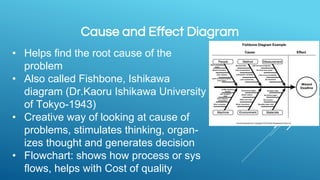
Cause and Effect Diagram
• Helps find the root cause of the
problem
• Also called Fishbone, Ishikawa
diagram (Dr.Kaoru Ishikawa University
of Tokyo-1943)
• Creative way of looking at cause of
problems, stimulates thinking, organ-
izes thought and generates decision
• Flowchart: shows how process or sys
flows, helps with Cost of quality
Flowchart
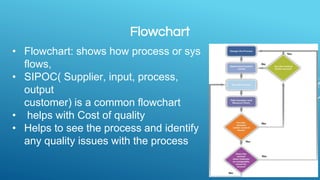
• Flowchart: shows how process or sys
flows,
• SIPOC( Supplier, input, process,
output
customer) is a common flowchart
• helps with Cost of quality
• Helps to see the process and identify
any quality issues with the process
Check sheet (Tally sheet)
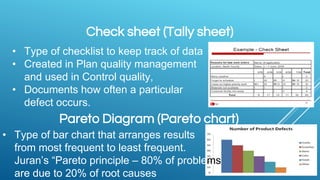
• Type of checklist to keep track of data
• Created in Plan quality management
and used in Control quality,
• Documents how often a particular
defect occurs.
Pareto Diagram (Pareto chart)
• Type of bar chart that arranges results
from most frequent to least frequent.
Juran’s “Pareto principle – 80% of problems
are due to 20% of root causes
Histogram
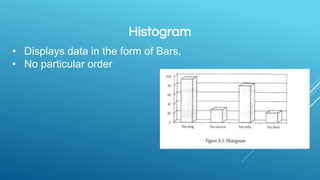
• Displays data in the form of Bars,
• No particular order
Control Charts
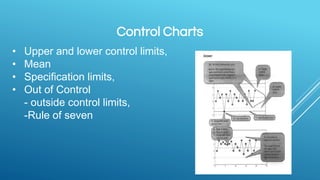
• Upper and lower control limits,
• Mean
• Specification limits,
• Out of Control
- outside control limits,
-Rule of seven
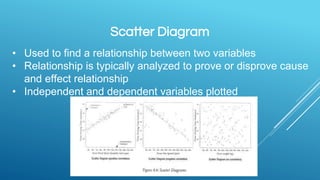
Scatter Diagram
• Used to find a relationship between two variables
• Relationship is typically analyzed to prove or disprove cause
and effect relationship
• Independent and dependent variables plotted
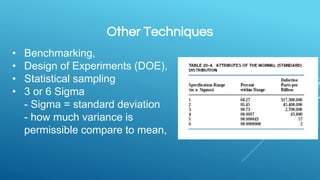
Other Techniques
• Benchmarking,
• Design of Experiments (DOE),
• Statistical sampling
• 3 or 6 Sigma
- Sigma = standard deviation
- how much variance is
permissible compare to mean,
Output Plan Quality Management
• Quality Management Plan:
What Quality practice and standards are applicable?,
What Quality responsibilities are and what Quality processes
will be followed?
Meetings , metrics and Reports?
• Quality Metrics: What is being measured and how?
Failure rate, defect density measurements
• Quality Checklists: List of required steps in a process ,
check for completeness
• Process Improvement plans
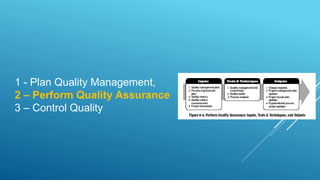
1 - Plan Quality Management,
2 – Perform Quality Assurance
3 – Control Quality
Perform Quality Assurance
• Done during executing,
• Uses measurements gather under Control Quality
• Audits output of quality control,
• Ensures appropriate quality standards are used
• Facilitates the improvement of quality processes
Tools & techniques
• Quality Audits,
• Process analysis
• Affinity diagrams,
Perform Quality Assurance – Tools &
Techniques
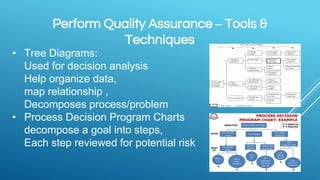
• Tree Diagrams:
Used for decision analysis
Help organize data,
map relationship ,
Decomposes process/problem
• Process Decision Program Charts
decompose a goal into steps,
Each step reviewed for potential risk
Perform Quality Assurance – Tools &
Techniques
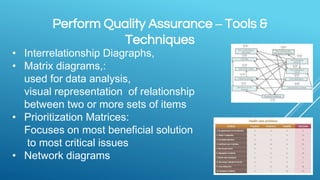
• Interrelationship Diagraphs,
• Matrix diagrams,:
used for data analysis,
visual representation of relationship
between two or more sets of items
• Prioritization Matrices:
Focuses on most beneficial solution
to most critical issues
• Network diagrams
Perform Quality Assurance –Output
• Change requests,
• Updated standards, processes and quality systems,
• Updated PMP and project docs
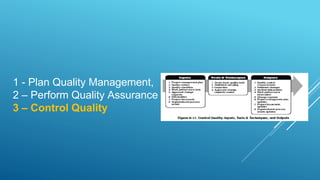
1 - Plan Quality Management,
2 – Perform Quality Assurance
3 – Control Quality
Control Quality
• Ensure a certain level of quality in a deliverable,
• Major Function: Measure
• Validate if project work and deliverables meet quality
standards,
• Ensures customer satisfaction,
• Involves confirming and documenting the achievement of
agreed-to requirements
• Results in change requests, validated deliverables
Control Quality – Answers questions
like…
• Are the results of work meeting standards?
• What is the actual variance from the standard?
• Variance from standards or processes outside acceptable
limits?
• Checklists being followed to meet metrics?
• What changes in the project should be considered?
Some Quality control Terms
• Mutual Exclusivity (two things cannot occur in same trial)
• Probability
• Normal Distribution (bell curve used to measure variation)
• Statistical independence,(Probability of one not impacting the
other)
• Standard deviation
Control Quality Tools & Techniques
• Seven quality tools,
• Statistical Sampling,
• Inspection (work product, particular activity, final product)
• - reviews,
- peer reviews,
- audits
- walkthroughs
Control Quality - Outputs
Outputs include:
• Measurements,
• Validated changes,
• Work performance information,
• Updates to PMP (Quality MP, Process improvement plan),
• Change request (types?)
• Lesson learned,
• Verified deliverables
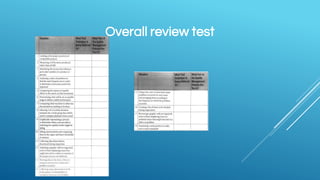
Overall review test
The Active PMP Learner
Visit
http://management.simplicable.com/management/new/management
for PM resource and professional insights
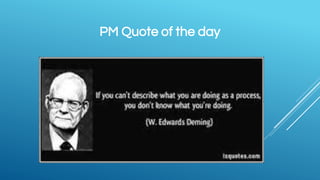
PM Quote of the day

7- PMP Training - Quality Management

  • 1.
    6.Quality Management Project ManagementTraining, Qais Ur Rehman Rasooli, PMP
  • 2.
    What is Quality? • Quality is the defined as “the degree to which project fulfills requirements” • Quality is customer driven, Customers are demanding - Higher performance requirements, - Shorter product development timeframes, - Use of latest technology, - Use of best materials and processes, - Lower Contractor profit Margins, - Fewer Defect and thus rejects, • Quality is affected by market expectations
  • 3.
    Project Quality Management- Introduction • Includes processes and activities that, Determine quality policies, procedures and responsibilities So project will satisfy the need for which the project was undertaken • Supports continuous improvement, • Ensures project and product requirements are met, • Includes Planning, Performing QA, Controlling Quality
  • 4.
    Project Quality Management- Introduction • Help preventing problems rather than solving them, • The view of quality has changed now, • Identify What is acceptable quality and how it will be measured.
  • 5.
    Quality Theorists • JosephJuran: 80/20 principle, advocated top management involvement and “fitness for use” • W.Edward Deming: 14 points of Total quality management, advocated Plan-Do- Check-Act as a the basis of quality improvement, • Philip Crosby: Cost of poor quality, zero defects ,prevention over inspection, Quality is conformance to requirements
  • 6.
    Quality related PMI-isms •Recommend improvements to current quality standards, policies and procedures, • Quality to be consider whenever there is change to project constraints, • Check quality before an activity completes, • PM spends time to improve quality, • PM must plan continuous quality improvement, • PM focuses on following authorized approaches and processes
  • 7.
    Quality related PMI-isms– Cont’d… • Some activities are related to quality control/assurance department, • PM determines quality metrics before the project work starts, • Go to page 295 of Rita PMP Exam prep and skim through the list
  • 8.
    Quality related Terms •Gold Platting, • Prevention over inspection, • Marginal Analysis: looking for the point where the revenue to equals the incremental cost to achieve that quality, • Continuous improvement (Kaizen) • Just in time • Total Quality Management (TQM), • Responsibility for Quality • Impact of Poor quality
  • 9.
    Difference between PlanQuality Management, Perform QA, Control Quality • Define quality for the project, product and project management • Plan on how it will be achieved Plan Quality Management • Ensure the team is following Org policies, standards and processes, • Evaluate if processes need to improved or modified Perform QA • Examine the actual deliverables • Ensure the deliverables are correct and meet planned level of quality, Control Quality
  • 10.
  • 11.
    1 - PlanQuality Management, 2 – Perform Quality Assurance 3 – Control Quality
  • 12.
    Plan Quality Management •Process of identifying org/industry practices, quality requirements or standards for the project and deliverables, • Document and plan how the project will demonstrate complaiance with relevant quality requirements/standards, • Look for available external and internal standards and practices • Find out what Customer quality standards are?, • Are additional project specific standards or procedures req? • Inputs: Project MP, Stakeholder register, risk register, Req documentation, OPA, EEF
  • 13.
    Plan Quality Management •Once standard and procedures are identified -determine the work needed to meet standards, -determine the specific measurements and frequency • Determine the level of quality efforts appropriate to the needs of the project • Output is a Quality management Plan
  • 14.
    Plan Quality Management– Tools and techniques • Cost-Benefit Analysis • Cost of Quality (COQ): Includes costs incurred -Prevent Non Conformance, Appraising the product -Cost of Nonconformance • Seven Basic Quality tools • Benchmarking • Design of experiments • Statistical sampling • 3 or 6 sigma
  • 15.
    Seven Basic QualityTools • Help clarify stakeholder requirements and expectations, • Helps clarify acceptance criteria, • Manage stakeholders expectations, • Identify which tool we will use in QA and QC work, • Cause and effect diagram • Flowchart • Check sheet • Pareto diagram • Histogram • Control chart • Scatter diagram
  • 16.
    Cause and EffectDiagram • Helps find the root cause of the problem • Also called Fishbone, Ishikawa diagram (Dr.Kaoru Ishikawa University of Tokyo-1943) • Creative way of looking at cause of problems, stimulates thinking, organ- izes thought and generates decision • Flowchart: shows how process or sys flows, helps with Cost of quality
  • 17.
    Flowchart • Flowchart: showshow process or sys flows, • SIPOC( Supplier, input, process, output customer) is a common flowchart • helps with Cost of quality • Helps to see the process and identify any quality issues with the process
  • 18.
    Check sheet (Tallysheet) • Type of checklist to keep track of data • Created in Plan quality management and used in Control quality, • Documents how often a particular defect occurs. Pareto Diagram (Pareto chart) • Type of bar chart that arranges results from most frequent to least frequent. Juran’s “Pareto principle – 80% of problems are due to 20% of root causes
  • 19.
    Histogram • Displays datain the form of Bars, • No particular order
  • 20.
    Control Charts • Upperand lower control limits, • Mean • Specification limits, • Out of Control - outside control limits, -Rule of seven
  • 21.
    Scatter Diagram • Usedto find a relationship between two variables • Relationship is typically analyzed to prove or disprove cause and effect relationship • Independent and dependent variables plotted
  • 22.
    Other Techniques • Benchmarking, •Design of Experiments (DOE), • Statistical sampling • 3 or 6 Sigma - Sigma = standard deviation - how much variance is permissible compare to mean,
  • 23.
    Output Plan QualityManagement • Quality Management Plan: What Quality practice and standards are applicable?, What Quality responsibilities are and what Quality processes will be followed? Meetings , metrics and Reports? • Quality Metrics: What is being measured and how? Failure rate, defect density measurements • Quality Checklists: List of required steps in a process , check for completeness • Process Improvement plans
  • 24.
    1 - PlanQuality Management, 2 – Perform Quality Assurance 3 – Control Quality
  • 25.
    Perform Quality Assurance •Done during executing, • Uses measurements gather under Control Quality • Audits output of quality control, • Ensures appropriate quality standards are used • Facilitates the improvement of quality processes Tools & techniques • Quality Audits, • Process analysis • Affinity diagrams,
  • 26.
    Perform Quality Assurance– Tools & Techniques • Tree Diagrams: Used for decision analysis Help organize data, map relationship , Decomposes process/problem • Process Decision Program Charts decompose a goal into steps, Each step reviewed for potential risk
  • 27.
    Perform Quality Assurance– Tools & Techniques • Interrelationship Diagraphs, • Matrix diagrams,: used for data analysis, visual representation of relationship between two or more sets of items • Prioritization Matrices: Focuses on most beneficial solution to most critical issues • Network diagrams
  • 28.
    Perform Quality Assurance–Output • Change requests, • Updated standards, processes and quality systems, • Updated PMP and project docs
  • 29.
    1 - PlanQuality Management, 2 – Perform Quality Assurance 3 – Control Quality
  • 30.
    Control Quality • Ensurea certain level of quality in a deliverable, • Major Function: Measure • Validate if project work and deliverables meet quality standards, • Ensures customer satisfaction, • Involves confirming and documenting the achievement of agreed-to requirements • Results in change requests, validated deliverables
  • 31.
    Control Quality –Answers questions like… • Are the results of work meeting standards? • What is the actual variance from the standard? • Variance from standards or processes outside acceptable limits? • Checklists being followed to meet metrics? • What changes in the project should be considered?
  • 32.
    Some Quality controlTerms • Mutual Exclusivity (two things cannot occur in same trial) • Probability • Normal Distribution (bell curve used to measure variation) • Statistical independence,(Probability of one not impacting the other) • Standard deviation
  • 33.
    Control Quality Tools& Techniques • Seven quality tools, • Statistical Sampling, • Inspection (work product, particular activity, final product) • - reviews, - peer reviews, - audits - walkthroughs
  • 34.
    Control Quality -Outputs Outputs include: • Measurements, • Validated changes, • Work performance information, • Updates to PMP (Quality MP, Process improvement plan), • Change request (types?) • Lesson learned, • Verified deliverables
  • 35.
  • 36.
    The Active PMPLearner Visit http://management.simplicable.com/management/new/management for PM resource and professional insights
  • 37.
    PM Quote ofthe day