Nicholas
Portugal
Precalculus
Honors
Period A7
POLAR
GRAPHS
 During the last few weeks of pre-calculus, we learned a
variety of different polar graphs through five packet
activities using the TI-Nspire calculators.
 Polar graphs are essentially graphs on a circular coordinate
plane compared to the conventional rectangular planes.
 Polar graphs can be represented using function graphs,
which are comprised of sine waves that follow a distinct
pattern to represent different components of the polar graph.
 While polar graphs can be represented using function
graphs, as they both contain angular measurements, we
also learned how to convert ‘polar coordinates’ (e.g. 5,90º)
to ‘rectangular’ coordinates ([5 x cos 90],[5 x sin 90]  0,5)
using respective sine and cosine formulas to differentiate
between both ‘x’ and ‘y’ on the rectangular coordinate plane.
OVERVIEW
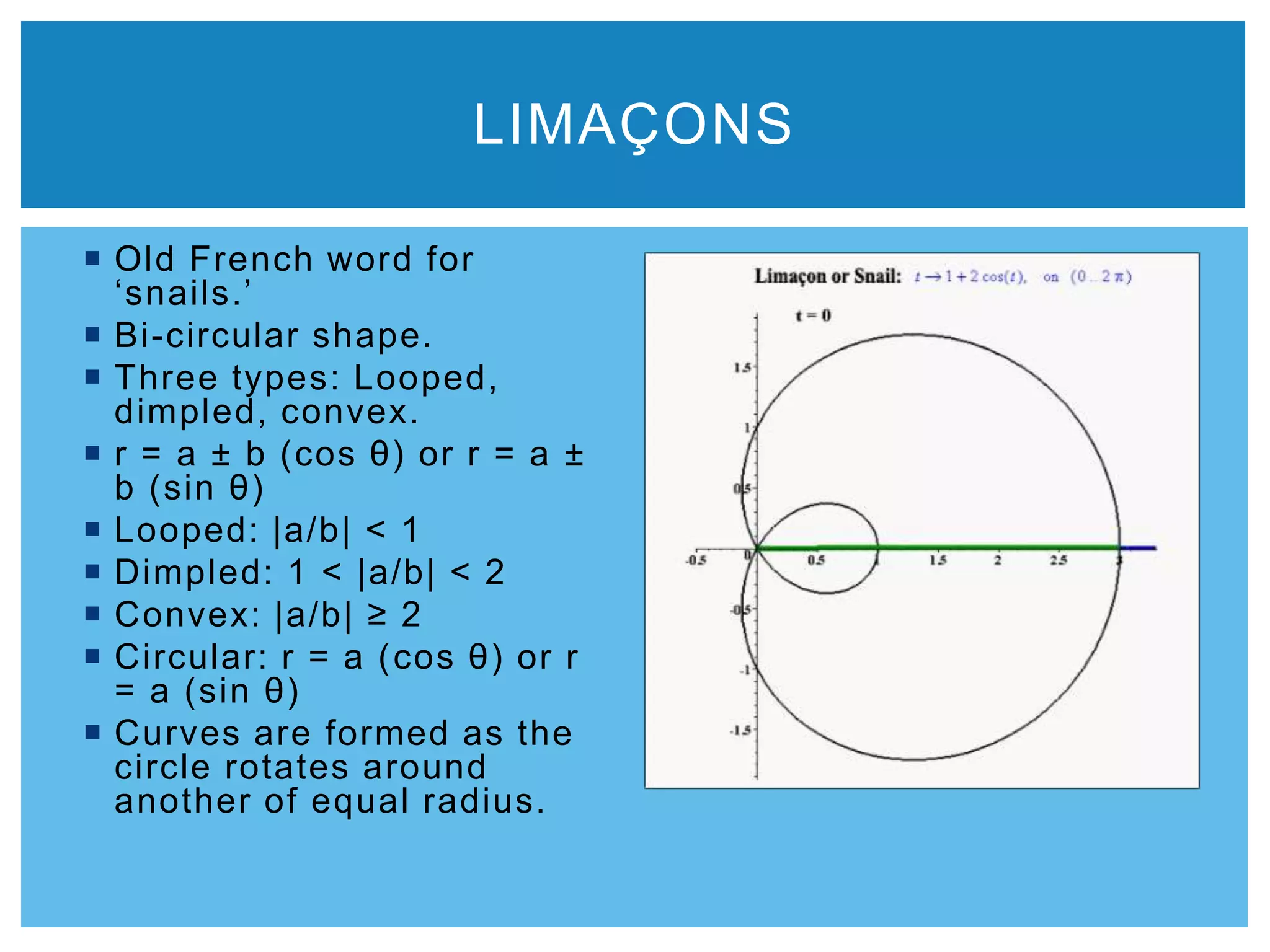
 Old French word for
‘snails.’
 Bi-circular shape.
 Three types: Looped,
dimpled, convex.
 r = a ± b (cos θ) or r = a ±
b (sin θ)
 Looped: |a/b| < 1
 Dimpled: 1 < |a/b| < 2
 Convex: |a/b| ≥ 2
 Circular: r = a (cos θ) or r
= a (sin θ)
 Curves are formed as the
circle rotates around
another of equal radius.
LIMAÇONS
 Named for its flowery
petals that extend from the
origin.
 r = a [cos (nθ)] or r = a [sin
(nθ)]
 Odd # of Petals: When n is
odd (n). Curves formed as
it increases from 0 to π.
 Even # of Petals: When n
is even (2n). Curves
formed as it increases from
0 to 2π.
 If n is even, the graph is
symmetric about the x-
axis, y-axis, and the origin.
 Depending on the n value,
the graph will be shaped in
a particular way.
ROSES
 Shaped like an infinity
symbol or figure-eight.
 r2 = a2 [cos (2θ)] or r2
= a2 [sin (2θ)].
 r = ±√a2 [cos (2θ)] or r
= ±√a2 [sin (2θ)].
 a ≠ 0
 Graphs are generated
as the angle increases
gradually from 0 to 2π.
 Symmetrical across
the x-axis, y-axis, and
the origin.
LEMNISCATES
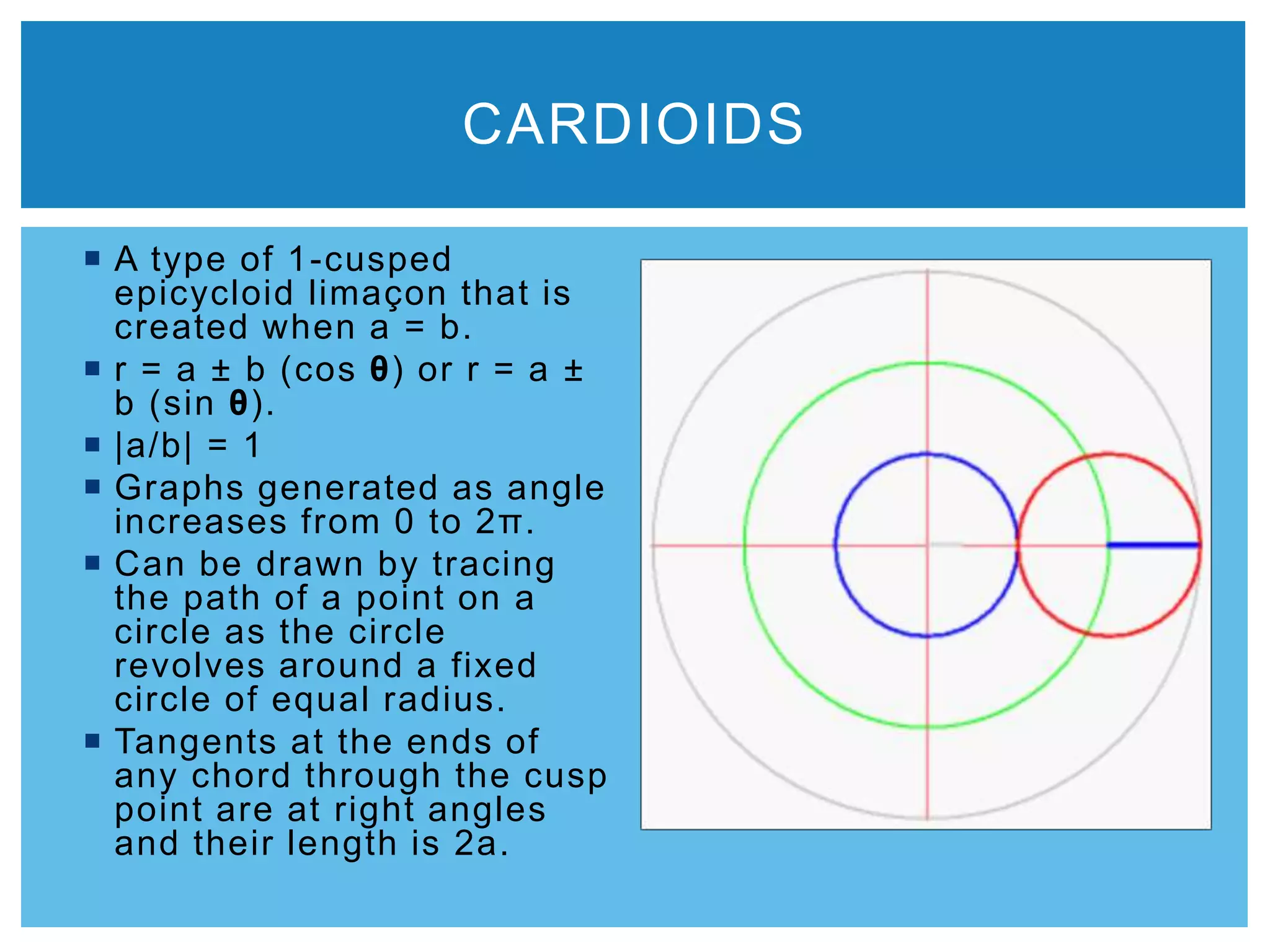
 A type of 1-cusped
epicycloid limaçon that is
created when a = b.
 r = a ± b (cos θ) or r = a ±
b (sin θ).
 |a/b| = 1
 Graphs generated as angle
increases from 0 to 2π.
 Can be drawn by tracing
the path of a point on a
circle as the circle
revolves around a fixed
circle of equal radius.
 Tangents at the ends of
any chord through the cusp
point are at right angles
and their length is 2a.
CARDIOIDS
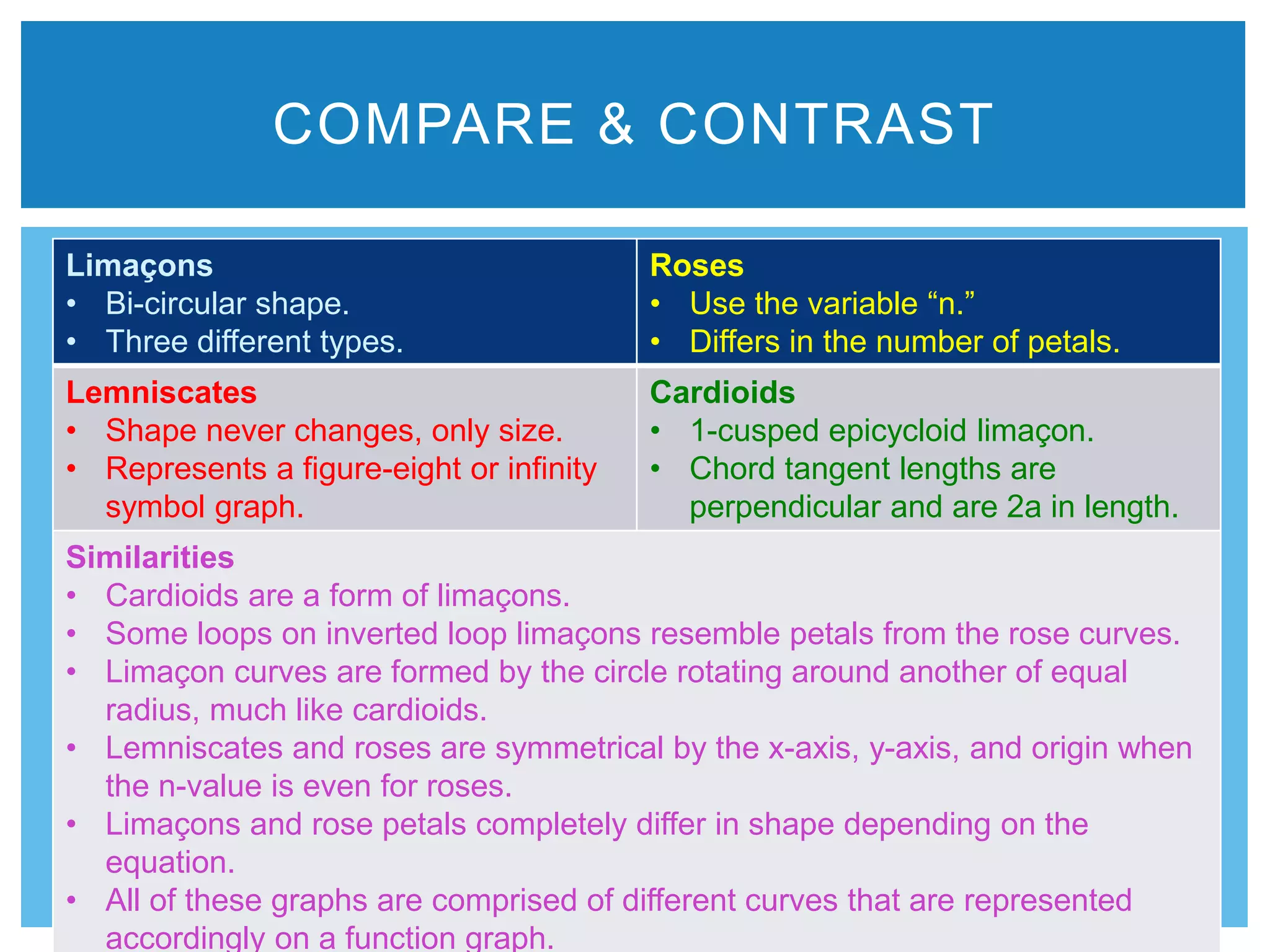
Limaçons
• Bi-circular shape.
• Three different types.
Roses
• Use the variable “n.”
• Differs in the number of petals.
Lemniscates
• Shape never changes, only size.
• Represents a figure-eight or infinity
symbol graph.
Cardioids
• 1-cusped epicycloid limaçon.
• Chord tangent lengths are
perpendicular and are 2a in length.
Similarities
• Cardioids are a form of limaçons.
• Some loops on inverted loop limaçons resemble petals from the rose curves.
• Limaçon curves are formed by the circle rotating around another of equal
radius, much like cardioids.
• Lemniscates and roses are symmetrical by the x-axis, y-axis, and origin when
the n-value is even for roses.
• Limaçons and rose petals completely differ in shape depending on the
equation.
• All of these graphs are comprised of different curves that are represented
accordingly on a function graph.
COMPARE & CONTRAST
 Overall, the polar unit was perhaps one of the most difficult
units this entire year. I learned from the many mistakes I made
along the way while completing the packets, and using the TI-
Nspire calculators helped me to visualize how the graphs were
drawn, and how they compared with function graphs.
 Using both limaçons and roses together was fascinating
because they correlated so well with each other.
 I was able to learn about a new type of graph from this unit, as
I previously only knew how to graph function graphs and
rectangular graphs.
 After each packet I began to grasp polar graphs even better,
though I did not particularly enjoy only learning through the
lessons on the calculators.
 Finally, if there were one thing to change about this unit, I
would have also provided supplemental lessons on the subject
in addition to the packets to ensure greater understanding,
especially for students taking calculus next year.
SUMMARY

Polar Graphs: Limaçons, Roses, Lemniscates, & Cardioids

  • 1.
  • 2.
     During thelast few weeks of pre-calculus, we learned a variety of different polar graphs through five packet activities using the TI-Nspire calculators.  Polar graphs are essentially graphs on a circular coordinate plane compared to the conventional rectangular planes.  Polar graphs can be represented using function graphs, which are comprised of sine waves that follow a distinct pattern to represent different components of the polar graph.  While polar graphs can be represented using function graphs, as they both contain angular measurements, we also learned how to convert ‘polar coordinates’ (e.g. 5,90º) to ‘rectangular’ coordinates ([5 x cos 90],[5 x sin 90]  0,5) using respective sine and cosine formulas to differentiate between both ‘x’ and ‘y’ on the rectangular coordinate plane. OVERVIEW
  • 3.
     Old Frenchword for ‘snails.’  Bi-circular shape.  Three types: Looped, dimpled, convex.  r = a ± b (cos θ) or r = a ± b (sin θ)  Looped: |a/b| < 1  Dimpled: 1 < |a/b| < 2  Convex: |a/b| ≥ 2  Circular: r = a (cos θ) or r = a (sin θ)  Curves are formed as the circle rotates around another of equal radius. LIMAÇONS
  • 4.
     Named forits flowery petals that extend from the origin.  r = a [cos (nθ)] or r = a [sin (nθ)]  Odd # of Petals: When n is odd (n). Curves formed as it increases from 0 to π.  Even # of Petals: When n is even (2n). Curves formed as it increases from 0 to 2π.  If n is even, the graph is symmetric about the x- axis, y-axis, and the origin.  Depending on the n value, the graph will be shaped in a particular way. ROSES
  • 5.
     Shaped likean infinity symbol or figure-eight.  r2 = a2 [cos (2θ)] or r2 = a2 [sin (2θ)].  r = ±√a2 [cos (2θ)] or r = ±√a2 [sin (2θ)].  a ≠ 0  Graphs are generated as the angle increases gradually from 0 to 2π.  Symmetrical across the x-axis, y-axis, and the origin. LEMNISCATES
  • 6.
     A typeof 1-cusped epicycloid limaçon that is created when a = b.  r = a ± b (cos θ) or r = a ± b (sin θ).  |a/b| = 1  Graphs generated as angle increases from 0 to 2π.  Can be drawn by tracing the path of a point on a circle as the circle revolves around a fixed circle of equal radius.  Tangents at the ends of any chord through the cusp point are at right angles and their length is 2a. CARDIOIDS
  • 7.
    Limaçons • Bi-circular shape. •Three different types. Roses • Use the variable “n.” • Differs in the number of petals. Lemniscates • Shape never changes, only size. • Represents a figure-eight or infinity symbol graph. Cardioids • 1-cusped epicycloid limaçon. • Chord tangent lengths are perpendicular and are 2a in length. Similarities • Cardioids are a form of limaçons. • Some loops on inverted loop limaçons resemble petals from the rose curves. • Limaçon curves are formed by the circle rotating around another of equal radius, much like cardioids. • Lemniscates and roses are symmetrical by the x-axis, y-axis, and origin when the n-value is even for roses. • Limaçons and rose petals completely differ in shape depending on the equation. • All of these graphs are comprised of different curves that are represented accordingly on a function graph. COMPARE & CONTRAST
  • 8.
     Overall, thepolar unit was perhaps one of the most difficult units this entire year. I learned from the many mistakes I made along the way while completing the packets, and using the TI- Nspire calculators helped me to visualize how the graphs were drawn, and how they compared with function graphs.  Using both limaçons and roses together was fascinating because they correlated so well with each other.  I was able to learn about a new type of graph from this unit, as I previously only knew how to graph function graphs and rectangular graphs.  After each packet I began to grasp polar graphs even better, though I did not particularly enjoy only learning through the lessons on the calculators.  Finally, if there were one thing to change about this unit, I would have also provided supplemental lessons on the subject in addition to the packets to ensure greater understanding, especially for students taking calculus next year. SUMMARY