


© ABCC Australia 2015 new-physics.com
TIME DILATION IN RELATIVITY
Cosmic Adventure 5.6
© ABCC Australia 2015 new-physics.com
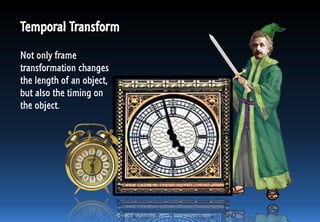
Temporal Transform
Not only frame
transformation changes
the length of an object,
but also the timing on
the object.
© ABCC Australia 2015 new-physics.com
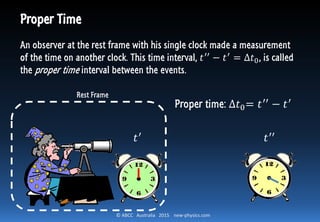
Proper Time
An observer at the rest frame with his single clock made a measurement
of the time on another clock. This time interval, 𝑡′′
− 𝑡′
= ∆𝑡0, is called
the proper time interval between the events.
𝑡′′𝑡′
Proper time: ∆𝑡0= 𝑡′′
− 𝑡′
Rest Frame
© ABCC Australia 2015 new-physics.com
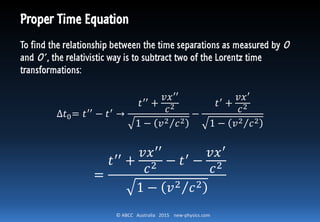
Proper Time Equation
To find the relationship between the time separations as measured by O
and O’ , the relativistic way is to subtract two of the Lorentz time
transformations:
∆𝑡0= 𝑡′′ − 𝑡′ →
𝑡′′ +
𝑣𝑥′′
𝑐2
1 − 𝑣2 𝑐2
−
𝑡′ +
𝑣𝑥′
𝑐2
1 − 𝑣2 𝑐2
=
𝑡′′
+
𝑣𝑥′′
𝑐2 − 𝑡′
−
𝑣𝑥′
𝑐2
1 − 𝑣2 𝑐2
© ABCC Australia 2015 new-physics.com
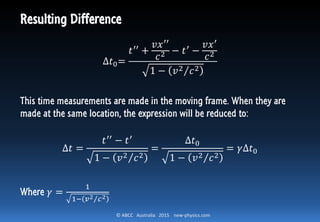
Resulting Difference
∆𝑡0=
𝑡′′ +
𝑣𝑥′′
𝑐2 − 𝑡′ −
𝑣𝑥′
𝑐2
1 − 𝑣2 𝑐2
These time measurements are made in the moving frame. When they are
made at the same location, the expression will be reduced to:
∆𝑡 =
𝑡′′ − 𝑡′
1 − 𝑣2 𝑐2
=
∆𝑡0
1 − 𝑣2 𝑐2
= 𝛾∆𝑡0
Where 𝛾 =
1
1− 𝑣2 𝑐2
© ABCC Australia 2015 new-physics.com
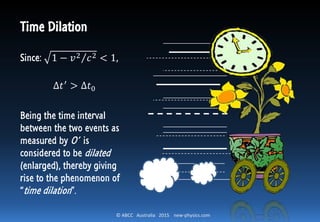
Time Dilation
Since: 1 − 𝑣2 𝑐2 < 1,
∆𝑡 > ∆𝑡0
Being the time interval
between the two events
measured by O’ is
considered to be dilated
(enlarged), thereby giving
rise to the phenomenon of
“time dilation”.
© ABCC Australia 2015 new-physics.com
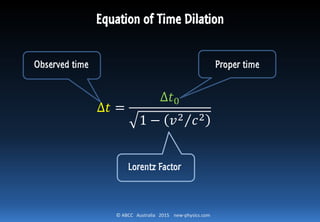
Equation of Time Dilation
∆𝑡 =
∆𝑡0
1 − 𝑣2 𝑐2
Observed time Proper time
Lorentz Factor
© ABCC Australia 2015 new-physics.com
0 0.1 0.2 0.3 0.4 0.5 0.6 0.7 0.8 0.9 1.0
10.0
8.0
6.0
4.0
2.0
1.0
Timedilation
∆𝑡 =
∆𝑡0
1 −
𝑣2
𝑐2
Velocity as a fraction of the speed of light
𝑣/𝑐
© ABCC Australia 2015 new-physics.com
Time Changes due to
Frame Transfer
For example, one can place
cameras at the location of
clock B and at the location of
the clock C, and a picture is
taken by each camera when the
clock C passes clock B.
Each picture will show that the
clock C has advanced through
∆𝑡0 while clock B has
advanced through ∆𝑡.
∆𝑡 and ∆𝑡0 are related by the
time dilation equation.
Clock A Clock BClock B
Clock C
Clock C
𝑣
𝑣
Clock C advances
through ∆𝑡 𝑜
Clock A & B advances through ∆𝑡
© ABCC Australia 2015 new-physics.com
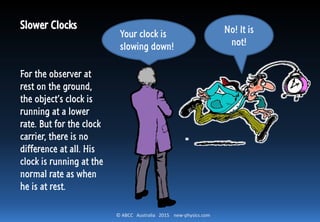
Slower Clocks
For the observer at
rest on the ground,
the object’s clock is
running at a lower
rate. But for the clock
carrier, there is no
difference at all. His
clock is running at the
normal rate as when
he is at rest.
No! It is
not!
Your clock is
slowing down!
© ABCC Australia 2015 new-physics.com
Time Lapse by Slower Clock
Once the moving clock re-
unites with the ground clock, it
will again run at the same rate
as the ground clock. It is only
when the clock is in motion
with respect to the other clock
that the phenomenon of time
dilation takes place.
Naturally, the slower clock will
remain behind by the amount
of time it spent.
© ABCC Australia 2015 new-physics.com
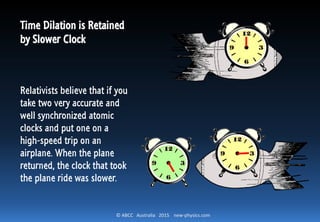
Time Dilation is Retained
by Slower Clock
Relativists believe that if you
take two very accurate and
well synchronized atomic
clocks and put one on a
high-speed trip on an
airplane. When the plane
returned, the clock that took
the plane ride was slower.
© ABCC Australia 2015 new-physics.com
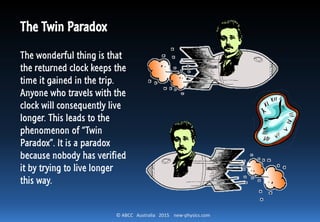
The Twin Paradox
The wonderful thing is that
the returned clock keeps the
time it gained in the trip.
Anyone who travels with the
clock will consequently live
longer. This leads to the
phenomenon of “Twin
Paradox”. It is a paradox
because nobody has verified
it by trying to live longer
this way.
© ABCC Australia 2015 new-physics.com
Dr. Einstein will return to earth nearly as young, while his twin on earth
will have aged terribly.
© ABCC Australia 2015 new-physics.com
Example of Calculation
The earth bound Einstein calculate the time dilation with the equation:
∆𝑡 =
∆𝑡0
1 − 𝑣2 𝑐2
where:
∆𝑡 = time observed in the other reference frame
∆𝑡0 = time in observers own frame of reference (rest time)
𝑣 = the speed of the moving rocket
𝑐 = the speed of light in a vacuum
© ABCC Australia 2015 new-physics.com
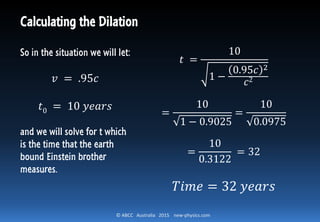
Calculating the Dilation
So in the situation we will let:
𝑣 = .95𝑐
𝑡0 = 10 𝑦𝑒𝑎𝑟𝑠
and we will solve for t which
is the time that the earth
bound Einstein brother
measures.
𝑡 =
10
1 −
0.95𝑐 2
𝑐2
=
10
1 − 0.9025
=
10
0.0975
=
10
0.3122
= 32
𝑇𝑖𝑚𝑒 = 32 𝑦𝑒𝑎𝑟𝑠
© ABCC Australia 2015 new-physics.com
Muon Life Time
The extended lifetime of the
muon provides another
proof of time dilation. But so
far the results are not
absolutely precise and the
relativistic explanation is not
too clear. There are other
ways of achieving the results
and in a more logical way.
We will be glad to talk about
it in a different session.
© ABCC Australia 2015 new-physics.com
Both Answers Real and Correct
Objectively speaking, the
observer is seeing two different
times.
So which time is correct?
According to the relativists, they
both are.
The reason is that time is not
absolute but is relative, it
depends on the relative
relationship of the reference
frames.
So why then is the
phenomenon called a
paradox?
© ABCC Australia 2015 new-physics.com
VISONIC TIME DILATION – CLOCKS AT REST
To be continued on:
Cosmic Adventure 5.7

Cosmic Adventure 5.6 Time Dilation in Relativity

  • 1.
    © ABCC Australia2015 new-physics.com TIME DILATION IN RELATIVITY Cosmic Adventure 5.6
  • 2.
    © ABCC Australia2015 new-physics.com Temporal Transform Not only frame transformation changes the length of an object, but also the timing on the object.
  • 3.
    © ABCC Australia2015 new-physics.com Proper Time An observer at the rest frame with his single clock made a measurement of the time on another clock. This time interval, 𝑡′′ − 𝑡′ = ∆𝑡0, is called the proper time interval between the events. 𝑡′′𝑡′ Proper time: ∆𝑡0= 𝑡′′ − 𝑡′ Rest Frame
  • 4.
    © ABCC Australia2015 new-physics.com Proper Time Equation To find the relationship between the time separations as measured by O and O’ , the relativistic way is to subtract two of the Lorentz time transformations: ∆𝑡0= 𝑡′′ − 𝑡′ → 𝑡′′ + 𝑣𝑥′′ 𝑐2 1 − 𝑣2 𝑐2 − 𝑡′ + 𝑣𝑥′ 𝑐2 1 − 𝑣2 𝑐2 = 𝑡′′ + 𝑣𝑥′′ 𝑐2 − 𝑡′ − 𝑣𝑥′ 𝑐2 1 − 𝑣2 𝑐2
  • 5.
    © ABCC Australia2015 new-physics.com Resulting Difference ∆𝑡0= 𝑡′′ + 𝑣𝑥′′ 𝑐2 − 𝑡′ − 𝑣𝑥′ 𝑐2 1 − 𝑣2 𝑐2 These time measurements are made in the moving frame. When they are made at the same location, the expression will be reduced to: ∆𝑡 = 𝑡′′ − 𝑡′ 1 − 𝑣2 𝑐2 = ∆𝑡0 1 − 𝑣2 𝑐2 = 𝛾∆𝑡0 Where 𝛾 = 1 1− 𝑣2 𝑐2
  • 6.
    © ABCC Australia2015 new-physics.com Time Dilation Since: 1 − 𝑣2 𝑐2 < 1, ∆𝑡 > ∆𝑡0 Being the time interval between the two events measured by O’ is considered to be dilated (enlarged), thereby giving rise to the phenomenon of “time dilation”.
  • 7.
    © ABCC Australia2015 new-physics.com Equation of Time Dilation ∆𝑡 = ∆𝑡0 1 − 𝑣2 𝑐2 Observed time Proper time Lorentz Factor
  • 8.
    © ABCC Australia2015 new-physics.com 0 0.1 0.2 0.3 0.4 0.5 0.6 0.7 0.8 0.9 1.0 10.0 8.0 6.0 4.0 2.0 1.0 Timedilation ∆𝑡 = ∆𝑡0 1 − 𝑣2 𝑐2 Velocity as a fraction of the speed of light 𝑣/𝑐
  • 9.
    © ABCC Australia2015 new-physics.com Time Changes due to Frame Transfer For example, one can place cameras at the location of clock B and at the location of the clock C, and a picture is taken by each camera when the clock C passes clock B. Each picture will show that the clock C has advanced through ∆𝑡0 while clock B has advanced through ∆𝑡. ∆𝑡 and ∆𝑡0 are related by the time dilation equation. Clock A Clock BClock B Clock C Clock C 𝑣 𝑣 Clock C advances through ∆𝑡 𝑜 Clock A & B advances through ∆𝑡
  • 10.
    © ABCC Australia2015 new-physics.com Slower Clocks For the observer at rest on the ground, the object’s clock is running at a lower rate. But for the clock carrier, there is no difference at all. His clock is running at the normal rate as when he is at rest. No! It is not! Your clock is slowing down!
  • 11.
    © ABCC Australia2015 new-physics.com Time Lapse by Slower Clock Once the moving clock re- unites with the ground clock, it will again run at the same rate as the ground clock. It is only when the clock is in motion with respect to the other clock that the phenomenon of time dilation takes place. Naturally, the slower clock will remain behind by the amount of time it spent.
  • 12.
    © ABCC Australia2015 new-physics.com Time Dilation is Retained by Slower Clock Relativists believe that if you take two very accurate and well synchronized atomic clocks and put one on a high-speed trip on an airplane. When the plane returned, the clock that took the plane ride was slower.
  • 13.
    © ABCC Australia2015 new-physics.com The Twin Paradox The wonderful thing is that the returned clock keeps the time it gained in the trip. Anyone who travels with the clock will consequently live longer. This leads to the phenomenon of “Twin Paradox”. It is a paradox because nobody has verified it by trying to live longer this way.
  • 14.
    © ABCC Australia2015 new-physics.com Dr. Einstein will return to earth nearly as young, while his twin on earth will have aged terribly.
  • 15.
    © ABCC Australia2015 new-physics.com Example of Calculation The earth bound Einstein calculate the time dilation with the equation: ∆𝑡 = ∆𝑡0 1 − 𝑣2 𝑐2 where: ∆𝑡 = time observed in the other reference frame ∆𝑡0 = time in observers own frame of reference (rest time) 𝑣 = the speed of the moving rocket 𝑐 = the speed of light in a vacuum
  • 16.
    © ABCC Australia2015 new-physics.com Calculating the Dilation So in the situation we will let: 𝑣 = .95𝑐 𝑡0 = 10 𝑦𝑒𝑎𝑟𝑠 and we will solve for t which is the time that the earth bound Einstein brother measures. 𝑡 = 10 1 − 0.95𝑐 2 𝑐2 = 10 1 − 0.9025 = 10 0.0975 = 10 0.3122 = 32 𝑇𝑖𝑚𝑒 = 32 𝑦𝑒𝑎𝑟𝑠
  • 17.
    © ABCC Australia2015 new-physics.com Muon Life Time The extended lifetime of the muon provides another proof of time dilation. But so far the results are not absolutely precise and the relativistic explanation is not too clear. There are other ways of achieving the results and in a more logical way. We will be glad to talk about it in a different session.
  • 18.
    © ABCC Australia2015 new-physics.com Both Answers Real and Correct Objectively speaking, the observer is seeing two different times. So which time is correct? According to the relativists, they both are. The reason is that time is not absolute but is relative, it depends on the relative relationship of the reference frames. So why then is the phenomenon called a paradox?
  • 19.
    © ABCC Australia2015 new-physics.com VISONIC TIME DILATION – CLOCKS AT REST To be continued on: Cosmic Adventure 5.7