Download to read offline


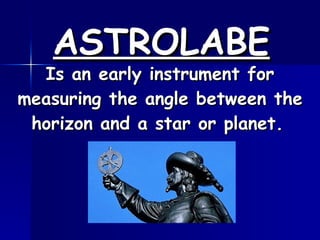


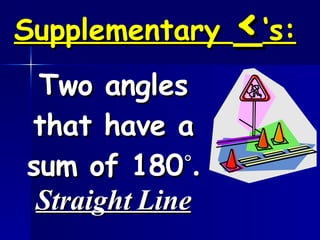
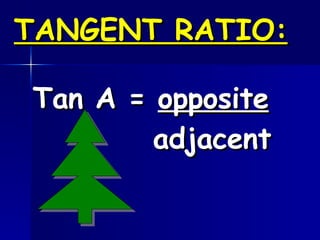
The document discusses identifying special angle pairs when making an astrolabe, an early instrument for measuring angles between the horizon and stars. It defines complementary angles as having a sum of 90 degrees and occurring in corners, and supplementary angles as having a sum of 180 degrees and occurring on a straight line. It then states the objective is to use the tangent ratio to find unknown side lengths in right triangles, defining the tangent ratio as the opposite side over the adjacent side.

![Math12 lesson201[1]](https://cdn.slidesharecdn.com/ss_thumbnails/math12lesson2011-110719005558-phpapp01-thumbnail.jpg?width=640&height=640&fit=bounds)


![PM [B05] Angles & Measurement](https://cdn.slidesharecdn.com/ss_thumbnails/pmb05anglesmeasure-151011170600-lva1-app6891-thumbnail.jpg?width=640&height=640&fit=bounds)


