© ABCC Australia 2015 new-physics.com
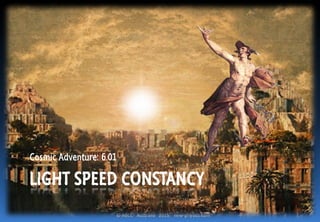
LIGHT SPEED CONSTANCY
Cosmic Adventure: 6.01
© ABCC Australia 2015 new-physics.com
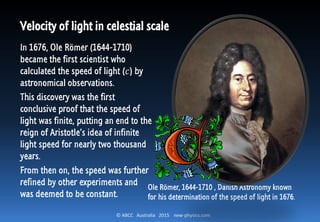
Velocity of light in celestial scale
In 1676, Ole Römer (1644-1710)
became the first scientist who
calculated the speed of light (𝑐) by
astronomical observations.
This discovery was the first
conclusive proof that the speed of
light was finite, putting an end to the
reign of Aristotle’s idea of infinite
light speed for nearly two thousand
years.
From then on, the speed was further
refined by other experiments and
was deemed to be constant.
Ole Römer, 1644-1710 , Danish Astronomy known
for his determination of the speed of light in 1676.
© ABCC Australia 2015 new-physics.com
But is this
speed a
constant ?
© ABCC Australia 2015 new-physics.com
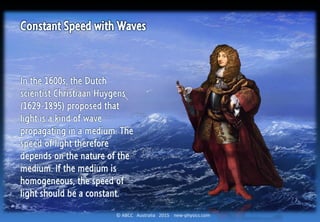
Constant Speed with Waves
In the 1600s, the Dutch
scientist Christiaan Huygens
(1629-1895) proposed that
light is a kind of wave
propagating in a medium. The
speed of light therefore
depends on the nature of the
medium. If the medium is
homogeneous, the speed of
light should be a constant.
© ABCC Australia 2015 new-physics.com
Constant Speed with
Particles
Sir Isaac Newton (1643-
1727) believed that light is
made up of particles instead
of wave, and, as particles,
once let loose in space, will
assume a constant speed in
a vacuum.
© ABCC Australia 2015 new-physics.com
Energy Packets
In the twentieth century, Max
Plank (1858-1947) postulated
that light was emitted in
discrete packets of energy like
particles.
As particles, the speed of light
should be a constant in a
vacuum.
© ABCC Australia 2015 new-physics.com
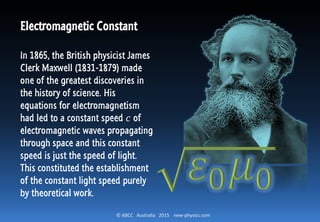
Electromagnetic Constant
In 1865, the British physicist James
Clerk Maxwell (1831-1879) made
one of the greatest discoveries in
the history of science. His
equations for electromagnetism
had led to a constant speed 𝑐 of
electromagnetic waves propagating
through space and this constant
speed is just the speed of light.
This constituted the establishment
of the constant light speed purely
by theoretical work.
© ABCC Australia 2015 new-physics.com
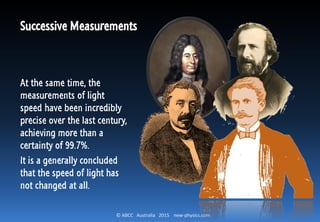
Successive Measurements
At the same time, the
measurements of light
speed have been incredibly
precise over the last century,
achieving more than a
certainty of 99.7%.
It is a generally concluded
that the speed of light has
not changed at all.
© ABCC Australia 2015 new-physics.com
Measurements through the Centuries
Date Scientist Country Experimental Speed Uncertainty Error
Method (108m/s)
1600 Galileo Italy Lanterns and shutters "Fast" ?
1676 Roemer France Moons of Jupiter 2.14 ? 28%
1729 Bradley England Aberration of Light 3.08 ? 2.70%
1849 Fizeau France Cog Wheel 3.14 ? 4.70%
1879 Michelson US Rotating mirror 2.9991 75000.0 400 in 106
Michelson US Rotating mirror 2.99798 22000.0 18 in 106
1950 Essen England Microwave cavity 2.997925 1000.0 0.1 in 106
1958 Froome England Interferometer 2.997925 100.0 0.1 in 106 1972
Evenson US Laser Method 2.997924 1.1 2 in 109
1974 Blaney England Laser Method 2.997924 0.6 3 in 109
1976 Woods England Laser Method 2.997924 0.2 3 in 109
1983 International 2.99792458 0.0 Exact
Data From History of the Speed of Light by Jennifer Deaton and Tina Patrick. 1996.
© ABCC Australia 2015 new-physics.com
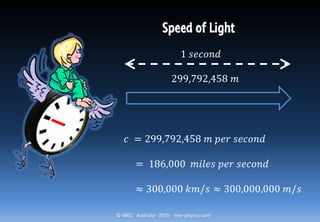
𝑐 = 299,792,458 𝑚 𝑝𝑒𝑟 𝑠𝑒𝑐𝑜𝑛𝑑
= 186,000 𝑚𝑖𝑙𝑒𝑠 𝑝𝑒𝑟 𝑠𝑒𝑐𝑜𝑛𝑑
≈ 300,000 𝑘𝑚/𝑠 ≈ 300,000,000 𝑚/𝑠
1 𝑠𝑒𝑐𝑜𝑛𝑑
299,792,458 𝑚
Speed of Light
© ABCC Australia 2015 new-physics.com
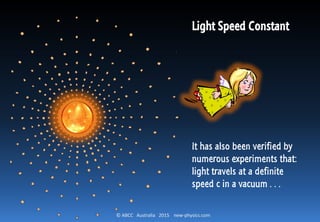
Light Speed Constant
It has also been verified by
numerous experiments that:
light travels at a definite
speed c in a vacuum . . .
© ABCC Australia 2015 new-physics.com
. . . and this speed applies to the entire spectrum of light. [Wikipedia]
© ABCC Australia 2015 new-physics.com
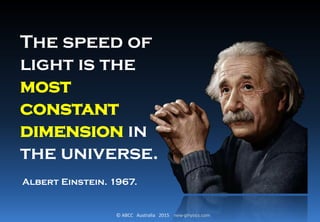
The speed of
light is the
most
constant
dimension in
the universe.
Albert Einstein. 1967.
© ABCC Australia 2015 new-physics.com
Light Speed as Standard
Length and Time
Since the speed of light is
believed to be constant, the
International System of Units
decided to make it a standard
of measuring length and time.
The committee selected two
specific waves from an
emission spectrum of caesium-
133 to define the second and
the meter.
© ABCC Australia 2015 new-physics.com
c in Classical Physics
So in classical physics, the
speed c has been regarded
as an universal constant,
ranked in the same category
as the other great constants
such as h (Planck’s constant)
or e (electron charge).
© ABCC Australia 2015 new-physics.com
SPEED OF LIGHT & OBSERVATION
To be continued on: Cosmic Adventure 6.02

CA 6.01 Light Speed Constancy

  • 1.
    © ABCC Australia2015 new-physics.com LIGHT SPEED CONSTANCY Cosmic Adventure: 6.01
  • 2.
    © ABCC Australia2015 new-physics.com Velocity of light in celestial scale In 1676, Ole Römer (1644-1710) became the first scientist who calculated the speed of light (𝑐) by astronomical observations. This discovery was the first conclusive proof that the speed of light was finite, putting an end to the reign of Aristotle’s idea of infinite light speed for nearly two thousand years. From then on, the speed was further refined by other experiments and was deemed to be constant. Ole Römer, 1644-1710 , Danish Astronomy known for his determination of the speed of light in 1676.
  • 3.
    © ABCC Australia2015 new-physics.com But is this speed a constant ?
  • 4.
    © ABCC Australia2015 new-physics.com Constant Speed with Waves In the 1600s, the Dutch scientist Christiaan Huygens (1629-1895) proposed that light is a kind of wave propagating in a medium. The speed of light therefore depends on the nature of the medium. If the medium is homogeneous, the speed of light should be a constant.
  • 5.
    © ABCC Australia2015 new-physics.com Constant Speed with Particles Sir Isaac Newton (1643- 1727) believed that light is made up of particles instead of wave, and, as particles, once let loose in space, will assume a constant speed in a vacuum.
  • 6.
    © ABCC Australia2015 new-physics.com Energy Packets In the twentieth century, Max Plank (1858-1947) postulated that light was emitted in discrete packets of energy like particles. As particles, the speed of light should be a constant in a vacuum.
  • 7.
    © ABCC Australia2015 new-physics.com Electromagnetic Constant In 1865, the British physicist James Clerk Maxwell (1831-1879) made one of the greatest discoveries in the history of science. His equations for electromagnetism had led to a constant speed 𝑐 of electromagnetic waves propagating through space and this constant speed is just the speed of light. This constituted the establishment of the constant light speed purely by theoretical work.
  • 8.
    © ABCC Australia2015 new-physics.com Successive Measurements At the same time, the measurements of light speed have been incredibly precise over the last century, achieving more than a certainty of 99.7%. It is a generally concluded that the speed of light has not changed at all.
  • 9.
    © ABCC Australia2015 new-physics.com Measurements through the Centuries Date Scientist Country Experimental Speed Uncertainty Error Method (108m/s) 1600 Galileo Italy Lanterns and shutters "Fast" ? 1676 Roemer France Moons of Jupiter 2.14 ? 28% 1729 Bradley England Aberration of Light 3.08 ? 2.70% 1849 Fizeau France Cog Wheel 3.14 ? 4.70% 1879 Michelson US Rotating mirror 2.9991 75000.0 400 in 106 Michelson US Rotating mirror 2.99798 22000.0 18 in 106 1950 Essen England Microwave cavity 2.997925 1000.0 0.1 in 106 1958 Froome England Interferometer 2.997925 100.0 0.1 in 106 1972 Evenson US Laser Method 2.997924 1.1 2 in 109 1974 Blaney England Laser Method 2.997924 0.6 3 in 109 1976 Woods England Laser Method 2.997924 0.2 3 in 109 1983 International 2.99792458 0.0 Exact Data From History of the Speed of Light by Jennifer Deaton and Tina Patrick. 1996.
  • 10.
    © ABCC Australia2015 new-physics.com 𝑐 = 299,792,458 𝑚 𝑝𝑒𝑟 𝑠𝑒𝑐𝑜𝑛𝑑 = 186,000 𝑚𝑖𝑙𝑒𝑠 𝑝𝑒𝑟 𝑠𝑒𝑐𝑜𝑛𝑑 ≈ 300,000 𝑘𝑚/𝑠 ≈ 300,000,000 𝑚/𝑠 1 𝑠𝑒𝑐𝑜𝑛𝑑 299,792,458 𝑚 Speed of Light
  • 11.
    © ABCC Australia2015 new-physics.com Light Speed Constant It has also been verified by numerous experiments that: light travels at a definite speed c in a vacuum . . .
  • 12.
    © ABCC Australia2015 new-physics.com . . . and this speed applies to the entire spectrum of light. [Wikipedia]
  • 13.
    © ABCC Australia2015 new-physics.com The speed of light is the most constant dimension in the universe. Albert Einstein. 1967.
  • 14.
    © ABCC Australia2015 new-physics.com Light Speed as Standard Length and Time Since the speed of light is believed to be constant, the International System of Units decided to make it a standard of measuring length and time. The committee selected two specific waves from an emission spectrum of caesium- 133 to define the second and the meter.
  • 15.
    © ABCC Australia2015 new-physics.com c in Classical Physics So in classical physics, the speed c has been regarded as an universal constant, ranked in the same category as the other great constants such as h (Planck’s constant) or e (electron charge).
  • 16.
    © ABCC Australia2015 new-physics.com SPEED OF LIGHT & OBSERVATION To be continued on: Cosmic Adventure 6.02