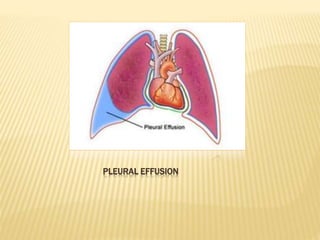
PLEURAL EFFUSION
Rana Shankor Roy
INTRODUCTION
 The accumulation of serous fluid within the
pleural space is termed pleural effusion.
 This fluid may be------
Water(Hydrothorax)
Blood(Hemothorax)
Chyle(Chylothorax)
Pus(Pyothorax or Empyema)
PLEURAL FLUID
 Normal fluid in pleural space: 5-15ml.
 At least 500ml fluid need to detect clinically.
 At least 300ml fluid need to detect
radiologically in PA view.
 At least 100ml fluid need to detect
radiologically in Lateral decubitus position.
 Less than 100ml or small fluid can be
detected by USG.
PLEURAL EFFUSION
WHAT ARE THE CAUSES?
 Common causes are—
Pneumonia
TB
Pulmonary Infarction
Malignant disease
Cardiac failure
 Uncommon causes are---
Hypoproteinaemia(NS, Liver failure)
CT disease(SLE, RA)
Acute Rheumatic fever
Meig’s syndrome(With ovarian tumor & Ascites)
CAUSES ACCORDING TO AGE
 Young:
Pulmonary TB,
Para-pneumonic
 Middle aged or elderly:
Pulmonary TB,
Para-pneumonic
Bronchial carcinoma
CAUSES ACCORDING TO SIDE PREDOMINANT
 Right:
Liver abscess
Meig's syndrome
Dengue hemorrhagic fever
 Left:
Acute pancreatitis
RA
TYPE
 Transudative (Protein<3gm/dl), due to decreased oncotic
pressure or elevated hydrostatic pressure ------
CCF
NS
Cirrhosis of liver
Hypoproteinaemia
Meig’s syndrome
 Exudative (Protein>3gm/dl), due to increased capillary leak and
diminished fluid resorption --------
Pulmonary TB
Para-pneumonic effusion
Bronchial carcinoma
SLE, RA
Acute pancreatitis
LIGHT’S CRITERIA: TRANSUDATE VS. EXUDATE
Exudate is likely if one or more of the following
criteria are met:
• Pleural fluid protein : serum protein ratio >
0.5
• Pleural fluid LDH : serum LDH ratio > 0.6
• Pleural fluid LDH > two-thirds of the upper
limit of normal serum LDH
CASE PRESENTATION
 Asymptomatic until it is large enough to
cause respiratory compromise.
 Breathlessness, particularly on exertion.
 Chest pain(Due to pleurisy) on inspiration
and coughing.
 According to cause( Cough, Fever, Sputum,
Weight loss, Hemoptysis)
WHAT YOU EXPECT IN PHYSICAL EXAMINATION?
 Inspection:
Restriction of movement in affected side.
 Palpation:
Incase of massive pleural effusion trachea & apex beat shifted
the opposite side.
Vocal fremitus reduced or absent in affected side.
Total chest expansibility reduced.
 Percussion:
Percussion note is stony dull in affected side.
 Auscultation:
Breath sound diminished or absent in affected side.
Vocal resonance is also diminished or absent in affected side.
DEFINITIVE SIGNS
 Reduced or absent breath sound
 Stony dull percussion note.
INVESTIGATIONS
 Imaging:
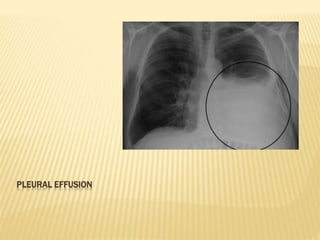
i) Erect chest X-ray P/A view:
The classical appearance of pleural fluid on
the erect PA chest film is of a curved shadow
at the lung base, blunting the costophrenic
angle and ascending towards the axilla.
ii) USG of chest
iii) CT scan of chest
INVESTIGATIONS
 Pleural aspiration and biopsy:
i) The presence of blood is consistent with
pulmonary infarction or malignancy, but may
result from a traumatic tap.
ii) Biochemical analysis allows classification into
transudate and exudates
iii) Gram stain may suggest parapneumonic
effusion.
iv) A low pH suggests infection but may also be
seen in rheumatoid arthritis, ruptured oesophagus
or advanced malignancy.
BED SIDE CONFIRMATION
 By needle aspiration
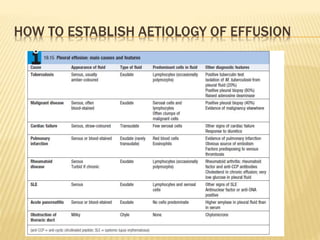
HOW TO ESTABLISH AETIOLOGY OF EFFUSION
PLEURAL EFFUSION
D/D
 Thickened pleura.(No medistinal shifting,
dullness impaired)
 Mass lesion.
MANAGEMENT
 Therapeutic aspiration:
required to palliate breathlessness but
removing more than 1.5 L at a time is
associated with a small risk of re-expansion
pulmonary oedema.
 Treatment of the underlying cause.
IF CLINICALLY PLEURAL EFFUSION BUT NO FLUID
ON ASPIRATION. CAUSES ARE-----
 Fluid may be thick(Empyema).
 Thickened pleura.
 Mass lesion
Pleural effusion

Pleural effusion

  • 1.
  • 2.
    INTRODUCTION  The accumulationof serous fluid within the pleural space is termed pleural effusion.  This fluid may be------ Water(Hydrothorax) Blood(Hemothorax) Chyle(Chylothorax) Pus(Pyothorax or Empyema)
  • 3.
    PLEURAL FLUID  Normalfluid in pleural space: 5-15ml.  At least 500ml fluid need to detect clinically.  At least 300ml fluid need to detect radiologically in PA view.  At least 100ml fluid need to detect radiologically in Lateral decubitus position.  Less than 100ml or small fluid can be detected by USG.
  • 4.
  • 5.
    WHAT ARE THECAUSES?  Common causes are— Pneumonia TB Pulmonary Infarction Malignant disease Cardiac failure  Uncommon causes are--- Hypoproteinaemia(NS, Liver failure) CT disease(SLE, RA) Acute Rheumatic fever Meig’s syndrome(With ovarian tumor & Ascites)
  • 6.
    CAUSES ACCORDING TOAGE  Young: Pulmonary TB, Para-pneumonic  Middle aged or elderly: Pulmonary TB, Para-pneumonic Bronchial carcinoma
  • 7.
    CAUSES ACCORDING TOSIDE PREDOMINANT  Right: Liver abscess Meig's syndrome Dengue hemorrhagic fever  Left: Acute pancreatitis RA
  • 8.
    TYPE  Transudative (Protein<3gm/dl),due to decreased oncotic pressure or elevated hydrostatic pressure ------ CCF NS Cirrhosis of liver Hypoproteinaemia Meig’s syndrome  Exudative (Protein>3gm/dl), due to increased capillary leak and diminished fluid resorption -------- Pulmonary TB Para-pneumonic effusion Bronchial carcinoma SLE, RA Acute pancreatitis
  • 9.
    LIGHT’S CRITERIA: TRANSUDATEVS. EXUDATE Exudate is likely if one or more of the following criteria are met: • Pleural fluid protein : serum protein ratio > 0.5 • Pleural fluid LDH : serum LDH ratio > 0.6 • Pleural fluid LDH > two-thirds of the upper limit of normal serum LDH
  • 10.
    CASE PRESENTATION  Asymptomaticuntil it is large enough to cause respiratory compromise.  Breathlessness, particularly on exertion.  Chest pain(Due to pleurisy) on inspiration and coughing.  According to cause( Cough, Fever, Sputum, Weight loss, Hemoptysis)
  • 11.
    WHAT YOU EXPECTIN PHYSICAL EXAMINATION?  Inspection: Restriction of movement in affected side.  Palpation: Incase of massive pleural effusion trachea & apex beat shifted the opposite side. Vocal fremitus reduced or absent in affected side. Total chest expansibility reduced.  Percussion: Percussion note is stony dull in affected side.  Auscultation: Breath sound diminished or absent in affected side. Vocal resonance is also diminished or absent in affected side.
  • 12.
    DEFINITIVE SIGNS  Reducedor absent breath sound  Stony dull percussion note.
  • 13.
    INVESTIGATIONS  Imaging: i) Erectchest X-ray P/A view: The classical appearance of pleural fluid on the erect PA chest film is of a curved shadow at the lung base, blunting the costophrenic angle and ascending towards the axilla. ii) USG of chest iii) CT scan of chest
  • 14.
    INVESTIGATIONS  Pleural aspirationand biopsy: i) The presence of blood is consistent with pulmonary infarction or malignancy, but may result from a traumatic tap. ii) Biochemical analysis allows classification into transudate and exudates iii) Gram stain may suggest parapneumonic effusion. iv) A low pH suggests infection but may also be seen in rheumatoid arthritis, ruptured oesophagus or advanced malignancy.
  • 15.
    BED SIDE CONFIRMATION By needle aspiration
  • 16.
    HOW TO ESTABLISHAETIOLOGY OF EFFUSION
  • 17.
  • 18.
    D/D  Thickened pleura.(Nomedistinal shifting, dullness impaired)  Mass lesion.
  • 19.
    MANAGEMENT  Therapeutic aspiration: requiredto palliate breathlessness but removing more than 1.5 L at a time is associated with a small risk of re-expansion pulmonary oedema.  Treatment of the underlying cause.
  • 20.
    IF CLINICALLY PLEURALEFFUSION BUT NO FLUID ON ASPIRATION. CAUSES ARE-----  Fluid may be thick(Empyema).  Thickened pleura.  Mass lesion