BRONCHIAL ASTHMA
Rana Shankor roy
DEFINITION
 Asthma is a disease of the airways
characterized by an increased
responsiveness of the tracheobronchial tree
to many different stimuli, resulting in
episodes of reversible airway obstruction.
 It is IgE mediated type-I hypersensitivity
reaction.
SO, WHAT HAPPENS IN ASTHMA?
 Airflow limitation
 Airway hyper-reactivity
 Airway inflammation
TYPES OF ASTHMA
 Extrinsic asthma: when a difinite external
cause can be identified.
 Intrinsic asthma: when a difinite external
cause can not be identified.
WHAT ARE THE TRIGGERING FACTORS?
 Allergens (e.g. house dust mites and animal dander).
 Drugs (e.g. beta-blockers and non-steroidal anti-
inflammatory drugs).
 Environmental (e.g. climatic conditions and air
pollution).
 Occupations (e.g. exposure to industrial chemicals,
drugs, metals, dusts).
 Infections (e.g. viral and bacterial).
 Exercise.
 Emotion.
 Cigarette smoke.
WHAT POSITIVE HISTORY YOU EXPECT?
 Age of onset of breathlessness is usually
childhood.
 Diurnal variation of breathlessness(Usually
worsens at late night & early morning).
 Awakening short of breath.
 Precipitating factors.
 Occupational history.
 Relieved by bronchodilators.
 History of allergy.
 Family history.
SYMPTOMS & SIGNS
 Typical symptoms include recurrent episodes of
Wheezing
Chest tightness,
Breathlessness
Cough.
 Signs are
Signs of respiratory distress( Tachypnea, use of
accessory respiratory muscles)
Cyanosis
Auscultation of chest reveals ronchi throughout the
chest, more prominent during expiration
COUGH-VARIANT ASTHMA(CVA)
 Cough may be the dominant symptom in
some patients, and the lack of wheeze or
breathlessness may lead to a delay in
reaching the diagnosis of so-called cough-
variant asthma(CVA).
DIAGNOSIS
The diagnosis of asthma is predominantly clinical
and based on a characteristic history.
 Pulmonary function test:
i) spirometry to measure FEV1 and VC.
ii) If spirometry is not available, a peak flow
meter may be used. Patients should be
instructed to record peak flow readings after
rising in the morning and before retiring in the
evening. A diurnal variation in PEF of more than
20% (the lowest values typically being recorded
in the morning) is considered diagnostic.
 Measurement of allergic status:
Skin prick tests.
Measurement of total and allergen-specific IgE.
A full blood picture may show the peripheral
blood eosinophilia.
 Radiological examination:
Chest X-ray appearances are often normal or
show hyperinflation of lung fields.
 Sputum for eosinophil count.
HOW TO MAKE A DIAGNOSIS OF ASTHMA
 Compatible clinical history plus either/or :
• FEV1 ≥ 15% (and 200 mL) increase following
administration of a bronchodilator/trial of
corticosteroids
• > 20% diurnal variation on ≥ 3 days in a week
for 2 weeks on PEF diary
• FEV1 ≥ 15% decrease after 6 mins of
exercise
D/D
 Chronic obstructive pulmonary disease (COPD).
 Upper airway obstruction: tumour, vocal cord
dysfunction and laryngeal oedema.
 Endobronchial disease: foreign body aspiration,
neoplasm, bronchial stenosis.
 Left ventricular failure.
 Carcinoid tumours.
 Recurrent pulmonary emboli.
 Eosinophilic pneumonias.
 Systemic vasculitis with pulmonary involvement.
WHY NOT COPD?
 In COPD(chronic bronchitis), there is
presence of cough with sputum production,
on most of the days for at least 3 consecutive
months in a year for at least 2 successive
years.
 May no history of smoking.
 May be children
 May have famiy history.
MANAGEMENT OF ASTHMA
 Avoidance of further exposure to aggrevating
factors.
 Using mask at work.
 If no response, step care asthma
management plan.
The therapeutic targets of medications used for
asthma include:
 Drugs that inhibit smooth muscle contraction
(e.g. beta-2-agonists, anticholinergic and
methylxanthines such as theophylline).
 Drugs that prevent or reverse airway
inflammation (e.g. corticosteroids and mast cell
stabilizing agents).
 Drugs that modify the action of leukotriene's
(e.g. leukotriene antagonists or 5-lipoxygenase
inhibitors).
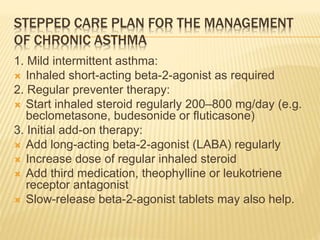
STEPPED CARE PLAN FOR THE MANAGEMENT
OF CHRONIC ASTHMA
1. Mild intermittent asthma:
 Inhaled short-acting beta-2-agonist as required
2. Regular preventer therapy:
 Start inhaled steroid regularly 200–800 mg/day (e.g.
beclometasone, budesonide or fluticasone)
3. Initial add-on therapy:
 Add long-acting beta-2-agonist (LABA) regularly
 Increase dose of regular inhaled steroid
 Add third medication, theophylline or leukotriene
receptor antagonist
 Slow-release beta-2-agonist tablets may also help.
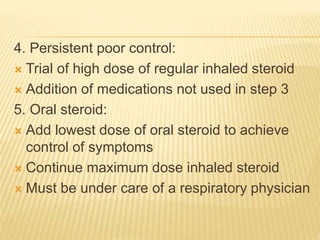
4. Persistent poor control:
 Trial of high dose of regular inhaled steroid
 Addition of medications not used in step 3
5. Oral steroid:
 Add lowest dose of oral steroid to achieve
control of symptoms
 Continue maximum dose inhaled steroid
 Must be under care of a respiratory physician
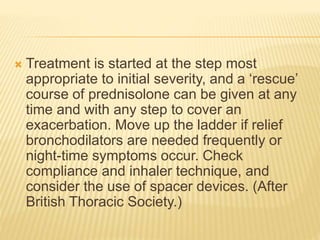
 Treatment is started at the step most
appropriate to initial severity, and a ‘rescue’
course of prednisolone can be given at any
time and with any step to cover an
exacerbation. Move up the ladder if relief
bronchodilators are needed frequently or
night-time symptoms occur. Check
compliance and inhaler technique, and
consider the use of spacer devices. (After
British Thoracic Society.)
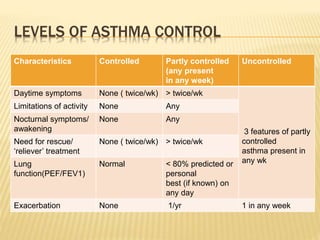
LEVELS OF ASTHMA CONTROL
Characteristics Controlled Partly controlled
(any present
in any week)
Uncontrolled
Daytime symptoms None ( twice/wk) > twice/wk
3 features of partly
controlled
asthma present in
any wk
Limitations of activity None Any
Nocturnal symptoms/
awakening
None Any
Need for rescue/
‘reliever’ treatment
None ( twice/wk) > twice/wk
Lung
function(PEF/FEV1)
Normal < 80% predicted or
personal
best (if known) on
any day
Exacerbation None 1/yr 1 in any week
HOW TO USE A METERED-DOSE INHALER
 Remove the cap and shake the inhaler
 Breathe out gently and place the mouthpiece
into the mouth
 Incline the head backwards to minimise
oropharyngeal deposition
 Simultaneously, begin a slow deep
inspiration, depress the canister and
continue to inhale
 Hold the breath for 10 seconds
IMMEDIATE ASSESSMENT OF ACUTE
SEVERE ASTHMA
 Acute severe asthma/ status asthmaticus
• PEF 33–50% predicted (< 200 L/min)
• Respiratory rate ≥ 25 breaths/min
• Heart rate ≥ 110 beats/min
• Inability to complete sentences in 1 breath
 Life-threatening features
• PEF < 33% predicted(< 100 L/min)
• SpO2 < 92% or PaO2< 8 kPa (60 mmHg)(especially if
being treated with oxygen)
• Normal or raised PaCO2
• Silent chest
• Cyanosis
• Feeble respiratory effort
• Bradycardia or arrhythmias
• Hypotension
• Exhaustion
• Confusion
• Coma
 Near-fatal asthma
• Raised PaCO2 and/or requiring mechanical
ventilation with raised inflation pressures.
INDICATIONS FOR ASSISTED VENTILATION IN
ACUTE SEVERE ASTHMA
 Coma
 Respiratory arrest
 Deterioration of arterial blood gas tensions
despite optimal therapy
PaO2 < 8 kPa (60 mmHg) and falling
PaCO2 > 6 kPa (45 mmHg) and rising
pH low and falling (H+ high and rising)
 Exhaustion, confusion, drowsiness
HOW TO MANAGE ACUTE SEVERE CASES?
 High concentration oxygen – aim for saturations above
92%
 Frequent nebulized salbutamol (5 mg) with ipratropium
bromide (0.5 mg q.d.s.) if severe attack. Use oxygen-
driven nebulizers if possible.
 Systemic corticosteroids (hydrocortisone 200 mg IV 4
hourly. After 24 hours prednisolone 60 mg daily for 2
weeks orally.)
 If no response IV infusion salbutamol or terbutaline or
magnesium sulphate may be given.
 Intravenous aminophylline may be given.
 Correction of fluid & electrolytes.
 If, no response shift to ICU.
WHEN WILL YOU DISCHARGE A PATIENT?
 Prior to discharge, patients should be stable
on discharge medication (nebulised therapy
should have been discontinued for at least
24 hours)
 The PEF should have reached 75% of
predicted or personal best.
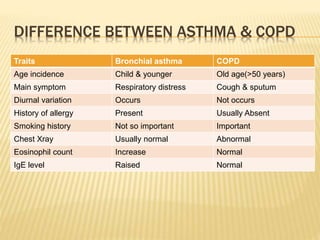
DIFFERENCE BETWEEN ASTHMA & COPD
Traits Bronchial asthma COPD
Age incidence Child & younger Old age(>50 years)
Main symptom Respiratory distress Cough & sputum
Diurnal variation Occurs Not occurs
History of allergy Present Usually Absent
Smoking history Not so important Important
Chest Xray Usually normal Abnormal
Eosinophil count Increase Normal
IgE level Raised Normal

Bronchial asthma

  • 1.
  • 2.
    DEFINITION  Asthma isa disease of the airways characterized by an increased responsiveness of the tracheobronchial tree to many different stimuli, resulting in episodes of reversible airway obstruction.  It is IgE mediated type-I hypersensitivity reaction.
  • 3.
    SO, WHAT HAPPENSIN ASTHMA?  Airflow limitation  Airway hyper-reactivity  Airway inflammation
  • 4.
    TYPES OF ASTHMA Extrinsic asthma: when a difinite external cause can be identified.  Intrinsic asthma: when a difinite external cause can not be identified.
  • 5.
    WHAT ARE THETRIGGERING FACTORS?  Allergens (e.g. house dust mites and animal dander).  Drugs (e.g. beta-blockers and non-steroidal anti- inflammatory drugs).  Environmental (e.g. climatic conditions and air pollution).  Occupations (e.g. exposure to industrial chemicals, drugs, metals, dusts).  Infections (e.g. viral and bacterial).  Exercise.  Emotion.  Cigarette smoke.
  • 6.
    WHAT POSITIVE HISTORYYOU EXPECT?  Age of onset of breathlessness is usually childhood.  Diurnal variation of breathlessness(Usually worsens at late night & early morning).  Awakening short of breath.  Precipitating factors.  Occupational history.  Relieved by bronchodilators.  History of allergy.  Family history.
  • 7.
    SYMPTOMS & SIGNS Typical symptoms include recurrent episodes of Wheezing Chest tightness, Breathlessness Cough.  Signs are Signs of respiratory distress( Tachypnea, use of accessory respiratory muscles) Cyanosis Auscultation of chest reveals ronchi throughout the chest, more prominent during expiration
  • 8.
    COUGH-VARIANT ASTHMA(CVA)  Coughmay be the dominant symptom in some patients, and the lack of wheeze or breathlessness may lead to a delay in reaching the diagnosis of so-called cough- variant asthma(CVA).
  • 9.
    DIAGNOSIS The diagnosis ofasthma is predominantly clinical and based on a characteristic history.  Pulmonary function test: i) spirometry to measure FEV1 and VC. ii) If spirometry is not available, a peak flow meter may be used. Patients should be instructed to record peak flow readings after rising in the morning and before retiring in the evening. A diurnal variation in PEF of more than 20% (the lowest values typically being recorded in the morning) is considered diagnostic.
  • 10.
     Measurement ofallergic status: Skin prick tests. Measurement of total and allergen-specific IgE. A full blood picture may show the peripheral blood eosinophilia.  Radiological examination: Chest X-ray appearances are often normal or show hyperinflation of lung fields.  Sputum for eosinophil count.
  • 11.
    HOW TO MAKEA DIAGNOSIS OF ASTHMA  Compatible clinical history plus either/or : • FEV1 ≥ 15% (and 200 mL) increase following administration of a bronchodilator/trial of corticosteroids • > 20% diurnal variation on ≥ 3 days in a week for 2 weeks on PEF diary • FEV1 ≥ 15% decrease after 6 mins of exercise
  • 12.
    D/D  Chronic obstructivepulmonary disease (COPD).  Upper airway obstruction: tumour, vocal cord dysfunction and laryngeal oedema.  Endobronchial disease: foreign body aspiration, neoplasm, bronchial stenosis.  Left ventricular failure.  Carcinoid tumours.  Recurrent pulmonary emboli.  Eosinophilic pneumonias.  Systemic vasculitis with pulmonary involvement.
  • 13.
    WHY NOT COPD? In COPD(chronic bronchitis), there is presence of cough with sputum production, on most of the days for at least 3 consecutive months in a year for at least 2 successive years.  May no history of smoking.  May be children  May have famiy history.
  • 14.
    MANAGEMENT OF ASTHMA Avoidance of further exposure to aggrevating factors.  Using mask at work.  If no response, step care asthma management plan.
  • 15.
    The therapeutic targetsof medications used for asthma include:  Drugs that inhibit smooth muscle contraction (e.g. beta-2-agonists, anticholinergic and methylxanthines such as theophylline).  Drugs that prevent or reverse airway inflammation (e.g. corticosteroids and mast cell stabilizing agents).  Drugs that modify the action of leukotriene's (e.g. leukotriene antagonists or 5-lipoxygenase inhibitors).
  • 16.
    STEPPED CARE PLANFOR THE MANAGEMENT OF CHRONIC ASTHMA 1. Mild intermittent asthma:  Inhaled short-acting beta-2-agonist as required 2. Regular preventer therapy:  Start inhaled steroid regularly 200–800 mg/day (e.g. beclometasone, budesonide or fluticasone) 3. Initial add-on therapy:  Add long-acting beta-2-agonist (LABA) regularly  Increase dose of regular inhaled steroid  Add third medication, theophylline or leukotriene receptor antagonist  Slow-release beta-2-agonist tablets may also help.
  • 17.
    4. Persistent poorcontrol:  Trial of high dose of regular inhaled steroid  Addition of medications not used in step 3 5. Oral steroid:  Add lowest dose of oral steroid to achieve control of symptoms  Continue maximum dose inhaled steroid  Must be under care of a respiratory physician
  • 18.
     Treatment isstarted at the step most appropriate to initial severity, and a ‘rescue’ course of prednisolone can be given at any time and with any step to cover an exacerbation. Move up the ladder if relief bronchodilators are needed frequently or night-time symptoms occur. Check compliance and inhaler technique, and consider the use of spacer devices. (After British Thoracic Society.)
  • 19.
    LEVELS OF ASTHMACONTROL Characteristics Controlled Partly controlled (any present in any week) Uncontrolled Daytime symptoms None ( twice/wk) > twice/wk 3 features of partly controlled asthma present in any wk Limitations of activity None Any Nocturnal symptoms/ awakening None Any Need for rescue/ ‘reliever’ treatment None ( twice/wk) > twice/wk Lung function(PEF/FEV1) Normal < 80% predicted or personal best (if known) on any day Exacerbation None 1/yr 1 in any week
  • 20.
    HOW TO USEA METERED-DOSE INHALER  Remove the cap and shake the inhaler  Breathe out gently and place the mouthpiece into the mouth  Incline the head backwards to minimise oropharyngeal deposition  Simultaneously, begin a slow deep inspiration, depress the canister and continue to inhale  Hold the breath for 10 seconds
  • 21.
    IMMEDIATE ASSESSMENT OFACUTE SEVERE ASTHMA  Acute severe asthma/ status asthmaticus • PEF 33–50% predicted (< 200 L/min) • Respiratory rate ≥ 25 breaths/min • Heart rate ≥ 110 beats/min • Inability to complete sentences in 1 breath
  • 22.
     Life-threatening features •PEF < 33% predicted(< 100 L/min) • SpO2 < 92% or PaO2< 8 kPa (60 mmHg)(especially if being treated with oxygen) • Normal or raised PaCO2 • Silent chest • Cyanosis • Feeble respiratory effort • Bradycardia or arrhythmias • Hypotension • Exhaustion • Confusion • Coma
  • 23.
     Near-fatal asthma •Raised PaCO2 and/or requiring mechanical ventilation with raised inflation pressures.
  • 24.
    INDICATIONS FOR ASSISTEDVENTILATION IN ACUTE SEVERE ASTHMA  Coma  Respiratory arrest  Deterioration of arterial blood gas tensions despite optimal therapy PaO2 < 8 kPa (60 mmHg) and falling PaCO2 > 6 kPa (45 mmHg) and rising pH low and falling (H+ high and rising)  Exhaustion, confusion, drowsiness
  • 25.
    HOW TO MANAGEACUTE SEVERE CASES?  High concentration oxygen – aim for saturations above 92%  Frequent nebulized salbutamol (5 mg) with ipratropium bromide (0.5 mg q.d.s.) if severe attack. Use oxygen- driven nebulizers if possible.  Systemic corticosteroids (hydrocortisone 200 mg IV 4 hourly. After 24 hours prednisolone 60 mg daily for 2 weeks orally.)  If no response IV infusion salbutamol or terbutaline or magnesium sulphate may be given.  Intravenous aminophylline may be given.  Correction of fluid & electrolytes.  If, no response shift to ICU.
  • 26.
    WHEN WILL YOUDISCHARGE A PATIENT?  Prior to discharge, patients should be stable on discharge medication (nebulised therapy should have been discontinued for at least 24 hours)  The PEF should have reached 75% of predicted or personal best.
  • 27.
    DIFFERENCE BETWEEN ASTHMA& COPD Traits Bronchial asthma COPD Age incidence Child & younger Old age(>50 years) Main symptom Respiratory distress Cough & sputum Diurnal variation Occurs Not occurs History of allergy Present Usually Absent Smoking history Not so important Important Chest Xray Usually normal Abnormal Eosinophil count Increase Normal IgE level Raised Normal