Using Statistical testsRichard Salisbury	richardasalisbury@gmail.com
What I’m going to coverKey conceptsWhat test when?Examples
Key concept 1: The null hypothesisI predict that any difference seen between two groups is due to chance alone.Use 95% cut off in medicineP > 0.05 = accept null hypothesisP < 0.05 = reject null hypothesis as difference is NOT due to chance. There is a statistically significant difference between groups.
Key concept 2: Data typesContinuous eg. heightDiscrete - integersOrdinal - rankedCategorical eg. Hair colourDichotomous/Binary eg. Yes/no
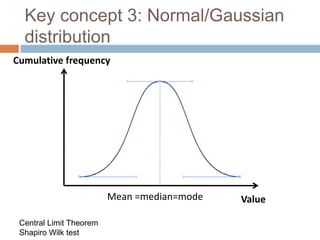
Key concept 3: Normal/Gaussian distributionCumulative frequency Mean =median=mode  ValueCentral Limit TheoremShapiro Wilk test
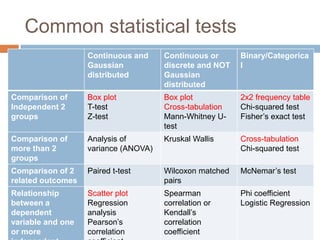
Common statistical tests
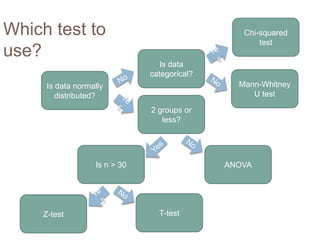
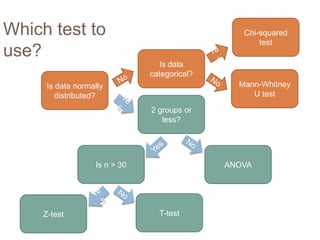
Chi-squared testWhich test to use?YesIs data categorical?NoMann-Whitney U testIs data normally distributed?No2 groups or less?YesNoYesIs n > 30ANOVANoYesT-testZ-test
Normally distributed data - T-testComparison of means taking into account spreadAllows comparison 2 groups OR a comparison of one group and an expected mean1 tailed Vs 2 tailed – what question are you asking?Independent groups Vs Dependent/Paired groups
Example 1I have audited BMI of 20 patients undergoing gastric banding, I want to compare this with the national average.Data - BMI is a continuous variable and therefore will be normally distributed about the mean.Groups - 2 groupsNumber - n<30T-test using mean and variance of my group compared to mean and variance of national average.2 tail t-test as I am interested in knowing whether the BMI is different therefore either smaller or larger1 tail t-test could be used if I wanted to ask is the BMI larger in patients undergoing gastric banding compared to national average
Example 2Does CBT change the mood (measured by visual analogue scale) of 50 depressed individuals? – Comparison of before and after scoresData – Normally distributedGroups – 2; before Vs after CBTNumber – n>30 BUT groups are not independent – repeated measures2-tail paired T-test1-tail paired t-test would be for a question that asks if CBT increases mood.
Alternatives to t-testZ-test for independent variables where n > 30ANOVA for more than 2 groups – multiple comparisons (the more comparisons you do, the more likely you are to get a false positive)ANOVA tests for difference between all groupsA post test egBonferroni then tests for differences between individual groupsEg. RCT Placebo Vs Drug A Vs Drug B
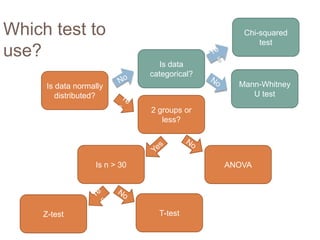
Chi-squared testWhich test to use?YesIs data categorical?NoMann-Whitney U testIs data normally distributed?No2 groups or less?YesNoYesIs n > 30ANOVANoYesT-testZ-test
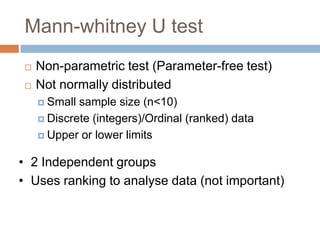
Mann-whitney U testNon-parametric test (Parameter-free test)Not normally distributedSmall sample size (n<10)Discrete (integers)/Ordinal (ranked) dataUpper or lower limits2 Independent groups
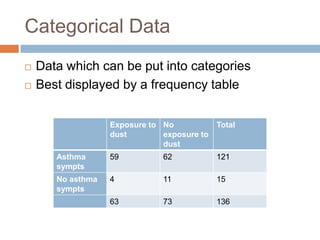
Uses ranking to analyse data (not important)Categorical DataData which can be put into categoriesBest displayed by a frequency table
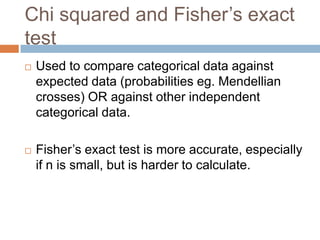
Chi squared and Fisher’s exact testUsed to compare categorical data against expected data (probabilities eg. Mendellian crosses) OR against other independent categorical data.Fisher’s exact test is more accurate, especially if n is small, but is harder to calculate.
Regression AnalysisCompares how an independent variable changes the value of a dependent variable, independent of any other independent variables.This is as complicated as it sounds. Seek help early!
Examples to finish
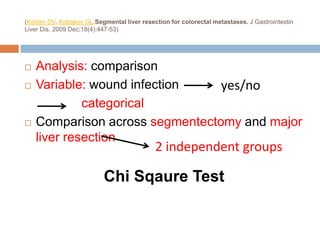
Example 1(Kostov DV, KobakovGL.Segmental liver resection for colorectal metastases. J Gastrointestin Liver Dis. 2009 Dec;18(4):447-53)56 colorectal liver metastasis patients had two types of operations for their liver metastasis: 38 patients had major liver resection with 16 of them having surgical wound infection later. 18 patients had segmentectomy and only 7 of them experienced wound infection later. Objective: is the occurrence of wound infection different in these two types of operations? (Kostov DV, Kobakov GL.Segmental liver resection for colorectal metastases. J Gastrointestin Liver Dis. 2009 Dec;18(4):447-53)Analysis: comparisonVariable: wound infectioncategorical Comparison across segmentectomy and major liver resectionChi Sqaure Test yes/no2 independent groups
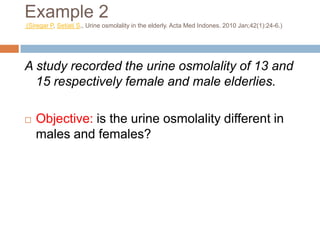
Example 2  (Siregar P, Setiati S., Urine osmolality in the elderly. Acta Med Indones. 2010 Jan;42(1):24-6.)A study recorded the urine osmolality of 13 and 15 respectively female and male elderlies.Objective: is the urine osmolality different in males and females?
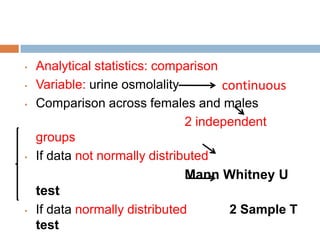
Analytical statistics: comparison
Variable: urine osmolality
Comparison across females and males           2 independent groups If data not normally distributed Mann Whitney U testIf data normally distributed 2 Sample T testcontinuous

Medical Statistics Pt 2

  • 1.
    Using Statistical testsRichardSalisbury richardasalisbury@gmail.com
  • 2.
    What I’m goingto coverKey conceptsWhat test when?Examples
  • 3.
    Key concept 1:The null hypothesisI predict that any difference seen between two groups is due to chance alone.Use 95% cut off in medicineP > 0.05 = accept null hypothesisP < 0.05 = reject null hypothesis as difference is NOT due to chance. There is a statistically significant difference between groups.
  • 4.
    Key concept 2:Data typesContinuous eg. heightDiscrete - integersOrdinal - rankedCategorical eg. Hair colourDichotomous/Binary eg. Yes/no
  • 5.
    Key concept 3:Normal/Gaussian distributionCumulative frequency Mean =median=mode ValueCentral Limit TheoremShapiro Wilk test
  • 6.
  • 7.
    Chi-squared testWhich testto use?YesIs data categorical?NoMann-Whitney U testIs data normally distributed?No2 groups or less?YesNoYesIs n > 30ANOVANoYesT-testZ-test
  • 8.
    Chi-squared testWhich testto use?YesIs data categorical?NoMann-Whitney U testIs data normally distributed?No2 groups or less?YesNoYesIs n > 30ANOVANoYesT-testZ-test
  • 9.
    Normally distributed data- T-testComparison of means taking into account spreadAllows comparison 2 groups OR a comparison of one group and an expected mean1 tailed Vs 2 tailed – what question are you asking?Independent groups Vs Dependent/Paired groups
  • 10.
    Example 1I haveaudited BMI of 20 patients undergoing gastric banding, I want to compare this with the national average.Data - BMI is a continuous variable and therefore will be normally distributed about the mean.Groups - 2 groupsNumber - n<30T-test using mean and variance of my group compared to mean and variance of national average.2 tail t-test as I am interested in knowing whether the BMI is different therefore either smaller or larger1 tail t-test could be used if I wanted to ask is the BMI larger in patients undergoing gastric banding compared to national average
  • 11.
    Example 2Does CBTchange the mood (measured by visual analogue scale) of 50 depressed individuals? – Comparison of before and after scoresData – Normally distributedGroups – 2; before Vs after CBTNumber – n>30 BUT groups are not independent – repeated measures2-tail paired T-test1-tail paired t-test would be for a question that asks if CBT increases mood.
  • 12.
    Alternatives to t-testZ-testfor independent variables where n > 30ANOVA for more than 2 groups – multiple comparisons (the more comparisons you do, the more likely you are to get a false positive)ANOVA tests for difference between all groupsA post test egBonferroni then tests for differences between individual groupsEg. RCT Placebo Vs Drug A Vs Drug B
  • 13.
    Chi-squared testWhich testto use?YesIs data categorical?NoMann-Whitney U testIs data normally distributed?No2 groups or less?YesNoYesIs n > 30ANOVANoYesT-testZ-test
  • 14.
    Mann-whitney U testNon-parametrictest (Parameter-free test)Not normally distributedSmall sample size (n<10)Discrete (integers)/Ordinal (ranked) dataUpper or lower limits2 Independent groups
  • 15.
    Uses ranking toanalyse data (not important)Categorical DataData which can be put into categoriesBest displayed by a frequency table
  • 16.
    Chi squared andFisher’s exact testUsed to compare categorical data against expected data (probabilities eg. Mendellian crosses) OR against other independent categorical data.Fisher’s exact test is more accurate, especially if n is small, but is harder to calculate.
  • 17.
    Regression AnalysisCompares howan independent variable changes the value of a dependent variable, independent of any other independent variables.This is as complicated as it sounds. Seek help early!
  • 18.
  • 19.
    Example 1(Kostov DV,KobakovGL.Segmental liver resection for colorectal metastases. J Gastrointestin Liver Dis. 2009 Dec;18(4):447-53)56 colorectal liver metastasis patients had two types of operations for their liver metastasis: 38 patients had major liver resection with 16 of them having surgical wound infection later. 18 patients had segmentectomy and only 7 of them experienced wound infection later. Objective: is the occurrence of wound infection different in these two types of operations? (Kostov DV, Kobakov GL.Segmental liver resection for colorectal metastases. J Gastrointestin Liver Dis. 2009 Dec;18(4):447-53)Analysis: comparisonVariable: wound infectioncategorical Comparison across segmentectomy and major liver resectionChi Sqaure Test yes/no2 independent groups
  • 20.
    Example 2 (Siregar P, Setiati S., Urine osmolality in the elderly. Acta Med Indones. 2010 Jan;42(1):24-6.)A study recorded the urine osmolality of 13 and 15 respectively female and male elderlies.Objective: is the urine osmolality different in males and females?
  • 21.
  • 22.
  • 23.
    Comparison across femalesand males 2 independent groups If data not normally distributed Mann Whitney U testIf data normally distributed 2 Sample T testcontinuous