Assigned by:
Prof: Dr. iftikhar jafri
*
*Planning:
*Planning is the process of thinking
about the activities required to
achieve the desired goal. Planning
involves instructional planning and
time frames and planning.
*
*Many planning strategies are organized around four
elements:”the nature of the subject matter, the
learners, the context, and the teacher’s role.
*Teacher must decide what is important to include,
given their goals, and know how to make it
accessible to a particular group of students.
Teachers need to implement the big picture of
their curricular vision.
*
*Developing systematic time plans involves
knowing what needs to be done and when
to do it, or focusing on task and time.
Think of integrated assessment planning
in terms of three time frames: pre
instruction, during instruction, and post
instruction.
*
*Three tools are especially useful in teacher centered
planning and instruction.
*1. Behavioral objectives
*2. Tasks analysis
*3. Instructional taxonomies
*Behavioral objectives:
*One tool is that of behavioral objectives, statements
about changes that the teacher wishes to see in
students’ performance. These objectives should be very
specific.
*Task analysis:
* This tool focuses on breaking down a complex
task that students are to learn into its
components parts.
*
*Instructional taxonomies:
* Instructional taxonomies also aid teacher
centered approaches . A taxonomy is
classification system. Blooms taxonomy has
been used by many teachers in their lesson
planning to create goals and objectives.
*Teachers can use Bloom’s taxonomies for the
cognitive, affective and psychomotor domains
to plan instruction.
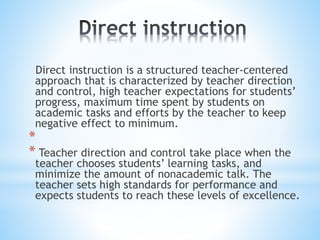
Direct instruction is a structured teacher-centered
approach that is characterized by teacher direction
and control, high teacher expectations for students’
progress, maximum time spent by students on
academic tasks and efforts by the teacher to keep
negative effect to minimum.
*
* Teacher direction and control take place when the
teacher chooses students’ learning tasks, and
minimize the amount of nonacademic talk. The
teacher sets high standards for performance and
expects students to reach these levels of excellence.
*
*Many teacher-centered strategies reflect direct instruction.
*
*Orienting: before presenting and explaining new material, establish
a framework for the lesson and orient students to the new material:
*Review the previous day’s activities
*Discuss the lesson’s objective
*Provide clear, explicit instructions about the work to be done and
*Give an overview of today’s lesson.
*Lecturing, explaining, and demonstrating
*Questioning and discussing
*Mastery learning
*Seat work
*Homework
*
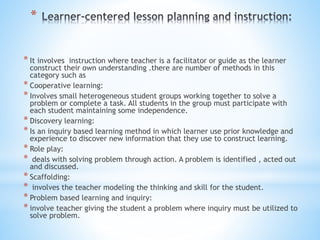
* It involves instruction where teacher is a facilitator or guide as the learner
construct their own understanding .there are number of methods in this
category such as
* Cooperative learning:
* Involves small heterogeneous student groups working together to solve a
problem or complete a task. All students in the group must participate with
each student maintaining some independence.
* Discovery learning:
* Is an inquiry based learning method in which learner use prior knowledge and
experience to discover new information that they use to construct learning.
* Role play:
* deals with solving problem through action. A problem is identified , acted out
and discussed.
* Scaffolding:
* involves the teacher modeling the thinking and skill for the student.
* Problem based learning and inquiry:
* involve teacher giving the student a problem where inquiry must be utilized to
solve problem.
*
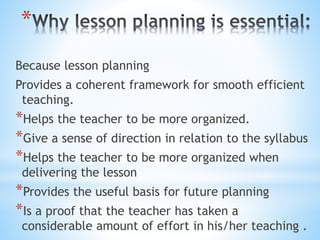
Because lesson planning
Provides a coherent framework for smooth efficient
teaching.
*Helps the teacher to be more organized.
*Give a sense of direction in relation to the syllabus
*Helps the teacher to be more organized when
delivering the lesson
*Provides the useful basis for future planning
*Is a proof that the teacher has taken a
considerable amount of effort in his/her teaching .
*
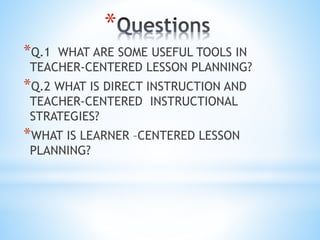
*Q.1 WHAT ARE SOME USEFUL TOOLS IN
TEACHER-CENTERED LESSON PLANNING?
*Q.2 WHAT IS DIRECT INSTRUCTION AND
TEACHER-CENTERED INSTRUCTIONAL
STRATEGIES?
*WHAT IS LEARNER –CENTERED LESSON
PLANNING?
Uzma sheikh, M.Phil. Batch:2016
Roll no. 47
Faculty of Education, Old Campus
University of Sindh Hyderabad

Planning and instruction ppt

  • 2.
    Assigned by: Prof: Dr.iftikhar jafri
  • 3.
    * *Planning: *Planning is theprocess of thinking about the activities required to achieve the desired goal. Planning involves instructional planning and time frames and planning.
  • 4.
    * *Many planning strategiesare organized around four elements:”the nature of the subject matter, the learners, the context, and the teacher’s role. *Teacher must decide what is important to include, given their goals, and know how to make it accessible to a particular group of students. Teachers need to implement the big picture of their curricular vision.
  • 5.
    * *Developing systematic timeplans involves knowing what needs to be done and when to do it, or focusing on task and time. Think of integrated assessment planning in terms of three time frames: pre instruction, during instruction, and post instruction.
  • 6.
    * *Three tools areespecially useful in teacher centered planning and instruction. *1. Behavioral objectives *2. Tasks analysis *3. Instructional taxonomies *Behavioral objectives: *One tool is that of behavioral objectives, statements about changes that the teacher wishes to see in students’ performance. These objectives should be very specific.
  • 7.
    *Task analysis: * Thistool focuses on breaking down a complex task that students are to learn into its components parts. * *Instructional taxonomies: * Instructional taxonomies also aid teacher centered approaches . A taxonomy is classification system. Blooms taxonomy has been used by many teachers in their lesson planning to create goals and objectives. *Teachers can use Bloom’s taxonomies for the cognitive, affective and psychomotor domains to plan instruction.
  • 8.
    Direct instruction isa structured teacher-centered approach that is characterized by teacher direction and control, high teacher expectations for students’ progress, maximum time spent by students on academic tasks and efforts by the teacher to keep negative effect to minimum. * * Teacher direction and control take place when the teacher chooses students’ learning tasks, and minimize the amount of nonacademic talk. The teacher sets high standards for performance and expects students to reach these levels of excellence.
  • 9.
    * *Many teacher-centered strategiesreflect direct instruction. * *Orienting: before presenting and explaining new material, establish a framework for the lesson and orient students to the new material: *Review the previous day’s activities *Discuss the lesson’s objective *Provide clear, explicit instructions about the work to be done and *Give an overview of today’s lesson. *Lecturing, explaining, and demonstrating *Questioning and discussing *Mastery learning *Seat work *Homework
  • 10.
    * * It involvesinstruction where teacher is a facilitator or guide as the learner construct their own understanding .there are number of methods in this category such as * Cooperative learning: * Involves small heterogeneous student groups working together to solve a problem or complete a task. All students in the group must participate with each student maintaining some independence. * Discovery learning: * Is an inquiry based learning method in which learner use prior knowledge and experience to discover new information that they use to construct learning. * Role play: * deals with solving problem through action. A problem is identified , acted out and discussed. * Scaffolding: * involves the teacher modeling the thinking and skill for the student. * Problem based learning and inquiry: * involve teacher giving the student a problem where inquiry must be utilized to solve problem.
  • 11.
    * Because lesson planning Providesa coherent framework for smooth efficient teaching. *Helps the teacher to be more organized. *Give a sense of direction in relation to the syllabus *Helps the teacher to be more organized when delivering the lesson *Provides the useful basis for future planning *Is a proof that the teacher has taken a considerable amount of effort in his/her teaching .
  • 12.
    * *Q.1 WHAT ARESOME USEFUL TOOLS IN TEACHER-CENTERED LESSON PLANNING? *Q.2 WHAT IS DIRECT INSTRUCTION AND TEACHER-CENTERED INSTRUCTIONAL STRATEGIES? *WHAT IS LEARNER –CENTERED LESSON PLANNING?
  • 13.
    Uzma sheikh, M.Phil.Batch:2016 Roll no. 47 Faculty of Education, Old Campus University of Sindh Hyderabad