Associate Professor
Centre for Environmental Management
National Institute of Technical Teachers Training and Research
Taramani, Chennai - 600 113, India
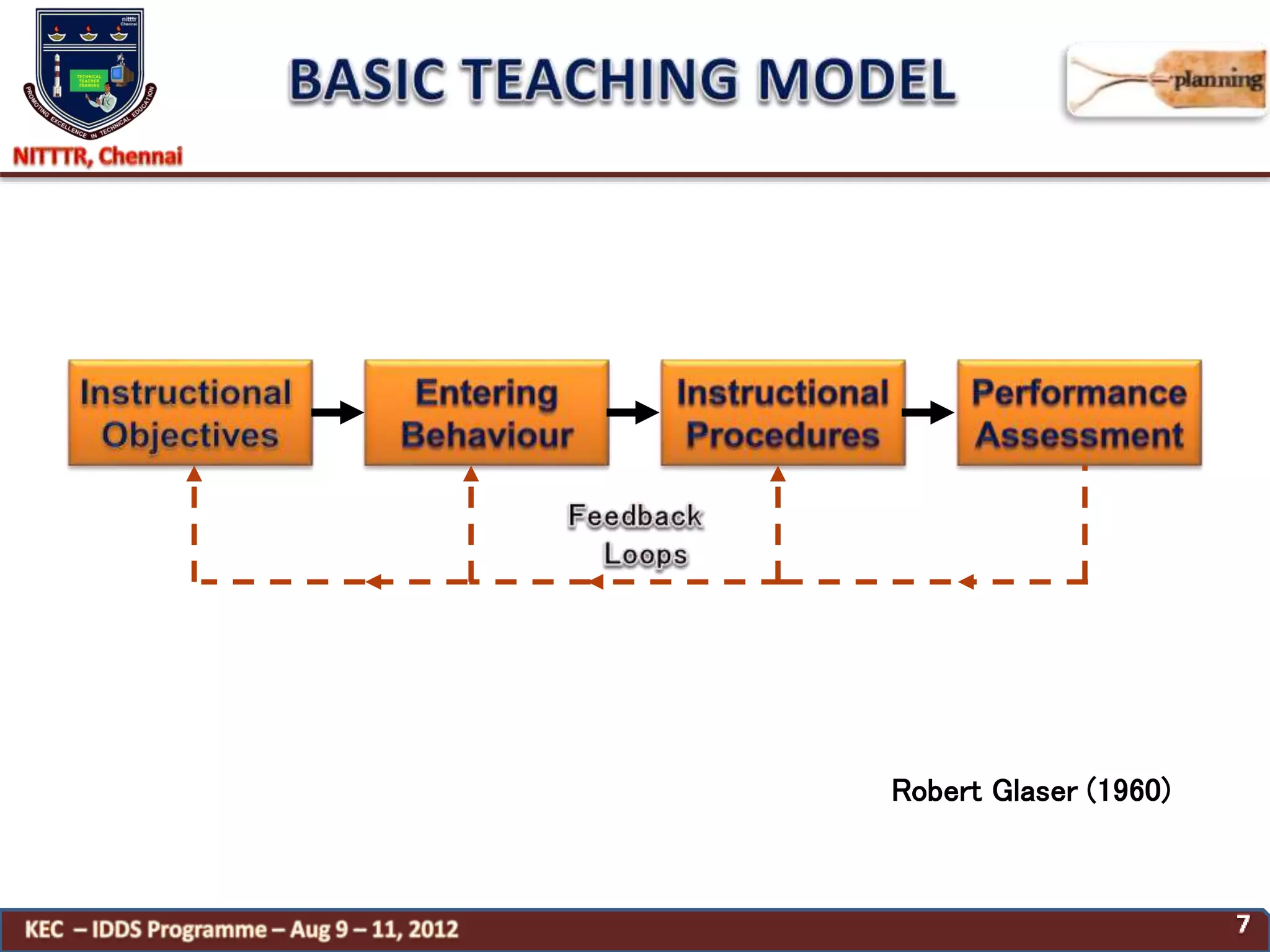
Robert Glaser (1960)
Contd.
1. To ensure the right allocation - teaching time - each
topic - avoid running out of material.
2. To prevent unnecessary overlapping - repetition of
information.
3. To teach - topics in a logical sequence.
4. To select - most suitable instructional methods -
materials - media
5. To budget - for the instructional resources required - to
procure - prepare them.
6. To revise the instructional materials - in the light of the
feedback obtained - the previous year - semester.
7. To provide a variety of activities - learning experiences - for
the students.
8. To enhance teacher’s self confidence - in his/her ability -
teach in an interesting - effective way - by designing a
number of tactical alternatives.
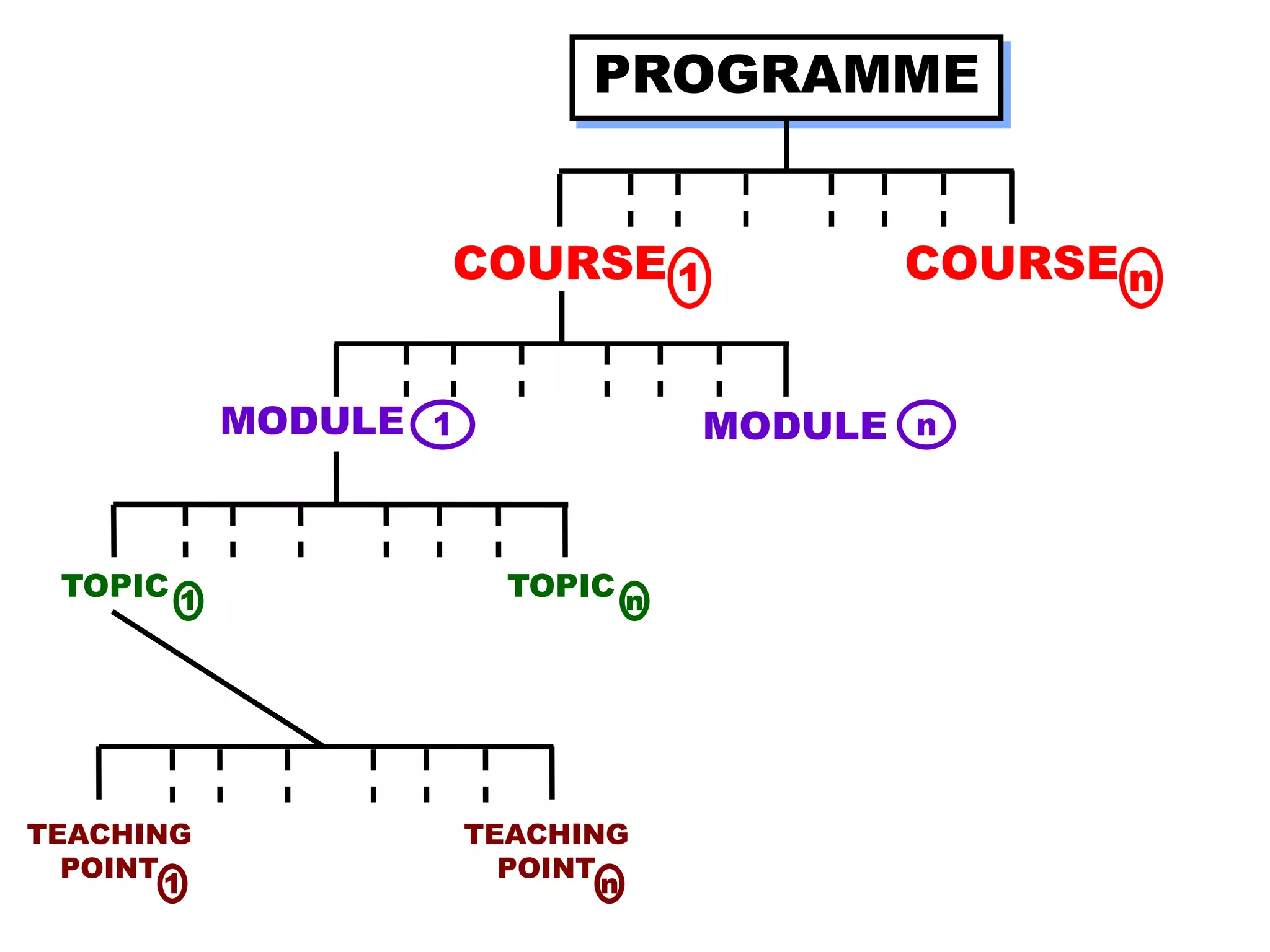
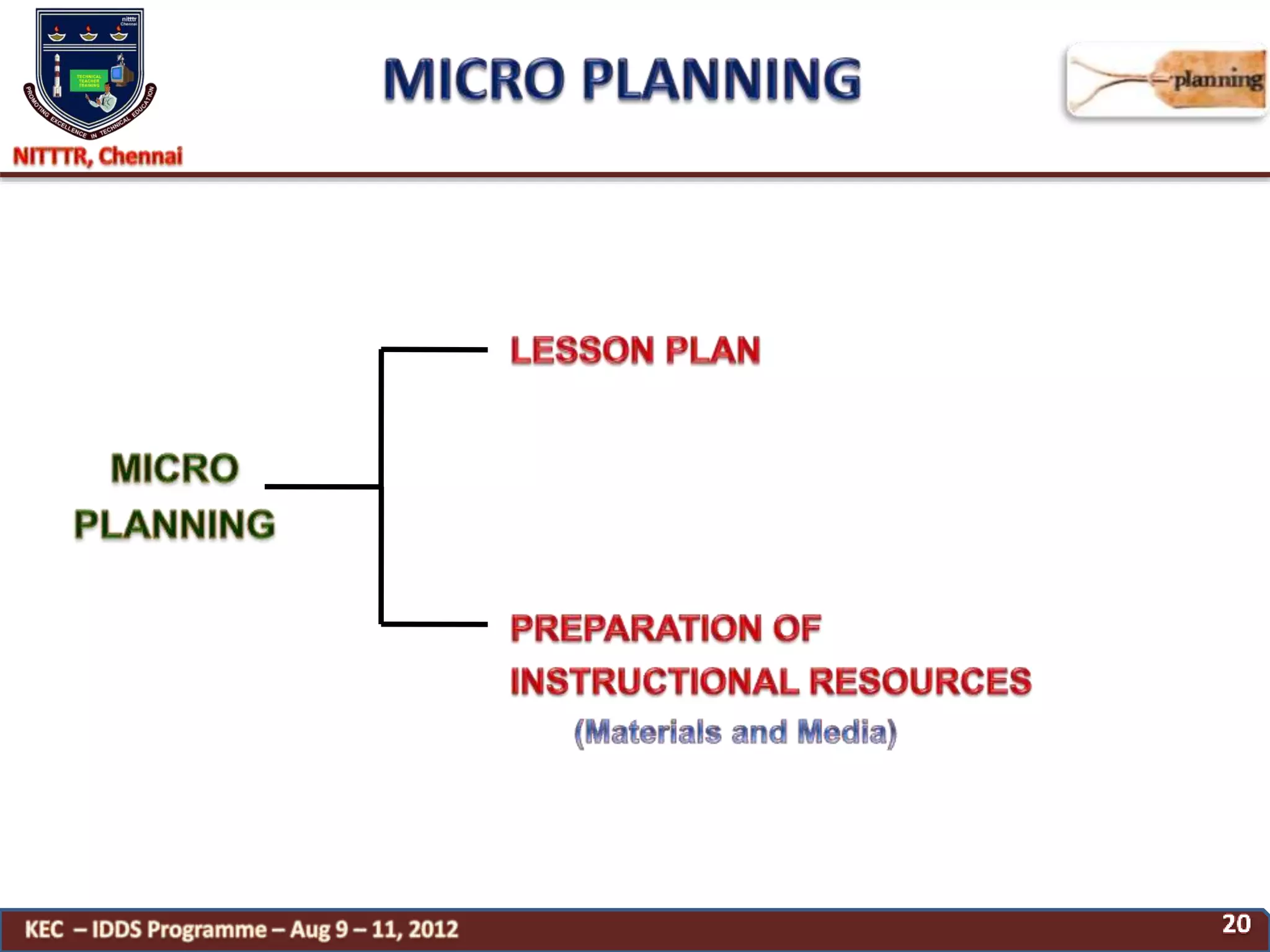
PROGRAMME
COURSE 1 COURSE n
MODULE 1 nMODULE
TOPIC 1 TOPIC n
TEACHING
POINT
1
TEACHING
POINT
n
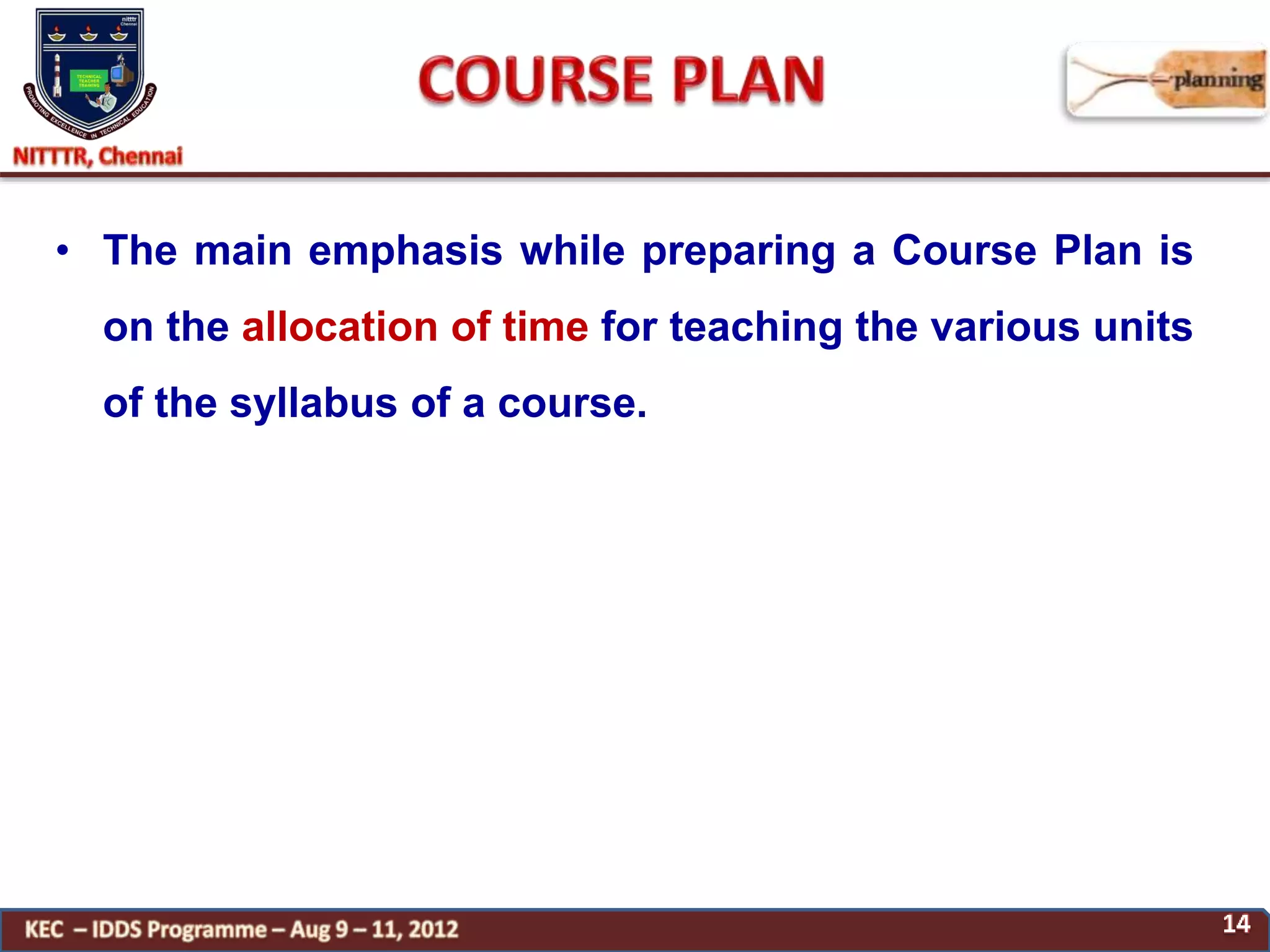
• The main emphasis while preparing a Course Plan is
on the allocation of time for teaching the various units
of the syllabus of a course.
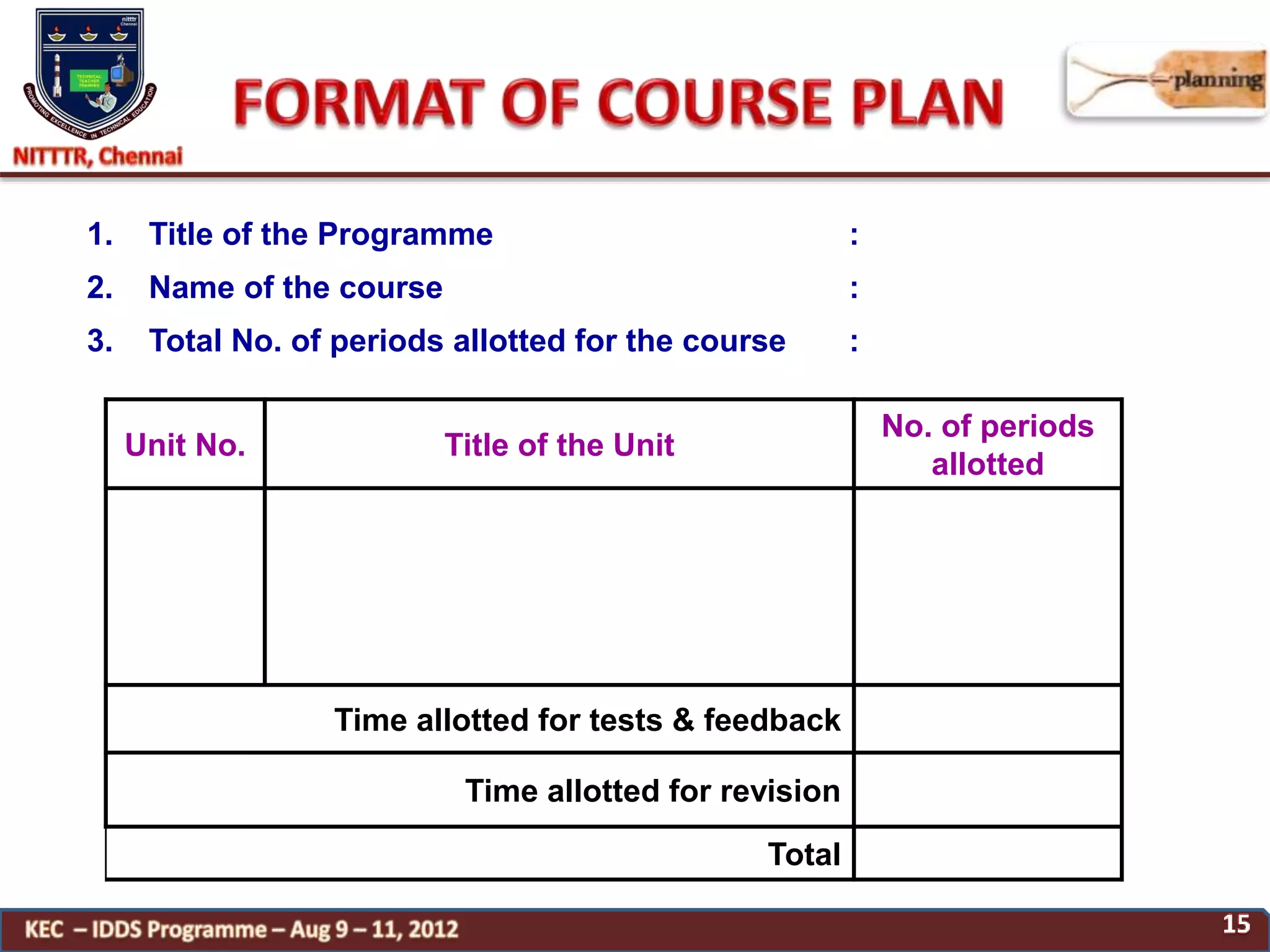
1. Title of the Programme :
2. Name of the course :
3. Total No. of periods allotted for the course :
Unit No. Title of the Unit
No. of periods
allotted
Time allotted for tests & feedback
Time allotted for revision
Total
• The unit plan will enable the teacher to identify
 resources needed (materials and media)
 teaching strategies (methods) and
 evaluation procedures to be used
 Objectives of the lesson
 Maturity, interest and abilities of the target group
 Time available
 Facilities available
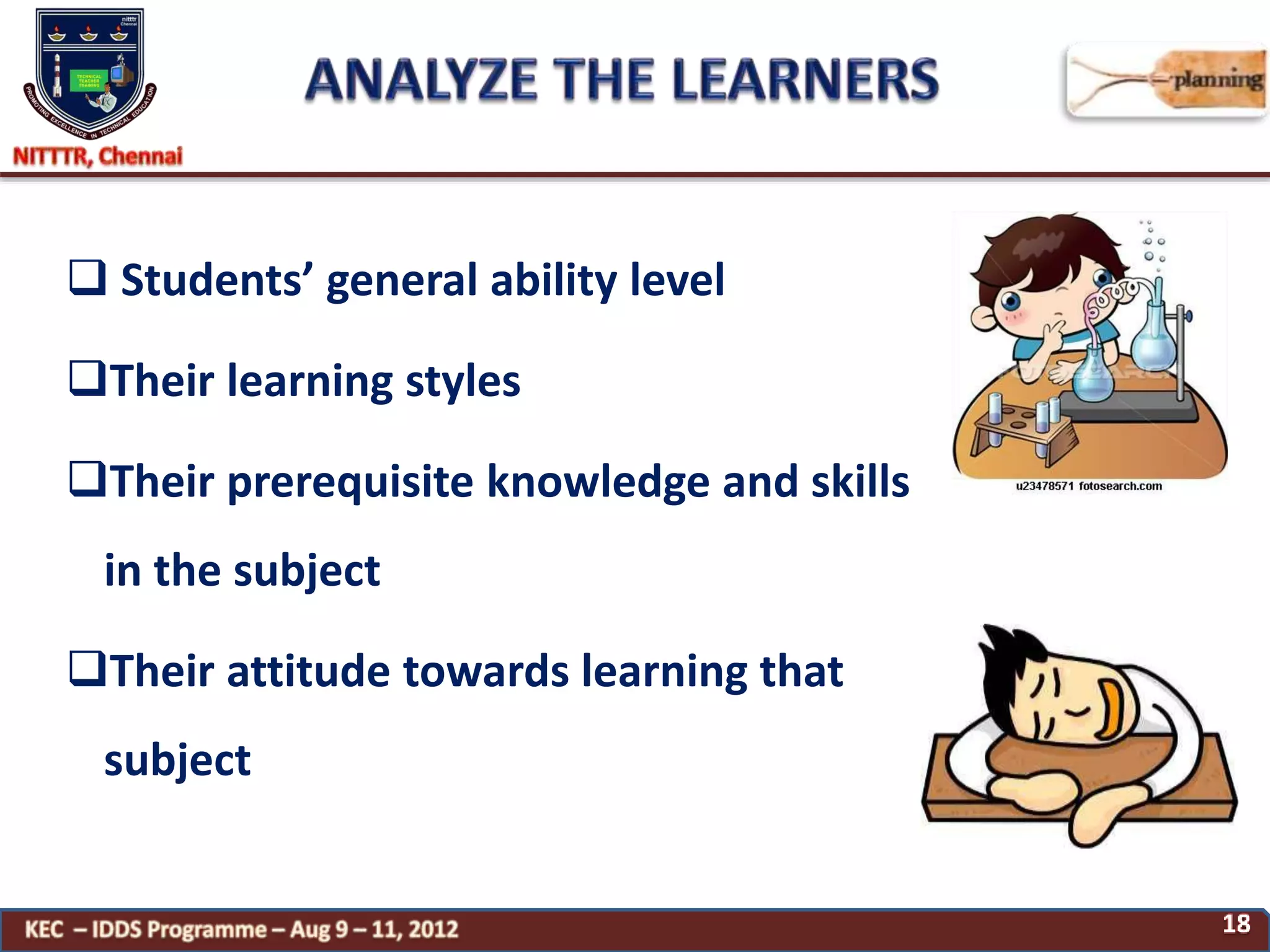
 Students’ general ability level
Their learning styles
Their prerequisite knowledge and skills
in the subject
Their attitude towards learning that
subject
• The resources (Instructional materials and media)
needed are to be identified:
 Handouts
 Work Sheets
 Chalk board
 Magnetic board
 Charts
 OHP transparencies
 Audio tapes
 Video tapes
 Multimedia Learning Packages
 Films
 Models
 Actual apparatus or equipment
 Demonstration Kits
 Slides
 Lesson refers to the learning experiences provided during a
single period of instruction.
 The duration - of an Instructional period - one to three hours.
 A Lesson - is highly structured to facilitate - ensure the
participation of the learners.
 During a lesson - lot of opportunities - provided to the learners
- for interaction - practice
• Lesson Plan is a blue print for a period of
instruction. It lists the activities in which the
students and the teacher will be engaged in at
different phases of a lesson.
Structuring involves:
(i) Breaking down a complex topic into simple and
small teaching points and
(ii) Organising the various teaching points in a logical
sequence
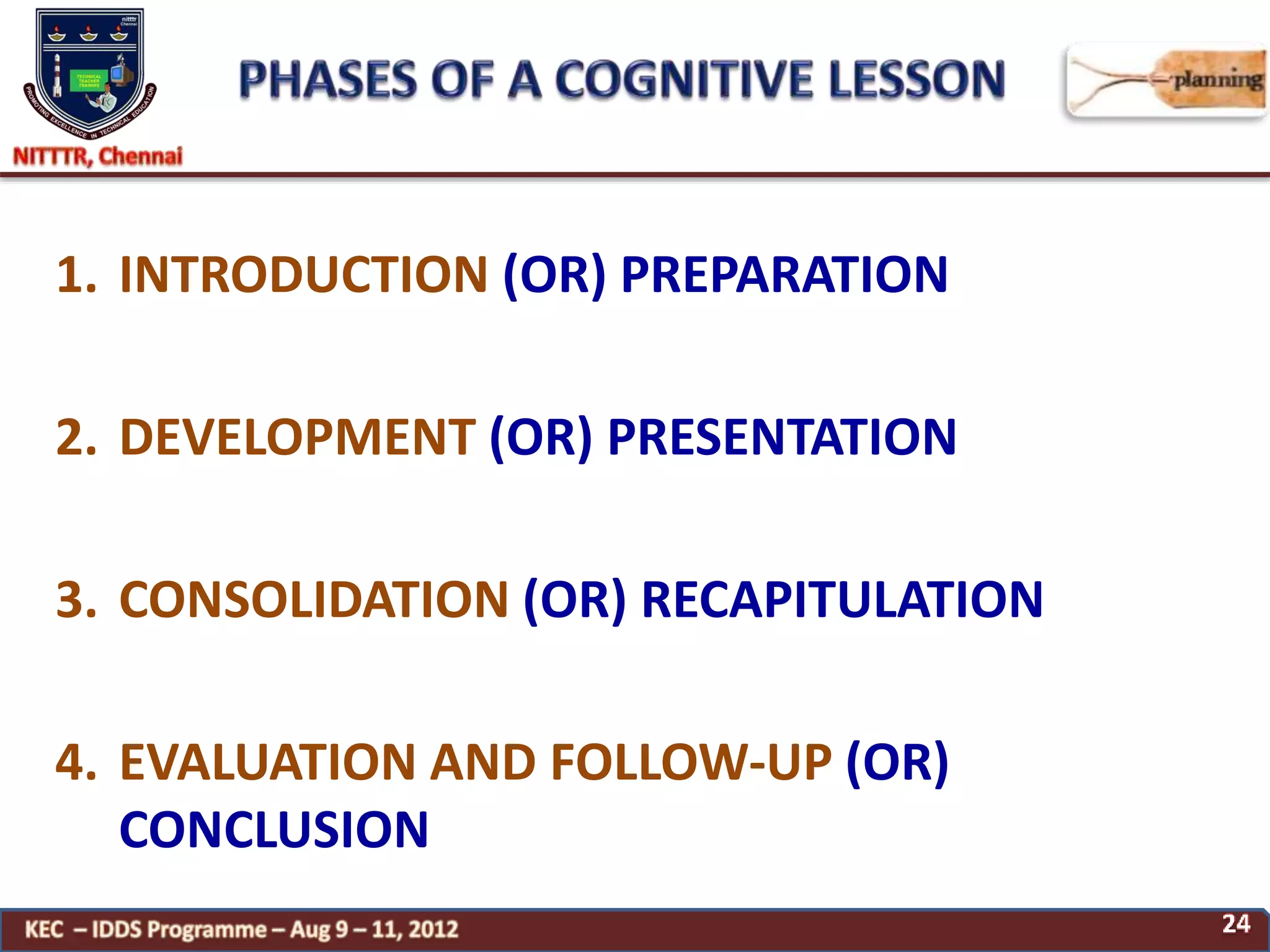
1. INTRODUCTION (OR) PREPARATION
2. DEVELOPMENT (OR) PRESENTATION
3. CONSOLIDATION (OR) RECAPITULATION
4. EVALUATION AND FOLLOW-UP (OR)
CONCLUSION
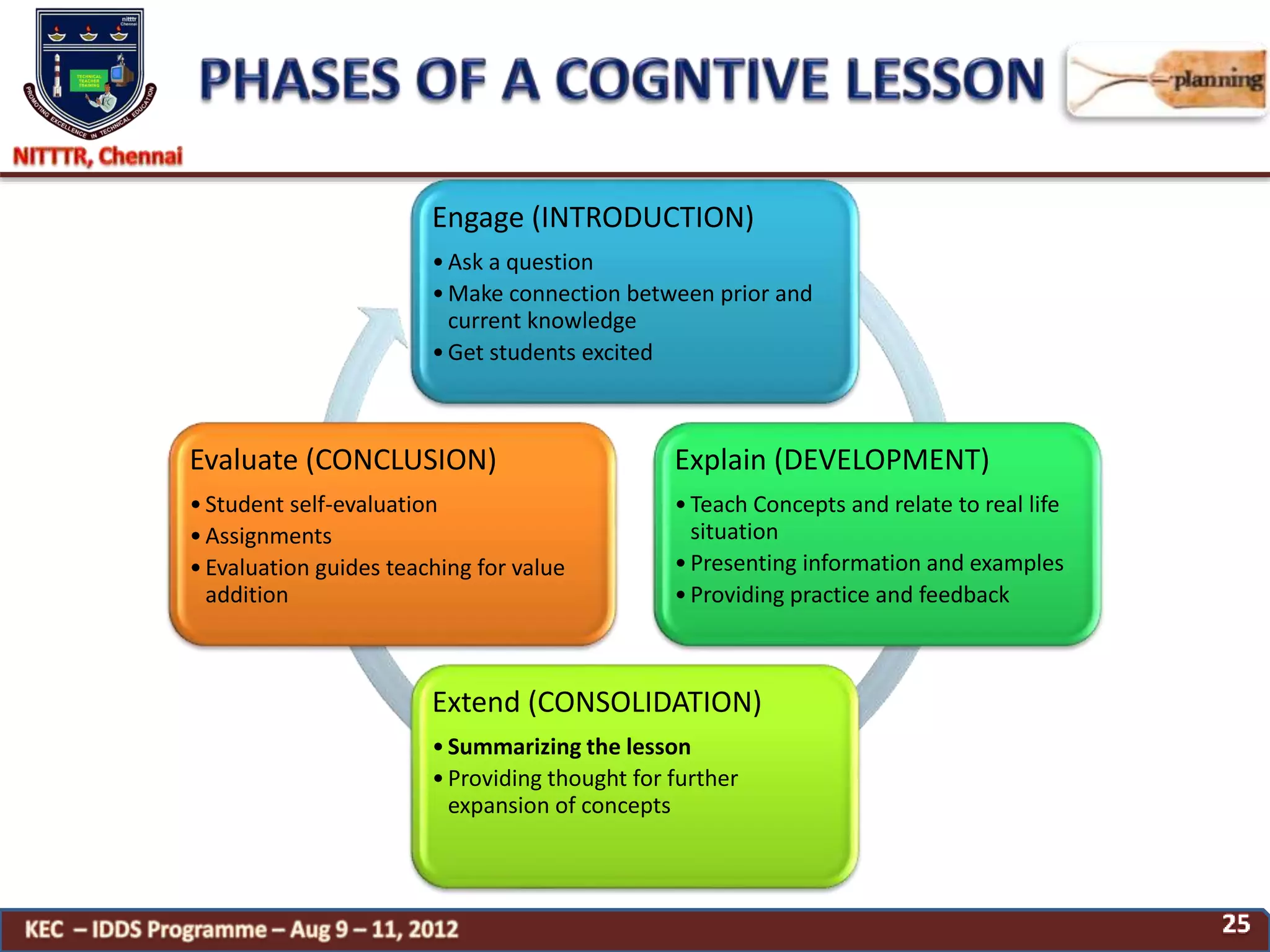
Engage (INTRODUCTION)
•Ask a question
•Make connection between prior and
current knowledge
•Get students excited
Explain (DEVELOPMENT)
•Teach Concepts and relate to real life
situation
•Presenting information and examples
•Providing practice and feedback
Extend (CONSOLIDATION)
•Summarizing the lesson
•Providing thought for further
expansion of concepts
Evaluate (CONCLUSION)
•Student self-evaluation
•Assignments
•Evaluation guides teaching for value
addition
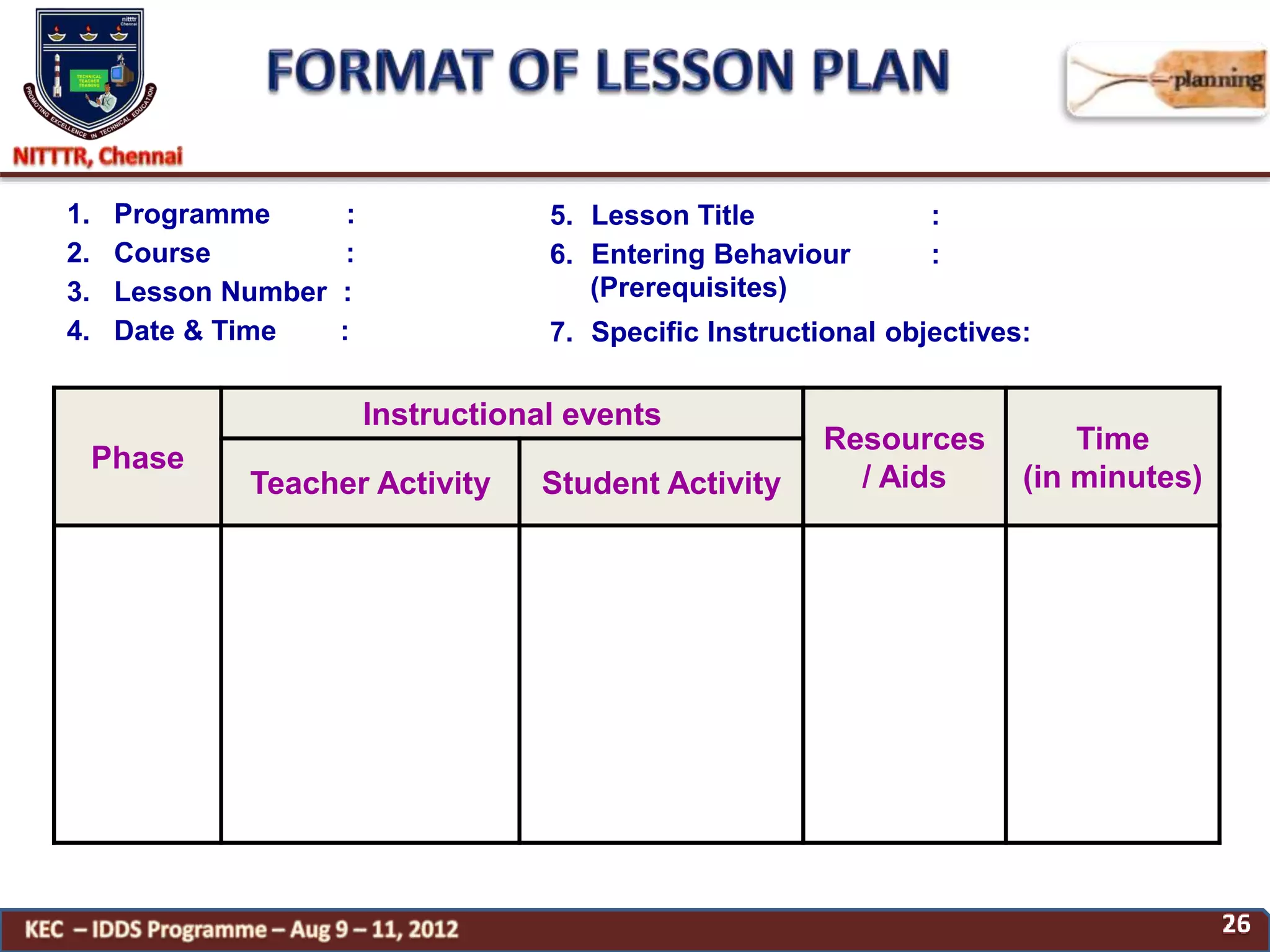
1. Programme :
2. Course :
3. Lesson Number :
4. Date & Time :
5. Lesson Title :
6. Entering Behaviour :
7. Specific Instructional objectives:
Phase
Instructional events
Resources
/ Aids
Time
(in minutes)Teacher Activity Student Activity
(Prerequisites)
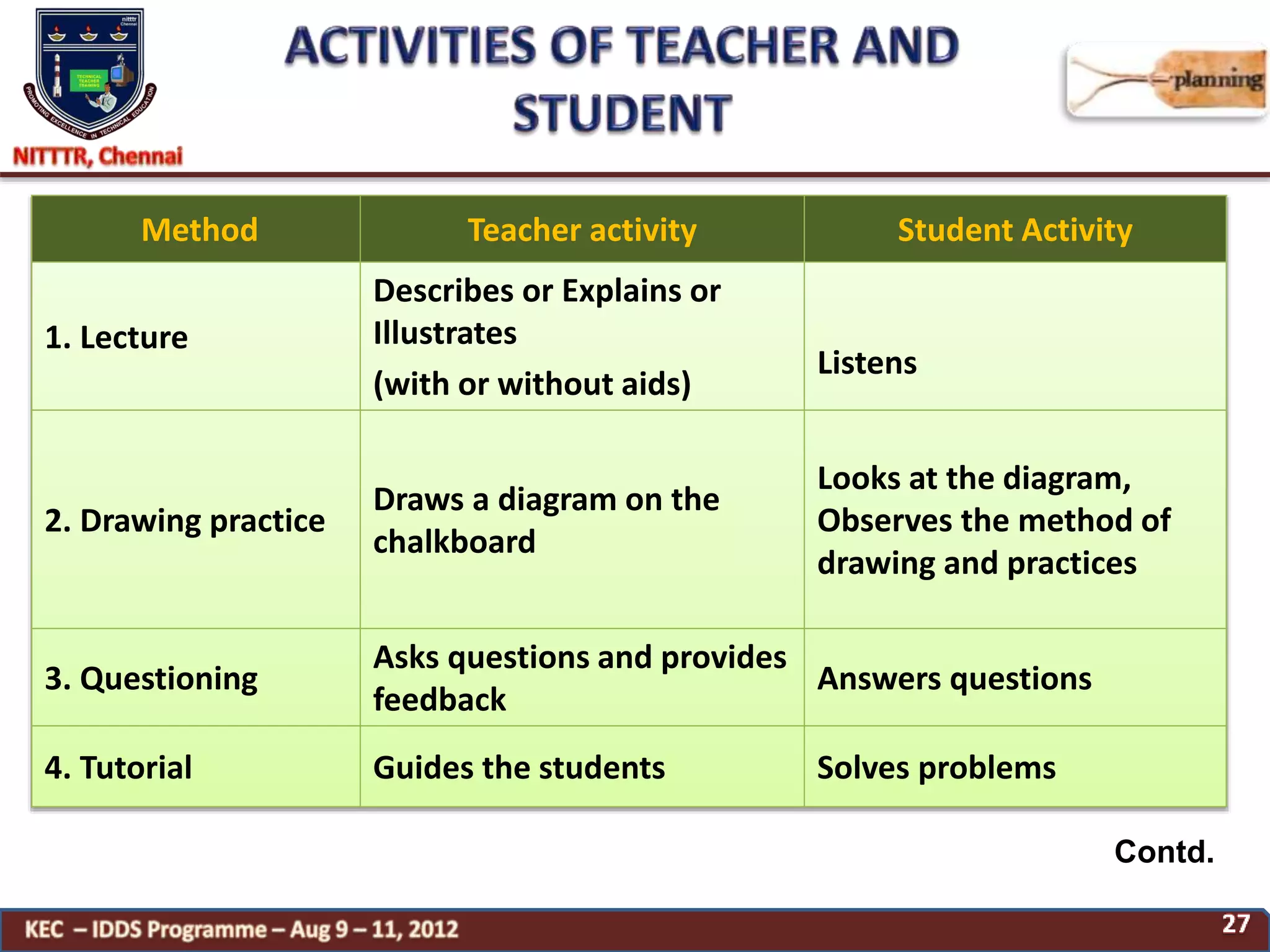
Method Teacher activity Student Activity
1. Lecture
Describes or Explains or
Illustrates
(with or without aids)
Listens
2. Drawing practice
Draws a diagram on the
chalkboard
Looks at the diagram,
Observes the method of
drawing and practices
3. Questioning
Asks questions and provides
feedback
Answers questions
4. Tutorial Guides the students Solves problems
Contd.
Method Teacher activity Student Activity
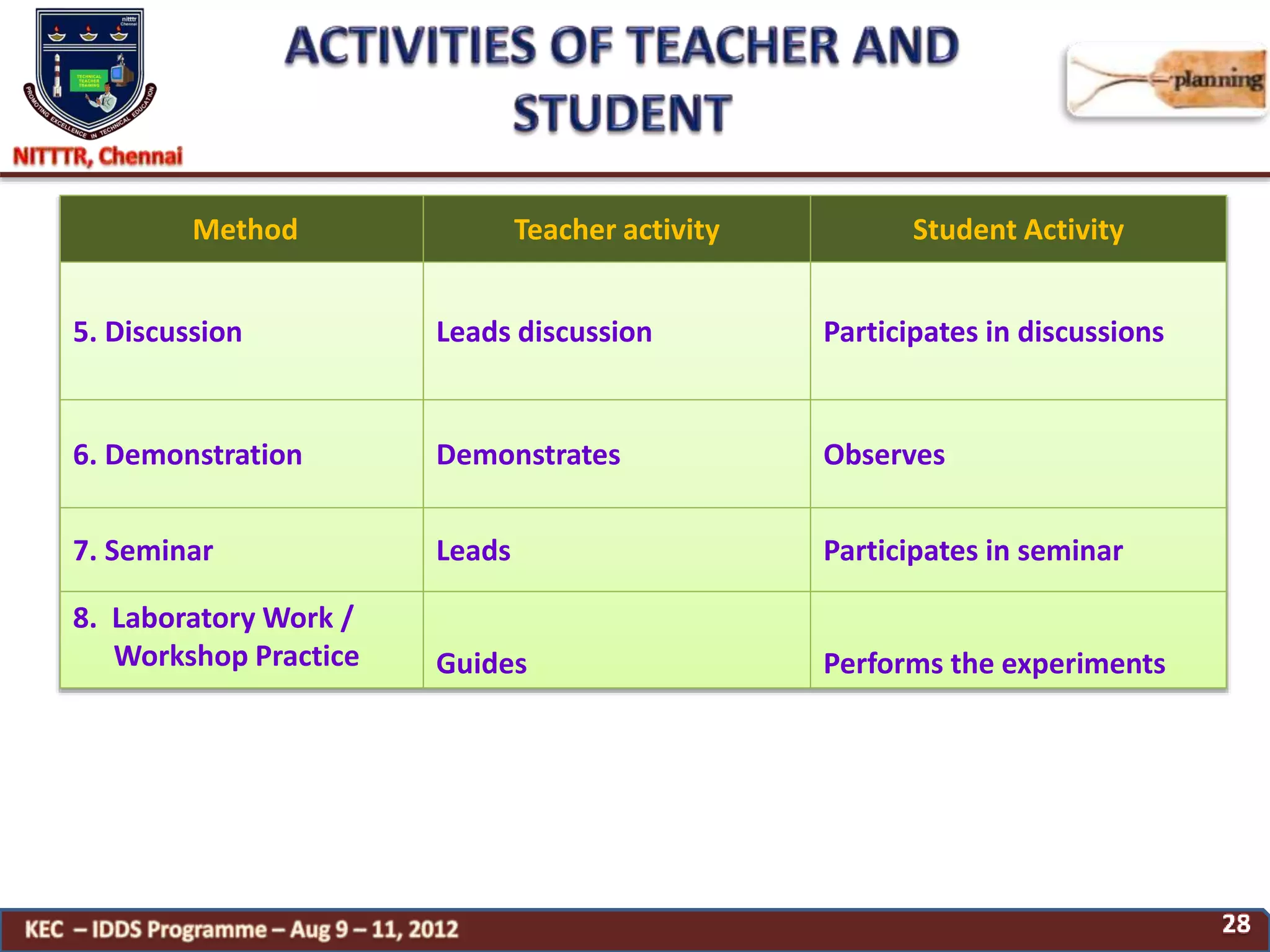
5. Discussion Leads discussion Participates in discussions
6. Demonstration Demonstrates Observes
7. Seminar Leads Participates in seminar
8. Laboratory Work /
Workshop Practice Guides Performs the experiments
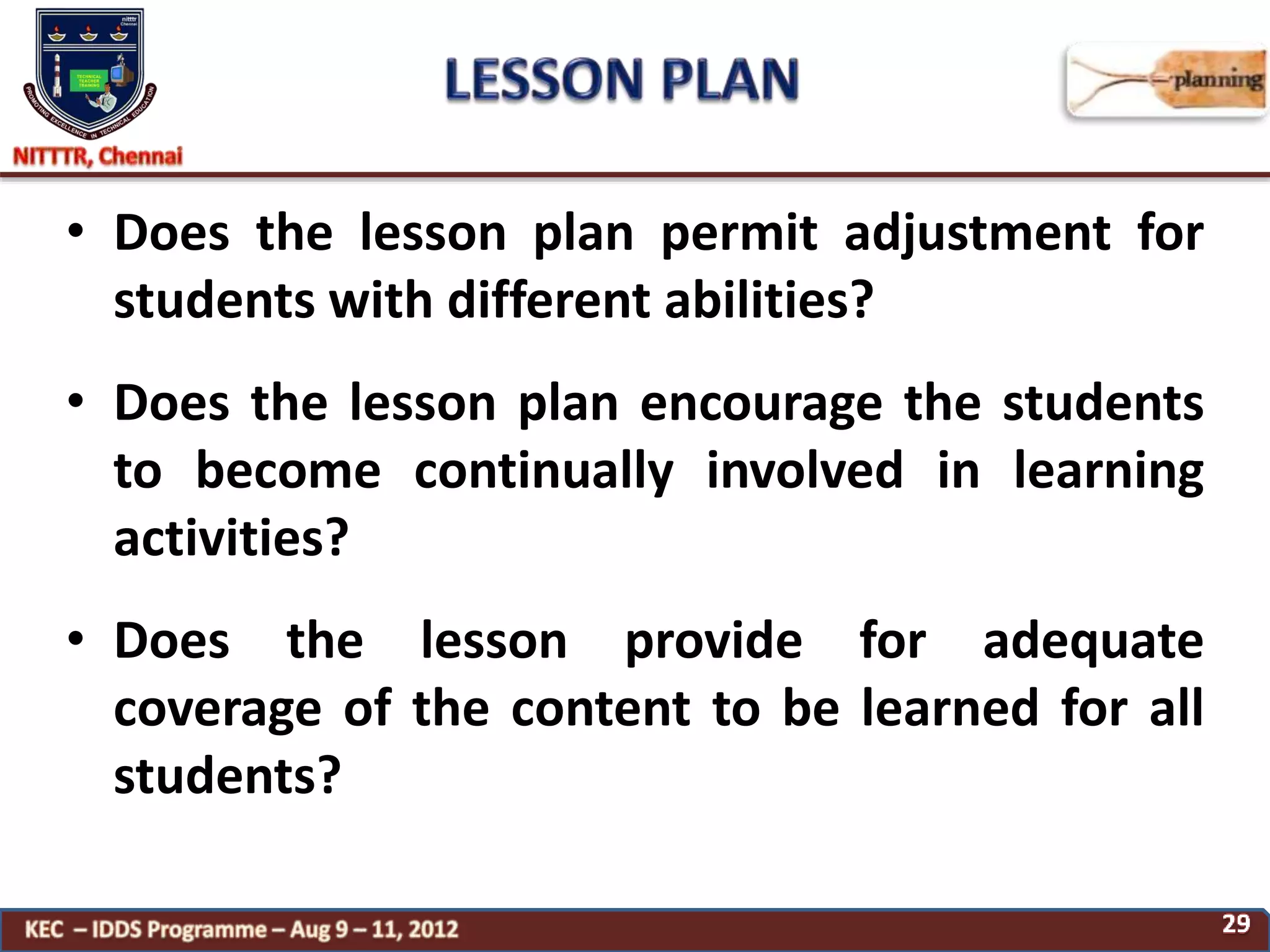
• Does the lesson plan permit adjustment for
students with different abilities?
• Does the lesson plan encourage the students
to become continually involved in learning
activities?
• Does the lesson provide for adequate
coverage of the content to be learned for all
students?
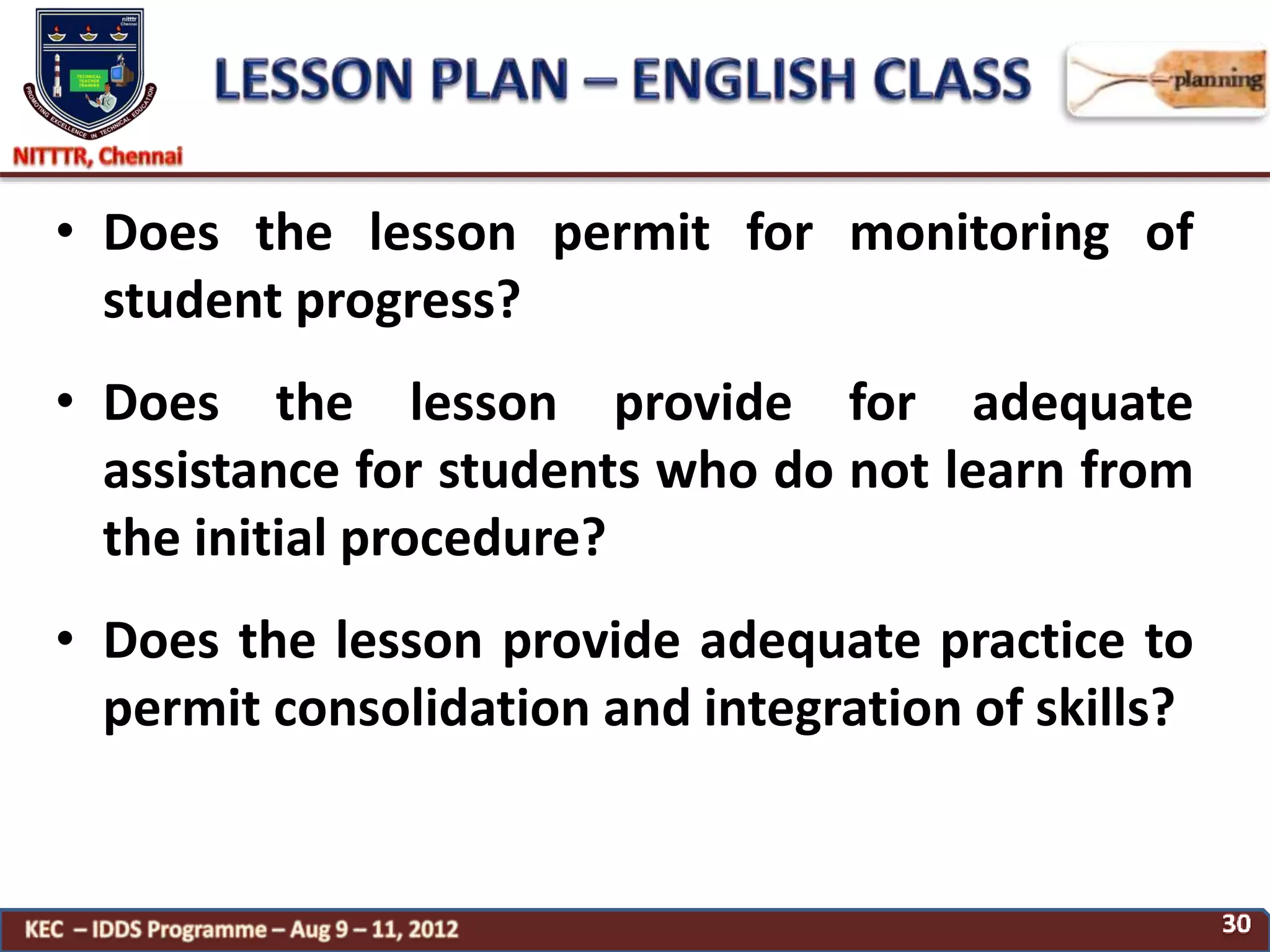
• Does the lesson permit for monitoring of
student progress?
• Does the lesson provide for adequate
assistance for students who do not learn from
the initial procedure?
• Does the lesson provide adequate practice to
permit consolidation and integration of skills?
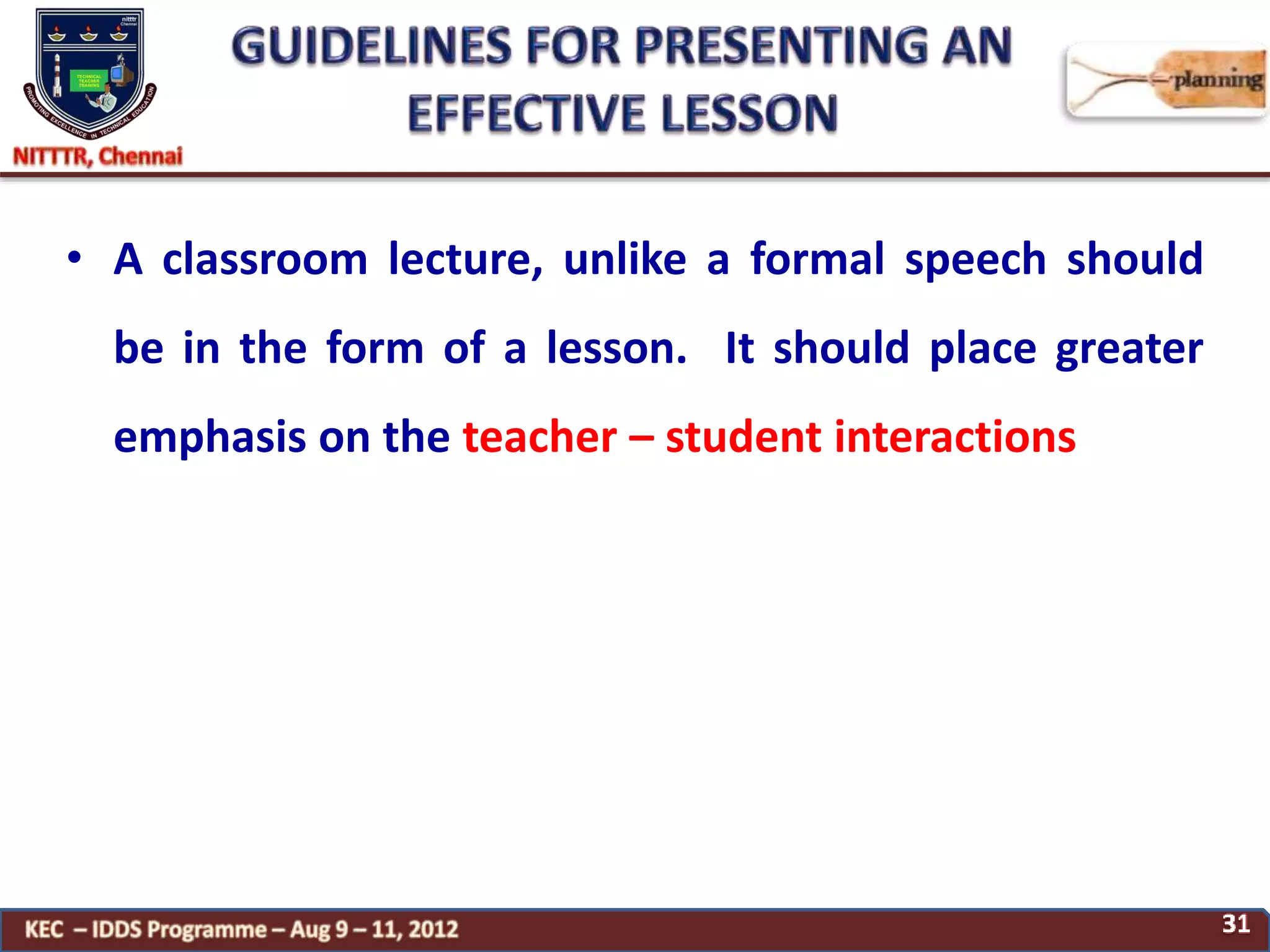
• A classroom lecture, unlike a formal speech should
be in the form of a lesson. It should place greater
emphasis on the teacher – student interactions
Contd.
Plan an introduction to attract the students interest.
This can be done by the following techniques:
 Highlight the relevance and usefulness of the topic to be
learnt.
 State a historical or current problem related to the lecture
content.
 Relate lecture content to the material presented in the
previous class.
• Provide a brief overview of the lecture content by
stating the expected learning outcomes. Write the
title of the lesson on the chalk board.
• Ask questions to find out whether your students
possess the entry behaviour necessary for
understanding the lecture content.
Contd.
• Organize the material to be presented in some
logical order. Suggested organization schemes
include:
 Cause-effect
 Time sequential
 Problem – Solution
 Pro-con
 Ascending – Descending
Contd.
• Strike a balance between depth and breadth of
coverage. When every nuance or detail of topic is
discussed, students often lose sight of the main
ideas. When too many ideas are presented and not
developed, students fail to gain understanding.
• Ask simple questions during the development phase
in order to ensure the logical development of the
topic.
Contd.
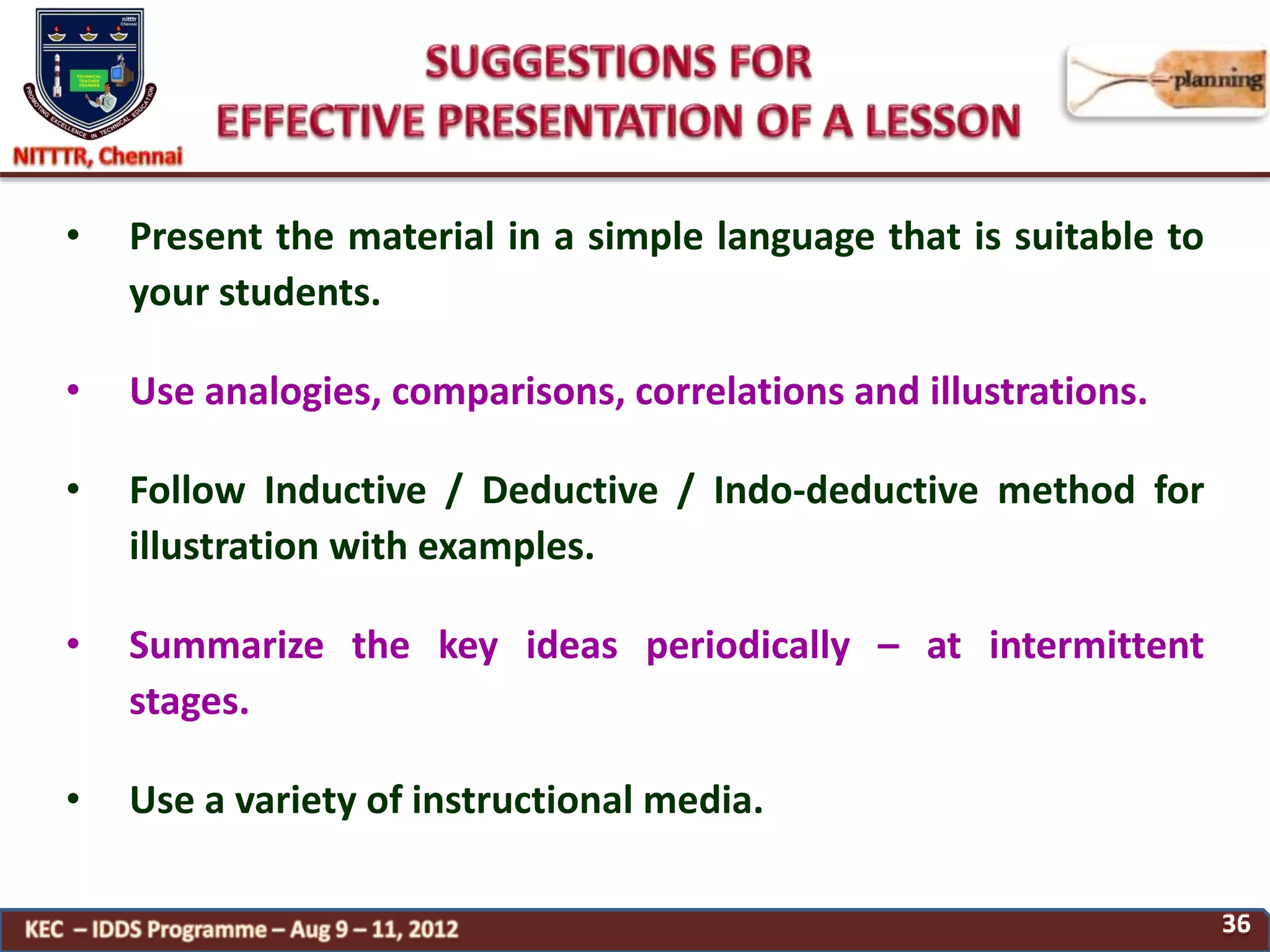
• Present the material in a simple language that is suitable to
your students.
• Use analogies, comparisons, correlations and illustrations.
• Follow Inductive / Deductive / Indo-deductive method for
illustration with examples.
• Summarize the key ideas periodically – at intermittent
stages.
• Use a variety of instructional media.
• Avoid reading from books or notes.
• While speaking, face the students and not the
chalkboard.
• Maintain eye contact with all the students.
• Modulate the tone of your voice in order to give
emphasis and also attract the attention of students
• Become aware of your mannerism and try to avoid
them.
• Provide for humour as and when possible.
• During the concluding phase, ask questions to
evaluate the achievement of objectives.
• Briefly summarize lecture material and preview what
lies ahead.
Evaluate
– Did every student meet the goal?
– How will I document?
– How and when will I remediate those that still
need help?
– When will I review this skill/concept?
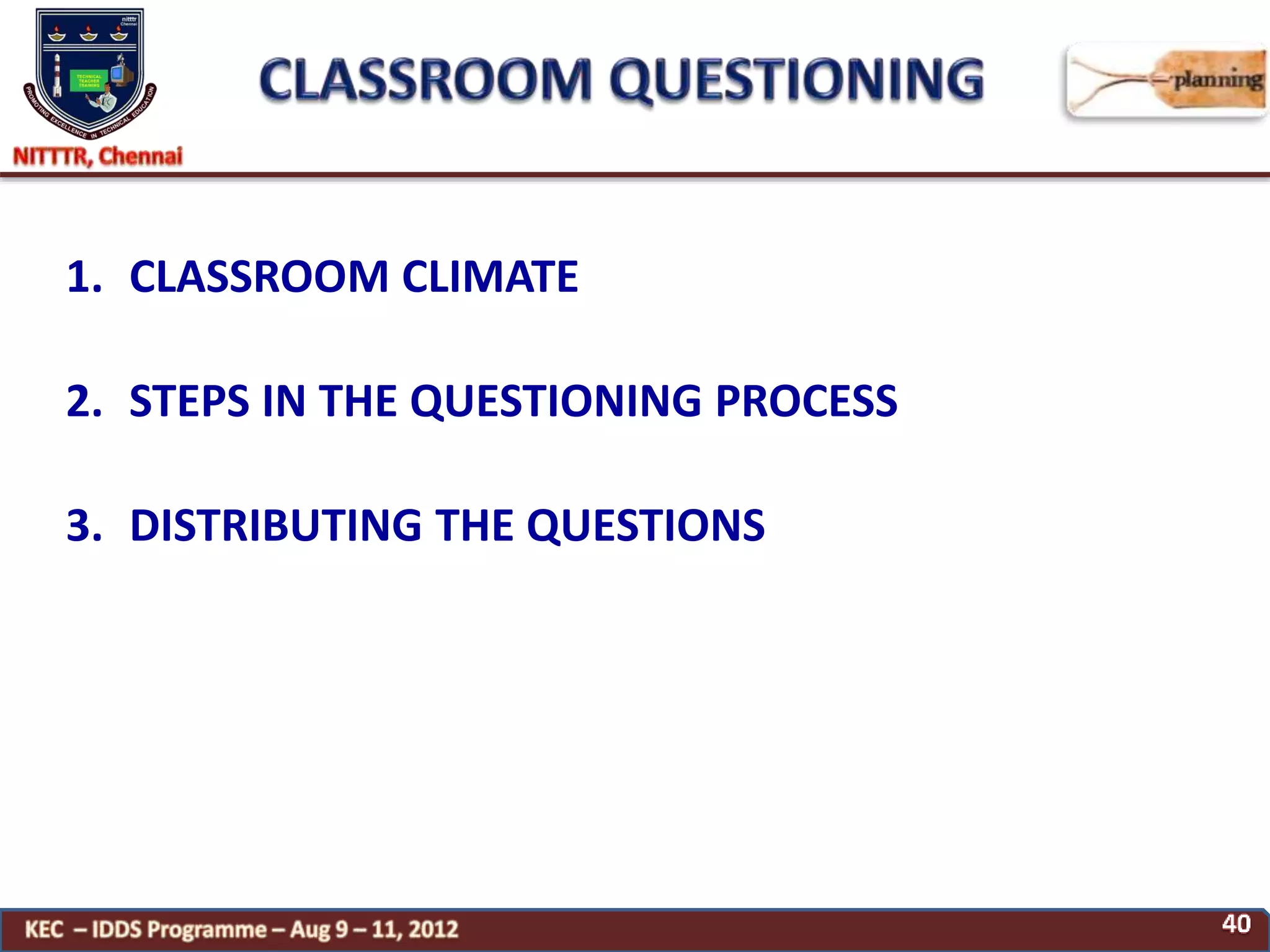
1. CLASSROOM CLIMATE
2. STEPS IN THE QUESTIONING PROCESS
3. DISTRIBUTING THE QUESTIONS
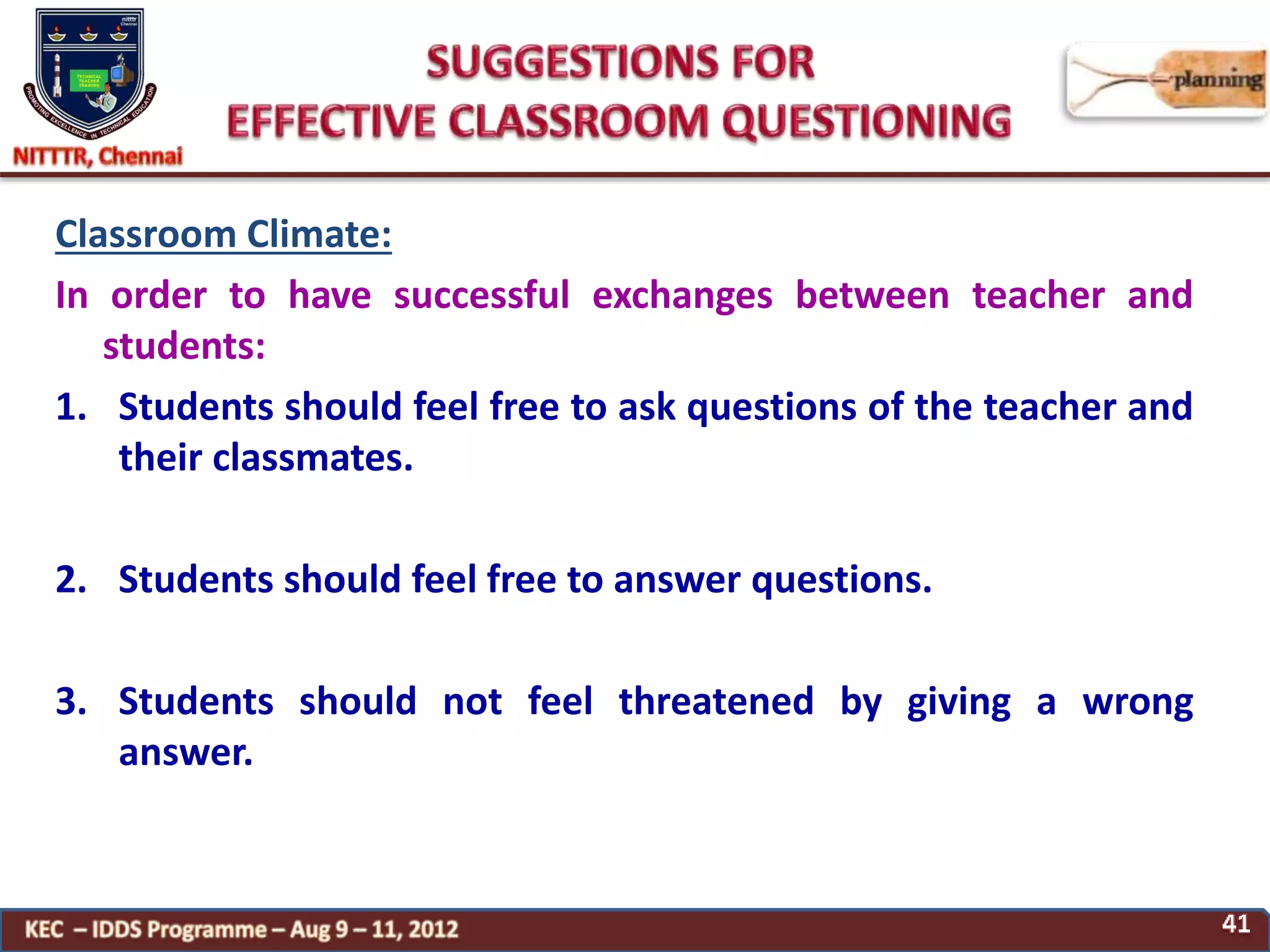
Classroom Climate:
In order to have successful exchanges between teacher and
students:
1. Students should feel free to ask questions of the teacher and
their classmates.
2. Students should feel free to answer questions.
3. Students should not feel threatened by giving a wrong
answer.
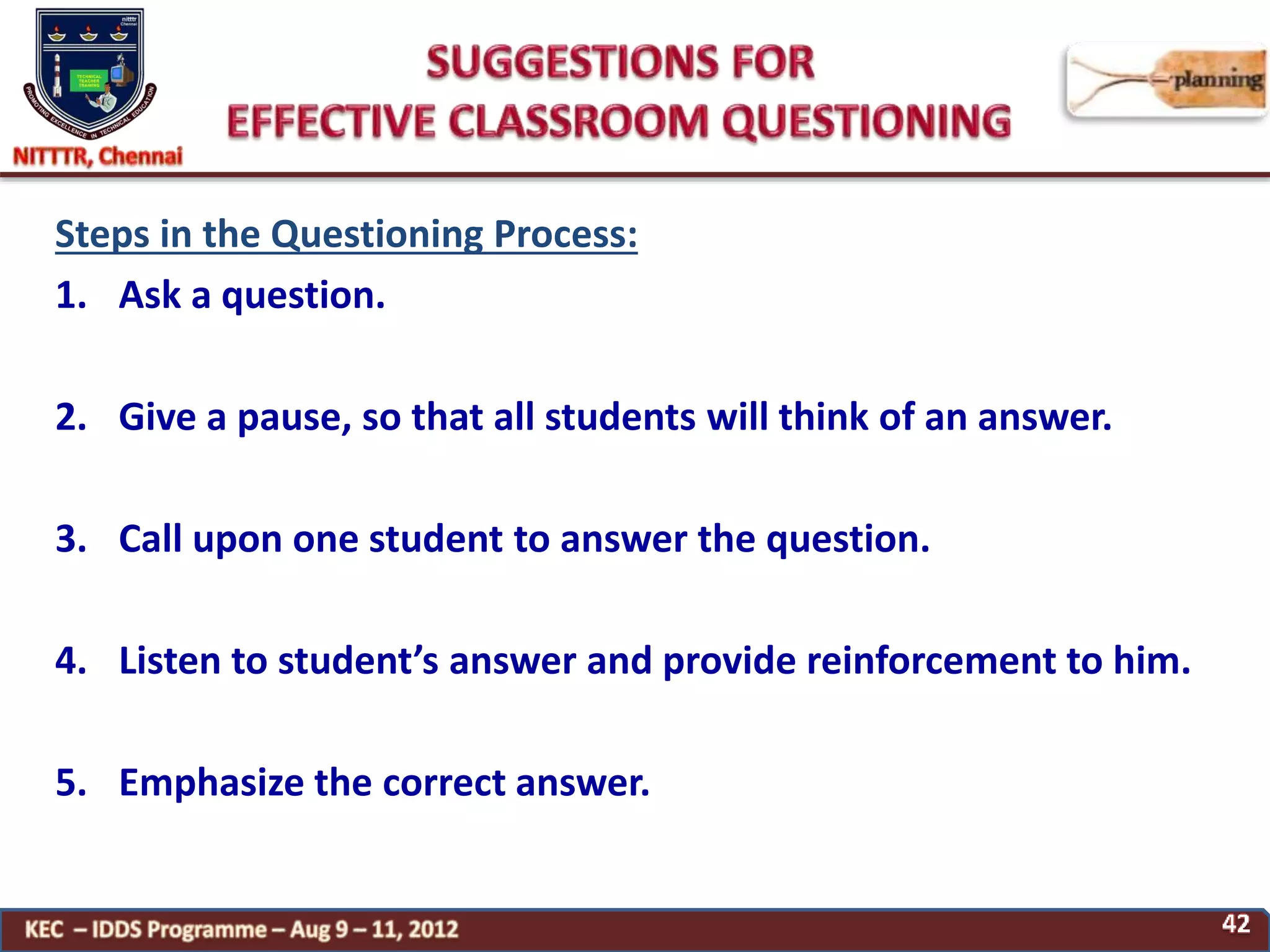
Steps in the Questioning Process:
1. Ask a question.
2. Give a pause, so that all students will think of an answer.
3. Call upon one student to answer the question.
4. Listen to student’s answer and provide reinforcement to him.
5. Emphasize the correct answer.
45
Any doubts??
Further comments ??
Unanswered questions ??
Unresolved issues
Instructional planning - Janardhanan G

Instructional planning - Janardhanan G

  • 1.
    Associate Professor Centre forEnvironmental Management National Institute of Technical Teachers Training and Research Taramani, Chennai - 600 113, India
  • 7.
  • 8.
    Contd. 1. To ensurethe right allocation - teaching time - each topic - avoid running out of material. 2. To prevent unnecessary overlapping - repetition of information. 3. To teach - topics in a logical sequence. 4. To select - most suitable instructional methods - materials - media
  • 9.
    5. To budget- for the instructional resources required - to procure - prepare them. 6. To revise the instructional materials - in the light of the feedback obtained - the previous year - semester. 7. To provide a variety of activities - learning experiences - for the students. 8. To enhance teacher’s self confidence - in his/her ability - teach in an interesting - effective way - by designing a number of tactical alternatives.
  • 11.
    PROGRAMME COURSE 1 COURSEn MODULE 1 nMODULE TOPIC 1 TOPIC n TEACHING POINT 1 TEACHING POINT n
  • 14.
    • The mainemphasis while preparing a Course Plan is on the allocation of time for teaching the various units of the syllabus of a course.
  • 15.
    1. Title ofthe Programme : 2. Name of the course : 3. Total No. of periods allotted for the course : Unit No. Title of the Unit No. of periods allotted Time allotted for tests & feedback Time allotted for revision Total
  • 16.
    • The unitplan will enable the teacher to identify  resources needed (materials and media)  teaching strategies (methods) and  evaluation procedures to be used
  • 17.
     Objectives ofthe lesson  Maturity, interest and abilities of the target group  Time available  Facilities available
  • 18.
     Students’ generalability level Their learning styles Their prerequisite knowledge and skills in the subject Their attitude towards learning that subject
  • 19.
    • The resources(Instructional materials and media) needed are to be identified:  Handouts  Work Sheets  Chalk board  Magnetic board  Charts  OHP transparencies  Audio tapes  Video tapes  Multimedia Learning Packages  Films  Models  Actual apparatus or equipment  Demonstration Kits  Slides
  • 21.
     Lesson refersto the learning experiences provided during a single period of instruction.  The duration - of an Instructional period - one to three hours.  A Lesson - is highly structured to facilitate - ensure the participation of the learners.  During a lesson - lot of opportunities - provided to the learners - for interaction - practice
  • 22.
    • Lesson Planis a blue print for a period of instruction. It lists the activities in which the students and the teacher will be engaged in at different phases of a lesson.
  • 23.
    Structuring involves: (i) Breakingdown a complex topic into simple and small teaching points and (ii) Organising the various teaching points in a logical sequence
  • 24.
    1. INTRODUCTION (OR)PREPARATION 2. DEVELOPMENT (OR) PRESENTATION 3. CONSOLIDATION (OR) RECAPITULATION 4. EVALUATION AND FOLLOW-UP (OR) CONCLUSION
  • 25.
    Engage (INTRODUCTION) •Ask aquestion •Make connection between prior and current knowledge •Get students excited Explain (DEVELOPMENT) •Teach Concepts and relate to real life situation •Presenting information and examples •Providing practice and feedback Extend (CONSOLIDATION) •Summarizing the lesson •Providing thought for further expansion of concepts Evaluate (CONCLUSION) •Student self-evaluation •Assignments •Evaluation guides teaching for value addition
  • 26.
    1. Programme : 2.Course : 3. Lesson Number : 4. Date & Time : 5. Lesson Title : 6. Entering Behaviour : 7. Specific Instructional objectives: Phase Instructional events Resources / Aids Time (in minutes)Teacher Activity Student Activity (Prerequisites)
  • 27.
    Method Teacher activityStudent Activity 1. Lecture Describes or Explains or Illustrates (with or without aids) Listens 2. Drawing practice Draws a diagram on the chalkboard Looks at the diagram, Observes the method of drawing and practices 3. Questioning Asks questions and provides feedback Answers questions 4. Tutorial Guides the students Solves problems Contd.
  • 28.
    Method Teacher activityStudent Activity 5. Discussion Leads discussion Participates in discussions 6. Demonstration Demonstrates Observes 7. Seminar Leads Participates in seminar 8. Laboratory Work / Workshop Practice Guides Performs the experiments
  • 29.
    • Does thelesson plan permit adjustment for students with different abilities? • Does the lesson plan encourage the students to become continually involved in learning activities? • Does the lesson provide for adequate coverage of the content to be learned for all students?
  • 30.
    • Does thelesson permit for monitoring of student progress? • Does the lesson provide for adequate assistance for students who do not learn from the initial procedure? • Does the lesson provide adequate practice to permit consolidation and integration of skills?
  • 31.
    • A classroomlecture, unlike a formal speech should be in the form of a lesson. It should place greater emphasis on the teacher – student interactions
  • 32.
    Contd. Plan an introductionto attract the students interest. This can be done by the following techniques:  Highlight the relevance and usefulness of the topic to be learnt.  State a historical or current problem related to the lecture content.  Relate lecture content to the material presented in the previous class.
  • 33.
    • Provide abrief overview of the lecture content by stating the expected learning outcomes. Write the title of the lesson on the chalk board. • Ask questions to find out whether your students possess the entry behaviour necessary for understanding the lecture content. Contd.
  • 34.
    • Organize thematerial to be presented in some logical order. Suggested organization schemes include:  Cause-effect  Time sequential  Problem – Solution  Pro-con  Ascending – Descending Contd.
  • 35.
    • Strike abalance between depth and breadth of coverage. When every nuance or detail of topic is discussed, students often lose sight of the main ideas. When too many ideas are presented and not developed, students fail to gain understanding. • Ask simple questions during the development phase in order to ensure the logical development of the topic. Contd.
  • 36.
    • Present thematerial in a simple language that is suitable to your students. • Use analogies, comparisons, correlations and illustrations. • Follow Inductive / Deductive / Indo-deductive method for illustration with examples. • Summarize the key ideas periodically – at intermittent stages. • Use a variety of instructional media.
  • 37.
    • Avoid readingfrom books or notes. • While speaking, face the students and not the chalkboard. • Maintain eye contact with all the students. • Modulate the tone of your voice in order to give emphasis and also attract the attention of students
  • 38.
    • Become awareof your mannerism and try to avoid them. • Provide for humour as and when possible. • During the concluding phase, ask questions to evaluate the achievement of objectives. • Briefly summarize lecture material and preview what lies ahead.
  • 39.
    Evaluate – Did everystudent meet the goal? – How will I document? – How and when will I remediate those that still need help? – When will I review this skill/concept?
  • 40.
    1. CLASSROOM CLIMATE 2.STEPS IN THE QUESTIONING PROCESS 3. DISTRIBUTING THE QUESTIONS
  • 41.
    Classroom Climate: In orderto have successful exchanges between teacher and students: 1. Students should feel free to ask questions of the teacher and their classmates. 2. Students should feel free to answer questions. 3. Students should not feel threatened by giving a wrong answer.
  • 42.
    Steps in theQuestioning Process: 1. Ask a question. 2. Give a pause, so that all students will think of an answer. 3. Call upon one student to answer the question. 4. Listen to student’s answer and provide reinforcement to him. 5. Emphasize the correct answer.
  • 45.
  • 47.
    Any doubts?? Further comments?? Unanswered questions ?? Unresolved issues