Analyzing Mathematics Lessons in
          Lesson Study


           Erlina R Ronda
         erlinaronda@gmail.com


             UPNISMED
Planning and Implementing Effective
Lessons


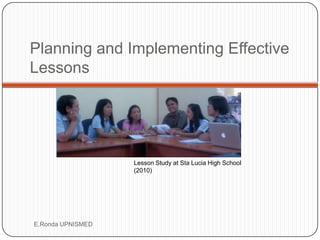
                   Lesson Study at Sta Lucia High School
                   (2010)


E.Ronda UPNISMED
1. Set clear objectives that enhance
students’ learning
Not good:
Students will find the area of an L-shape polygon
Better:
Students will find the area of an L-shape polygon
  using their knowledge for calculating the area of
  rectangles and squares
Best:
Students will understand that they can find the
 area of an L-shape polygon by changing it into
 familiar ones
E.Ronda UPNISMED
2. Link the lesson content to the
curriculum, the unit, prior lesson, and
future lessons
 What have my students studied previously that is
  related to this topic?
 What will my students study in the future that will
  build upon this topic?


   E.Ronda UPNISMED
Example of links in the lesson Finding the area
   of an L-shape figure

 Connection to prior knowledge about area of
  squares and rectangles
 The area of a figure is equal to the sum of the area
  of its parts
 Cutting and rearranging pieces of figure does not
  change the area


  These ideas are the foundation for approaching the area of
  parallelograms, triangles and area of compound figures that students will
  study later.

   E.Ronda UPNISMED
3. Provide meaningful tasks or
problems
 It must be accessible to students with their
    current understanding
   It must have multiple entry points and multiple
    solution paths
   It should capture students attention
   It must be meaningful to them (not necessarily
    real-world problems)
   Students can generate their own questions from
    the task.


E.Ronda UPNISMED
4. Anticipate and plan for students’
difficulties
 The purpose is not always to avoid the
  challenges.
 Explicit discussion of particular challenges may
  be beneficial to students
 Having multiple contingency plans will allow
  teachers to deal with those challenges more
  effectively.


E.Ronda UPNISMED
5. Provide necessary materials and
  technology for all students to access
  the task
 Plan for what materials to provide and when to
  provide it.
 How will it generate and facilitate students
  discussion in small groups, in the whole class?


   E.Ronda UPNISMED
Key questions to support learning
 Questions that should help students reflect,
  evaluate, and summarize their learning
 Questions that ask students to recall and connect
  to prior experiences that may connect to the
  current task to initiate thinking
 Questions that ask students to compare and
  contrast various ideas that would deepen thinking


E.Ronda UPNISMED
6. Group students to provide
opportunities for them to express
ideas
 Learning can be hindered by inappropriate
  grouping of students
 Balance the students’ need to think and solve
  independently and their need to exchange ideas


 E.Ronda UPNISMED
7. Identify additional tasks/problems
to help students solidify and extend
their understanding


E.Ronda UPNISMED
8. Assess students’ understanding

 How will the students problem solving be different
  if they have not been taught this lesson?


E.Ronda UPNISMED
Analyzing and revising the
lesson


                   Lesson Study at Ligao National High School
                   (2011)


E.Ronda UPNISMED
Attainment of objectives
 Did the students see the connection between the
    topic that students previously learned and the one
    they learned during the class?
   What seems to prompt students to make this
    connection?
   What changes might promote students to make
    connections more effectively?
   Did the lesson activities encourage students to learn
    continuously after the lesson
   Did the students understand how and why the topic is
    important?
   Did the students accomplish the learning obejectives?

E.Ronda UPNISMED
Learning tasks and materials
 Was the degree of challenge appropriate for the
    students at the time?
   If not, what seems to be missing?
   Was there any unanticipated response?
   Did the lesson provide opportunities for students to
    express math ideas and thinking process in individual
    writing and the class/group discussion
   Did the lesson incorporate use of visualization and
    communication tools that include board writing?
   Did the lesson provide students to extend/secure their
    knowledge/understanding/skills (extension problems
    and/or exercises during the lesson outside the class)?

E.Ronda UPNISMED
Teacher questioning and support for
students learning
 Did the teacher’s questions and guidance
  enhance students learning?
 Which questions seem to enhance students’
  learning?
 Did teacher provide appropriate support for
  students to overcome misconceptions and
  misunderstanding? What was the misconception
  and was support promoted overcoming it?
 Was grouping (individual, pairs, small groups,
  whole class) used appropriately to maximize
  students learning?

E.Ronda UPNISMED
Effective integration of assessment
 Did the teacher use formative assessments to
  make decisions to modify/adjust the plan to
  maximize students learning?
 Were the methods for evaluation appropriate?


E.Ronda UPNISMED
Reference: Guide for Planning and
Analyzing Mathematics Lessons in
Lesson Study published by APEC
More pages on Lesson Study
1. What is Lesson Study?
2. Lesson Study Readings
3. How to facilitate a lesson study group
4. Lesson study on teaching subtraction of
   integers


E.Ronda UPNISMED

Planning and analyzing mathematics lesson

  • 1.
    Analyzing Mathematics Lessonsin Lesson Study Erlina R Ronda erlinaronda@gmail.com UPNISMED
  • 2.
    Planning and ImplementingEffective Lessons Lesson Study at Sta Lucia High School (2010) E.Ronda UPNISMED
  • 3.
    1. Set clearobjectives that enhance students’ learning Not good: Students will find the area of an L-shape polygon Better: Students will find the area of an L-shape polygon using their knowledge for calculating the area of rectangles and squares Best: Students will understand that they can find the area of an L-shape polygon by changing it into familiar ones E.Ronda UPNISMED
  • 4.
    2. Link thelesson content to the curriculum, the unit, prior lesson, and future lessons  What have my students studied previously that is related to this topic?  What will my students study in the future that will build upon this topic? E.Ronda UPNISMED
  • 5.
    Example of linksin the lesson Finding the area of an L-shape figure  Connection to prior knowledge about area of squares and rectangles  The area of a figure is equal to the sum of the area of its parts  Cutting and rearranging pieces of figure does not change the area These ideas are the foundation for approaching the area of parallelograms, triangles and area of compound figures that students will study later. E.Ronda UPNISMED
  • 6.
    3. Provide meaningfultasks or problems  It must be accessible to students with their current understanding  It must have multiple entry points and multiple solution paths  It should capture students attention  It must be meaningful to them (not necessarily real-world problems)  Students can generate their own questions from the task. E.Ronda UPNISMED
  • 7.
    4. Anticipate andplan for students’ difficulties  The purpose is not always to avoid the challenges.  Explicit discussion of particular challenges may be beneficial to students  Having multiple contingency plans will allow teachers to deal with those challenges more effectively. E.Ronda UPNISMED
  • 8.
    5. Provide necessarymaterials and technology for all students to access the task  Plan for what materials to provide and when to provide it.  How will it generate and facilitate students discussion in small groups, in the whole class? E.Ronda UPNISMED
  • 9.
    Key questions tosupport learning  Questions that should help students reflect, evaluate, and summarize their learning  Questions that ask students to recall and connect to prior experiences that may connect to the current task to initiate thinking  Questions that ask students to compare and contrast various ideas that would deepen thinking E.Ronda UPNISMED
  • 10.
    6. Group studentsto provide opportunities for them to express ideas  Learning can be hindered by inappropriate grouping of students  Balance the students’ need to think and solve independently and their need to exchange ideas E.Ronda UPNISMED
  • 11.
    7. Identify additionaltasks/problems to help students solidify and extend their understanding E.Ronda UPNISMED
  • 12.
    8. Assess students’understanding  How will the students problem solving be different if they have not been taught this lesson? E.Ronda UPNISMED
  • 13.
    Analyzing and revisingthe lesson Lesson Study at Ligao National High School (2011) E.Ronda UPNISMED
  • 14.
    Attainment of objectives Did the students see the connection between the topic that students previously learned and the one they learned during the class?  What seems to prompt students to make this connection?  What changes might promote students to make connections more effectively?  Did the lesson activities encourage students to learn continuously after the lesson  Did the students understand how and why the topic is important?  Did the students accomplish the learning obejectives? E.Ronda UPNISMED
  • 15.
    Learning tasks andmaterials  Was the degree of challenge appropriate for the students at the time?  If not, what seems to be missing?  Was there any unanticipated response?  Did the lesson provide opportunities for students to express math ideas and thinking process in individual writing and the class/group discussion  Did the lesson incorporate use of visualization and communication tools that include board writing?  Did the lesson provide students to extend/secure their knowledge/understanding/skills (extension problems and/or exercises during the lesson outside the class)? E.Ronda UPNISMED
  • 16.
    Teacher questioning andsupport for students learning  Did the teacher’s questions and guidance enhance students learning?  Which questions seem to enhance students’ learning?  Did teacher provide appropriate support for students to overcome misconceptions and misunderstanding? What was the misconception and was support promoted overcoming it?  Was grouping (individual, pairs, small groups, whole class) used appropriately to maximize students learning? E.Ronda UPNISMED
  • 17.
    Effective integration ofassessment  Did the teacher use formative assessments to make decisions to modify/adjust the plan to maximize students learning?  Were the methods for evaluation appropriate? E.Ronda UPNISMED
  • 18.
    Reference: Guide forPlanning and Analyzing Mathematics Lessons in Lesson Study published by APEC More pages on Lesson Study 1. What is Lesson Study? 2. Lesson Study Readings 3. How to facilitate a lesson study group 4. Lesson study on teaching subtraction of integers E.Ronda UPNISMED

Editor's Notes

  • #10 Students own questions and reasoning play the central role in the lesson