LESSON PLANNING
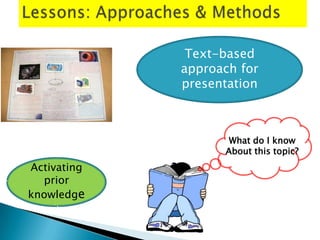
Text-based
             approach for
             presentation


                    What do I know
                   About this topic?
Activating
  prior
knowledge
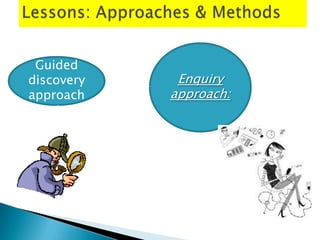
Guided
discovery    Enquiry
approach    approach:
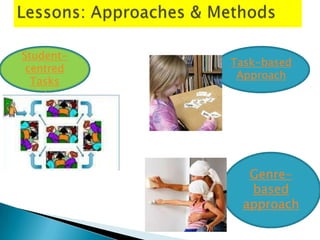
Student-
           Task-based
 centred
            Approach
  Tasks


              Genre-
              based
             approach
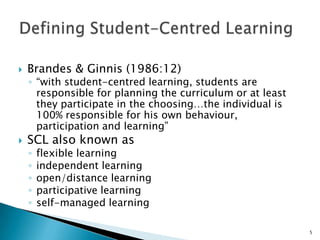
   Brandes & Ginnis (1986:12)
    ◦ “with student-centred learning, students are
      responsible for planning the curriculum or at least
      they participate in the choosing…the individual is
      100% responsible for his own behaviour,
      participation and learning”
   SCL also known as
    ◦   flexible learning
    ◦   independent learning
    ◦   open/distance learning
    ◦   participative learning
    ◦   self-managed learning

                                                            5
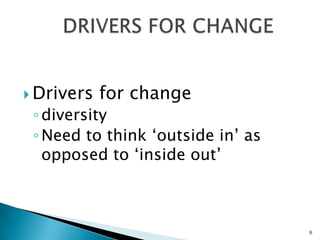
 Drivers   for change
 ◦ diversity
 ◦ Need to think „outside in‟ as
   opposed to „inside out‟


                                   6
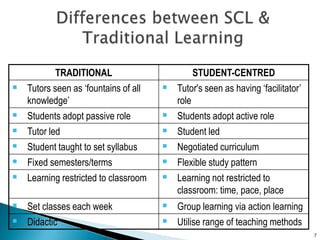
TRADITIONAL                            STUDENT-CENTRED
 Tutors seen as ‘fountains of all      Tutor's seen as having ‘facilitator’
    knowledge’                             role
   Students adopt passive role           Students adopt active role
   Tutor led                             Student led
   Student taught to set syllabus        Negotiated curriculum
   Fixed semesters/terms                 Flexible study pattern
   Learning restricted to classroom      Learning not restricted to
                                           classroom: time, pace, place
 Set classes each week                 Group learning via action learning
 Didactic                              Utilise range of teaching methods
                                                                                7
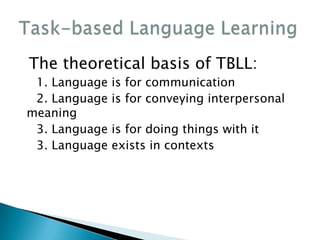
The theoretical basis of TBLL:
 1. Language   is for communication
 2. Language   is for conveying interpersonal
meaning
 3. Language   is for doing things with it
 3. Language   exists in contexts
The pedagogical principle of TBLL:
 Learning by doing
 Doing in learning
 Learning for doing
 Learning in interacting
The Features of TBLL:
1. Learning a language by doing things with it
2. The situations should be as real as possible
3. Language activities should always be
integrated with culture
4. Language activities should be for expressing
ideas instead of parroting things
5. There should not be an identical answer to a
question or identical outcome of an activity
6. Student-centered, not teacher-centered
7. Students are encouraged to use language
creatively
8. Activities of different skills should be
integrated
Exercises are mainly for:
1. Checking the command of language knowledge
2. Reviewing and consolidating language knowledge
3. Drilling on language forms
4. Working on separate words or sentences without
a context
5. Working for separate language skills
6. Working in rather mechanical drills, such as filling
blanks, matching, choosing the right answer,
translating separate sentences, checking answers,
locating the right sound, etc.
7. Arriving at one unified answer for the
question
:
1. Arousing students‟ interest
2. Doing things
3. Communicating ideas
4. Conveying information
5. Solving problems
6. Working in context
7. Involving more than one language
 knowledge or skill
8. Analyzing, discussing, negotiating
9. Working in pairs or groups
10. Allowing different end-products
Language learning tasks
               &
 Real Life (Real world)
Tasks
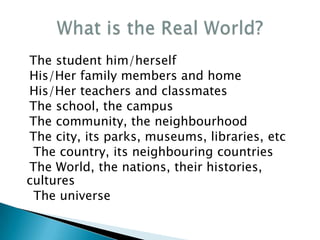
The student him/herself
His/Her family members and home
His/Her teachers and classmates
The school, the campus
The community, the neighbourhood
The city, its parks, museums, libraries, etc
 The country, its neighbouring countries
The World, the nations, their histories,
cultures
 The universe
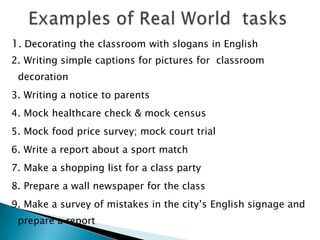
1. Decorating the classroom with slogans in English
2. Writing simple captions for pictures for classroom
 decoration
3. Writing a notice to parents
4. Mock healthcare check & mock census
5. Mock food price survey; mock court trial
6. Write a report about a sport match
7. Make a shopping list for a class party
8. Prepare a wall newspaper for the class
9. Make a survey of mistakes in the city‟s English signage and
 prepare a report
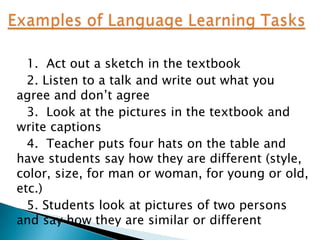
1. Act out a sketch in the textbook
  2. Listen to a talk and write out what you
agree and don‟t agree
  3. Look at the pictures in the textbook and
write captions
  4. Teacher puts four hats on the table and
have students say how they are different (style,
color, size, for man or woman, for young or old,
etc.)
  5. Students look at pictures of two persons
and say how they are similar or different
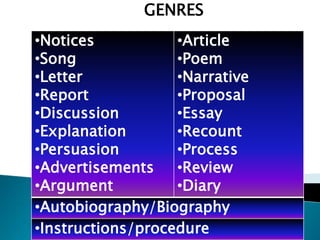
GENRES
•Notices           •Article
•Song              •Poem
•Letter            •Narrative
•Report            •Proposal
•Discussion        •Essay
•Explanation       •Recount
•Persuasion        •Process
•Advertisements    •Review
•Argument          •Diary
•Autobiography/Biography
•Instructions/procedure
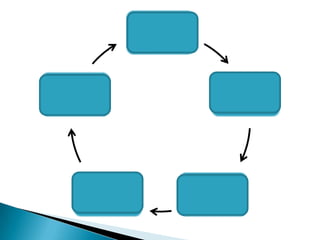
CONTEXTUALIZING


COMPARING                               MODELLING


       INDEPENDENT                 JOINT
      CONSTRUCTION             CONSTRUCTION
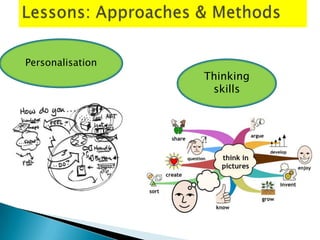
Personalisation
                  Thinking
                   skills
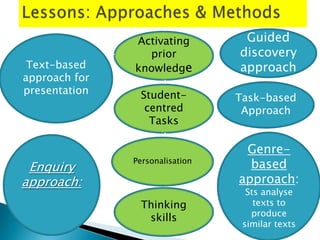
Activating         Guided
                 prior           discovery
 Text-based    knowledge         approach
approach for
presentation    Student-         Task-based
                 centred          Approach
                  Tasks

                                  Genre-
 Enquiry
               Personalisation
                                   based
approach:                        approach:
                                   Sts analyse
                Thinking             texts to
                                    produce
                 skills
                                  similar texts

Approaches

  • 1.
  • 2.
    Text-based approach for presentation What do I know About this topic? Activating prior knowledge
  • 3.
    Guided discovery Enquiry approach approach:
  • 4.
    Student- Task-based centred Approach Tasks Genre- based approach
  • 5.
    Brandes & Ginnis (1986:12) ◦ “with student-centred learning, students are responsible for planning the curriculum or at least they participate in the choosing…the individual is 100% responsible for his own behaviour, participation and learning”  SCL also known as ◦ flexible learning ◦ independent learning ◦ open/distance learning ◦ participative learning ◦ self-managed learning 5
  • 6.
     Drivers for change ◦ diversity ◦ Need to think „outside in‟ as opposed to „inside out‟ 6
  • 7.
    TRADITIONAL STUDENT-CENTRED  Tutors seen as ‘fountains of all  Tutor's seen as having ‘facilitator’ knowledge’ role  Students adopt passive role  Students adopt active role  Tutor led  Student led  Student taught to set syllabus  Negotiated curriculum  Fixed semesters/terms  Flexible study pattern  Learning restricted to classroom  Learning not restricted to classroom: time, pace, place  Set classes each week  Group learning via action learning  Didactic  Utilise range of teaching methods 7
  • 9.
    The theoretical basisof TBLL: 1. Language is for communication 2. Language is for conveying interpersonal meaning 3. Language is for doing things with it 3. Language exists in contexts
  • 10.
    The pedagogical principleof TBLL: Learning by doing Doing in learning Learning for doing Learning in interacting
  • 11.
    The Features ofTBLL: 1. Learning a language by doing things with it 2. The situations should be as real as possible 3. Language activities should always be integrated with culture 4. Language activities should be for expressing ideas instead of parroting things 5. There should not be an identical answer to a question or identical outcome of an activity 6. Student-centered, not teacher-centered 7. Students are encouraged to use language creatively 8. Activities of different skills should be integrated
  • 12.
    Exercises are mainlyfor: 1. Checking the command of language knowledge 2. Reviewing and consolidating language knowledge 3. Drilling on language forms 4. Working on separate words or sentences without a context 5. Working for separate language skills 6. Working in rather mechanical drills, such as filling blanks, matching, choosing the right answer, translating separate sentences, checking answers, locating the right sound, etc. 7. Arriving at one unified answer for the question
  • 13.
    : 1. Arousing students‟interest 2. Doing things 3. Communicating ideas 4. Conveying information 5. Solving problems 6. Working in context 7. Involving more than one language knowledge or skill 8. Analyzing, discussing, negotiating 9. Working in pairs or groups 10. Allowing different end-products
  • 14.
    Language learning tasks & Real Life (Real world) Tasks
  • 15.
    The student him/herself His/Herfamily members and home His/Her teachers and classmates The school, the campus The community, the neighbourhood The city, its parks, museums, libraries, etc The country, its neighbouring countries The World, the nations, their histories, cultures The universe
  • 16.
    1. Decorating theclassroom with slogans in English 2. Writing simple captions for pictures for classroom decoration 3. Writing a notice to parents 4. Mock healthcare check & mock census 5. Mock food price survey; mock court trial 6. Write a report about a sport match 7. Make a shopping list for a class party 8. Prepare a wall newspaper for the class 9. Make a survey of mistakes in the city‟s English signage and prepare a report
  • 17.
    1. Act outa sketch in the textbook 2. Listen to a talk and write out what you agree and don‟t agree 3. Look at the pictures in the textbook and write captions 4. Teacher puts four hats on the table and have students say how they are different (style, color, size, for man or woman, for young or old, etc.) 5. Students look at pictures of two persons and say how they are similar or different
  • 19.
    GENRES •Notices •Article •Song •Poem •Letter •Narrative •Report •Proposal •Discussion •Essay •Explanation •Recount •Persuasion •Process •Advertisements •Review •Argument •Diary •Autobiography/Biography •Instructions/procedure
  • 20.
    CONTEXTUALIZING COMPARING MODELLING INDEPENDENT JOINT CONSTRUCTION CONSTRUCTION
  • 21.
    Personalisation Thinking skills
  • 22.
    Activating Guided prior discovery Text-based knowledge approach approach for presentation Student- Task-based centred Approach Tasks Genre- Enquiry Personalisation based approach: approach: Sts analyse Thinking texts to produce skills similar texts