





Writing for publication Tim Dornan
Outline Why publish? What possibilities are there? How do you set about it?
Why? So as not to perish To: Influence policy Reach people who share your interest Contribute to building knowledge Teach
Possibilities: places Research journal - peer reviewed Book - whole or chapter (invited) Education or practice journal - +/- peer reviewed Report O t her
Possibilities: types 'Empirical' (data) 'Primary' - original research 'Secondary' - rigorous, if not systematic, review Editorial Book contribution Opinion or description Letter Abstract
Quality of research publications Journal impact factor Frequency with which your work is cited
Tips Good journals may invite short descriptions of (evaluated) good ideas Letters to prestigious journals carry weight Submitted editorials occasionally accepted Conference abstracts are sometimes published in good journals
Publishing is ****** hard work!
How do you set about it? Have suitable material Identify a suitable place to submit it Match the two well Get (competent) mentoring, if possible Read the journal authors’ instructions
Abstract – write last Structured – varies by journal Background/aim Setting Methods Results Conclusions Must not go beyond what data can support
Introduction
Framing the topic Specificity/generality determined by: The state of the research field Application to which the work will be put Choice Big picture or detail Methodology
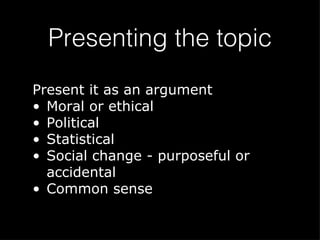
Presenting the topic Present it as an argument Moral or ethical Political Statistical Social change - purposeful or accidental Common sense
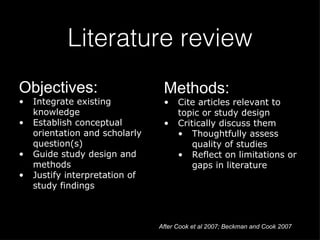
Literature review Objectives: Integrate existing knowledge Establish conceptual orientation and scholarly question(s) Guide study design and methods Justify interpretation of study findings Methods: Cite articles relevant to topic or study design Critically discuss them Thoughtfully assess quality of studies Reflect on limitations or gaps in literature After Cook et al 2007; Beckman and Cook 2007
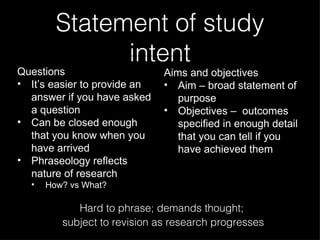
Statement of study intent Questions It’s easier to provide an answer if you have asked a question Can be closed enough that you know when you have arrived Phraseology reflects nature of research How? vs What? Aims and objectives Aim – broad statement of purpose Objectives –  outcomes specified in enough detail that you can tell if you have achieved them Hard to phrase; demands thought;  subject to revision as research progresses
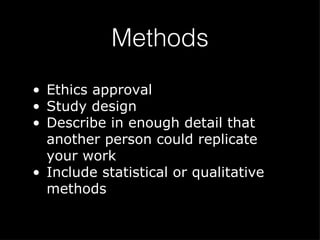
Methods Ethics approval Study design Describe in enough detail that another person could replicate your work Include statistical or qualitative methods
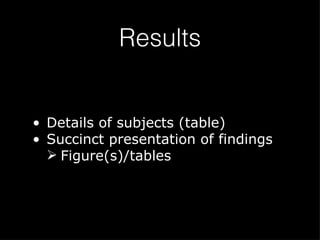
Results Details of subjects (table) Succinct presentation of findings Figure(s)/tables
Discussion Principal findings and meaning Strengths and limitations Relationship to other published work Implications Practice Future research
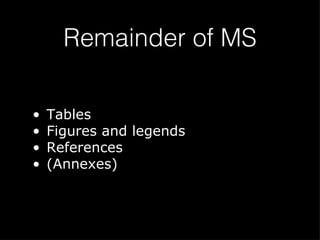
Remainder of MS Tables Figures and legends References (Annexes)
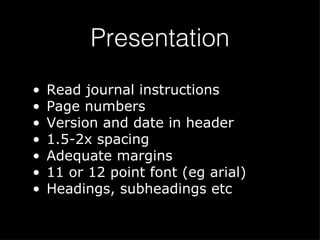
Presentation Read journal instructions Page numbers Version and date in header 1.5-2x spacing Adequate margins 11 or 12 point font (eg arial) Headings, subheadings etc
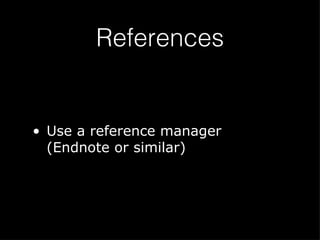
References Use a reference manager (Endnote or similar)
English style Write in as simple language as you can Variable length sentences; shorter rather than longer Avoid verbage Define abbreviations Avoid undefined terms (jargon) Punctuate carefully
 
Patients What’s the topic?
Patients in UGME: Argument Medical students everywhere learn in authentic practice settings Interaction with patients is a central part of their learning At least early on, students are not active providers of care Impact on patients of students’ learning is a self-evidently important topic
Patients in medical education The current literature in this area has several limitations. The majority of studies evaluated patient opinions using questionnaires, few offering patients the opportunity to expand on their answers and most requiring them to select from options that were in line with previous evidence, such as ‘better’, ‘same’ or ‘worse’. These methods have therefore given a fairly superficial description of the experience. Even semi-structured interviews have focused more on perceived benefits and disadvantages than in-depth analysis of the patient’s experience. In one study where 92% of patients reported benefits from student involvement, patients were interviewed by members of the faculty by whom they were treated. Despite being assured of anonymity, this could have led to patients feeling pressured to be more positive in their answers.  Emma McLachlan 2009
Patients in UGME How does involvement in medical student education affect a patient’s sense of identity?

Writing for Publication

  • 1.
  • 2.
    Outline Why publish?What possibilities are there? How do you set about it?
  • 3.
    Why? So asnot to perish To: Influence policy Reach people who share your interest Contribute to building knowledge Teach
  • 4.
    Possibilities: places Researchjournal - peer reviewed Book - whole or chapter (invited) Education or practice journal - +/- peer reviewed Report O t her
  • 5.
    Possibilities: types 'Empirical'(data) 'Primary' - original research 'Secondary' - rigorous, if not systematic, review Editorial Book contribution Opinion or description Letter Abstract
  • 6.
    Quality of researchpublications Journal impact factor Frequency with which your work is cited
  • 7.
    Tips Good journalsmay invite short descriptions of (evaluated) good ideas Letters to prestigious journals carry weight Submitted editorials occasionally accepted Conference abstracts are sometimes published in good journals
  • 8.
  • 9.
    How do youset about it? Have suitable material Identify a suitable place to submit it Match the two well Get (competent) mentoring, if possible Read the journal authors’ instructions
  • 10.
    Abstract – writelast Structured – varies by journal Background/aim Setting Methods Results Conclusions Must not go beyond what data can support
  • 11.
  • 12.
    Framing the topicSpecificity/generality determined by: The state of the research field Application to which the work will be put Choice Big picture or detail Methodology
  • 13.
    Presenting the topicPresent it as an argument Moral or ethical Political Statistical Social change - purposeful or accidental Common sense
  • 14.
    Literature review Objectives:Integrate existing knowledge Establish conceptual orientation and scholarly question(s) Guide study design and methods Justify interpretation of study findings Methods: Cite articles relevant to topic or study design Critically discuss them Thoughtfully assess quality of studies Reflect on limitations or gaps in literature After Cook et al 2007; Beckman and Cook 2007
  • 15.
    Statement of studyintent Questions It’s easier to provide an answer if you have asked a question Can be closed enough that you know when you have arrived Phraseology reflects nature of research How? vs What? Aims and objectives Aim – broad statement of purpose Objectives – outcomes specified in enough detail that you can tell if you have achieved them Hard to phrase; demands thought; subject to revision as research progresses
  • 16.
    Methods Ethics approvalStudy design Describe in enough detail that another person could replicate your work Include statistical or qualitative methods
  • 17.
    Results Details ofsubjects (table) Succinct presentation of findings Figure(s)/tables
  • 18.
    Discussion Principal findingsand meaning Strengths and limitations Relationship to other published work Implications Practice Future research
  • 19.
    Remainder of MSTables Figures and legends References (Annexes)
  • 20.
    Presentation Read journalinstructions Page numbers Version and date in header 1.5-2x spacing Adequate margins 11 or 12 point font (eg arial) Headings, subheadings etc
  • 21.
    References Use areference manager (Endnote or similar)
  • 22.
    English style Writein as simple language as you can Variable length sentences; shorter rather than longer Avoid verbage Define abbreviations Avoid undefined terms (jargon) Punctuate carefully
  • 23.
  • 24.
  • 25.
    Patients in UGME:Argument Medical students everywhere learn in authentic practice settings Interaction with patients is a central part of their learning At least early on, students are not active providers of care Impact on patients of students’ learning is a self-evidently important topic
  • 26.
    Patients in medicaleducation The current literature in this area has several limitations. The majority of studies evaluated patient opinions using questionnaires, few offering patients the opportunity to expand on their answers and most requiring them to select from options that were in line with previous evidence, such as ‘better’, ‘same’ or ‘worse’. These methods have therefore given a fairly superficial description of the experience. Even semi-structured interviews have focused more on perceived benefits and disadvantages than in-depth analysis of the patient’s experience. In one study where 92% of patients reported benefits from student involvement, patients were interviewed by members of the faculty by whom they were treated. Despite being assured of anonymity, this could have led to patients feeling pressured to be more positive in their answers. Emma McLachlan 2009
  • 27.
    Patients in UGMEHow does involvement in medical student education affect a patient’s sense of identity?