Knowledge and Information
      Management
     by Individuals

             MARZENA ŚWIGOŃ

    UNIVERSITY OF WARMIA AND MAZURY
          IN OLSZTYN (POLAND)


                4th International Conference
on Qualitative and Quantitative Methods in Libraries (QQML)
             Limerick, Ireland, 22–25 May 2012
QQML 2012
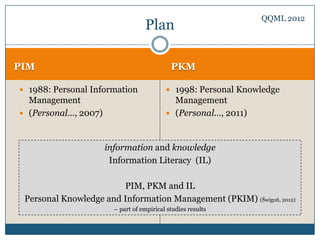
                                     Plan

PIM                                            PKM

 1988: Personal Information                  1998: Personal Knowledge
  Management                                   Management
 (Personal..., 2007)                         (Personal..., 2011)


                        information and knowledge
                         Information Literacy (IL)

                        PIM, PKM and IL
 Personal Knowledge and Information Management (PKIM) (Świgoń, 2012)
                          – part of empirical studies results
QQML 2012
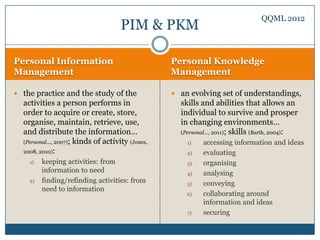
                                      PIM & PKM

Personal Information                               Personal Knowledge
Management                                         Management

 the practice and the study of the                 an evolving set of understandings,
  activities a person performs in                    skills and abilities that allows an
  order to acquire or create, store,                 individual to survive and prosper
  organise, maintain, retrieve, use,                 in changing environments…
  and distribute the information…                    (Personal..., 2011); skills (Barth, 2004):
  (Personal..., 2007); kinds of activity (Jones,       1)    accessing information and ideas
  2008, 2010):                                         2)    evaluating
    1)   keeping activities: from                      3)    organising
         information to need                           4)    analysing
    2)   finding/refinding activities: from            5)    conveying
         need to information
                                                       6)    collaborating around
                                                             information and ideas
                                                       7)    securing
QQML 2012
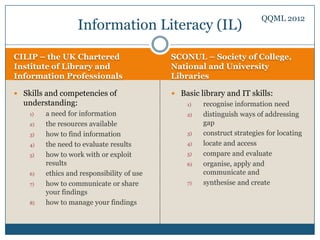
                   Information Literacy (IL)

CILIP – the UK Chartered                    SCONUL – Society of College,
Institute of Library and                    National and University
Information Professionals                   Libraries

 Skills and competencies of                 Basic library and IT skills:
  understanding:                                1)   recognise information need
    1)   a need for information                 2)   distinguish ways of addressing
    2)   the resources available                     gap
    3)   how to find information                3)   construct strategies for locating
    4)   the need to evaluate results           4)   locate and access
    5)   how to work with or exploit            5)   compare and evaluate
         results                                6)   organise, apply and
    6)   ethics and responsibility of use            communicate and
    7)   how to communicate or share            7)   synthesise and create
         your findings
    8)   how to manage your findings
QQML 2012
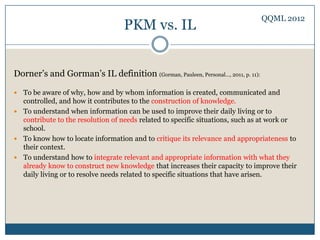
                                   PKM vs. IL


Dorner’s and Gorman’s IL definition (Gorman, Pauleen, Personal…, 2011, p. 11):

 To be aware of why, how and by whom information is created, communicated and
  controlled, and how it contributes to the construction of knowledge.
 To understand when information can be used to improve their daily living or to
  contribute to the resolution of needs related to specific situations, such as at work or
  school.
 To know how to locate information and to critique its relevance and appropriateness to
  their context.
 To understand how to integrate relevant and appropriate information with what they
  already know to construct new knowledge that increases their capacity to improve their
  daily living or to resolve needs related to specific situations that have arisen.
Personal Knowledge and Information
       Management (PKIM)

   AN INTEGRATED AND HUMANISTIC APPROACH
               TO PIM, PKM, IL

    WITH REFERENCE TO EXPLICIT AND TACIT
        KNOWLEDGE AND INFORMATION

                (ŚWIGOŃ, 2012)
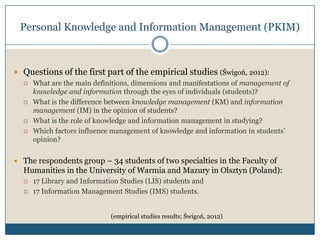
Personal Knowledge and Information Management (PKIM)


 Questions of the first part of the empirical studies (Świgoń, 2012):
     What are the main definitions, dimensions and manifestations of management of
      knowledge and information through the eyes of individuals (students)?
     What is the difference between knowledge management (KM) and information
      management (IM) in the opinion of students?
     What is the role of knowledge and information management in studying?
     Which factors influence management of knowledge and information in students’
      opinion?


 The respondents group – 34 students of two specialties in the Faculty of
  Humanities in the University of Warmia and Mazury in Olsztyn (Poland):
     17 Library and Information Studies (LIS) students and
     17 Information Management Studies (IMS) students.


                              (empirical studies results; Świgoń, 2012)
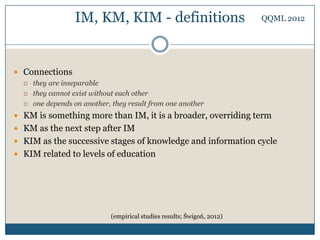
IM, KM, KIM - definitions                              QQML 2012


 Connections
     they are inseparable
     they cannot exist without each other
     one depends on another, they result from one another
 KM is something more than IM, it is a broader, overriding term
 KM as the next step after IM
 KIM as the successive stages of knowledge and information cycle
 KIM related to levels of education


                             (empirical studies results; Świgoń, 2012)
QQML 2012
                      IM & KM – differences


 IM comprises all accessible information (relevant, and non-relevant),
  whereas KM concerns only some information, selected, useful, reliable
  or recorded in memory
 KM is more connected to the scientific world, whereas IM – to everyday
  life and office work
 Other differences:
     complexity of both concepts
     scale
     subject


                              (empirical studies results; Świgoń, 2012)
Benefits of knowledge and information management


 In studying, learning, preparing for classes and writing research theses
  (in each field of studies at universities and even earlier – in high schools)
 In everyday life; in private and professional context:
     faster access to information
     assistance in problem solving
     better coping with information overload
     more effective selection of information
     ability to verify and correct information
     time, money and effort saving
     productivity in mental area
 In the information society


                               (empirical studies results; Świgoń, 2012)
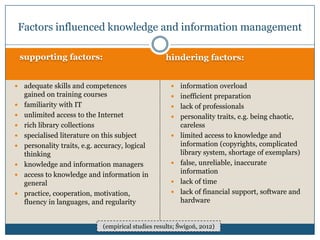
Factors influenced knowledge and information management

    supporting factors:                               hindering factors:


    adequate skills and competences                      information overload
     gained on training courses                           inefficient preparation
    familiarity with IT                                  lack of professionals
    unlimited access to the Internet                     personality traits, e.g. being chaotic,
    rich library collections                              careless
    specialised literature on this subject               limited access to knowledge and
    personality traits, e.g. accuracy, logical            information (copyrights, complicated
     thinking                                              library system, shortage of exemplars)
    knowledge and information managers                   false, unreliable, inaccurate
    access to knowledge and information in                information
     general                                              lack of time
    practice, cooperation, motivation,                   lack of financial support, software and
     fluency in languages, and regularity                  hardware


                               (empirical studies results; Świgoń, 2012)
QQML 2012
                                Conclusions


 Individuals perceive KM and IM as an integral area – KIM
 They see KIM as the possession and development of specific skills and abilities
  useful in all spheres of life (IL)

 Personal Knowledge and Information Management (PKIM) as an
  interdisciplinary and multidisciplinary concept would be valuable in theory
  (e.g. Information Science, Knowledge Management and Intellectual Capital,
  Education) and practice (e.g. university/high schools education programmes)
  (Świgoń, 2012)


                            (empirical studies results; Świgoń, 2012)
Marzena Świgoń, PhD
marzena.swigon@uwm.edu.pl


     QQML 2012              Thank you for your attention
     Limerick, Ireland

Knowledge and Information Management by Individuals

  • 1.
    Knowledge and Information Management by Individuals MARZENA ŚWIGOŃ UNIVERSITY OF WARMIA AND MAZURY IN OLSZTYN (POLAND) 4th International Conference on Qualitative and Quantitative Methods in Libraries (QQML) Limerick, Ireland, 22–25 May 2012
  • 2.
    QQML 2012 Plan PIM PKM  1988: Personal Information  1998: Personal Knowledge Management Management  (Personal..., 2007)  (Personal..., 2011) information and knowledge Information Literacy (IL) PIM, PKM and IL Personal Knowledge and Information Management (PKIM) (Świgoń, 2012) – part of empirical studies results
  • 3.
    QQML 2012 PIM & PKM Personal Information Personal Knowledge Management Management  the practice and the study of the  an evolving set of understandings, activities a person performs in skills and abilities that allows an order to acquire or create, store, individual to survive and prosper organise, maintain, retrieve, use, in changing environments… and distribute the information… (Personal..., 2011); skills (Barth, 2004): (Personal..., 2007); kinds of activity (Jones, 1) accessing information and ideas 2008, 2010): 2) evaluating 1) keeping activities: from 3) organising information to need 4) analysing 2) finding/refinding activities: from 5) conveying need to information 6) collaborating around information and ideas 7) securing
  • 4.
    QQML 2012 Information Literacy (IL) CILIP – the UK Chartered SCONUL – Society of College, Institute of Library and National and University Information Professionals Libraries  Skills and competencies of  Basic library and IT skills: understanding: 1) recognise information need 1) a need for information 2) distinguish ways of addressing 2) the resources available gap 3) how to find information 3) construct strategies for locating 4) the need to evaluate results 4) locate and access 5) how to work with or exploit 5) compare and evaluate results 6) organise, apply and 6) ethics and responsibility of use communicate and 7) how to communicate or share 7) synthesise and create your findings 8) how to manage your findings
  • 5.
    QQML 2012 PKM vs. IL Dorner’s and Gorman’s IL definition (Gorman, Pauleen, Personal…, 2011, p. 11):  To be aware of why, how and by whom information is created, communicated and controlled, and how it contributes to the construction of knowledge.  To understand when information can be used to improve their daily living or to contribute to the resolution of needs related to specific situations, such as at work or school.  To know how to locate information and to critique its relevance and appropriateness to their context.  To understand how to integrate relevant and appropriate information with what they already know to construct new knowledge that increases their capacity to improve their daily living or to resolve needs related to specific situations that have arisen.
  • 6.
    Personal Knowledge andInformation Management (PKIM) AN INTEGRATED AND HUMANISTIC APPROACH TO PIM, PKM, IL WITH REFERENCE TO EXPLICIT AND TACIT KNOWLEDGE AND INFORMATION (ŚWIGOŃ, 2012)
  • 7.
    Personal Knowledge andInformation Management (PKIM)  Questions of the first part of the empirical studies (Świgoń, 2012):  What are the main definitions, dimensions and manifestations of management of knowledge and information through the eyes of individuals (students)?  What is the difference between knowledge management (KM) and information management (IM) in the opinion of students?  What is the role of knowledge and information management in studying?  Which factors influence management of knowledge and information in students’ opinion?  The respondents group – 34 students of two specialties in the Faculty of Humanities in the University of Warmia and Mazury in Olsztyn (Poland):  17 Library and Information Studies (LIS) students and  17 Information Management Studies (IMS) students. (empirical studies results; Świgoń, 2012)
  • 8.
    IM, KM, KIM- definitions QQML 2012  Connections  they are inseparable  they cannot exist without each other  one depends on another, they result from one another  KM is something more than IM, it is a broader, overriding term  KM as the next step after IM  KIM as the successive stages of knowledge and information cycle  KIM related to levels of education (empirical studies results; Świgoń, 2012)
  • 9.
    QQML 2012 IM & KM – differences  IM comprises all accessible information (relevant, and non-relevant), whereas KM concerns only some information, selected, useful, reliable or recorded in memory  KM is more connected to the scientific world, whereas IM – to everyday life and office work  Other differences:  complexity of both concepts  scale  subject (empirical studies results; Świgoń, 2012)
  • 10.
    Benefits of knowledgeand information management  In studying, learning, preparing for classes and writing research theses (in each field of studies at universities and even earlier – in high schools)  In everyday life; in private and professional context:  faster access to information  assistance in problem solving  better coping with information overload  more effective selection of information  ability to verify and correct information  time, money and effort saving  productivity in mental area  In the information society (empirical studies results; Świgoń, 2012)
  • 11.
    Factors influenced knowledgeand information management supporting factors: hindering factors:  adequate skills and competences  information overload gained on training courses  inefficient preparation  familiarity with IT  lack of professionals  unlimited access to the Internet  personality traits, e.g. being chaotic,  rich library collections careless  specialised literature on this subject  limited access to knowledge and  personality traits, e.g. accuracy, logical information (copyrights, complicated thinking library system, shortage of exemplars)  knowledge and information managers  false, unreliable, inaccurate  access to knowledge and information in information general  lack of time  practice, cooperation, motivation,  lack of financial support, software and fluency in languages, and regularity hardware (empirical studies results; Świgoń, 2012)
  • 12.
    QQML 2012 Conclusions  Individuals perceive KM and IM as an integral area – KIM  They see KIM as the possession and development of specific skills and abilities useful in all spheres of life (IL)  Personal Knowledge and Information Management (PKIM) as an interdisciplinary and multidisciplinary concept would be valuable in theory (e.g. Information Science, Knowledge Management and Intellectual Capital, Education) and practice (e.g. university/high schools education programmes) (Świgoń, 2012) (empirical studies results; Świgoń, 2012)
  • 13.
    Marzena Świgoń, PhD marzena.swigon@uwm.edu.pl QQML 2012 Thank you for your attention Limerick, Ireland