
Knowledge management and Knowledge
Workers in the Digital Era: Challenges
and Issues


Presented by:
Sehnara B. Choudhury
Dept. of Library and Information Science
Assam University, Silchar
Introduction
   In the present information and
    knowledge era, knowledge has
    become a key resource. Faced with
    competition and increasingly dynamic
    environments,      organizations      are
    beginning to realize that there is a vast
    and largely untapped asset diffused
    around in the organization –
    knowledge
What is Knowledge
 Information is all about knowing that
  occurred or happened. Information becomes
  knowledge once it is processed in the mined
  of an individual.
 Knowledge is information interchange with
  experiences, reflected upon and interpreted
  in a particular context.
 Knowledge         is all about acquiring
  information and utilising it in a similarly
  placed situation so that latest action gives
  value addition over the earlier action.
Focus on Knowledge
 Strategic use of Knowledge
 Nurture knowledge workers
 Quality of people (knowledge workers).
 Generating new knowledge & accessing valuable
  knowledge from outside sources.
 Using accessible knowledge in decision making.
 Embedding knowledge in processes, products and/ or
  services.
 Representing knowledge in documents, databases, and
  software.
 Transferring existing knowledge into other parts of the
  organisation.
Radical Transformation

   Knowledge is vital for growth and survival
   Continuous innovation is impossible without
    knowledge assets.
   Nothing but knowledge can generate
    originality of service.
   It needs knowledge to leverage all
     organisational capabilities.
   Knowledge is the only core competence for
    coping with challenge and change.
Knowledge management (KM)

 A systematic and integrated coordination of
  organisation-wide activities of acquiring, creating,
  storing, sharing, dissemination, developing and
  deploying knowledge by individuals and groups in
  pursuit of organisational goals.
 KM is essentially about getting the right knowledge
  to the right person at the time.
 Knowledge Management is all about management of
  intangibles to deliver tangible results.
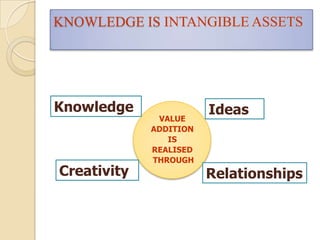
KNOWLEDGE IS INTANGIBLE ASSETS


Knowledge               Ideas
              VALUE
             ADDITION
                IS
             REALISED
             THROUGH
Creativity              Relationships
Need for Knowledge Management


•   Creating and populating a repository of
    in-house knowledge
•   Valuation of Knowledge
•   Facilitating the transfer of knowledge
•   Creating a knowledge sharing
     environment
•   Building an organisational culture
     focused on innovation and knowledge
    creation
Impact of Information and Communication
                   Technology

 Seamless access within organization
  and globally;
 Scholarly communication made easier
  and global;
 Virtual team research and discussion
  forum; and
 Digital library products and services.
The Challenges and Issues

Changing senario
 Worldwide shift to information economy to knowledge
  economy
 Rapid growth in knowledge and information-intensive
  product and services.
 Manual production workers being substituted/ replaced
  by information/ Knowledge workers
 The significant impact of the rapidly evolving ICTs on
  enterprises.
                        Challenges
 Multiple formats of information
 Changing user needs
 Organisational structures
 Changing role of librarians
Role of Librarians/Information
              Professionals
 Historically the librarians/information
  professional have been knowledge
  managers.
 They have information content domain
  expertise, as well as knowledge and
  expertise in knowledge transfer.
 Enhance transferable skills including
  information retrieval and information fluency
  skills.
 Access to electronic resources for on-campus
  and remote users, internal and remote
  database support, library’s digital content
  management system, e.g. resource discovery
  tools (link resolver, meta-data & federated
  search services).
Preparing Knowledge workers
of the Digital Era
 The required paradigm shift is for librarians/information
  professional to become facilitators/content managers of institutional
  communities of practice, as well as identified processes/services:
 create knowledge repositories, portals, “hubs” of information in
  identified areas of institutional processes to enhance quality and
  efficiency.
 engage in knowledge networks and discussions.
LIS professional need to:
 expand their horizon and their potential clientele, and
 extend interaction and collaboration-across discipline and user
  groups of different interests and service requirements.
Conclusion
 KM is introduced to help an organization of
  whatever nature to create, share, and use
  knowledge effectively.
     In the digital era Knowledge workers
  attempt to meet the information overload
  problem by analyzing, filtering, selecting and
  synthesizing    products     in    which   the
  information is maximally relevant, organized
  and available for users. So, KM will be very
  important, knowledge has crossed the
  boundaries as the concept library without
  walls become popular and so online
  databases, OPAC, web server and browsers,
  etc tools are important to satisfy the diverse
  information need of the clientele.
THANK
 YOU

Knowledge management and knowledge workers in the digital era challenges and issues

  • 1.
    Knowledge management andKnowledge Workers in the Digital Era: Challenges and Issues Presented by: Sehnara B. Choudhury Dept. of Library and Information Science Assam University, Silchar
  • 2.
    Introduction  In the present information and knowledge era, knowledge has become a key resource. Faced with competition and increasingly dynamic environments, organizations are beginning to realize that there is a vast and largely untapped asset diffused around in the organization – knowledge
  • 3.
    What is Knowledge Information is all about knowing that occurred or happened. Information becomes knowledge once it is processed in the mined of an individual.  Knowledge is information interchange with experiences, reflected upon and interpreted in a particular context.  Knowledge is all about acquiring information and utilising it in a similarly placed situation so that latest action gives value addition over the earlier action.
  • 4.
    Focus on Knowledge Strategic use of Knowledge  Nurture knowledge workers  Quality of people (knowledge workers).  Generating new knowledge & accessing valuable knowledge from outside sources.  Using accessible knowledge in decision making.  Embedding knowledge in processes, products and/ or services.  Representing knowledge in documents, databases, and software.  Transferring existing knowledge into other parts of the organisation.
  • 5.
    Radical Transformation  Knowledge is vital for growth and survival  Continuous innovation is impossible without knowledge assets.  Nothing but knowledge can generate originality of service.  It needs knowledge to leverage all organisational capabilities.  Knowledge is the only core competence for coping with challenge and change.
  • 6.
    Knowledge management (KM) A systematic and integrated coordination of organisation-wide activities of acquiring, creating, storing, sharing, dissemination, developing and deploying knowledge by individuals and groups in pursuit of organisational goals.  KM is essentially about getting the right knowledge to the right person at the time.  Knowledge Management is all about management of intangibles to deliver tangible results.
  • 7.
    KNOWLEDGE IS INTANGIBLEASSETS Knowledge Ideas VALUE ADDITION IS REALISED THROUGH Creativity Relationships
  • 8.
    Need for KnowledgeManagement • Creating and populating a repository of in-house knowledge • Valuation of Knowledge • Facilitating the transfer of knowledge • Creating a knowledge sharing environment • Building an organisational culture focused on innovation and knowledge creation
  • 9.
    Impact of Informationand Communication Technology  Seamless access within organization and globally;  Scholarly communication made easier and global;  Virtual team research and discussion forum; and  Digital library products and services.
  • 10.
    The Challenges andIssues Changing senario  Worldwide shift to information economy to knowledge economy  Rapid growth in knowledge and information-intensive product and services.  Manual production workers being substituted/ replaced by information/ Knowledge workers  The significant impact of the rapidly evolving ICTs on enterprises. Challenges  Multiple formats of information  Changing user needs  Organisational structures  Changing role of librarians
  • 11.
    Role of Librarians/Information Professionals  Historically the librarians/information professional have been knowledge managers.  They have information content domain expertise, as well as knowledge and expertise in knowledge transfer.  Enhance transferable skills including information retrieval and information fluency skills.  Access to electronic resources for on-campus and remote users, internal and remote database support, library’s digital content management system, e.g. resource discovery tools (link resolver, meta-data & federated search services).
  • 12.
    Preparing Knowledge workers ofthe Digital Era  The required paradigm shift is for librarians/information professional to become facilitators/content managers of institutional communities of practice, as well as identified processes/services:  create knowledge repositories, portals, “hubs” of information in identified areas of institutional processes to enhance quality and efficiency.  engage in knowledge networks and discussions. LIS professional need to:  expand their horizon and their potential clientele, and  extend interaction and collaboration-across discipline and user groups of different interests and service requirements.
  • 13.
    Conclusion  KM isintroduced to help an organization of whatever nature to create, share, and use knowledge effectively.  In the digital era Knowledge workers attempt to meet the information overload problem by analyzing, filtering, selecting and synthesizing products in which the information is maximally relevant, organized and available for users. So, KM will be very important, knowledge has crossed the boundaries as the concept library without walls become popular and so online databases, OPAC, web server and browsers, etc tools are important to satisfy the diverse information need of the clientele.
  • 14.