Knowledge
Management
Presented By
Rajiv Ranjan Mishra
MLi.Sc. Ist Sem
Contents
● Knowledge
● Types of knowledge
● Knowledge Management
● Objectives of KM
● Need of KM
● Importance of KM
● Principles of KM
● Components of KM
● Scope of Knowledge Management
● Challenges of KM
● Findings
● Changing scenario and driving force in KM
● Benefits of KM
● Conclusion
Knowledge
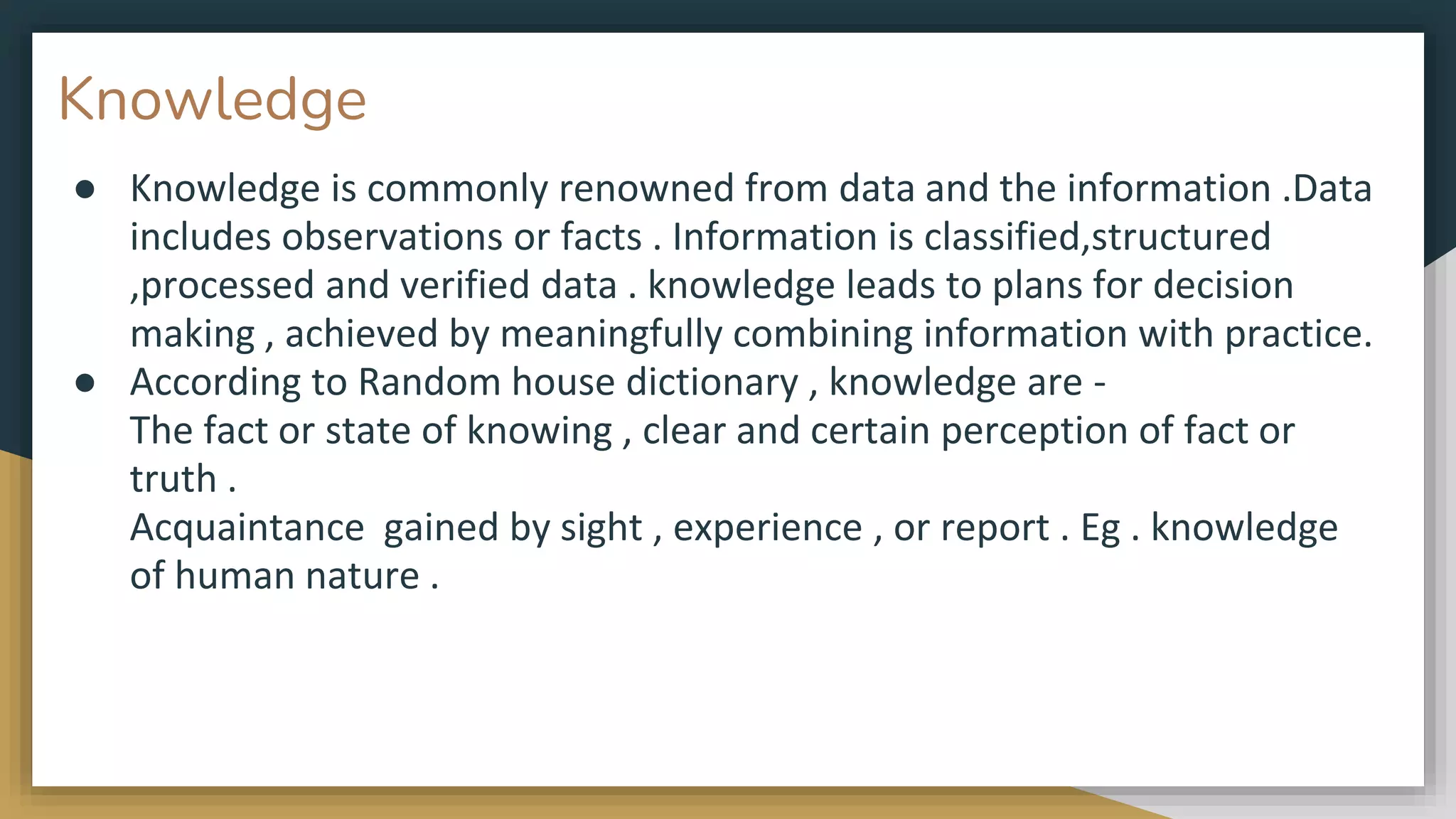
● Knowledge is commonly renowned from data and the information .Data
includes observations or facts . Information is classified,structured
,processed and verified data . knowledge leads to plans for decision
making , achieved by meaningfully combining information with practice.
● According to Random house dictionary , knowledge are -
The fact or state of knowing , clear and certain perception of fact or
truth .
Acquaintance gained by sight , experience , or report . Eg . knowledge
of human nature .
Tacit Knowledge
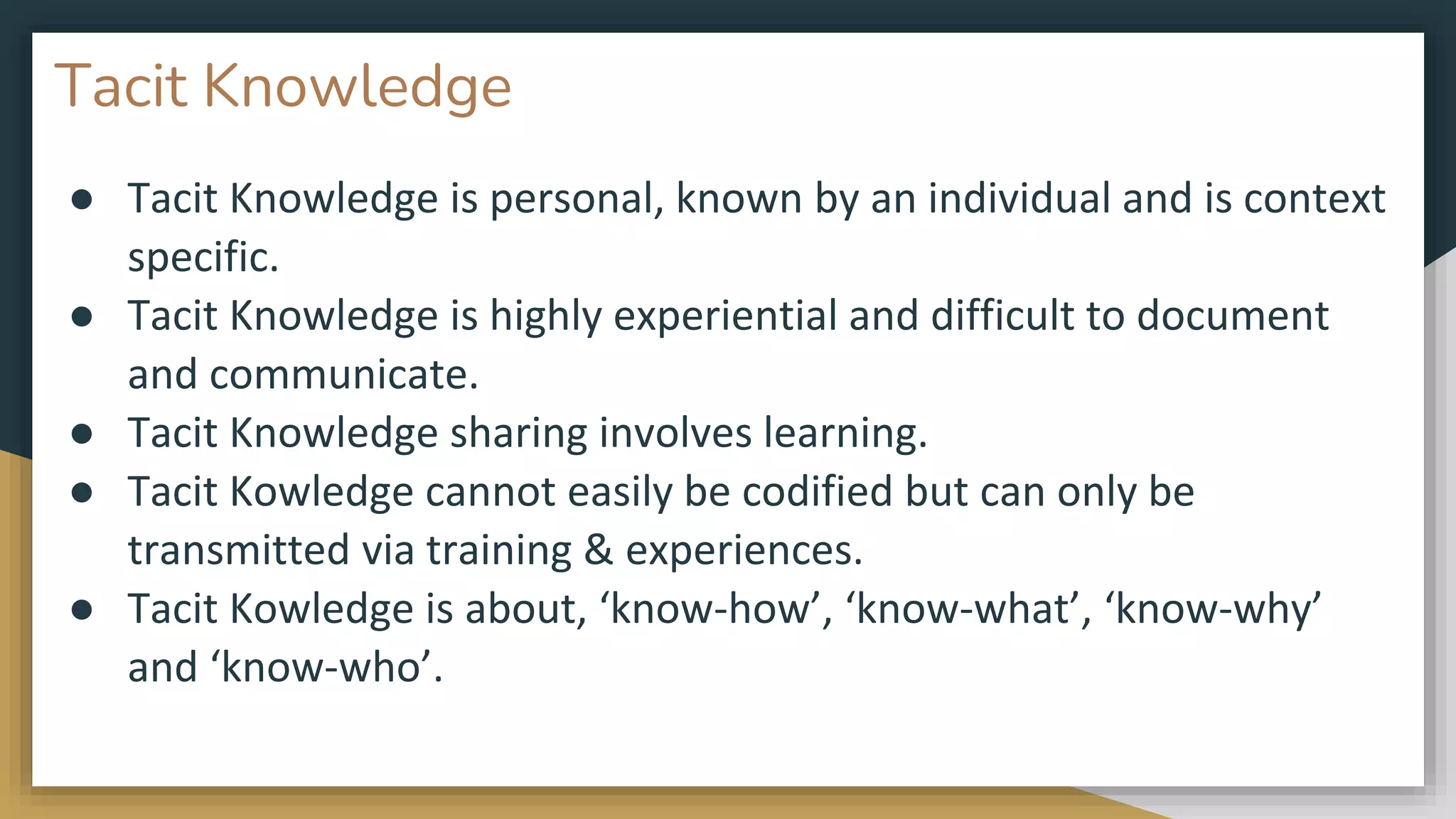
● Tacit Knowledge is personal, known by an individual and is context
specific.
● Tacit Knowledge is highly experiential and difficult to document
and communicate.
● Tacit Knowledge sharing involves learning.
● Tacit Kowledge cannot easily be codified but can only be
transmitted via training & experiences.
● Tacit Kowledge is about, ‘know-how’, ‘know-what’, ‘know-why’
and ‘know-who’.
Explicit Knowledge
● Explicit Knowledge is more formal.
● Explicit Knowledge is knowledge that can articulated , stored and
accessed .
● Explicit Knowledge is easily shared.
● Explicit Knowledge is reproducible.
● Explicit Knowledge can easily be codified, documented, transformed
and conveyed in systematic way.
Knowledge Management
According to working definition of IFLA , Knowledge Management
is “A process of creating (Generating, Capturing), Storing
(Preserving , Organising, Integrating ), Sharing (Communicating),
Applying (Implementing) and Reusing (Transforming)
organisational knowledge to enable an organisation to achieve
it's goals and objectives.”
Continue…….
Knowledge Management is -
● Max utilization of human (tacit),documentary (explicit) and
corporate knowledge for the improvement of an organization.
● Applying knowledge of how to create information that can people
use and rely on .
● The collection of processes that govern the creation ,dissemination
and utilization of knowledge.
Action on knowledge
Development - acquiring , capturing , creating , discovering
Application - using , enacting , executing , exploiting
Assessment - appraising ,evaluating , validating , verifying
Preservation - storing ,securing, conservating , retaining
Updation - evolving , improving , refreshing , maintaining
Transfer/dissemination - communicating , deploying , disseminating , sharing
Transform /Repackaging - compiling , formalizing , standardizing , explicating ,
extracting
Objective of Knowledge Management
● To promote collection , Processing , storage and distribution of
knowledge.
● To promote scientific Research.
● To promote relationship between library and users.
● To protect intellectual property right ,in information technology
era.
● To create knowledge repositories and manage knowledge as an
asset.
● To organize the value of knowledge and improve effective
research.
Need of Knowledge Management
● Sharing of information and best practices
● Decision making
● Access to information
● Value addition
● Economy
● Enhance innovation
● Minimize duplication of efforts
Importance of Knowledge Management
● Knowledge Management seeks to make the best use of the knowledge
that is available to the library ,while creating new knowledge in the
process.
● KM provides innovative and cost effective solution to the library users.
● KM involves enhancing organizational learning .
● Information technology , especially the Cyber technology drives the way
of knowledge management .Use of cyber technology accelerates the rate
of quality , quantity and cost effectiveness with improved productivity
and suitability in services.
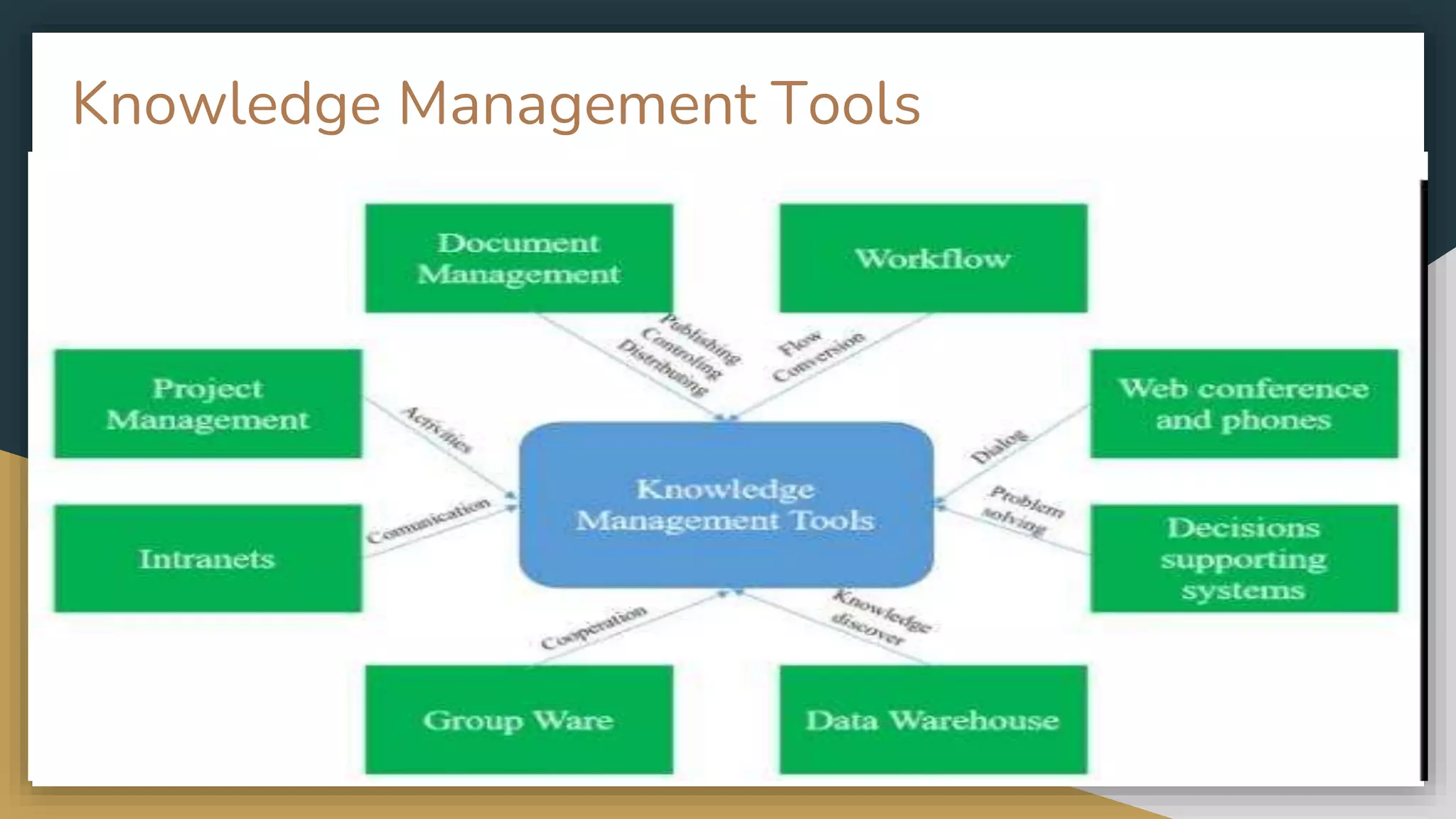
Knowledge Management Tools
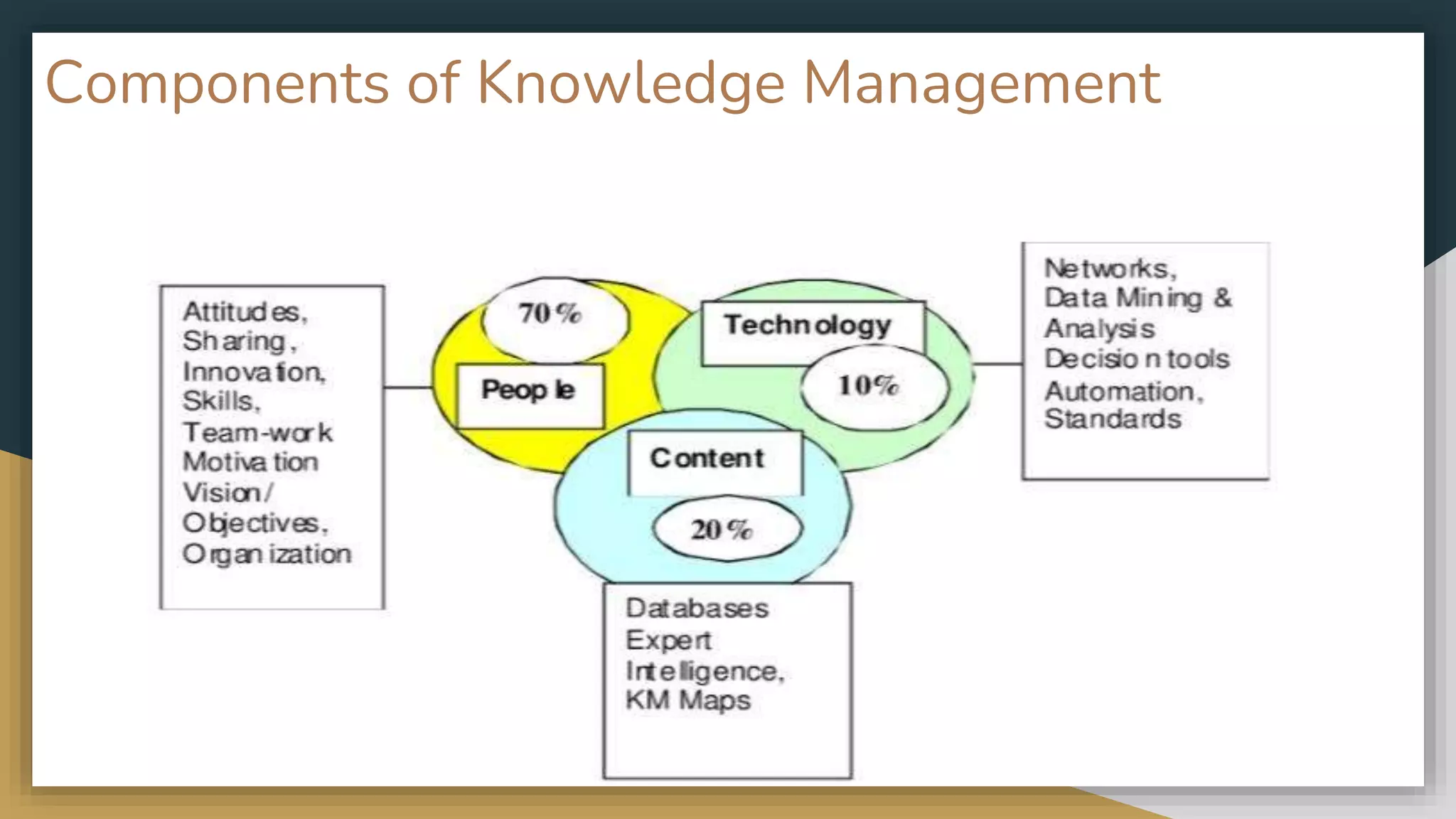
Components of Knowledge Management
Contents of KM in Libraries
● Theoretical innovation management of knowledge
Enrich and enlarge the theoretical and practical research fields of LIS
through pursuing the latest development trends in LIS.
● Technical Innovation management
Manage the network system constructed by institution and organization
that relate to full course of technical Innovation.
● Organizational innovation management
Create a set of effective organizational management system adaptable
to the requirement in the electronic library era, to support and
strengthen the KM activities by optimizing the functional departments
and operational procedures of libraries.
Scope of Knowledge Management
● Solution For the improvement of Future prospects of libraries .
● Method for improving knowledge based services for external and
internal users through creating a organization culture of sharing
knowledge and expertise with in the library .
● Solution for the development and application of the
organizational knowledge to improve library operation and
services .
● Means for the transformation of library into a more efficient and
knowledge sharing organization.
Continue ….
● Survival Factor for libraries to overcome the challenges , library
professionals are facing the changing and competitive
environment.
● Knowledge Management refers to a deliberate and consistent
effort to improve the utilization , transfer and creation of
knowledge in organizations.
Challenges of Knowledge Management
● Intellectual Capital
● Culture
● Structure
● Obsolescence
● Overloading
● Technology
Findings
● The concept of KM was emerged in bussiness sector , now it is
being used in public sector organization including academic
institutions and their libraries.
● Libraries are having explicit as well as tacit knowledge embeded in
working processes and experienced employees.
● Management of Knowledge helps an organization to improve the
quality of services.
● The perceptions of KM among LIS professionals are varied and
they mostly view KM as the management of recorded knowledge
rather sharing and using tacit knowledge embeded in employees.
Changing Scenario and driving forces in KM in
libraries
● Due to impact of globalization economic competition and revolution of
ICT , the libraries are under going tremendous change its environment.
● ICT tools and techniques , Knowledge Management system ,
Internet,Web resources ,digital libraries have made a significant change
in existing library systems and services.
● Knowledge acquisition is the starting point of KM in libraries. The
application of IT, enlarge the scope of knowledge acquisition rises
knowledge acquisition , speed and reduces knowledge acquisition cost .
Continue …..
● To cope with exponential growth in human knowledge , libraries
need to develop their resources, access and sharing strategies
from printed to electronic and digital resources .
● Libraries should be developed and maintained integrated online
public Access catalogue (OPAC’s)with both internal and external
resources as well as printed and other format of knowledge.
● ICT is one most driving force to applying KM in LIS field .
● Budget short falls and user expectations are main driving force
applying KM in LIS environment.
Continue…..
● Data wise technologies developed the following list of technologies for the KM.
Internet with in an organization
Document management system
Information Retrieval System
Relational and object databases
Electronic publishing
Help desk application
Data warehousing and data mining
Push technologies
Groupware and workflow system
Benefits
● Stimulating innovation and growth .
● Reusing ideas , documents, and expertise.
● Making organisation best problem solving
● Avoiding redundent efforts .
● Enable faster and better decision making
● Promoting standard and effective procedures.
Conclusion
Knowledge Management helps library and information
professionals in improving the services being rendered to
their users. We discussed the changing scenario in KM in
libraries and recast the role of library professionals as a
knowledge professionals.library should trained themselves
and their staffs to develop appropriate KM and use
information technology to equipied libraries to provide
better , faster ,pinponted services to it's clients /users .
References ….
● https://www.researchgate.net/publication/337242851
● www.researchgate.net
● http://egyankosh.ac.in//handle/123456789/25614

Knowledge management ppt

  • 1.
  • 2.
    Contents ● Knowledge ● Typesof knowledge ● Knowledge Management ● Objectives of KM ● Need of KM ● Importance of KM ● Principles of KM ● Components of KM ● Scope of Knowledge Management ● Challenges of KM ● Findings ● Changing scenario and driving force in KM ● Benefits of KM ● Conclusion
  • 3.
    Knowledge ● Knowledge iscommonly renowned from data and the information .Data includes observations or facts . Information is classified,structured ,processed and verified data . knowledge leads to plans for decision making , achieved by meaningfully combining information with practice. ● According to Random house dictionary , knowledge are - The fact or state of knowing , clear and certain perception of fact or truth . Acquaintance gained by sight , experience , or report . Eg . knowledge of human nature .
  • 4.
    Tacit Knowledge ● TacitKnowledge is personal, known by an individual and is context specific. ● Tacit Knowledge is highly experiential and difficult to document and communicate. ● Tacit Knowledge sharing involves learning. ● Tacit Kowledge cannot easily be codified but can only be transmitted via training & experiences. ● Tacit Kowledge is about, ‘know-how’, ‘know-what’, ‘know-why’ and ‘know-who’.
  • 5.
    Explicit Knowledge ● ExplicitKnowledge is more formal. ● Explicit Knowledge is knowledge that can articulated , stored and accessed . ● Explicit Knowledge is easily shared. ● Explicit Knowledge is reproducible. ● Explicit Knowledge can easily be codified, documented, transformed and conveyed in systematic way.
  • 6.
    Knowledge Management According toworking definition of IFLA , Knowledge Management is “A process of creating (Generating, Capturing), Storing (Preserving , Organising, Integrating ), Sharing (Communicating), Applying (Implementing) and Reusing (Transforming) organisational knowledge to enable an organisation to achieve it's goals and objectives.”
  • 7.
    Continue……. Knowledge Management is- ● Max utilization of human (tacit),documentary (explicit) and corporate knowledge for the improvement of an organization. ● Applying knowledge of how to create information that can people use and rely on . ● The collection of processes that govern the creation ,dissemination and utilization of knowledge.
  • 8.
    Action on knowledge Development- acquiring , capturing , creating , discovering Application - using , enacting , executing , exploiting Assessment - appraising ,evaluating , validating , verifying Preservation - storing ,securing, conservating , retaining Updation - evolving , improving , refreshing , maintaining Transfer/dissemination - communicating , deploying , disseminating , sharing Transform /Repackaging - compiling , formalizing , standardizing , explicating , extracting
  • 9.
    Objective of KnowledgeManagement ● To promote collection , Processing , storage and distribution of knowledge. ● To promote scientific Research. ● To promote relationship between library and users. ● To protect intellectual property right ,in information technology era. ● To create knowledge repositories and manage knowledge as an asset. ● To organize the value of knowledge and improve effective research.
  • 10.
    Need of KnowledgeManagement ● Sharing of information and best practices ● Decision making ● Access to information ● Value addition ● Economy ● Enhance innovation ● Minimize duplication of efforts
  • 11.
    Importance of KnowledgeManagement ● Knowledge Management seeks to make the best use of the knowledge that is available to the library ,while creating new knowledge in the process. ● KM provides innovative and cost effective solution to the library users. ● KM involves enhancing organizational learning . ● Information technology , especially the Cyber technology drives the way of knowledge management .Use of cyber technology accelerates the rate of quality , quantity and cost effectiveness with improved productivity and suitability in services.
  • 12.
  • 13.
  • 14.
    Contents of KMin Libraries ● Theoretical innovation management of knowledge Enrich and enlarge the theoretical and practical research fields of LIS through pursuing the latest development trends in LIS. ● Technical Innovation management Manage the network system constructed by institution and organization that relate to full course of technical Innovation. ● Organizational innovation management Create a set of effective organizational management system adaptable to the requirement in the electronic library era, to support and strengthen the KM activities by optimizing the functional departments and operational procedures of libraries.
  • 15.
    Scope of KnowledgeManagement ● Solution For the improvement of Future prospects of libraries . ● Method for improving knowledge based services for external and internal users through creating a organization culture of sharing knowledge and expertise with in the library . ● Solution for the development and application of the organizational knowledge to improve library operation and services . ● Means for the transformation of library into a more efficient and knowledge sharing organization.
  • 16.
    Continue …. ● SurvivalFactor for libraries to overcome the challenges , library professionals are facing the changing and competitive environment. ● Knowledge Management refers to a deliberate and consistent effort to improve the utilization , transfer and creation of knowledge in organizations.
  • 17.
    Challenges of KnowledgeManagement ● Intellectual Capital ● Culture ● Structure ● Obsolescence ● Overloading ● Technology
  • 18.
    Findings ● The conceptof KM was emerged in bussiness sector , now it is being used in public sector organization including academic institutions and their libraries. ● Libraries are having explicit as well as tacit knowledge embeded in working processes and experienced employees. ● Management of Knowledge helps an organization to improve the quality of services. ● The perceptions of KM among LIS professionals are varied and they mostly view KM as the management of recorded knowledge rather sharing and using tacit knowledge embeded in employees.
  • 19.
    Changing Scenario anddriving forces in KM in libraries ● Due to impact of globalization economic competition and revolution of ICT , the libraries are under going tremendous change its environment. ● ICT tools and techniques , Knowledge Management system , Internet,Web resources ,digital libraries have made a significant change in existing library systems and services. ● Knowledge acquisition is the starting point of KM in libraries. The application of IT, enlarge the scope of knowledge acquisition rises knowledge acquisition , speed and reduces knowledge acquisition cost .
  • 20.
    Continue ….. ● Tocope with exponential growth in human knowledge , libraries need to develop their resources, access and sharing strategies from printed to electronic and digital resources . ● Libraries should be developed and maintained integrated online public Access catalogue (OPAC’s)with both internal and external resources as well as printed and other format of knowledge. ● ICT is one most driving force to applying KM in LIS field . ● Budget short falls and user expectations are main driving force applying KM in LIS environment.
  • 21.
    Continue….. ● Data wisetechnologies developed the following list of technologies for the KM. Internet with in an organization Document management system Information Retrieval System Relational and object databases Electronic publishing Help desk application Data warehousing and data mining Push technologies Groupware and workflow system
  • 22.
    Benefits ● Stimulating innovationand growth . ● Reusing ideas , documents, and expertise. ● Making organisation best problem solving ● Avoiding redundent efforts . ● Enable faster and better decision making ● Promoting standard and effective procedures.
  • 23.
    Conclusion Knowledge Management helpslibrary and information professionals in improving the services being rendered to their users. We discussed the changing scenario in KM in libraries and recast the role of library professionals as a knowledge professionals.library should trained themselves and their staffs to develop appropriate KM and use information technology to equipied libraries to provide better , faster ,pinponted services to it's clients /users .
  • 24.
    References …. ● https://www.researchgate.net/publication/337242851 ●www.researchgate.net ● http://egyankosh.ac.in//handle/123456789/25614