Improving information skills in
the workplace: an overview of
      research findings
           Dr John Crawford
            Christine Irving
      Scottish Government, Victoria Quay
          Knowledge Event - CRAIK
          Tues 15th November 2011
Skills utilisation ?

• 'Skills utilisation is about ensuring the most effective
  application of skills in the workplace to maximise
  performance through the interplay of a number of key
  agents (e.g. employers, employees, learning providers
  and the state) and the use of a range of HR, management
  and working practices. Effective skills utilisation seeks to
  match the use of skills to business demands/needs.' (p.2)

Skills utilisation literature review, a report by CFE for the Education Analytical
Services, Lifelong Learning Research, Scottish Government (Executive
summary and full text ww.scotland.gov.uk/Publications/2008/12/15114643/0)
Information Skills

Defined as skills to help you:
• search, find, evaluate and present information

but to address:

• information overload
• the needs of the information society for competent
  information consumers
• requirements of the knowledge economy for a responsive
  workforce (Andretta, 2005)
• the term information literacy evolved from information skills.
Information Literacy definitions

"Information literacy is knowing when and why you need
   information, where to find it, and how to evaluate, use and
   communicate it in an ethical manner." CILIP (2004)
  www.cilip.org.uk/get-involved/advocacy/information-literacy/pages/default.aspx


“Information Literacy was defined as the ability to identify,
   locate, evaluate, organize and effectively create, use and
   communicate information to address an issue or problem.”
   Prague Declaration
Information Literacy Skills (CILIP definition)

• This definition implies several skills. We believe that the skills
  (or competencies) that are required to be information literate
  require an understanding of:
• A need for information
• The resources available
• How to find information
• The need to evaluate results
• How to work with or exploit results
• Ethics and responsibility of use
• How to communicate or share your findings
• How to manage your findings
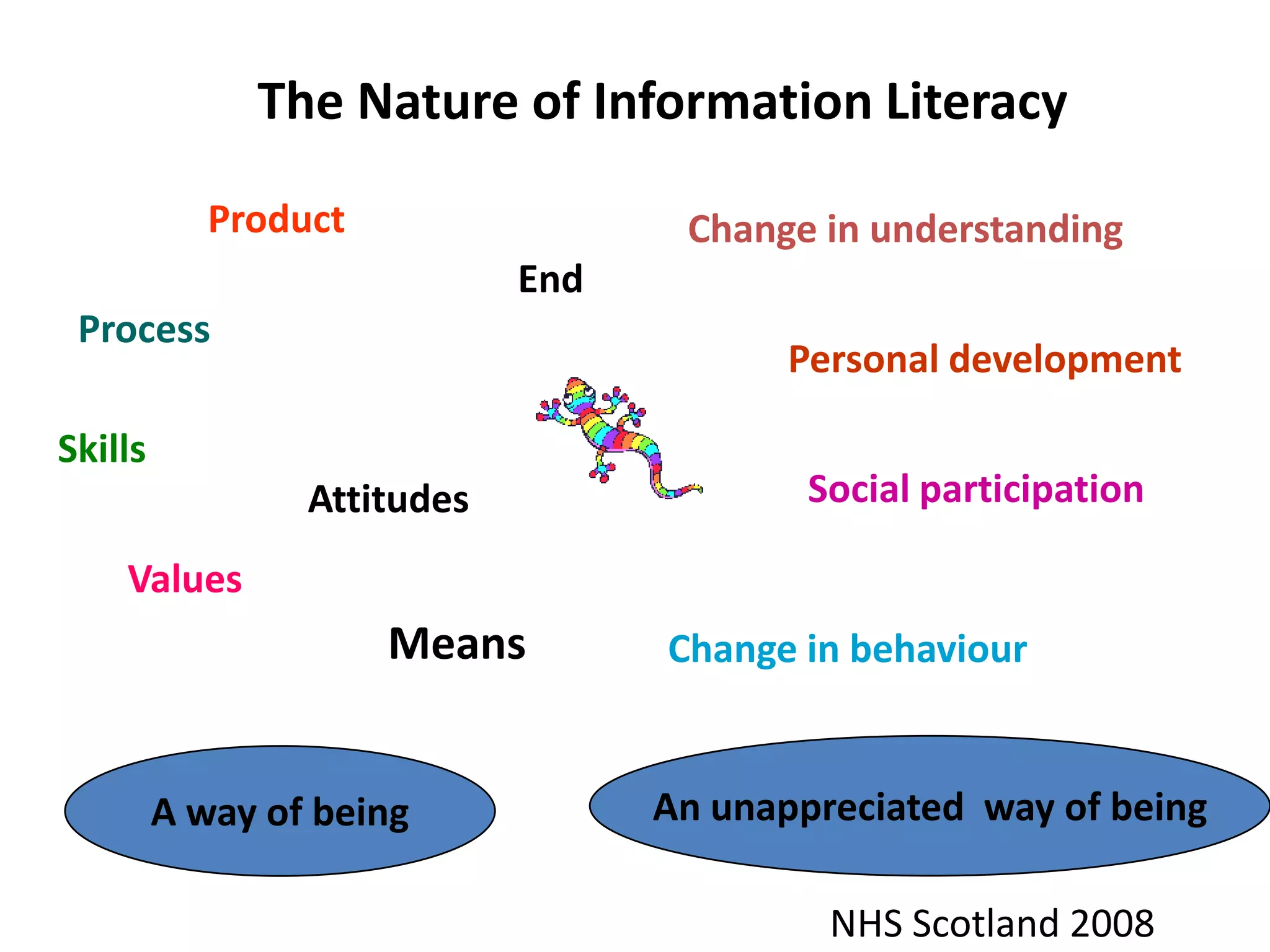
The Nature of Information Literacy

            Product                 Change in understanding
                             End
 Process
                                          Personal development

Skills
                 Attitudes                 Social participation

    Values
                      Means        Change in behaviour


         A way of being            An unappreciated way of being

                                            NHS Scotland 2008
The Scottish Information Literacy
           Project objectives 2004 - 2010
• Develop an information literacy framework, linking primary,
  secondary and tertiary education to lifelong learning including
  workplace and adult literacies agendas
• Advocacy on behalf of information literacy for education and
  the wider community
• Work with information literacy champions both UK and
  worldwide
• Research and promote information literacy in the workplace
• Identify and work with partners, both in education and the
  wider community
• Research the role of information literacy in continuing
  professional development
• Research the health and media literacies agenda
The role of the information literacy
    framework in the workplace and skills
                 development
• Framework skills and competencies (CILIP definition)
   – starting place
   – used as advocacy tool in discussions re skills strategy / skills
     needs
   – link to work related learning
   – needs to be interpreted to meet the needs of different
       • sectors , professions
       • organisations, departments, sections
       • employers, employees, learners
       • environments, resources (in all different formats and
         mediums), experiences
   – recognition of the nature of information literacy
Information literacy
              development and research
• Most work is done in higher education and schools, is linked
  to an assessment culture and is librarian directed
• Much less interest in the workplace and the wider community
• The public state sector is more interested in information than
  the private sector
• Subject/industry sector is a big factor in information usage
• The SME presents particular problems
• Information usage in the workplace is a collaborative and
  frequently unstructured activity and not librarian directed
Information literacy in the workplace
                  research
• Not a heavily studied area – limited literature
• Of particular interest is - Seven faces of information literacy

“Information literacy is experienced as:
     1. using information technology for information awareness and
        communication
     2. finding information from appropriate sources
     3. Executing a process
     4. controlling information
     5. building up a personal knowledge base in a new area of interest
     6. working with knowledge and personal perspectives adopted in such a
        way that novel insights are gained
     7. using information wisely for the benefit of others.”
                                             Bruce, Christine (1999)

    See also work by Bonnie Cheuk and Anne-Marie Lloyd
Information literacy in the workplace
            research (2)
“Organisations need people who can both collect and connect
information literate people operating in a knowledge
management environment.”

“Business leaders who have recognised the value of KM
should not have a difficulty in ‘joining the dots’ with IL
[information literacy]. The demands of the modern
organisation call for a workforce where IL is fostered,
encouraged and recognised. In the age of information
overload, IL skills are as essential as basic literacy and
numeracy”
                                      Abell & Skelton (2005)
Information literacy in the workplace -
              our research

• The role of information literacy in addressing a specific strand
  of lifelong learning: the work agenda (Irving, 2006)

• The role of information literacy in the workplace: an
  exploratory qualitative study (Crawford & Irving, 2007)

• Founded on a review of the pedagogic literature of learning in
  the workplace (Eraut, Felstead, Lave and Wenger)
   – Theorists agree that learning in the workplace is a form of
     social interaction
   – Split as to whether learning in the workplace is exclusively
     situated there or not.
The role of information literacy in addressing a
specific strand of lifelong learning: the work agenda

Small exploratory study based on six interviews - part of
• MSc in Lifelong Learning and Development
• Learning and Teaching Scotland CPD Resource for Teachers
Suggests that:
• the term information literacy is not recognised within the
  workplace
• however the associated skills and competencies are
  recognised by individuals as important in the workplace but …
• generally no formal training on offer at work
• people believe they have these skills but employ coping
  strategies and stick with the resources and skills they know
The role of information literacy in addressing a
specific strand of lifelong learning: the work agenda

also …
• employers implicitly expect people to have these skills and
   competencies particularly for professional roles

• however if employers need education to equip individuals
  with these skills, then information literacy needs to be
  explicitly recognised as a core / key life skills in the learning
  and teaching that takes place in school then further
  developed from there onward into further and higher
  education and in the workplace

• suggests that a person’s profession plays a key role of their
  view of and relationship with information and subsequently
  the level of information literacy skills and competencies
  required.
The role of information literacy in the
 workplace: an exploratory qualitative study

• Based on 20 interviews with employees mainly in the public
  sector in central Scotland

• Interviews arranged with the help of Project partners and
  contacts in Adult Literacies, Tribunals Service, Scottish
  Government Library Services and health libraries

• Lack of private sector contacts

• Funded by the British Academy
Scottish Government
                 Some findings …
• Relatively introverted information environment – ‘knowing
  the system’

• Need to bear in mind the views of ministers

• Existing policy is often used as a starting point in information
  searching

• People are the principal source of information

• IL process implicitly understood whether evaluating people or
  conventional sources
Scottish Government
             Some more findings …

• ERDM, the Intranet, the Scottish Government website, online
  newsletters, press cuttings and Google

• Advanced Internet searching techniques generally not
  understood

• Link between level of work, qualifications, and membership of
  professional bodies and levels of information searching

• Interviews with staff prepared to step outside the
  conventional information culture most noteworthy
Conclusions (1)
• The traditional ‘library’ view of information as deriving from
  electronic and printed sources only is invalid in the workplace
  - must include people as sources of information

• It is essential to recognize the key role of human relationships
  in the development of information literacy in the workplace

• The public enterprise with its emphasis on skills and
  qualifications is a fertile area for further investigation and
  developmental work

• Adult Literacies training is a powerful driver to encourage
  workplace information literacy

• Advanced Internet training extends employees’ information
  horizons
Conclusions (2)
• A skill and qualifications based agenda is an important pre-
  condition
• Information literacy training programmes must be highly
  focused on the target audience
• All organizations have information policies but may be
  unaware of the fact
• An understanding of what constitutes information literacy is
  widespread in the workplace but is often implicit rather than
  explicit and is based on qualifications, experience, and
  networking activities
• Organizations which access a wide range of information, of
  high quality, including sources outwith their organization, will
  make the best informed decisions
What we have found
• Different groups of people constantly reinterpret IL in the light of
  their own qualifications, training, experience and needs.

• Information Literacy is a key career choice, progression, CPD,
  employability and workplace skill.

• IL is still not recognised in government policy skills documents
  produced since 2005. It is rolled up with IT although digital
  literacy appearing however there have been some progress ….

• Scottish Government website – Education and Training
  (Information Literacies) www.scotland.gov.uk/Topics/Education/skills-
   strategy/progress/sg/supportingindividuals/InformationLiteracies/Q/forceup
   date/on
Progress / recognition for information literacy

• Scottish Government Library Services took on board the research findings –
  identified improvements to staff training, services and resources to help
  improve the information literacy skills of Scottish Government staff.

• Scottish Government Community of Practice for an Information Literate
  Scotland created
   – moving to new home with an updated National Information Literacy
      Framework Scotland ‘Information Skills for a 21st Century Scotland’

• The Curriculum for Excellence Literacy Experiences and Outcomes recognises
  information skills and competencies specifically:
   – finding and using information
   – understanding, analysing and evaluation
   – organising and using information
   www.ltscotland.org.uk/Images/literacy_experiences_outcomes_tcm4-
      539998.pdf
   and its relationship to lifelong learning and the workplace.
Questions?         Contact details


                    John Crawford
                polbae2003@yahoo.co.uk


                    Christine Irving
             Christine.irving8@googlemail.com

Improving information skills in the workplace: an overview of research findings

  • 1.
    Improving information skillsin the workplace: an overview of research findings Dr John Crawford Christine Irving Scottish Government, Victoria Quay Knowledge Event - CRAIK Tues 15th November 2011
  • 2.
    Skills utilisation ? •'Skills utilisation is about ensuring the most effective application of skills in the workplace to maximise performance through the interplay of a number of key agents (e.g. employers, employees, learning providers and the state) and the use of a range of HR, management and working practices. Effective skills utilisation seeks to match the use of skills to business demands/needs.' (p.2) Skills utilisation literature review, a report by CFE for the Education Analytical Services, Lifelong Learning Research, Scottish Government (Executive summary and full text ww.scotland.gov.uk/Publications/2008/12/15114643/0)
  • 3.
    Information Skills Defined asskills to help you: • search, find, evaluate and present information but to address: • information overload • the needs of the information society for competent information consumers • requirements of the knowledge economy for a responsive workforce (Andretta, 2005) • the term information literacy evolved from information skills.
  • 4.
    Information Literacy definitions "Informationliteracy is knowing when and why you need information, where to find it, and how to evaluate, use and communicate it in an ethical manner." CILIP (2004) www.cilip.org.uk/get-involved/advocacy/information-literacy/pages/default.aspx “Information Literacy was defined as the ability to identify, locate, evaluate, organize and effectively create, use and communicate information to address an issue or problem.” Prague Declaration
  • 5.
    Information Literacy Skills(CILIP definition) • This definition implies several skills. We believe that the skills (or competencies) that are required to be information literate require an understanding of: • A need for information • The resources available • How to find information • The need to evaluate results • How to work with or exploit results • Ethics and responsibility of use • How to communicate or share your findings • How to manage your findings
  • 6.
    The Nature ofInformation Literacy Product Change in understanding End Process Personal development Skills Attitudes Social participation Values Means Change in behaviour A way of being An unappreciated way of being NHS Scotland 2008
  • 7.
    The Scottish InformationLiteracy Project objectives 2004 - 2010 • Develop an information literacy framework, linking primary, secondary and tertiary education to lifelong learning including workplace and adult literacies agendas • Advocacy on behalf of information literacy for education and the wider community • Work with information literacy champions both UK and worldwide • Research and promote information literacy in the workplace • Identify and work with partners, both in education and the wider community • Research the role of information literacy in continuing professional development • Research the health and media literacies agenda
  • 8.
    The role ofthe information literacy framework in the workplace and skills development • Framework skills and competencies (CILIP definition) – starting place – used as advocacy tool in discussions re skills strategy / skills needs – link to work related learning – needs to be interpreted to meet the needs of different • sectors , professions • organisations, departments, sections • employers, employees, learners • environments, resources (in all different formats and mediums), experiences – recognition of the nature of information literacy
  • 9.
    Information literacy development and research • Most work is done in higher education and schools, is linked to an assessment culture and is librarian directed • Much less interest in the workplace and the wider community • The public state sector is more interested in information than the private sector • Subject/industry sector is a big factor in information usage • The SME presents particular problems • Information usage in the workplace is a collaborative and frequently unstructured activity and not librarian directed
  • 10.
    Information literacy inthe workplace research • Not a heavily studied area – limited literature • Of particular interest is - Seven faces of information literacy “Information literacy is experienced as: 1. using information technology for information awareness and communication 2. finding information from appropriate sources 3. Executing a process 4. controlling information 5. building up a personal knowledge base in a new area of interest 6. working with knowledge and personal perspectives adopted in such a way that novel insights are gained 7. using information wisely for the benefit of others.” Bruce, Christine (1999) See also work by Bonnie Cheuk and Anne-Marie Lloyd
  • 11.
    Information literacy inthe workplace research (2) “Organisations need people who can both collect and connect information literate people operating in a knowledge management environment.” “Business leaders who have recognised the value of KM should not have a difficulty in ‘joining the dots’ with IL [information literacy]. The demands of the modern organisation call for a workforce where IL is fostered, encouraged and recognised. In the age of information overload, IL skills are as essential as basic literacy and numeracy” Abell & Skelton (2005)
  • 12.
    Information literacy inthe workplace - our research • The role of information literacy in addressing a specific strand of lifelong learning: the work agenda (Irving, 2006) • The role of information literacy in the workplace: an exploratory qualitative study (Crawford & Irving, 2007) • Founded on a review of the pedagogic literature of learning in the workplace (Eraut, Felstead, Lave and Wenger) – Theorists agree that learning in the workplace is a form of social interaction – Split as to whether learning in the workplace is exclusively situated there or not.
  • 13.
    The role ofinformation literacy in addressing a specific strand of lifelong learning: the work agenda Small exploratory study based on six interviews - part of • MSc in Lifelong Learning and Development • Learning and Teaching Scotland CPD Resource for Teachers Suggests that: • the term information literacy is not recognised within the workplace • however the associated skills and competencies are recognised by individuals as important in the workplace but … • generally no formal training on offer at work • people believe they have these skills but employ coping strategies and stick with the resources and skills they know
  • 14.
    The role ofinformation literacy in addressing a specific strand of lifelong learning: the work agenda also … • employers implicitly expect people to have these skills and competencies particularly for professional roles • however if employers need education to equip individuals with these skills, then information literacy needs to be explicitly recognised as a core / key life skills in the learning and teaching that takes place in school then further developed from there onward into further and higher education and in the workplace • suggests that a person’s profession plays a key role of their view of and relationship with information and subsequently the level of information literacy skills and competencies required.
  • 15.
    The role ofinformation literacy in the workplace: an exploratory qualitative study • Based on 20 interviews with employees mainly in the public sector in central Scotland • Interviews arranged with the help of Project partners and contacts in Adult Literacies, Tribunals Service, Scottish Government Library Services and health libraries • Lack of private sector contacts • Funded by the British Academy
  • 16.
    Scottish Government Some findings … • Relatively introverted information environment – ‘knowing the system’ • Need to bear in mind the views of ministers • Existing policy is often used as a starting point in information searching • People are the principal source of information • IL process implicitly understood whether evaluating people or conventional sources
  • 17.
    Scottish Government Some more findings … • ERDM, the Intranet, the Scottish Government website, online newsletters, press cuttings and Google • Advanced Internet searching techniques generally not understood • Link between level of work, qualifications, and membership of professional bodies and levels of information searching • Interviews with staff prepared to step outside the conventional information culture most noteworthy
  • 18.
    Conclusions (1) • Thetraditional ‘library’ view of information as deriving from electronic and printed sources only is invalid in the workplace - must include people as sources of information • It is essential to recognize the key role of human relationships in the development of information literacy in the workplace • The public enterprise with its emphasis on skills and qualifications is a fertile area for further investigation and developmental work • Adult Literacies training is a powerful driver to encourage workplace information literacy • Advanced Internet training extends employees’ information horizons
  • 19.
    Conclusions (2) • Askill and qualifications based agenda is an important pre- condition • Information literacy training programmes must be highly focused on the target audience • All organizations have information policies but may be unaware of the fact • An understanding of what constitutes information literacy is widespread in the workplace but is often implicit rather than explicit and is based on qualifications, experience, and networking activities • Organizations which access a wide range of information, of high quality, including sources outwith their organization, will make the best informed decisions
  • 20.
    What we havefound • Different groups of people constantly reinterpret IL in the light of their own qualifications, training, experience and needs. • Information Literacy is a key career choice, progression, CPD, employability and workplace skill. • IL is still not recognised in government policy skills documents produced since 2005. It is rolled up with IT although digital literacy appearing however there have been some progress …. • Scottish Government website – Education and Training (Information Literacies) www.scotland.gov.uk/Topics/Education/skills- strategy/progress/sg/supportingindividuals/InformationLiteracies/Q/forceup date/on
  • 21.
    Progress / recognitionfor information literacy • Scottish Government Library Services took on board the research findings – identified improvements to staff training, services and resources to help improve the information literacy skills of Scottish Government staff. • Scottish Government Community of Practice for an Information Literate Scotland created – moving to new home with an updated National Information Literacy Framework Scotland ‘Information Skills for a 21st Century Scotland’ • The Curriculum for Excellence Literacy Experiences and Outcomes recognises information skills and competencies specifically: – finding and using information – understanding, analysing and evaluation – organising and using information www.ltscotland.org.uk/Images/literacy_experiences_outcomes_tcm4- 539998.pdf and its relationship to lifelong learning and the workplace.
  • 22.
    Questions? Contact details John Crawford polbae2003@yahoo.co.uk Christine Irving Christine.irving8@googlemail.com