By
Divya Thakur
Mpharmacy
Kaktiya university
INTRODUCTION:-
Para: outside
Enteron: intestine (i.e. beside the intestine)
Definition:-
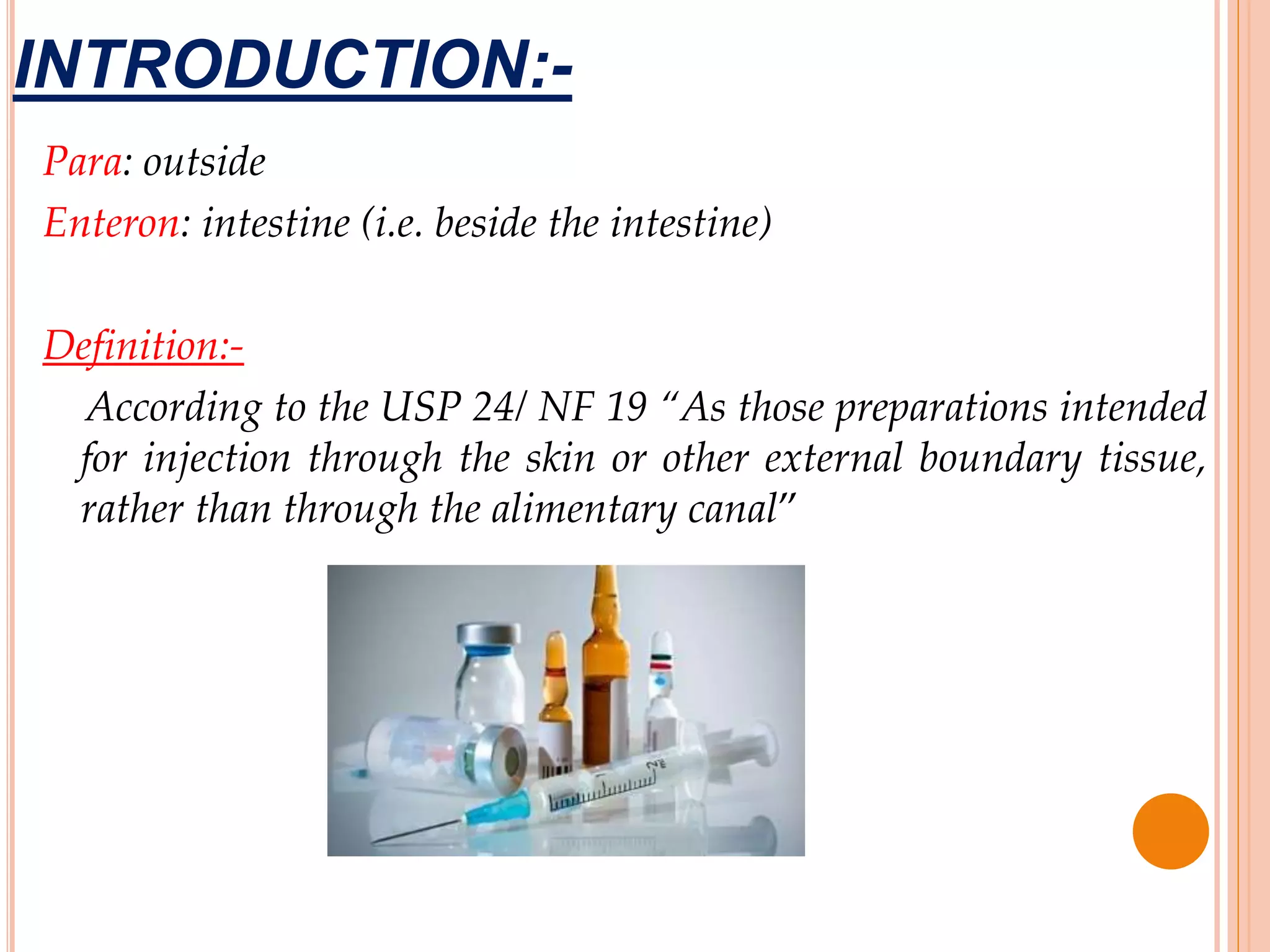
According to the USP 24/ NF 19 “As those preparations intended
for injection through the skin or other external boundary tissue,
rather than through the alimentary canal”
SMALL VOLUME PARENTRALS:-
Defination:-
According to USP “ an injection that is packaged in containers
labelled as containing 100 ml or less
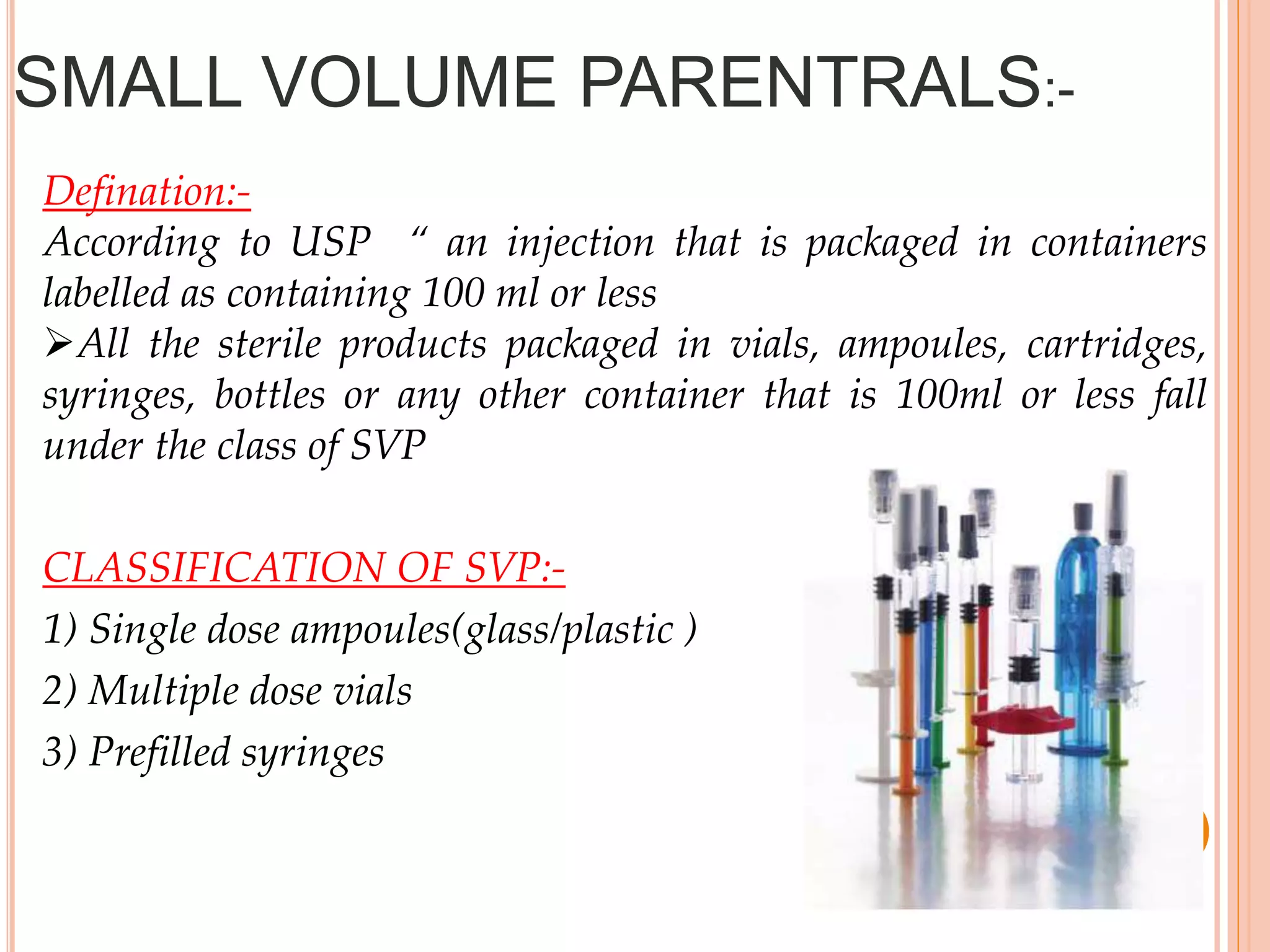
All the sterile products packaged in vials, ampoules, cartridges,
syringes, bottles or any other container that is 100ml or less fall
under the class of SVP
CLASSIFICATION OF SVP:-
1) Single dose ampoules(glass/plastic )
2) Multiple dose vials
3) Prefilled syringes
FORMULATION:-
1)vehicle:-
A)aqueous vehicle
B)water miscible vehicles
C)non aqueous vehicle
A)Aqueous vehicle:-
Types:-
Purified water, WFI,Sterile WFI, BacteriostaticWFI,
Sterile WF irrigation.
Preparation :-
 Distillation
 ion exchange
 reverse osmosis
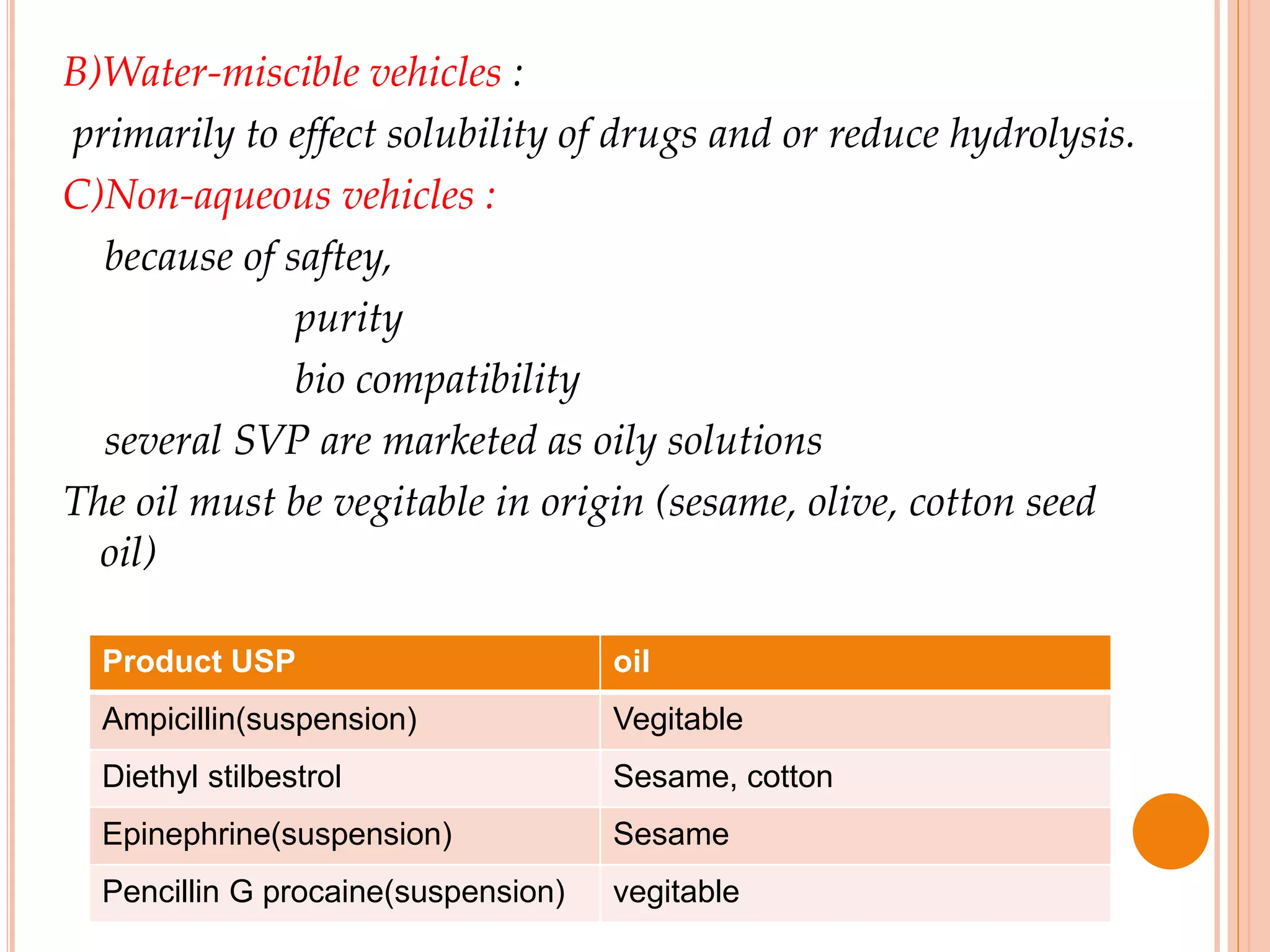
B)Water-miscible vehicles :
primarily to effect solubility of drugs and or reduce hydrolysis.
C)Non-aqueous vehicles :
because of saftey,
purity
bio compatibility
several SVP are marketed as oily solutions
The oil must be vegitable in origin (sesame, olive, cotton seed
oil)
Product USP oil
Ampicillin(suspension) Vegitable
Diethyl stilbestrol Sesame, cotton
Epinephrine(suspension) Sesame
Pencillin G procaine(suspension) vegitable
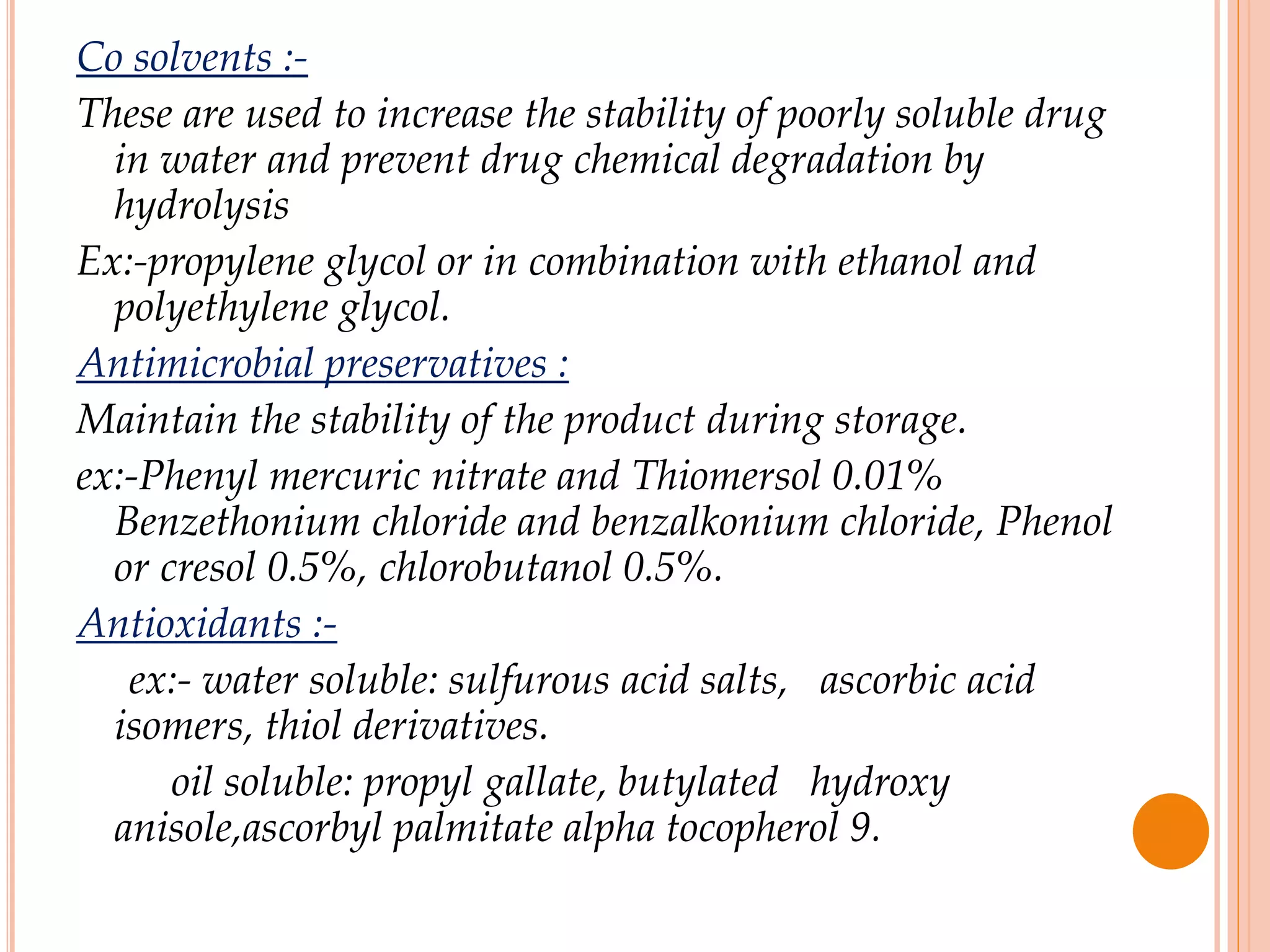
Co solvents :-
These are used to increase the stability of poorly soluble drug
in water and prevent drug chemical degradation by
hydrolysis
Ex:-propylene glycol or in combination with ethanol and
polyethylene glycol.
Antimicrobial preservatives :
Maintain the stability of the product during storage.
ex:-Phenyl mercuric nitrate and Thiomersol 0.01%
Benzethonium chloride and benzalkonium chloride, Phenol
or cresol 0.5%, chlorobutanol 0.5%.
Antioxidants :-
ex:- water soluble: sulfurous acid salts, ascorbic acid
isomers, thiol derivatives.
oil soluble: propyl gallate, butylated hydroxy
anisole,ascorbyl palmitate alpha tocopherol 9.
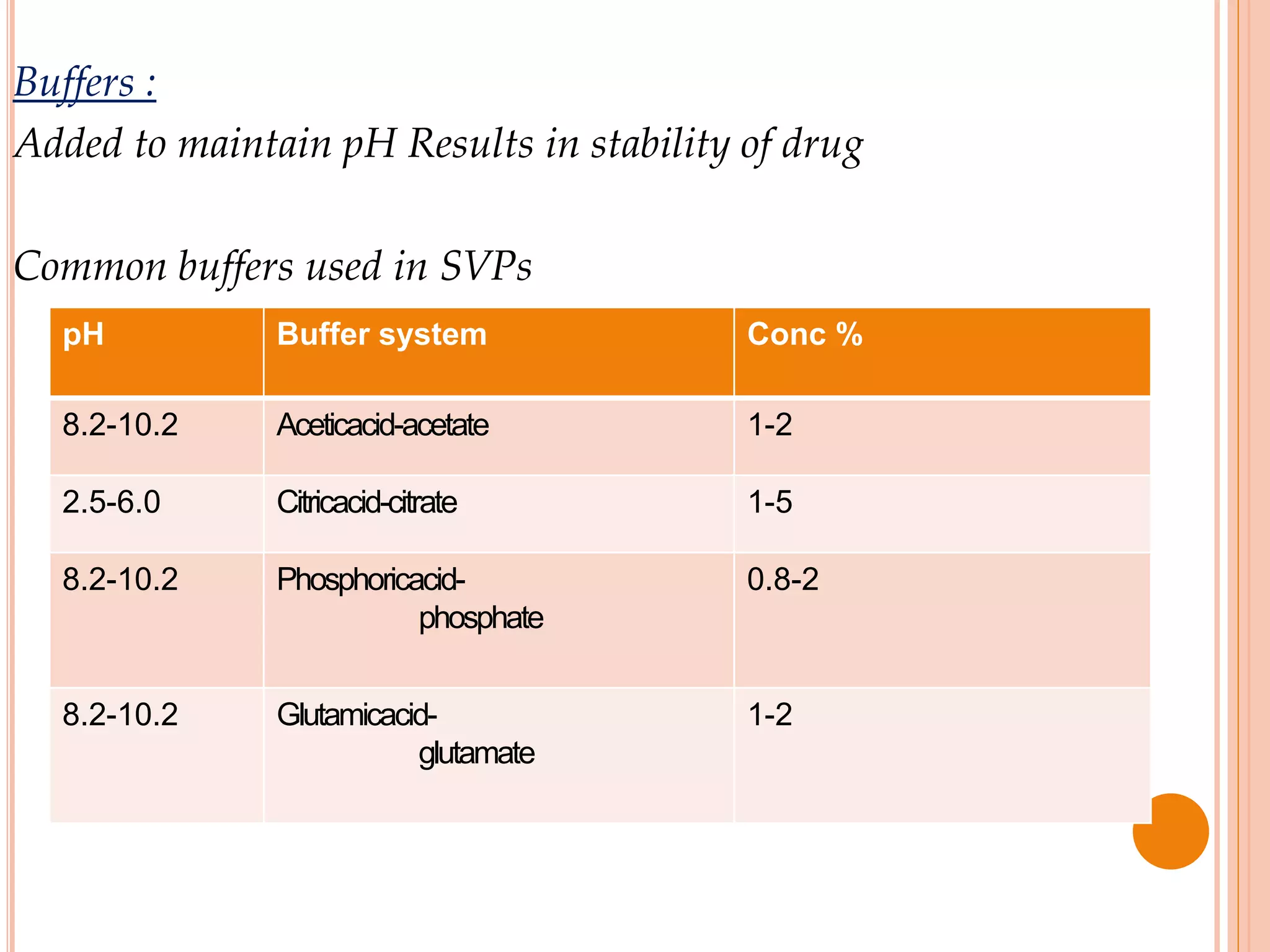
Buffers :
Added to maintain pH Results in stability of drug
Common buffers used in SVPs
pH Buffer system Conc %
8.2-10.2 Aceticacid-acetate 1-2
2.5-6.0 Citricacid-citrate 1-5
8.2-10.2 Phosphoricacid-
phosphate
0.8-2
8.2-10.2 Glutamicacid-
glutamate
1-2
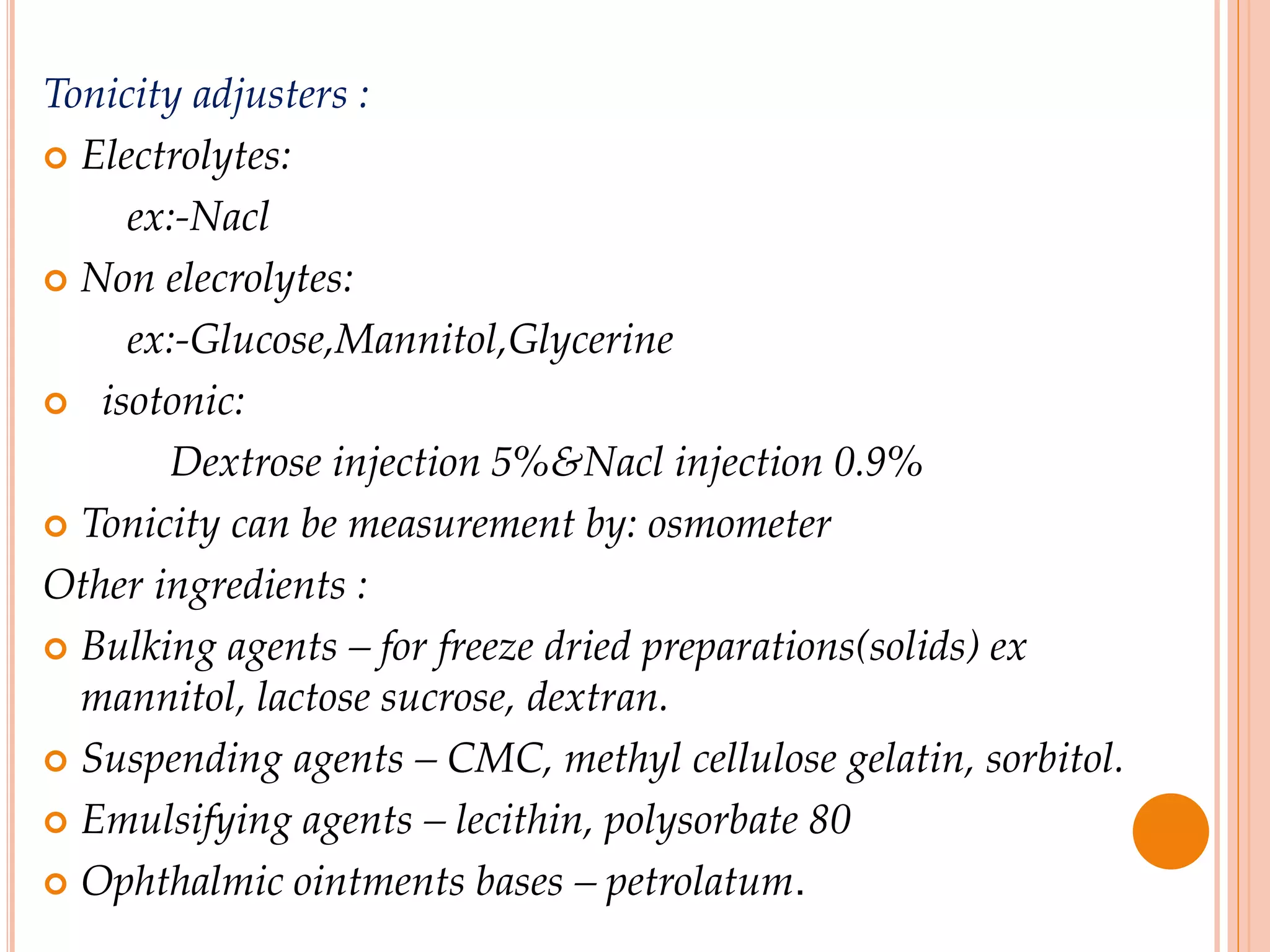
Tonicity adjusters :
 Electrolytes:
ex:-Nacl
 Non elecrolytes:
ex:-Glucose,Mannitol,Glycerine
 isotonic:
Dextrose injection 5%&Nacl injection 0.9%
 Tonicity can be measurement by: osmometer
Other ingredients :
 Bulking agents – for freeze dried preparations(solids) ex
mannitol, lactose sucrose, dextran.
 Suspending agents – CMC, methyl cellulose gelatin, sorbitol.
 Emulsifying agents – lecithin, polysorbate 80
 Ophthalmic ointments bases – petrolatum.
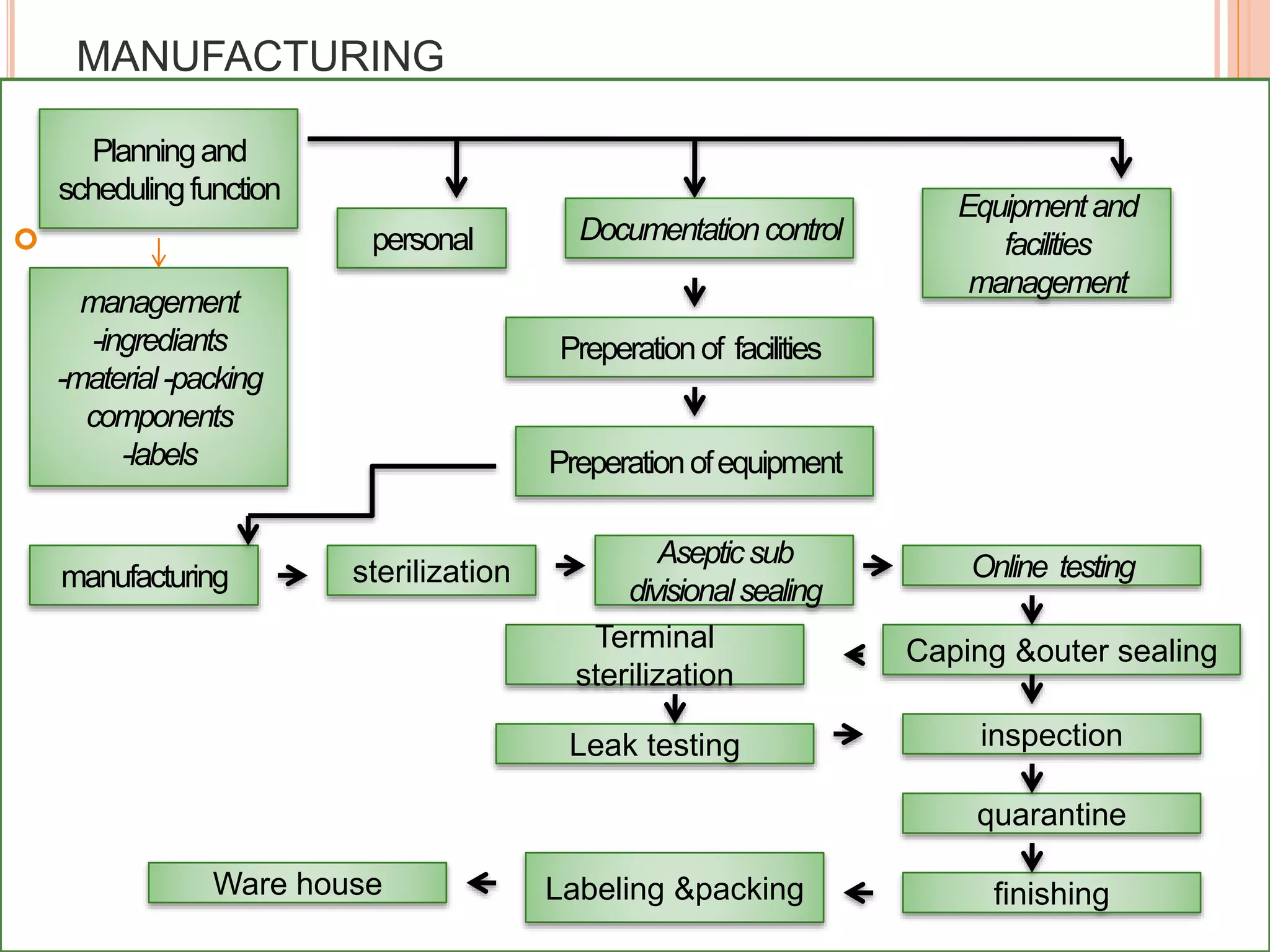
MANUFACTURING

Planningand
schedulingfunction
management
-ingrediants
-material-packing
components
-labels
personal Documentationcontrol
Equipmentand
facilities
management
Preperationof facilities
Preperationofequipment
Online testing
Caping &outer sealing
inspection
quarantine
finishingLabeling &packing
Asepticsub
divisionalsealing
sterilizationmanufacturing
Ware house
Leak testing
Terminal
sterilization
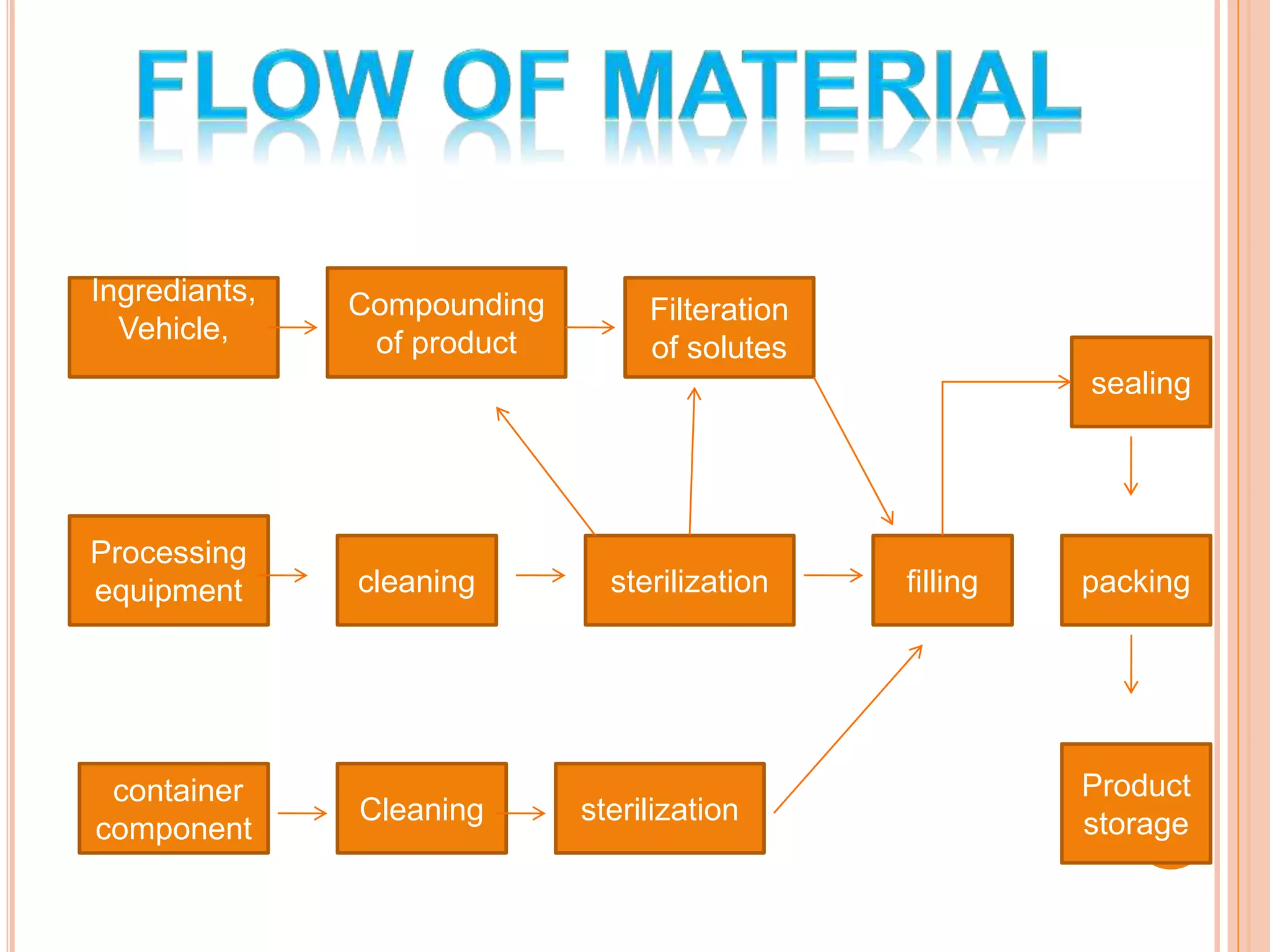
Filteration
of solutes
Compounding
of product
Ingrediants,
Vehicle,
sterilizationcleaning
Processing
equipment
sterilizationCleaning
container
component
filling
sealing
packing
Product
storage
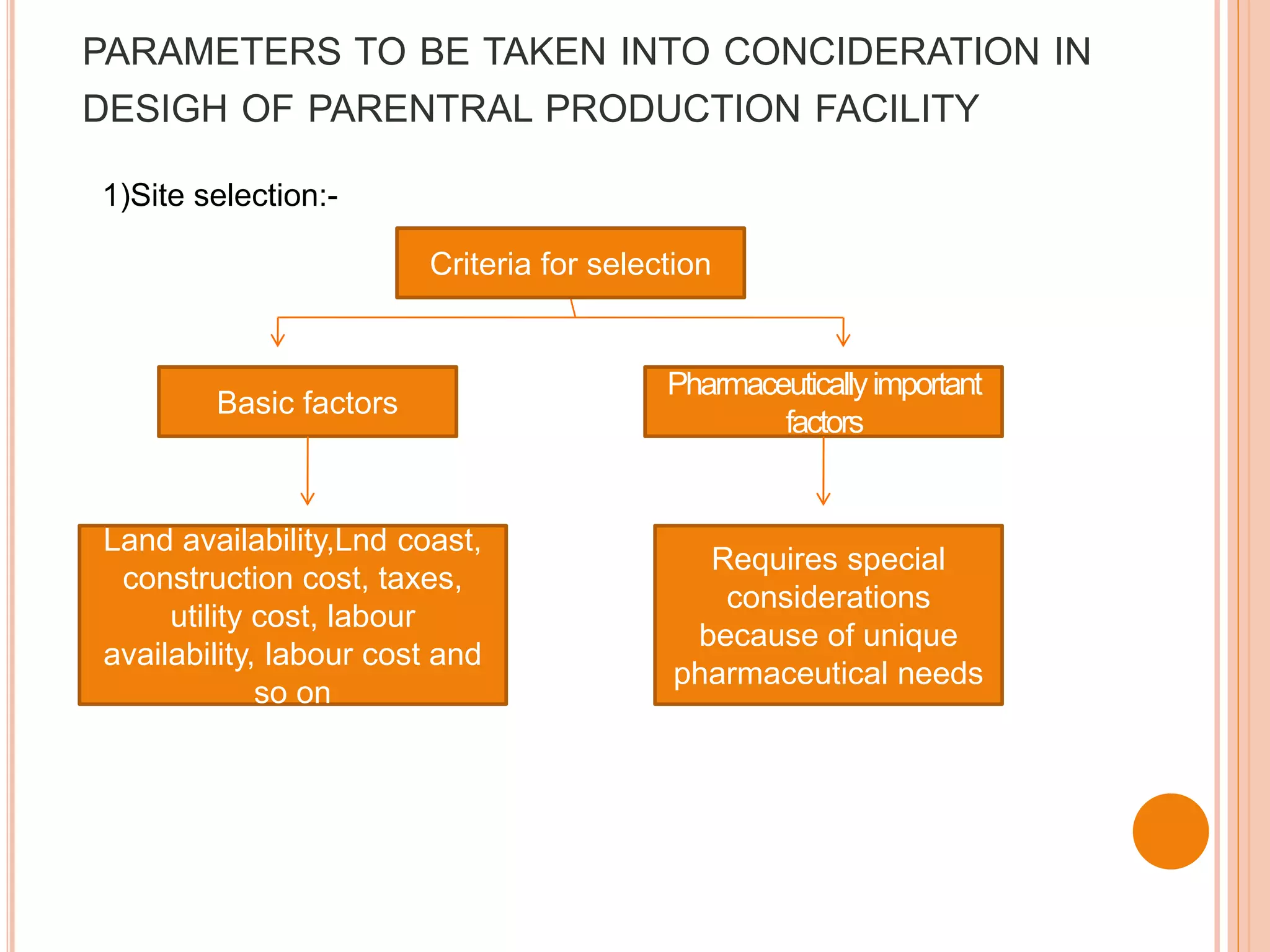
PARAMETERS TO BE TAKEN INTO CONCIDERATION IN
DESIGH OF PARENTRAL PRODUCTION FACILITY
Requires special
considerations
because of unique
pharmaceutical needs
Land availability,Lnd coast,
construction cost, taxes,
utility cost, labour
availability, labour cost and
so on
Pharmaceuticallyimportant
factors
Basic factors
Criteria for selection
1)Site selection:-
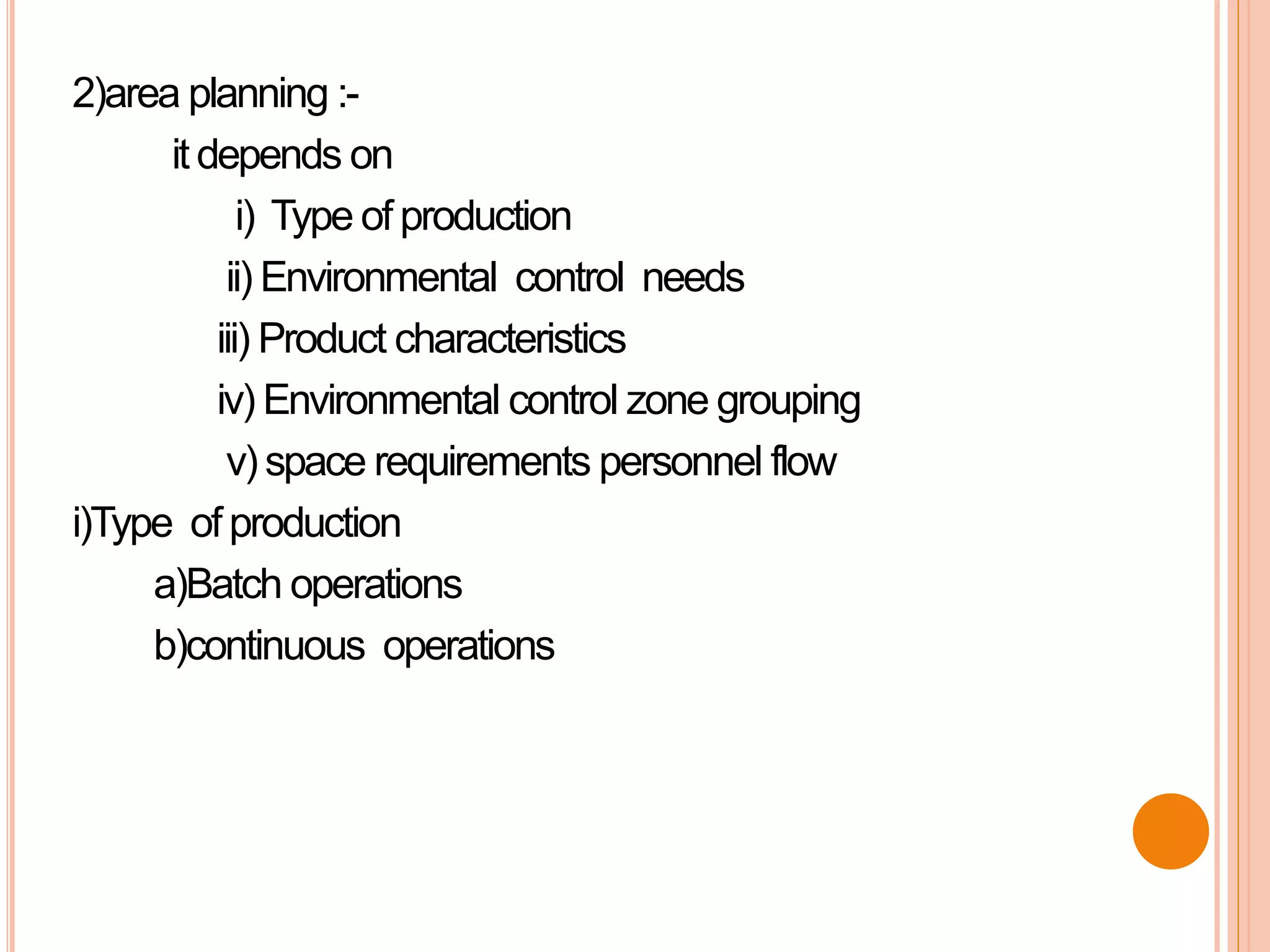
2)area planning :-
it depends on
i) Type of production
ii) Environmental control needs
iii) Product characteristics
iv) Environmental control zone grouping
v) space requirements personnel flow
i)Type of production
a)Batch operations
b)continuous operations
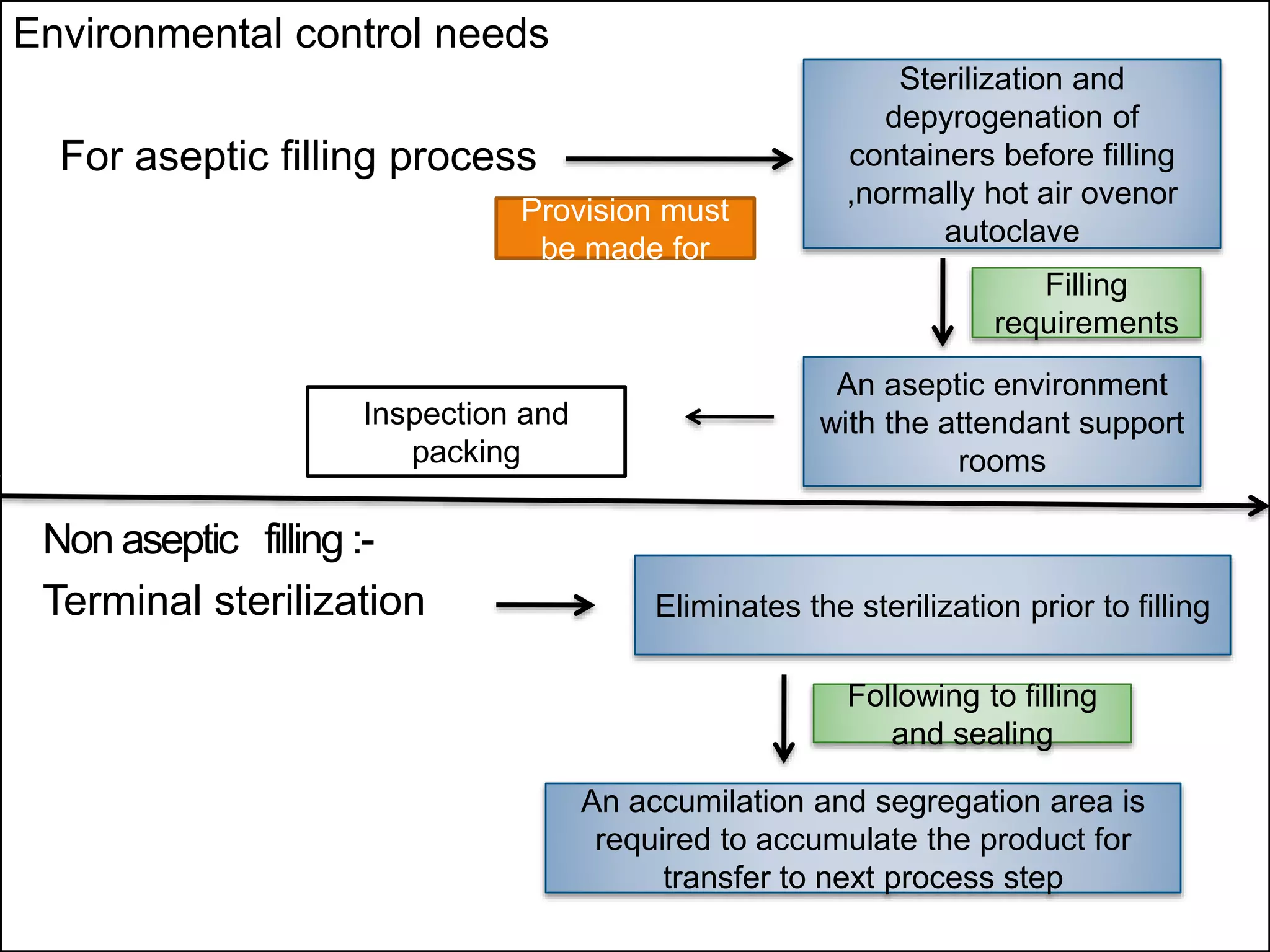
Environmental control needs
For aseptic filling process
Sterilization and
depyrogenation of
containers before filling
,normally hot air ovenor
autoclave
An aseptic environment
with the attendant support
rooms
Inspection and
packing
Filling
requirements
Provision must
be made for
Non aseptic filling :-
Terminal sterilization Eliminates the sterilization prior to filling
An accumilation and segregation area is
required to accumulate the product for
transfer to next process step
Following to filling
and sealing
Product characteristics:-
a)liquids:- easiest product to handle
b)emulsions:-ease transfer problems
c)Suspensions:- require maintaining a homogeneous mixture
Environmental control zone grouping:-
Zones as per cGMP
Zone 7:-filling line
Zone 6:-filling area
Zone 5:-weighing mixing
&transfer area
Zone 4:-clean area
Zone 3:-general production
Zone 2:-ware house
Zone 1:- exterior
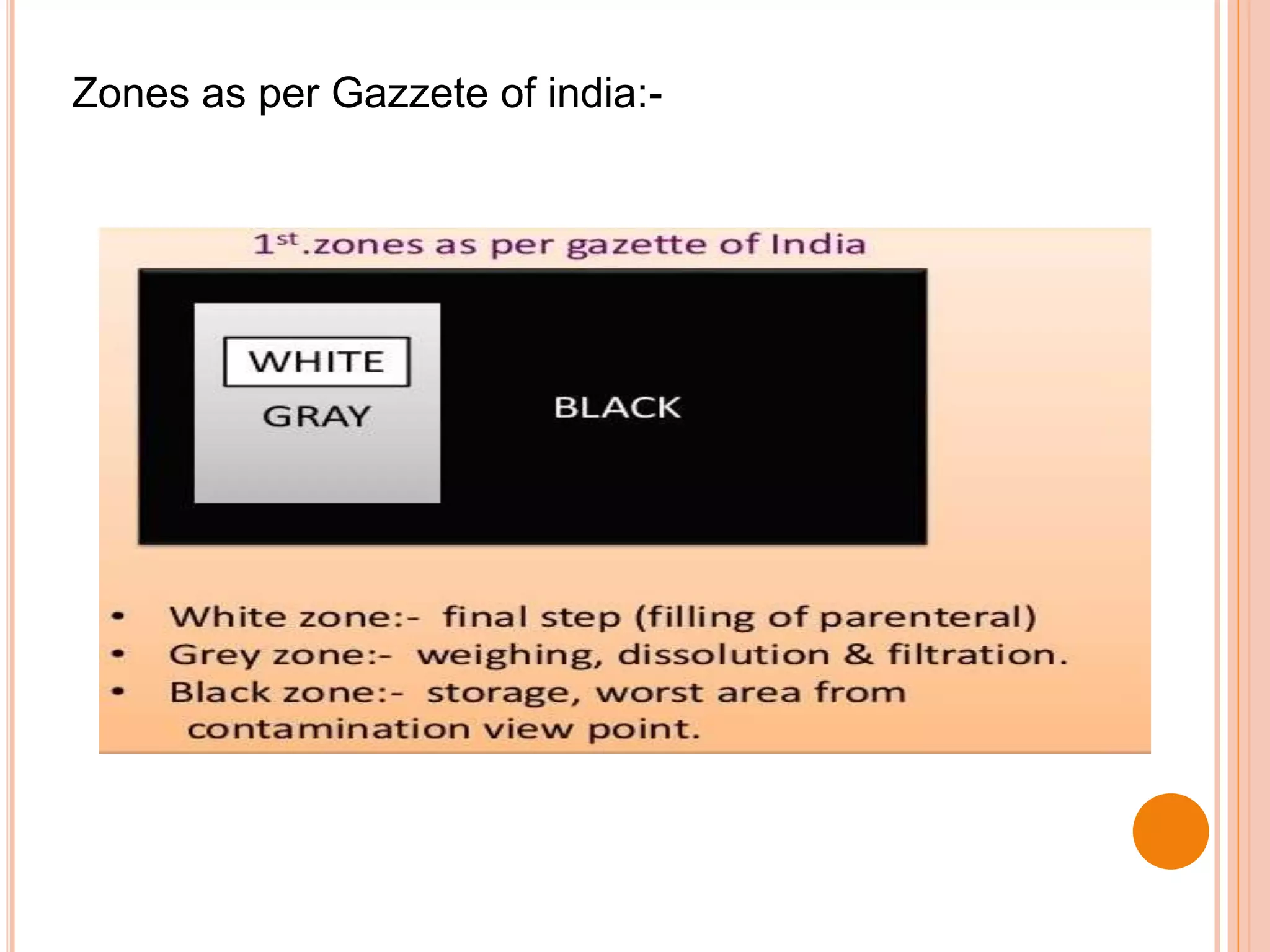
Zones as per Gazzete of india:-
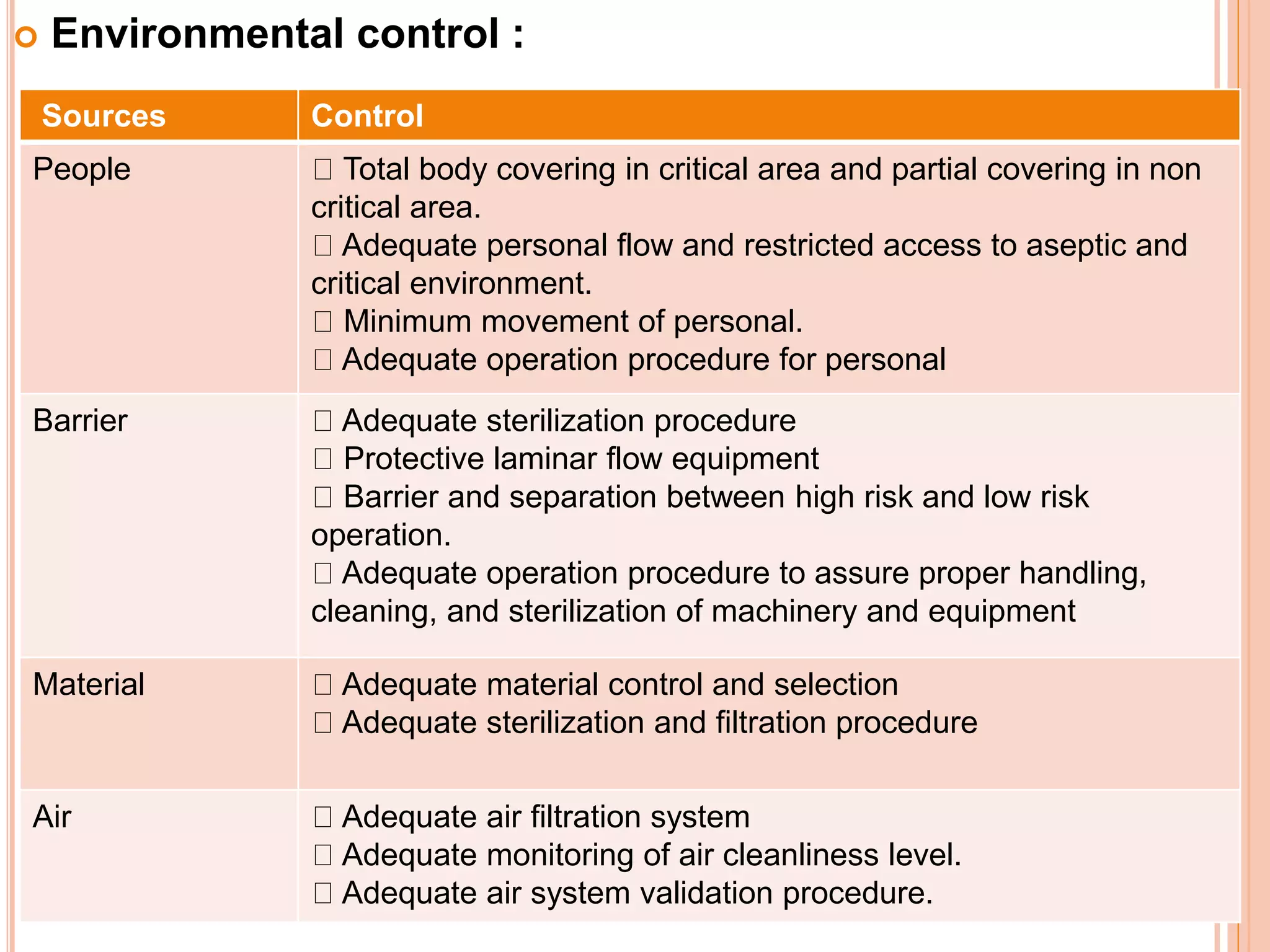
 Environmental control :
Sources Control
People Total body covering in critical area and partial covering in non
critical area.
Adequate personal flow and restricted access to aseptic and
critical environment.
Minimum movement of personal.
Adequate operation procedure for personal
Barrier Adequate sterilization procedure
Protective laminar flow equipment
Barrier and separation between high risk and low risk
operation.
Adequate operation procedure to assure proper handling,
cleaning, and sterilization of machinery and equipment
Material Adequate material control and selection
Adequate sterilization and filtration procedure
Air Adequate air filtration system
Adequate monitoring of air cleanliness level.
Adequate air system validation procedure.
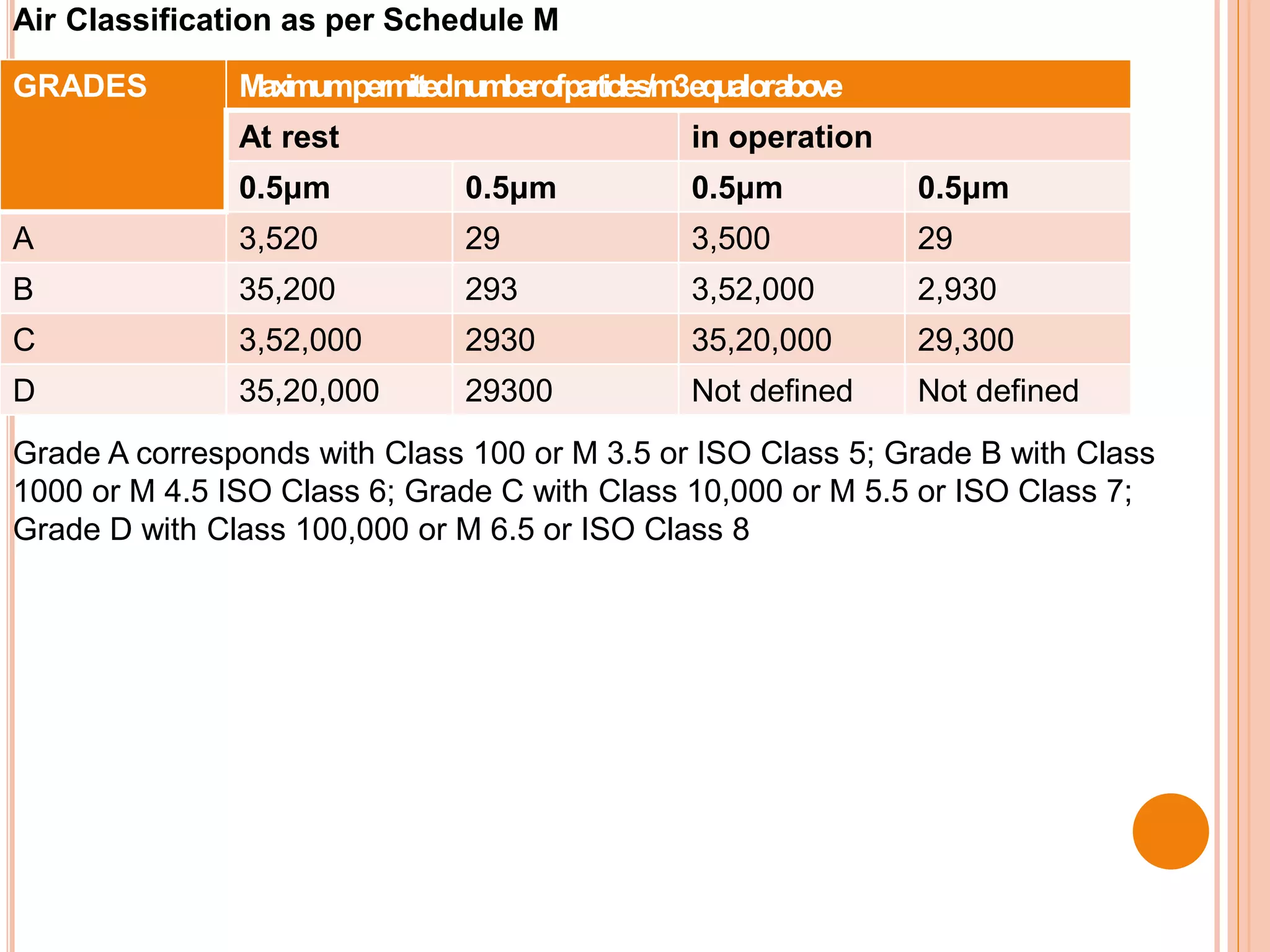
GRADES Maximumpermittednumberofparticles/m3equalorabove
At rest in operation
0.5μm 0.5μm 0.5μm 0.5μm
A 3,520 29 3,500 29
B 35,200 293 3,52,000 2,930
C 3,52,000 2930 35,20,000 29,300
D 35,20,000 29300 Not defined Not defined
Air Classification as per Schedule M
Grade A corresponds with Class 100 or M 3.5 or ISO Class 5; Grade B with Class
1000 or M 4.5 ISO Class 6; Grade C with Class 10,000 or M 5.5 or ISO Class 7;
Grade D with Class 100,000 or M 6.5 or ISO Class 8
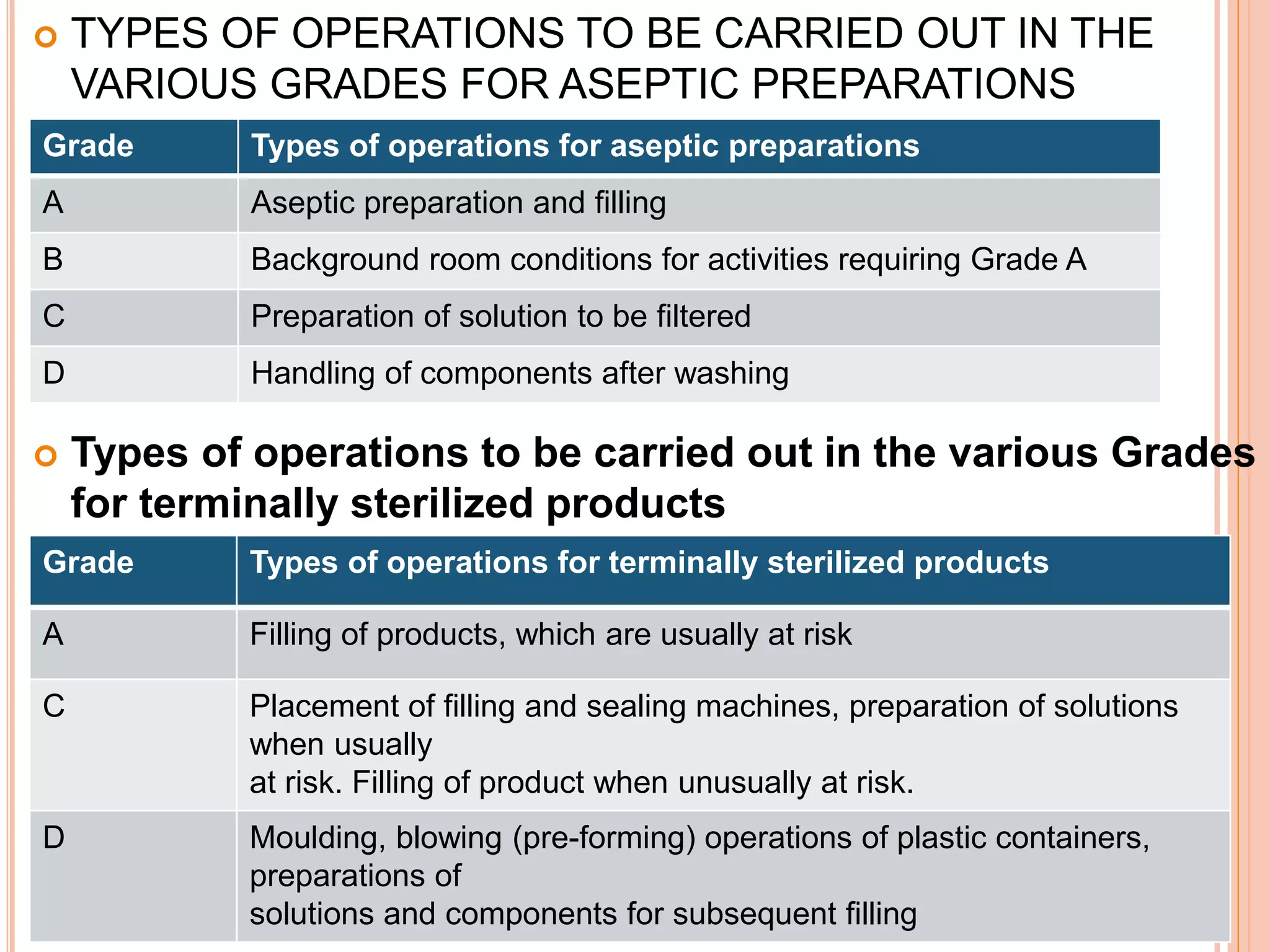
 TYPES OF OPERATIONS TO BE CARRIED OUT IN THE
VARIOUS GRADES FOR ASEPTIC PREPARATIONS
 Types of operations to be carried out in the various Grades
for terminally sterilized products
Grade Types of operations for aseptic preparations
A Aseptic preparation and filling
B Background room conditions for activities requiring Grade A
C Preparation of solution to be filtered
D Handling of components after washing
Grade Types of operations for terminally sterilized products
A Filling of products, which are usually at risk
C Placement of filling and sealing machines, preparation of solutions
when usually
at risk. Filling of product when unusually at risk.
D Moulding, blowing (pre-forming) operations of plastic containers,
preparations of
solutions and components for subsequent filling
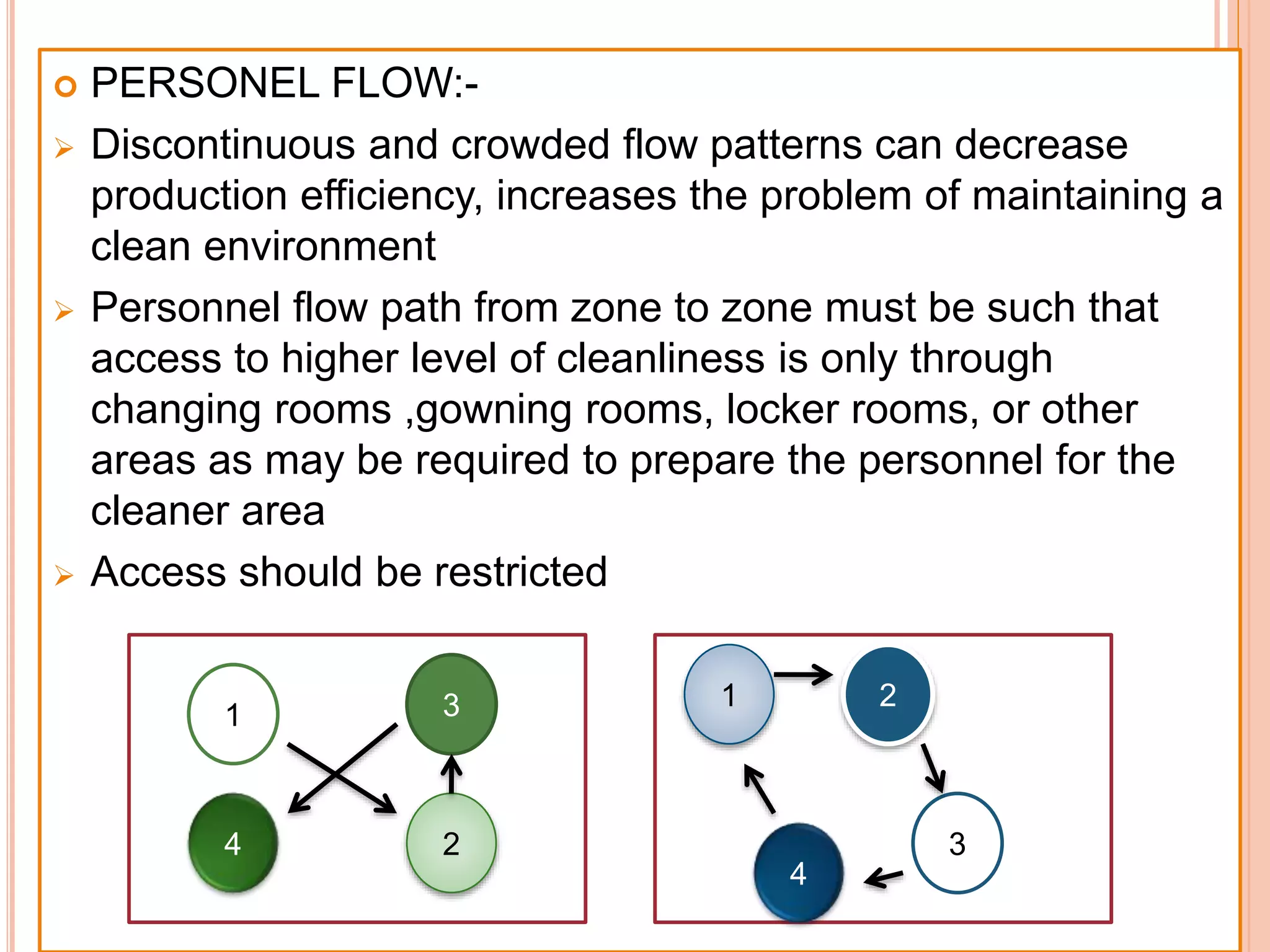
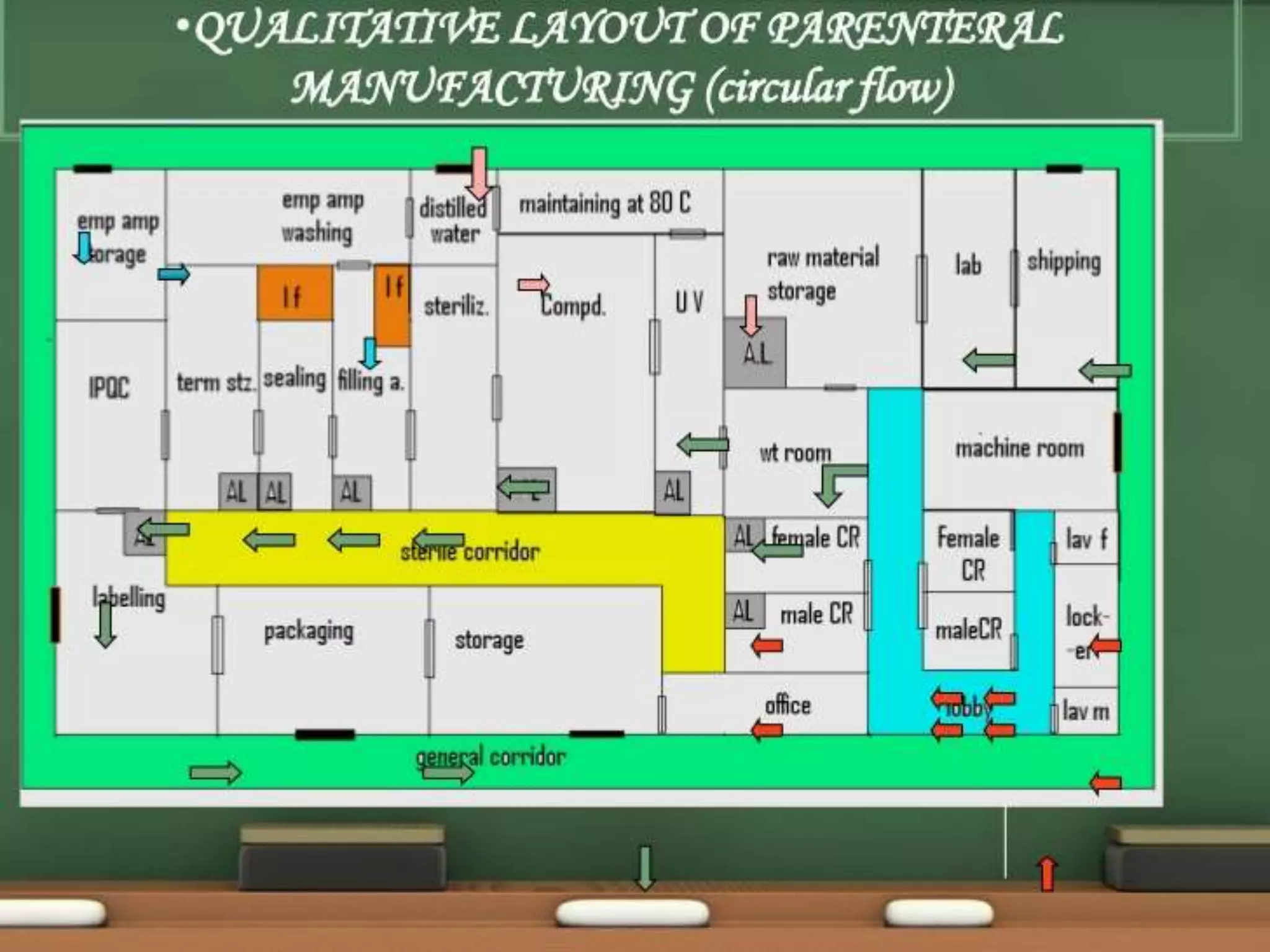
 PERSONEL FLOW:-
 Discontinuous and crowded flow patterns can decrease
production efficiency, increases the problem of maintaining a
clean environment
 Personnel flow path from zone to zone must be such that
access to higher level of cleanliness is only through
changing rooms ,gowning rooms, locker rooms, or other
areas as may be required to prepare the personnel for the
cleaner area
 Access should be restricted
1
2
4
3
213
4
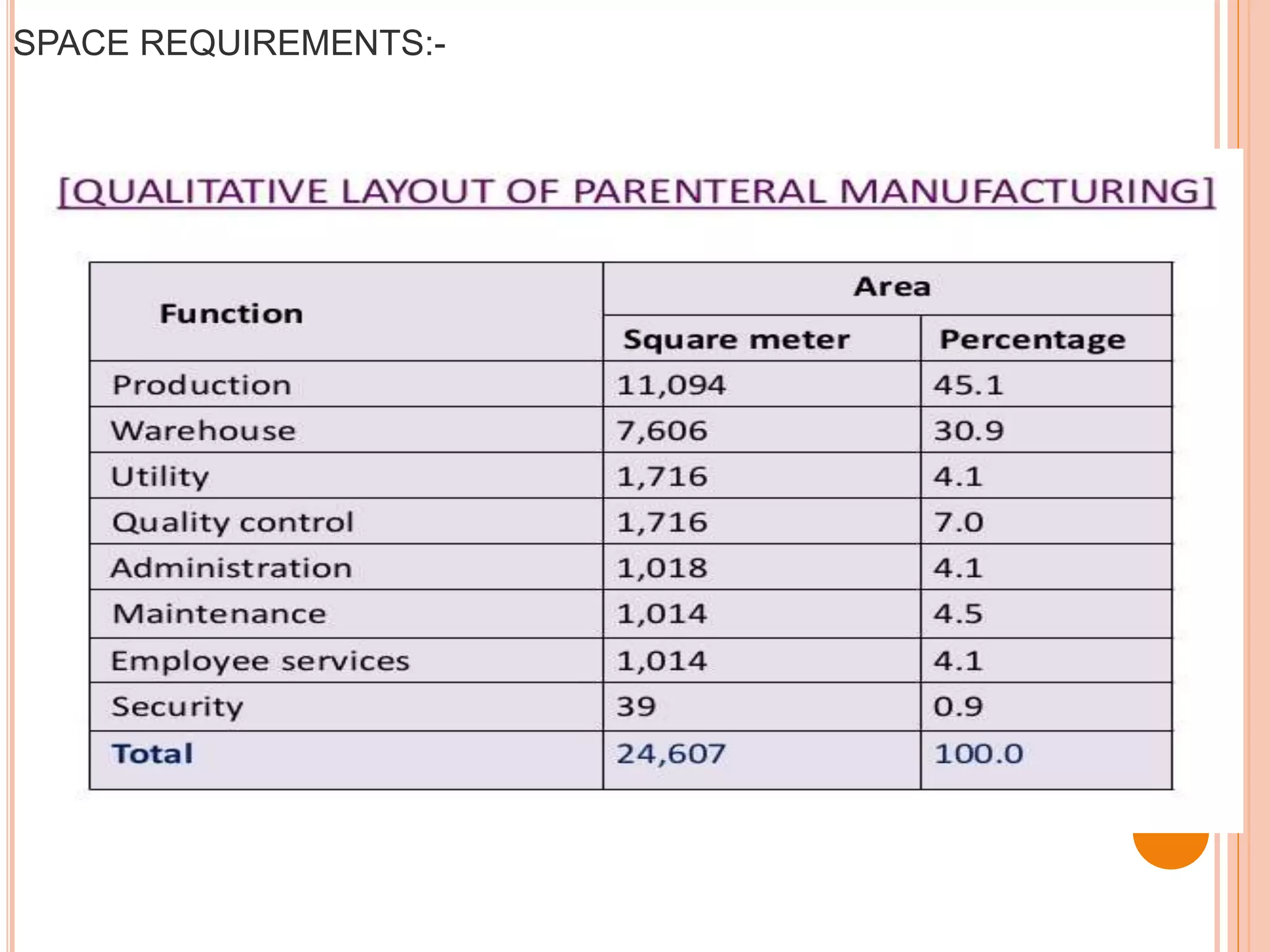
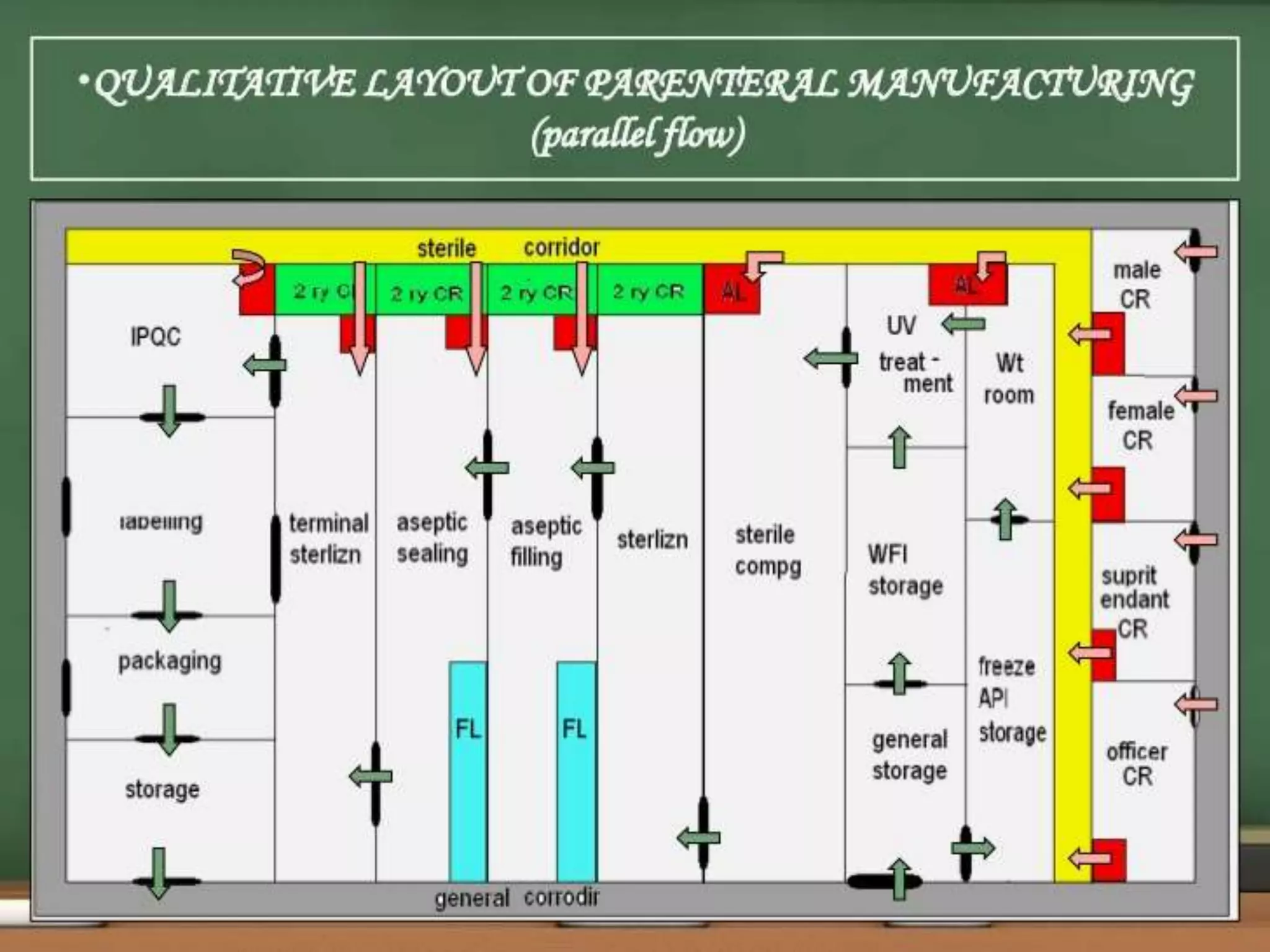
SPACE REQUIREMENTS:-
EQUIMENTS EMPLOYED:-
a) Manufacturing area: -
 1. Storage equipment for ampoules, vials bottles and closures.
 2. Washing and drying equipment.
 3. Dust proof storage cabinet
 4. Water still.
 5. Mixing and preparation tanks or other containers.
 6. Mixing equipment where necessary.
 7. Filtering equipment.
 8. Hot air sterilizer.
b) Aseptic filling and sealing rooms -
 9. Benches for filling and sealing.
 10. Bacteriological filters.
 11. Filling and sealing unit under laminar flow work station.
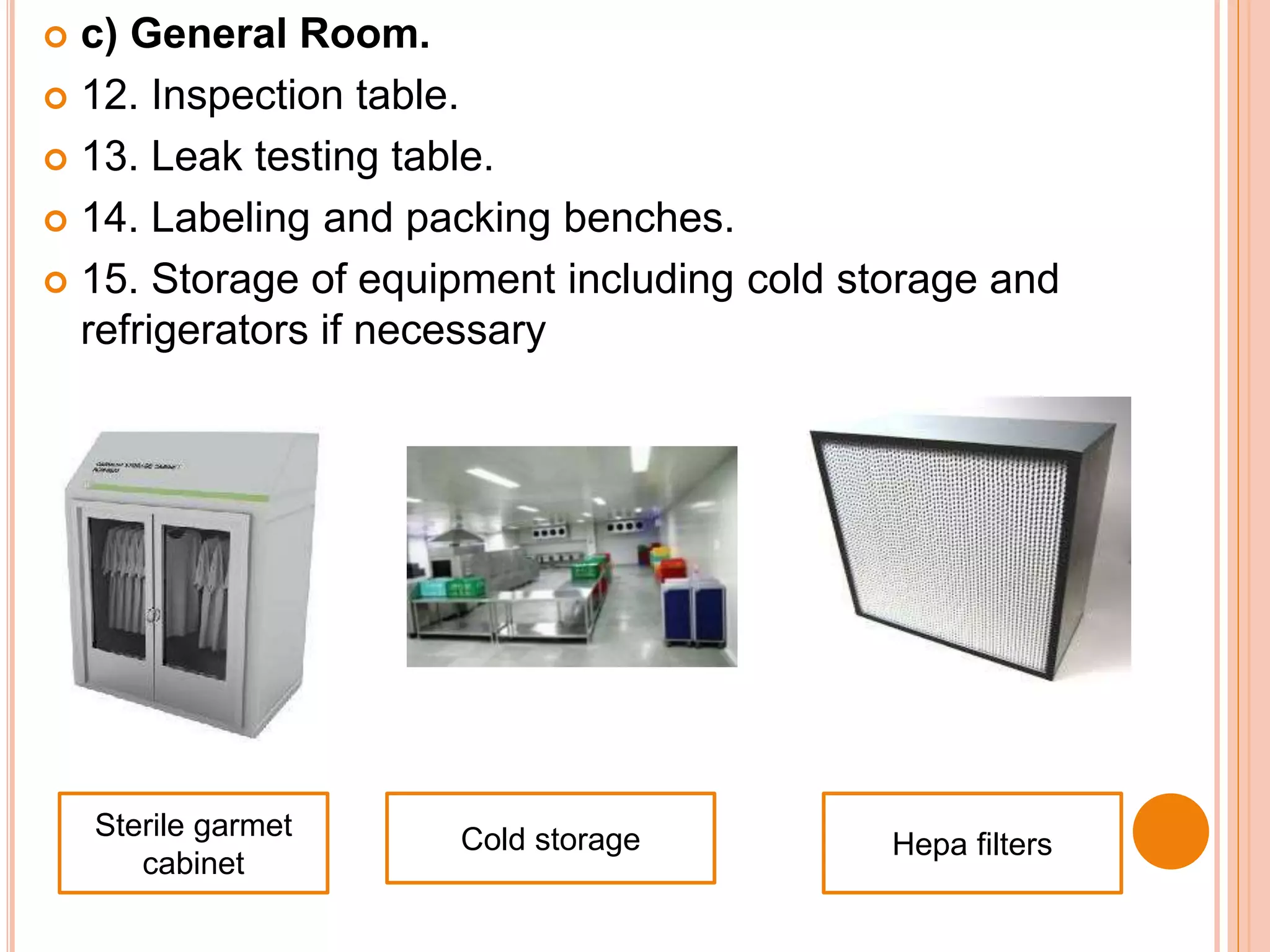
 c) General Room.
 12. Inspection table.
 13. Leak testing table.
 14. Labeling and packing benches.
 15. Storage of equipment including cold storage and
refrigerators if necessary
Sterile garmet
cabinet
Cold storage Hepa filters
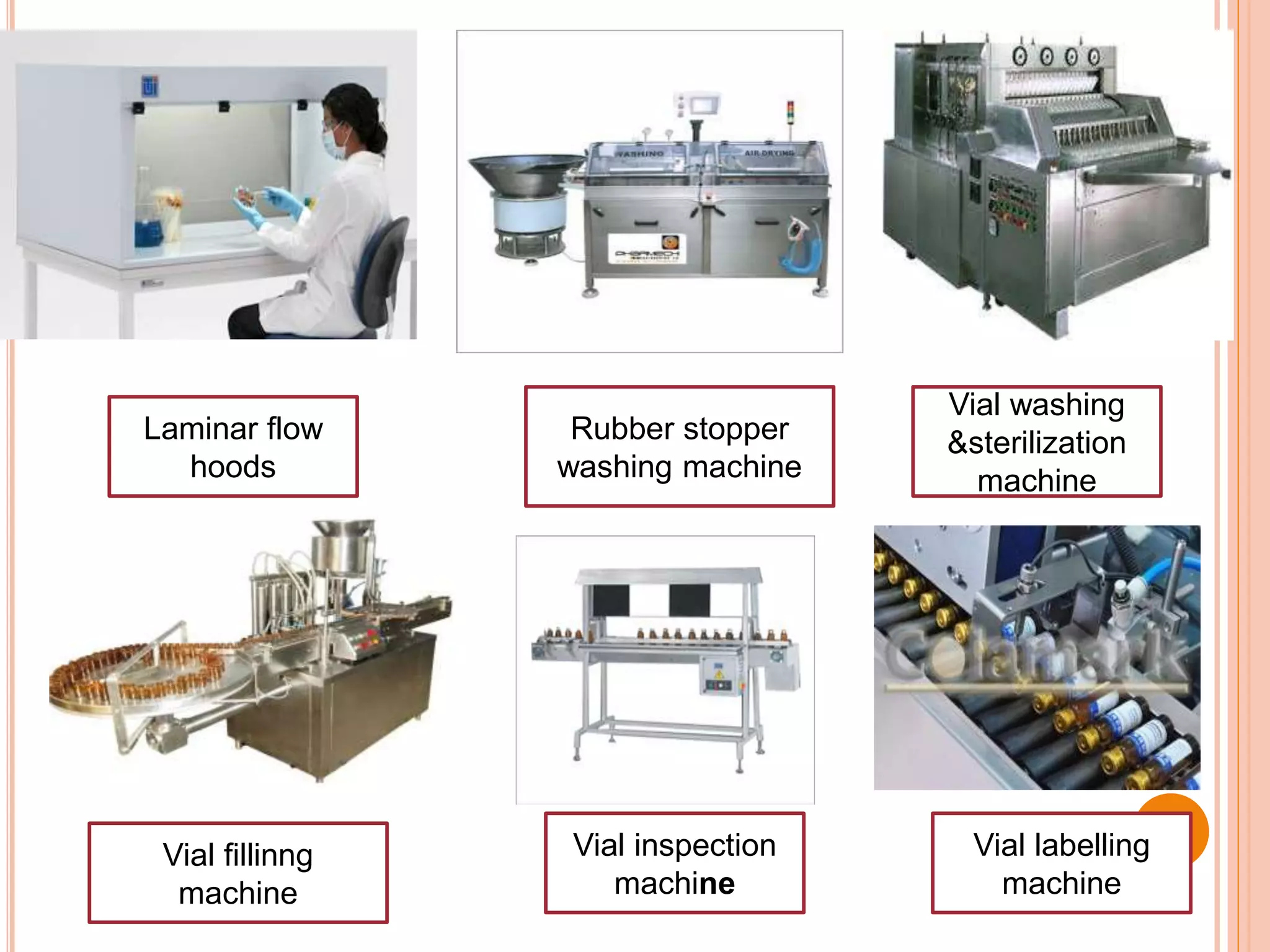
Laminar flow
hoods
Vial labelling
machine
Vial inspection
machine
Vial fillinng
machine
Rubber stopper
washing machine
Vial washing
&sterilization
machine
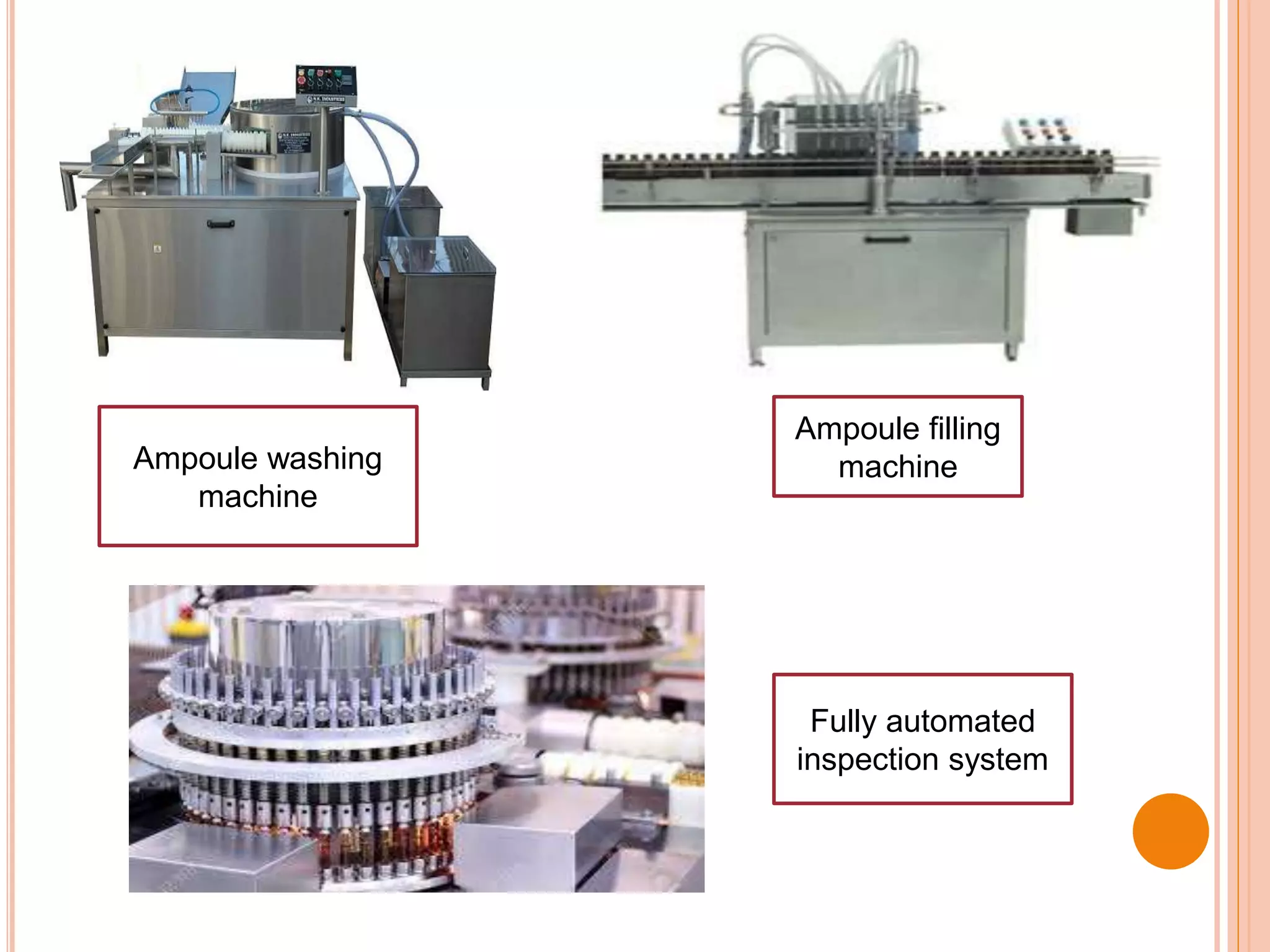
Ampoule filling
machineAmpoule washing
machine
Fully automated
inspection system
 Quality control
1)Particulate matter test
2)Leakage test
3)Clarity test
4)Pyrogen test
5)Sterility test
6)Bacterial endotoxin test
 Particulate matter test:-
Methods of monitoring particulate matter contamination
 Visual method
 Coulter counter method
 Filtration method
 Light blockage method
 Visual method:
-Filled container are examined against strong illuminated screen
by holding neck &rotating it slowly or inverted it tokeep out the
foreign matter
 Coulter counter method:
-Itis used for detection of particles less than 0.1 micrometer in
diameter
 Filtration method:
-Material is collected on filter & evaluated under microscope.
 Light blockage method:
used for hydraulic oils
 2) LEAKAGE TEST:
performed in vaccum chamber, ampoule dipped in 1%methylene
blue dye solution
 3) CLARITY TEST:
container held by neck against strong illuminated black and white
screen done by visual inspection
 4)sterility test:-
it is aprocedure carried out todetect and conform absence of
any viableform of microbes in or pharmacopeia preperation or
product
methods:-
1)membrane filtration method
2)direct inoculation method
 Membrane filtration method
all steps of this procedure are performed aseptically in a
class 100 laminar flow hood
 Direct inoculation method:-
 volume of produst is NMT10% volume of medium
 Suitable for aqueous solutions ,oily liquids , ointments
and creams
 Direct inoculation of culture medium suitable quantityof
preperation to be examined is transferred directly into
appropriate culture medium &incubate for NLT 14days
5) PYROGEN TEST
Rabbit test(old)
Lal test(new)
1)Rabbit test:-
The rabbit pyrogen test requires the injection of a small
amount of batched test material into a rabbit’s blood
stream, and monitoring for temperature increases
LAL TEST:-
There are three basic LAL test methodologies:
 gel-clot
 Turbidimetric
 Chromogenic
Limulus amebocyte lysate (lal) is an aqueous extract of blood
cells (amoebocytes) from the horseshoe crab, limulus
polyphemus. Lal reacts with
bacterial endotoxin or lipopolysaccharide (lps), which is a
membrane component of gram negative bacteria.
To test a sample for endotoxins it is mixed with lysate and water;
endotoxins are present if coagulation occurs

SMALL VOLUME PARENTRALS , MANUFACTURING AND QUALITY CONTROL

  • 1.
  • 2.
    INTRODUCTION:- Para: outside Enteron: intestine(i.e. beside the intestine) Definition:- According to the USP 24/ NF 19 “As those preparations intended for injection through the skin or other external boundary tissue, rather than through the alimentary canal”
  • 3.
    SMALL VOLUME PARENTRALS:- Defination:- Accordingto USP “ an injection that is packaged in containers labelled as containing 100 ml or less All the sterile products packaged in vials, ampoules, cartridges, syringes, bottles or any other container that is 100ml or less fall under the class of SVP CLASSIFICATION OF SVP:- 1) Single dose ampoules(glass/plastic ) 2) Multiple dose vials 3) Prefilled syringes
  • 4.
    FORMULATION:- 1)vehicle:- A)aqueous vehicle B)water misciblevehicles C)non aqueous vehicle A)Aqueous vehicle:- Types:- Purified water, WFI,Sterile WFI, BacteriostaticWFI, Sterile WF irrigation. Preparation :-  Distillation  ion exchange  reverse osmosis
  • 5.
    B)Water-miscible vehicles : primarilyto effect solubility of drugs and or reduce hydrolysis. C)Non-aqueous vehicles : because of saftey, purity bio compatibility several SVP are marketed as oily solutions The oil must be vegitable in origin (sesame, olive, cotton seed oil) Product USP oil Ampicillin(suspension) Vegitable Diethyl stilbestrol Sesame, cotton Epinephrine(suspension) Sesame Pencillin G procaine(suspension) vegitable
  • 6.
    Co solvents :- Theseare used to increase the stability of poorly soluble drug in water and prevent drug chemical degradation by hydrolysis Ex:-propylene glycol or in combination with ethanol and polyethylene glycol. Antimicrobial preservatives : Maintain the stability of the product during storage. ex:-Phenyl mercuric nitrate and Thiomersol 0.01% Benzethonium chloride and benzalkonium chloride, Phenol or cresol 0.5%, chlorobutanol 0.5%. Antioxidants :- ex:- water soluble: sulfurous acid salts, ascorbic acid isomers, thiol derivatives. oil soluble: propyl gallate, butylated hydroxy anisole,ascorbyl palmitate alpha tocopherol 9.
  • 7.
    Buffers : Added tomaintain pH Results in stability of drug Common buffers used in SVPs pH Buffer system Conc % 8.2-10.2 Aceticacid-acetate 1-2 2.5-6.0 Citricacid-citrate 1-5 8.2-10.2 Phosphoricacid- phosphate 0.8-2 8.2-10.2 Glutamicacid- glutamate 1-2
  • 8.
    Tonicity adjusters : Electrolytes: ex:-Nacl  Non elecrolytes: ex:-Glucose,Mannitol,Glycerine  isotonic: Dextrose injection 5%&Nacl injection 0.9%  Tonicity can be measurement by: osmometer Other ingredients :  Bulking agents – for freeze dried preparations(solids) ex mannitol, lactose sucrose, dextran.  Suspending agents – CMC, methyl cellulose gelatin, sorbitol.  Emulsifying agents – lecithin, polysorbate 80  Ophthalmic ointments bases – petrolatum.
  • 9.
    MANUFACTURING  Planningand schedulingfunction management -ingrediants -material-packing components -labels personal Documentationcontrol Equipmentand facilities management Preperationof facilities Preperationofequipment Onlinetesting Caping &outer sealing inspection quarantine finishingLabeling &packing Asepticsub divisionalsealing sterilizationmanufacturing Ware house Leak testing Terminal sterilization
  • 10.
  • 11.
    PARAMETERS TO BETAKEN INTO CONCIDERATION IN DESIGH OF PARENTRAL PRODUCTION FACILITY Requires special considerations because of unique pharmaceutical needs Land availability,Lnd coast, construction cost, taxes, utility cost, labour availability, labour cost and so on Pharmaceuticallyimportant factors Basic factors Criteria for selection 1)Site selection:-
  • 12.
    2)area planning :- itdepends on i) Type of production ii) Environmental control needs iii) Product characteristics iv) Environmental control zone grouping v) space requirements personnel flow i)Type of production a)Batch operations b)continuous operations
  • 13.
    Environmental control needs Foraseptic filling process Sterilization and depyrogenation of containers before filling ,normally hot air ovenor autoclave An aseptic environment with the attendant support rooms Inspection and packing Filling requirements Provision must be made for Non aseptic filling :- Terminal sterilization Eliminates the sterilization prior to filling An accumilation and segregation area is required to accumulate the product for transfer to next process step Following to filling and sealing
  • 14.
    Product characteristics:- a)liquids:- easiestproduct to handle b)emulsions:-ease transfer problems c)Suspensions:- require maintaining a homogeneous mixture Environmental control zone grouping:- Zones as per cGMP Zone 7:-filling line Zone 6:-filling area Zone 5:-weighing mixing &transfer area Zone 4:-clean area Zone 3:-general production Zone 2:-ware house Zone 1:- exterior
  • 15.
    Zones as perGazzete of india:-
  • 16.
     Environmental control: Sources Control People Total body covering in critical area and partial covering in non critical area. Adequate personal flow and restricted access to aseptic and critical environment. Minimum movement of personal. Adequate operation procedure for personal Barrier Adequate sterilization procedure Protective laminar flow equipment Barrier and separation between high risk and low risk operation. Adequate operation procedure to assure proper handling, cleaning, and sterilization of machinery and equipment Material Adequate material control and selection Adequate sterilization and filtration procedure Air Adequate air filtration system Adequate monitoring of air cleanliness level. Adequate air system validation procedure.
  • 17.
    GRADES Maximumpermittednumberofparticles/m3equalorabove At restin operation 0.5μm 0.5μm 0.5μm 0.5μm A 3,520 29 3,500 29 B 35,200 293 3,52,000 2,930 C 3,52,000 2930 35,20,000 29,300 D 35,20,000 29300 Not defined Not defined Air Classification as per Schedule M Grade A corresponds with Class 100 or M 3.5 or ISO Class 5; Grade B with Class 1000 or M 4.5 ISO Class 6; Grade C with Class 10,000 or M 5.5 or ISO Class 7; Grade D with Class 100,000 or M 6.5 or ISO Class 8
  • 18.
     TYPES OFOPERATIONS TO BE CARRIED OUT IN THE VARIOUS GRADES FOR ASEPTIC PREPARATIONS  Types of operations to be carried out in the various Grades for terminally sterilized products Grade Types of operations for aseptic preparations A Aseptic preparation and filling B Background room conditions for activities requiring Grade A C Preparation of solution to be filtered D Handling of components after washing Grade Types of operations for terminally sterilized products A Filling of products, which are usually at risk C Placement of filling and sealing machines, preparation of solutions when usually at risk. Filling of product when unusually at risk. D Moulding, blowing (pre-forming) operations of plastic containers, preparations of solutions and components for subsequent filling
  • 19.
     PERSONEL FLOW:- Discontinuous and crowded flow patterns can decrease production efficiency, increases the problem of maintaining a clean environment  Personnel flow path from zone to zone must be such that access to higher level of cleanliness is only through changing rooms ,gowning rooms, locker rooms, or other areas as may be required to prepare the personnel for the cleaner area  Access should be restricted 1 2 4 3 213 4
  • 20.
  • 23.
    EQUIMENTS EMPLOYED:- a) Manufacturingarea: -  1. Storage equipment for ampoules, vials bottles and closures.  2. Washing and drying equipment.  3. Dust proof storage cabinet  4. Water still.  5. Mixing and preparation tanks or other containers.  6. Mixing equipment where necessary.  7. Filtering equipment.  8. Hot air sterilizer. b) Aseptic filling and sealing rooms -  9. Benches for filling and sealing.  10. Bacteriological filters.  11. Filling and sealing unit under laminar flow work station.
  • 24.
     c) GeneralRoom.  12. Inspection table.  13. Leak testing table.  14. Labeling and packing benches.  15. Storage of equipment including cold storage and refrigerators if necessary Sterile garmet cabinet Cold storage Hepa filters
  • 25.
    Laminar flow hoods Vial labelling machine Vialinspection machine Vial fillinng machine Rubber stopper washing machine Vial washing &sterilization machine
  • 26.
  • 27.
     Quality control 1)Particulatematter test 2)Leakage test 3)Clarity test 4)Pyrogen test 5)Sterility test 6)Bacterial endotoxin test  Particulate matter test:- Methods of monitoring particulate matter contamination  Visual method  Coulter counter method  Filtration method  Light blockage method
  • 28.
     Visual method: -Filledcontainer are examined against strong illuminated screen by holding neck &rotating it slowly or inverted it tokeep out the foreign matter  Coulter counter method: -Itis used for detection of particles less than 0.1 micrometer in diameter  Filtration method: -Material is collected on filter & evaluated under microscope.  Light blockage method: used for hydraulic oils
  • 29.
     2) LEAKAGETEST: performed in vaccum chamber, ampoule dipped in 1%methylene blue dye solution  3) CLARITY TEST: container held by neck against strong illuminated black and white screen done by visual inspection  4)sterility test:- it is aprocedure carried out todetect and conform absence of any viableform of microbes in or pharmacopeia preperation or product methods:- 1)membrane filtration method 2)direct inoculation method
  • 30.
     Membrane filtrationmethod all steps of this procedure are performed aseptically in a class 100 laminar flow hood
  • 31.
     Direct inoculationmethod:-  volume of produst is NMT10% volume of medium  Suitable for aqueous solutions ,oily liquids , ointments and creams  Direct inoculation of culture medium suitable quantityof preperation to be examined is transferred directly into appropriate culture medium &incubate for NLT 14days 5) PYROGEN TEST Rabbit test(old) Lal test(new) 1)Rabbit test:- The rabbit pyrogen test requires the injection of a small amount of batched test material into a rabbit’s blood stream, and monitoring for temperature increases
  • 32.
    LAL TEST:- There arethree basic LAL test methodologies:  gel-clot  Turbidimetric  Chromogenic Limulus amebocyte lysate (lal) is an aqueous extract of blood cells (amoebocytes) from the horseshoe crab, limulus polyphemus. Lal reacts with bacterial endotoxin or lipopolysaccharide (lps), which is a membrane component of gram negative bacteria. To test a sample for endotoxins it is mixed with lysate and water; endotoxins are present if coagulation occurs