Pilon Fractures
Mohammed Nabil J AlAli
5th Year Medical Student
At King Faisal University

Powerpoint Templates

Page 1
Objectives
- OVERVIEW
( anatomy, definition, epidemiology and mechanisms )

- EVALUATION
( Clinical, physical and imaging )

- CLASSIFICATIONS
- ASSOCIATED INJURIES
- TREATMENT
- COMPLICATIONS
Powerpoint Templates

Page 2
A
N
A
T
O
M
Y

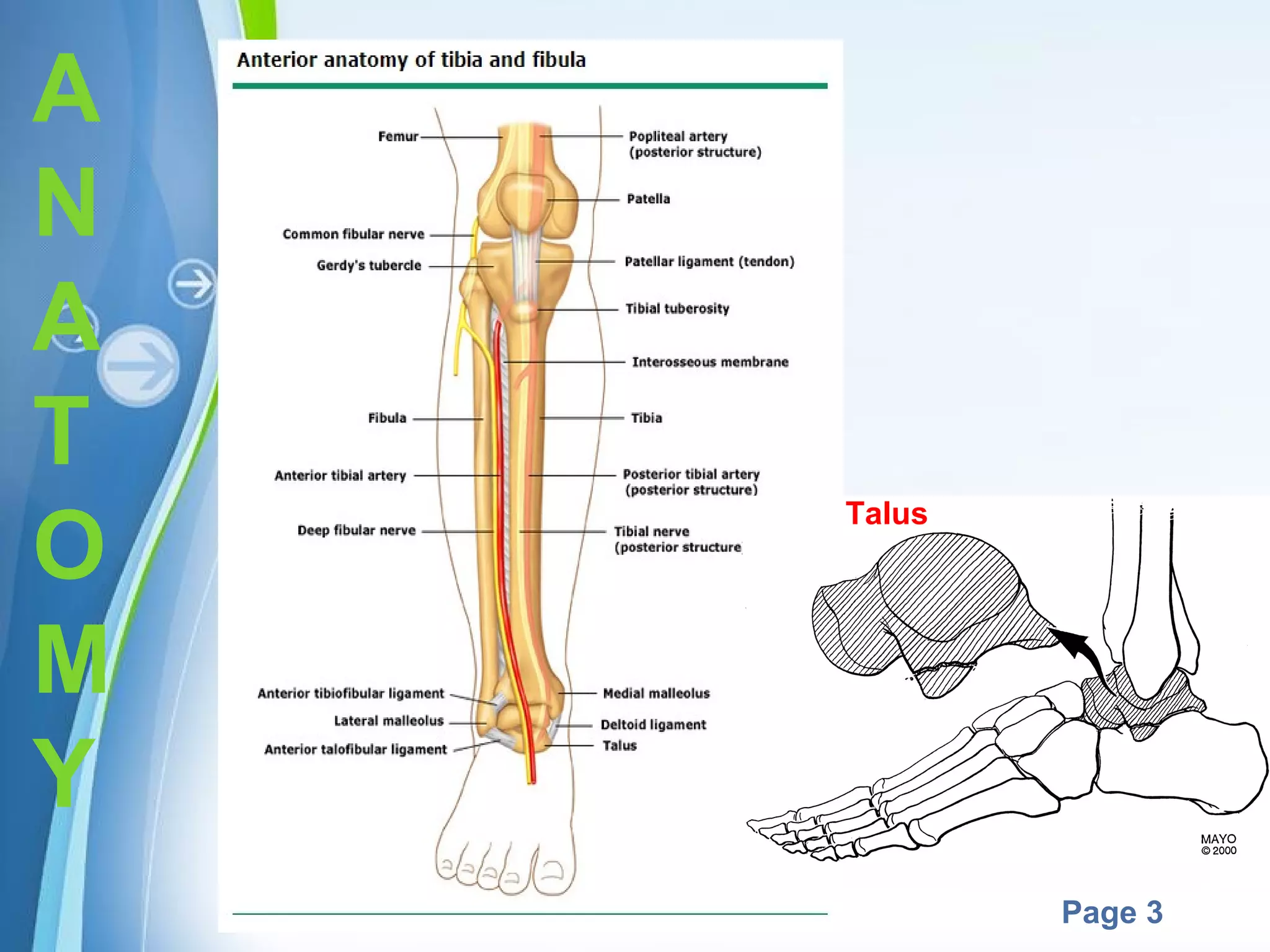
Talus

Powerpoint Templates

Page 3
A
N
A
T
O
M
Y
Powerpoint Templates

Page 4
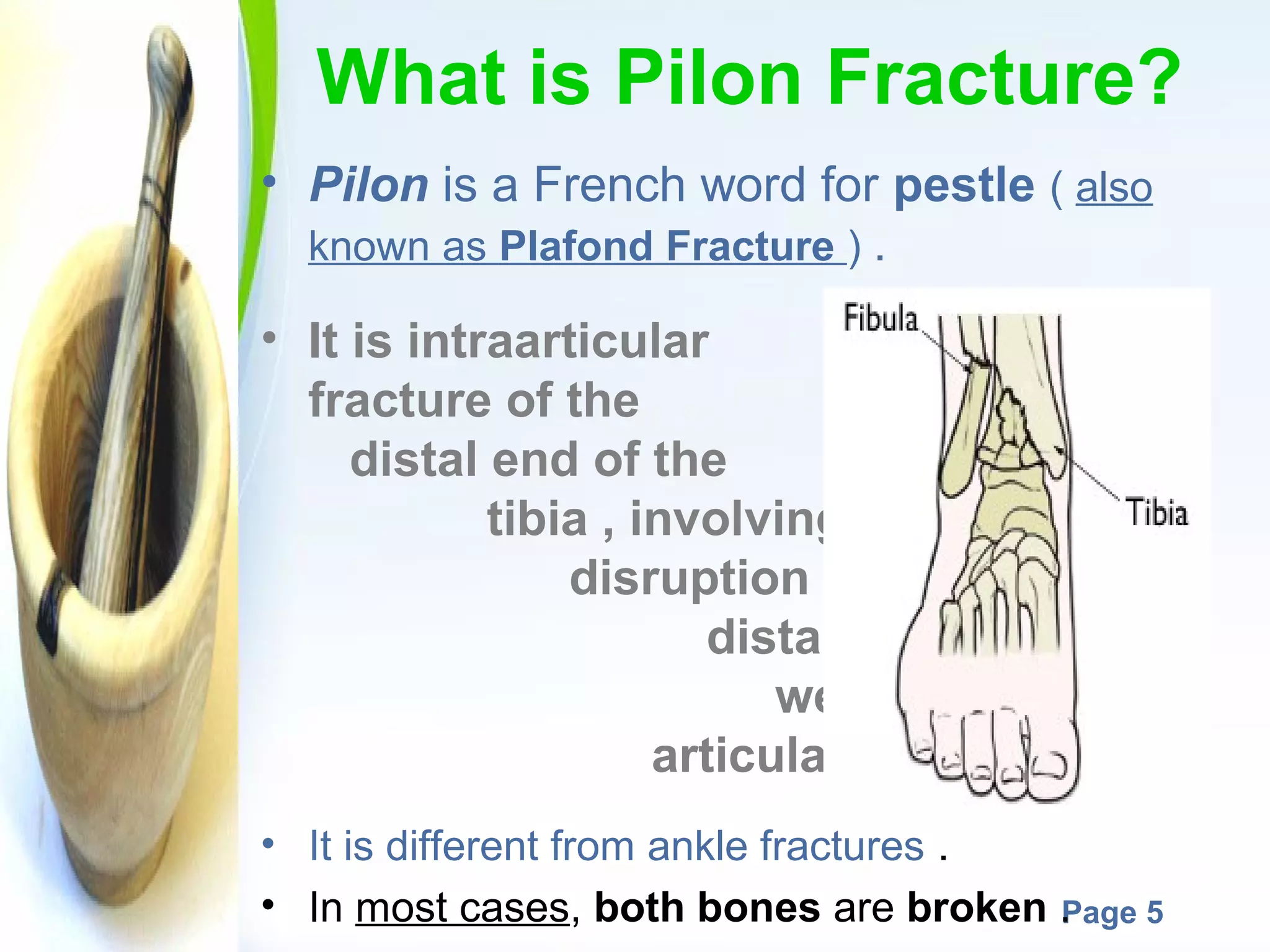
What is Pilon Fracture?
• Pilon is a French word for pestle ( also
known as Plafond Fracture ) .
• It is intraarticular
fracture of the
distal end of the
tibia , involving the
disruption of the
distal tibial
weight-bearing
articular surface .
• It is different from ankle fractures .
Powerpoint Templates
• In most cases, both bones are broken .
Page 5
EPIDEMIOLOGY
• Account for approximately 5-7% of all tibia
fractures.
• But less than 1% of all lower-extremity
fractures .
• More commonly at average age of 35 to 40
years old. rare in children and elderly.
• Commonly in men than women (3:1)
• Because of the energy required to cause
this type of fracture, 25% to 50% of patients
have additional injuries that require
Powerpoint Templates
treatment.
Page 6
Mechanism
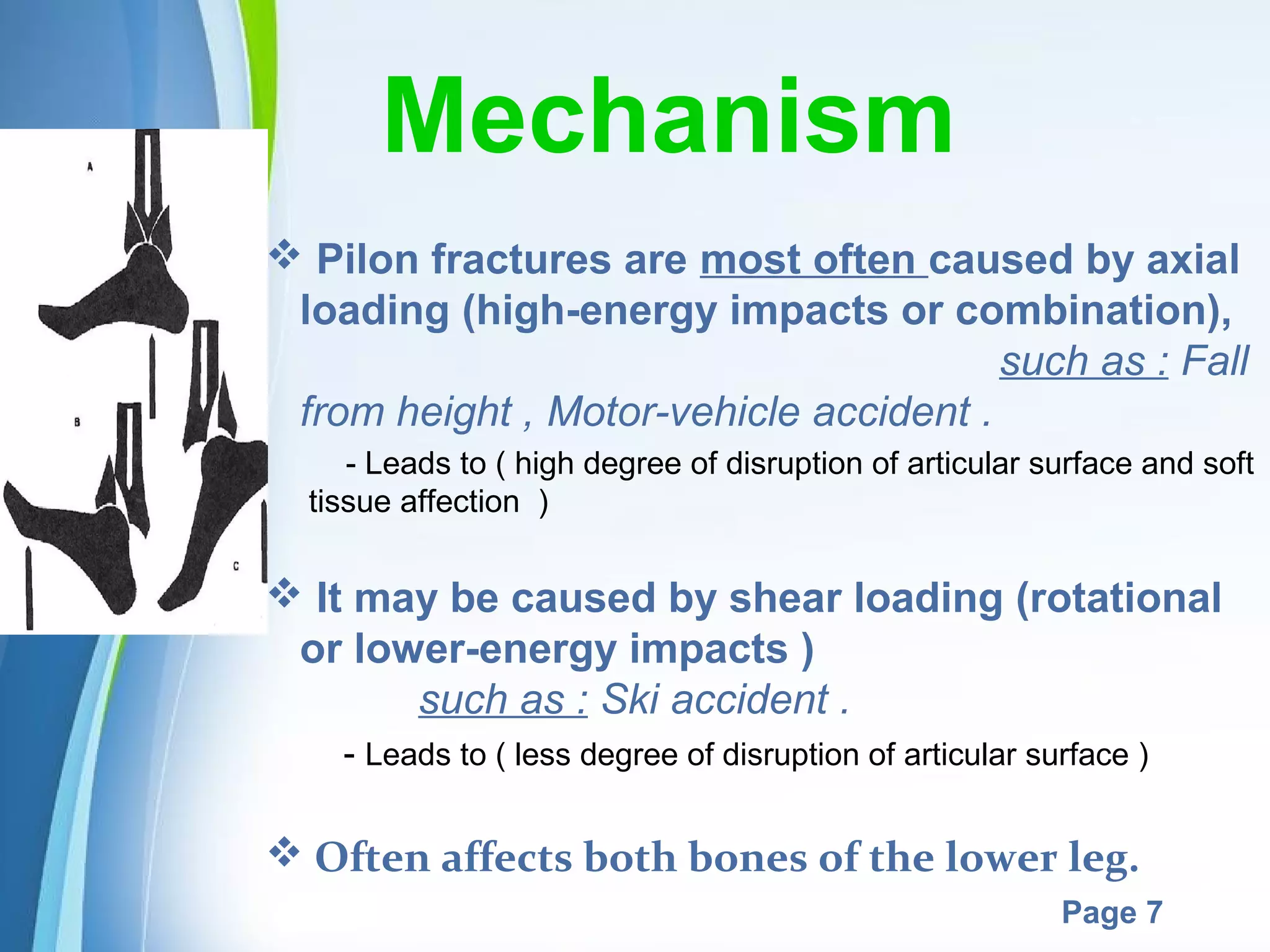
 Pilon fractures are most often caused by axial
loading (high-energy impacts or combination),
such as : Fall
from height , Motor-vehicle accident .
- Leads to ( high degree of disruption of articular surface and soft
tissue affection )

 It may be caused by shear loading (rotational
or lower-energy impacts )
such as : Ski accident .
- Leads to ( less degree of disruption of articular surface )

 Often affects both bones of the lower leg.
Powerpoint Templates

Page 7
EVALUATION
Clinical presentation

Physical examination

Imaging

Powerpoint Templates

Page 8
E
V
A
L
U
A
T
I
O
N

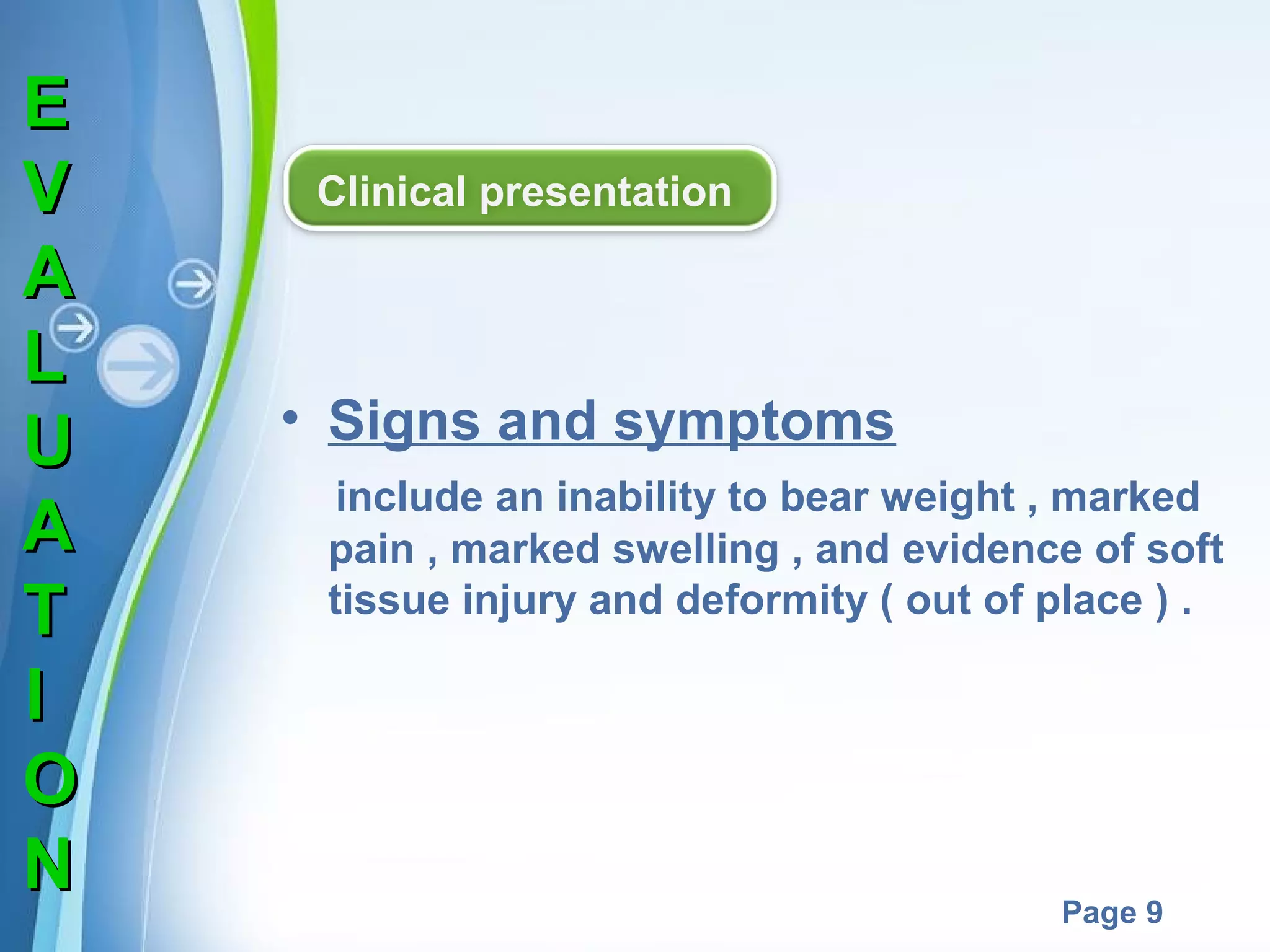
Clinical presentation

• Signs and symptoms
include an inability to bear weight , marked
pain , marked swelling , and evidence of soft
tissue injury and deformity ( out of place ) .

Powerpoint Templates

Page 9
E
V
A
L
U
A
T
I
O
N

Physical examination

• Neurovascular examination
include distal pulses , capillary refill ,
motor and sensory examination .

• Soft tissue
- Closed fractures : classified using the
method of Tscherne
- Opened fractures : classified using the
method of Gustilo .
Powerpoint Templates

Page 10
E
V
A
L
U
A
T
I
O
N

Imaging

Powerpoint Templates

Page 11
E
V
A
L
U
A
T
I
O
N

Imaging

Powerpoint Templates

Page 12
CLASSIFICATIONS
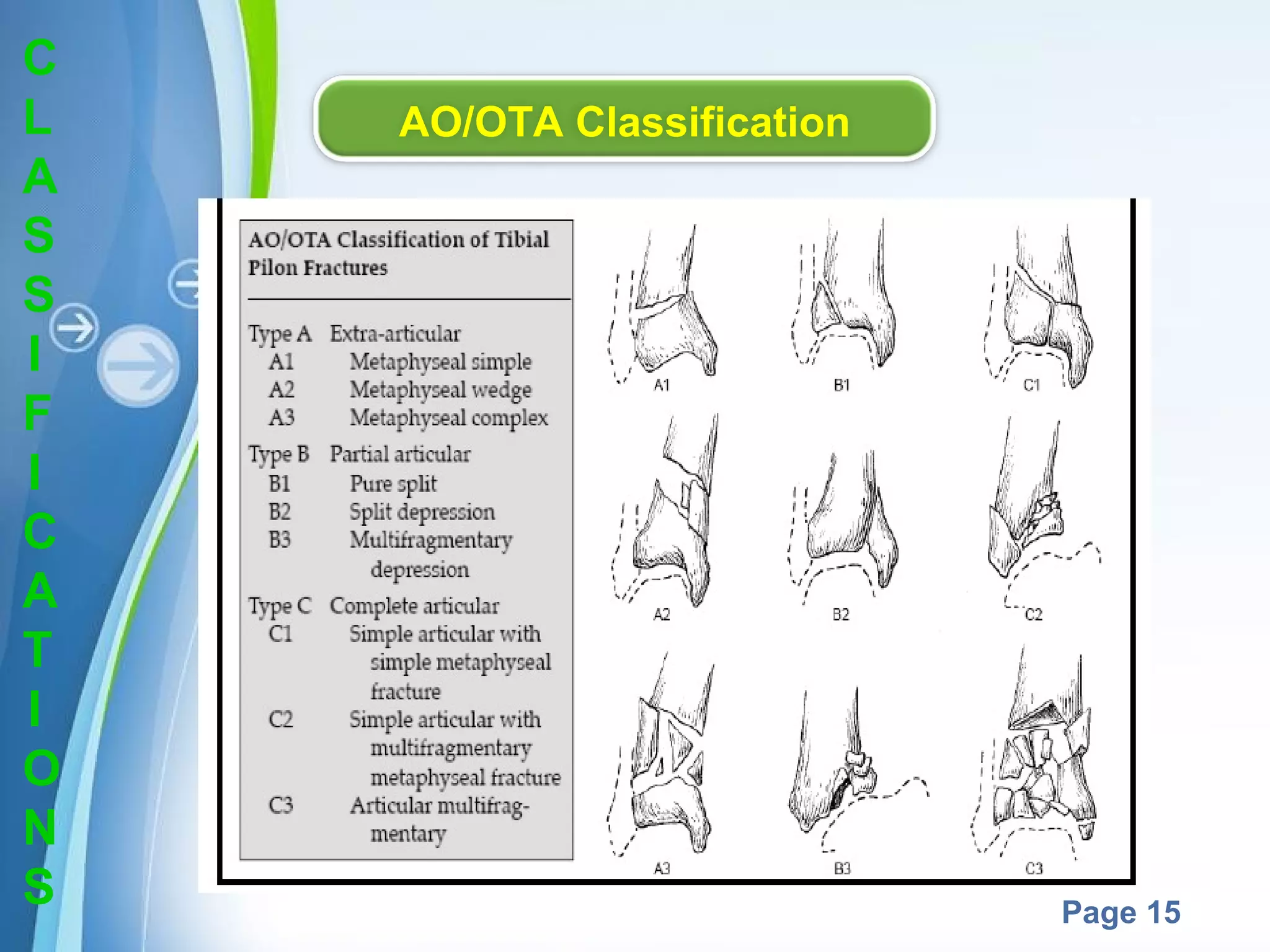
Association for Osteosynthesis/Orthopedic
trauma association (AO/OTA) Classification
Has good interobserver and intraobserver
agreement at the type level .
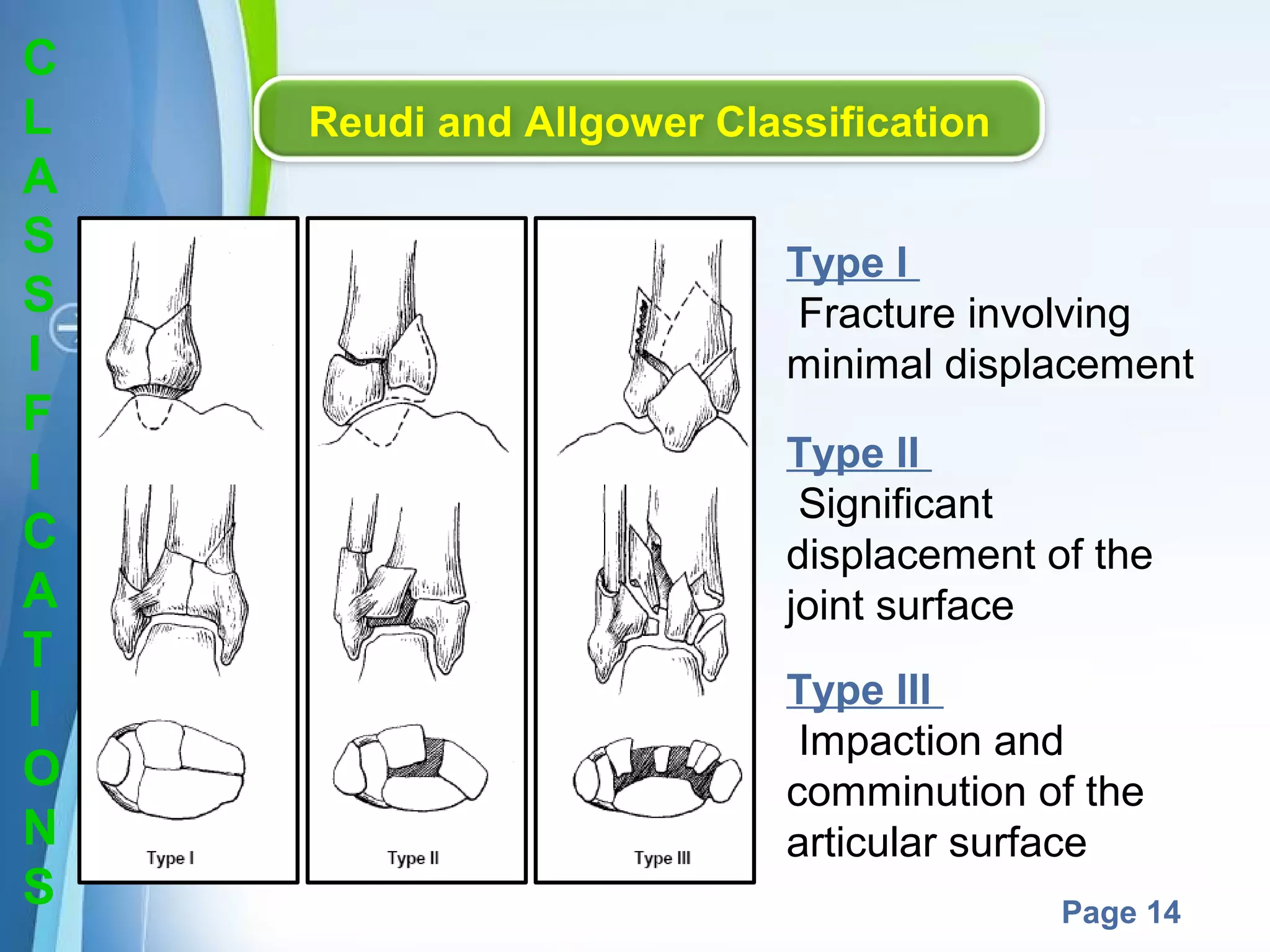
Reudi and Allgower Classification
Has good interobserver and intraobserver
agreement at the group level
Powerpoint Templates
(the most important ).

Page 13
C
L
A
S
S
I
F
I
C
A
T
I
O
N
S

Reudi and Allgower Classification
Type I
Fracture involving
minimal displacement
Type II
Significant
displacement of the
joint surface
Type III
Impaction and
comminution of the
articular surface
Powerpoint Templates

Page 14
C
L
A
S
S
I
F
I
C
A
T
I
O
N
S

AO/OTA Classification

Powerpoint Templates

Page 15
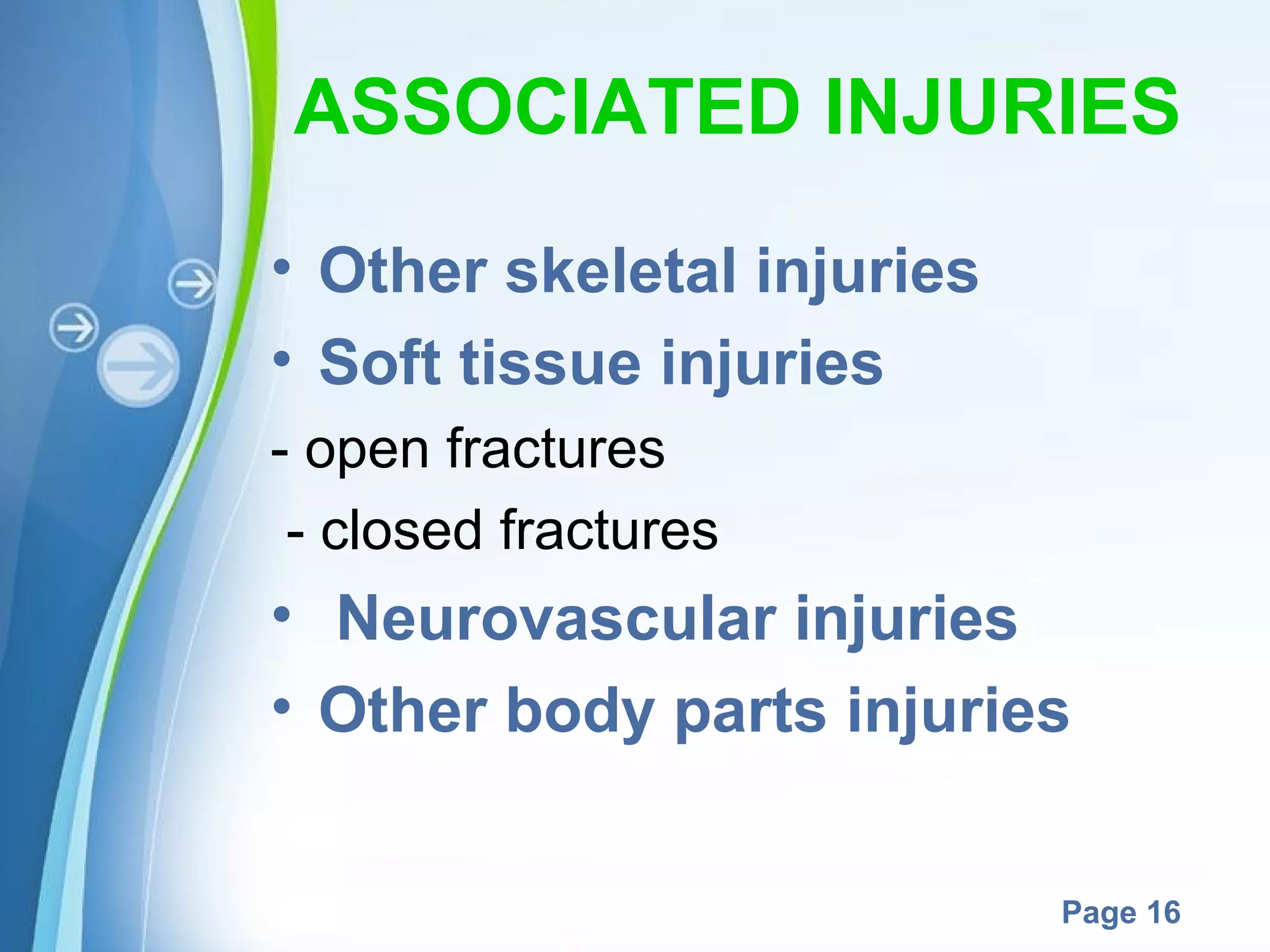
ASSOCIATED INJURIES
• Other skeletal injuries
• Soft tissue injuries
- open fractures
- closed fractures

• Neurovascular injuries
• Other body parts injuries
Powerpoint Templates

Page 16
T
R
E
A
T
M
E
N
T

TREATMENT and RATIONAl
 Treatment goals
 Treatment options
 Bony considerations
 soft tissue considerations
 Timing of surgery

Powerpoint Templates

Page 17
T
R
E
A
T
M
E
N
T

 Treatment goals
- Anatomical restoration of distal tibial articular surface .
- Early ankle range of motion.

 Treatment options
Non-surgical
( to manage
non-displaced fractures)

Cast and Splints

Surgical
( To manage displaced
fractures )

Modern methods :
(ORIF) and external
fixation with or without
limited internal fixation

Powerpoint Templates

Page 18
T
R
E
A
T
M
E
N
T

 Bony considerations
Fibula

Tibia
- Comminution
- Lower energy : (ORIF)
- High energy + large
number of small
articulations :
external fixation with or
without limited internal fixation

- Diaphyseal extention

Typically epi and
meta of fracture is
heal more rapid .

ORIF with plate and
scrow

Remember the most
important is restore
Tibia

Powerpoint Templates

Page 19
T
R
E
A
T
M
E
N
T

 soft tissue considerations
Low-energy injuries :
By ORIF

High-energy injuries :
By external fixation with
or without limited
internal fixation

 Timing of surgery
Depend on soft tissue affection .

Powerpoint Templates

Page 20
T
R
E
A
T
M
E
N
T

A splint

Plates and screws
Powerpoint Templates

An external fixator
Page 21
ANATOMICAL
CONSEDARATIONS AND
SURGICAL TECHNIQUES
• ORIF
• External fixation
- Unilateral
- ilizarvo ( consists of fine wire “ 1.8mm” for
interfragmentary fixation ) .
- hybird ( ring with wire distally )

• Soft tissue
• Ligamentotaxis
When traction is applied across the ankle joint , the
intraarticular fragments may be reduced by pull of the
Powerpoint Templates
Page 22
capsule and ligamentous structures .
COMPLICATIONS
Sever complications following ORIF of tibial fractures
range from 10-55% and some can lead to amputation

•
•
•
•
•
•
•
•

Soft tissue slough.
Infections .
Neurovascular injuries.
Bone healing problems
( Mal-alignment, Mal-union and Non-union ) .
Painful plates and screws.
Decreased ankle joint range of motion.
Chronic edema .
Posttraumatic arthritis .
Powerpoint Templates
Page 23
Any Question ?
Powerpoint Templates

Page 24
REFERENCES
- Review of Orthopaedic
Trauma by Mark R.Brinker , M.D.
- AAOS
- Medescape
(press on the title )

(press on the title )

- UpToDate

(press on the title )

Powerpoint Templates

Page 25
Thank you

Powerpoint Templates

Page 26

pilon fractures or " plafond "

  • 1.
    Pilon Fractures Mohammed NabilJ AlAli 5th Year Medical Student At King Faisal University Powerpoint Templates Page 1
  • 2.
    Objectives - OVERVIEW ( anatomy,definition, epidemiology and mechanisms ) - EVALUATION ( Clinical, physical and imaging ) - CLASSIFICATIONS - ASSOCIATED INJURIES - TREATMENT - COMPLICATIONS Powerpoint Templates Page 2
  • 3.
  • 4.
  • 5.
    What is PilonFracture? • Pilon is a French word for pestle ( also known as Plafond Fracture ) . • It is intraarticular fracture of the distal end of the tibia , involving the disruption of the distal tibial weight-bearing articular surface . • It is different from ankle fractures . Powerpoint Templates • In most cases, both bones are broken . Page 5
  • 6.
    EPIDEMIOLOGY • Account forapproximately 5-7% of all tibia fractures. • But less than 1% of all lower-extremity fractures . • More commonly at average age of 35 to 40 years old. rare in children and elderly. • Commonly in men than women (3:1) • Because of the energy required to cause this type of fracture, 25% to 50% of patients have additional injuries that require Powerpoint Templates treatment. Page 6
  • 7.
    Mechanism  Pilon fracturesare most often caused by axial loading (high-energy impacts or combination), such as : Fall from height , Motor-vehicle accident . - Leads to ( high degree of disruption of articular surface and soft tissue affection )  It may be caused by shear loading (rotational or lower-energy impacts ) such as : Ski accident . - Leads to ( less degree of disruption of articular surface )  Often affects both bones of the lower leg. Powerpoint Templates Page 7
  • 8.
  • 9.
    E V A L U A T I O N Clinical presentation • Signsand symptoms include an inability to bear weight , marked pain , marked swelling , and evidence of soft tissue injury and deformity ( out of place ) . Powerpoint Templates Page 9
  • 10.
    E V A L U A T I O N Physical examination • Neurovascularexamination include distal pulses , capillary refill , motor and sensory examination . • Soft tissue - Closed fractures : classified using the method of Tscherne - Opened fractures : classified using the method of Gustilo . Powerpoint Templates Page 10
  • 11.
  • 12.
  • 13.
    CLASSIFICATIONS Association for Osteosynthesis/Orthopedic traumaassociation (AO/OTA) Classification Has good interobserver and intraobserver agreement at the type level . Reudi and Allgower Classification Has good interobserver and intraobserver agreement at the group level Powerpoint Templates (the most important ). Page 13
  • 14.
    C L A S S I F I C A T I O N S Reudi and AllgowerClassification Type I Fracture involving minimal displacement Type II Significant displacement of the joint surface Type III Impaction and comminution of the articular surface Powerpoint Templates Page 14
  • 15.
  • 16.
    ASSOCIATED INJURIES • Otherskeletal injuries • Soft tissue injuries - open fractures - closed fractures • Neurovascular injuries • Other body parts injuries Powerpoint Templates Page 16
  • 17.
    T R E A T M E N T TREATMENT and RATIONAl Treatment goals  Treatment options  Bony considerations  soft tissue considerations  Timing of surgery Powerpoint Templates Page 17
  • 18.
    T R E A T M E N T  Treatment goals -Anatomical restoration of distal tibial articular surface . - Early ankle range of motion.  Treatment options Non-surgical ( to manage non-displaced fractures) Cast and Splints Surgical ( To manage displaced fractures ) Modern methods : (ORIF) and external fixation with or without limited internal fixation Powerpoint Templates Page 18
  • 19.
    T R E A T M E N T  Bony considerations Fibula Tibia -Comminution - Lower energy : (ORIF) - High energy + large number of small articulations : external fixation with or without limited internal fixation - Diaphyseal extention Typically epi and meta of fracture is heal more rapid . ORIF with plate and scrow Remember the most important is restore Tibia Powerpoint Templates Page 19
  • 20.
    T R E A T M E N T  soft tissueconsiderations Low-energy injuries : By ORIF High-energy injuries : By external fixation with or without limited internal fixation  Timing of surgery Depend on soft tissue affection . Powerpoint Templates Page 20
  • 21.
    T R E A T M E N T A splint Plates andscrews Powerpoint Templates An external fixator Page 21
  • 22.
    ANATOMICAL CONSEDARATIONS AND SURGICAL TECHNIQUES •ORIF • External fixation - Unilateral - ilizarvo ( consists of fine wire “ 1.8mm” for interfragmentary fixation ) . - hybird ( ring with wire distally ) • Soft tissue • Ligamentotaxis When traction is applied across the ankle joint , the intraarticular fragments may be reduced by pull of the Powerpoint Templates Page 22 capsule and ligamentous structures .
  • 23.
    COMPLICATIONS Sever complications followingORIF of tibial fractures range from 10-55% and some can lead to amputation • • • • • • • • Soft tissue slough. Infections . Neurovascular injuries. Bone healing problems ( Mal-alignment, Mal-union and Non-union ) . Painful plates and screws. Decreased ankle joint range of motion. Chronic edema . Posttraumatic arthritis . Powerpoint Templates Page 23
  • 24.
    Any Question ? PowerpointTemplates Page 24
  • 25.
    REFERENCES - Review ofOrthopaedic Trauma by Mark R.Brinker , M.D. - AAOS - Medescape (press on the title ) (press on the title ) - UpToDate (press on the title ) Powerpoint Templates Page 25
  • 26.

Editor's Notes

  • #6 Pilon is a French word for pestle, an instrument used for crushing or pounding. In many pilon fractures, the bones of the ankle joint are crushed due to the high-energy impact causing the injury. Pilon fractures may be considered high-energy ankle fractures. Pilon fractures affect the bottom of the shinbone (tibia) at the ankle joint. In most cases, both bones in the lower leg, the tibia and fibula, are broken near the ankle.
  • #11 Any neurovascular injury must be documented at the time of presentation.Compartment syndrome is a risk in acute injuries; therefore, frequent evaluations are necessary. A systematic and complete evaluation is necessary because other injuries (eg, to the spine or other extremities) may have occurred after a fall from height. The Oestern and Tscherne classification for open fractures uses wound size, level of contamination, and fracture pattern to grade open fractures, and is as follows: Grade I - Open fractures with a small puncture wound without skin contusion, negligible bacterial contamination, and a low-energy fracture pattern Grade II - Open injuries with small skin and soft-tissue contusions, moderate contamination, and variable fracture patterns Grade III - Open fractures with heavy contamination, extensive soft-tissue damage, and, often, associated arterial or neural injuries Grade IV - Open fractures with incomplete or complete amputations The Gustilo classification can also be used for open fractures and is as follows: Grade 1 - Skin lesion smaller than 1 cm; clean, simple bone fracture with minimal comminution Grade 2 - Skin lesion larger than 1 cm, no extensive soft-tissue damage, minimal crushing, moderate comminution and contamination Grade 3 - Extensive skin damage with muscle and neurovascular involvement, high-speed injury, comminution of the fracture, instabilityGrade 3a - Extensive laceration of soft tissues with bone fragments covered, usually high-speed traumas with severe comminution or segmental fractures Grade 3b - Extensive lesion of soft tissues with periosteal stripping, contamination, and severe comminution due to high-speed traumas; usually requires replacement of exposed bone with a local or free flap as a cover Grade 3c - Exposed fracture with arterial damage that requires repair
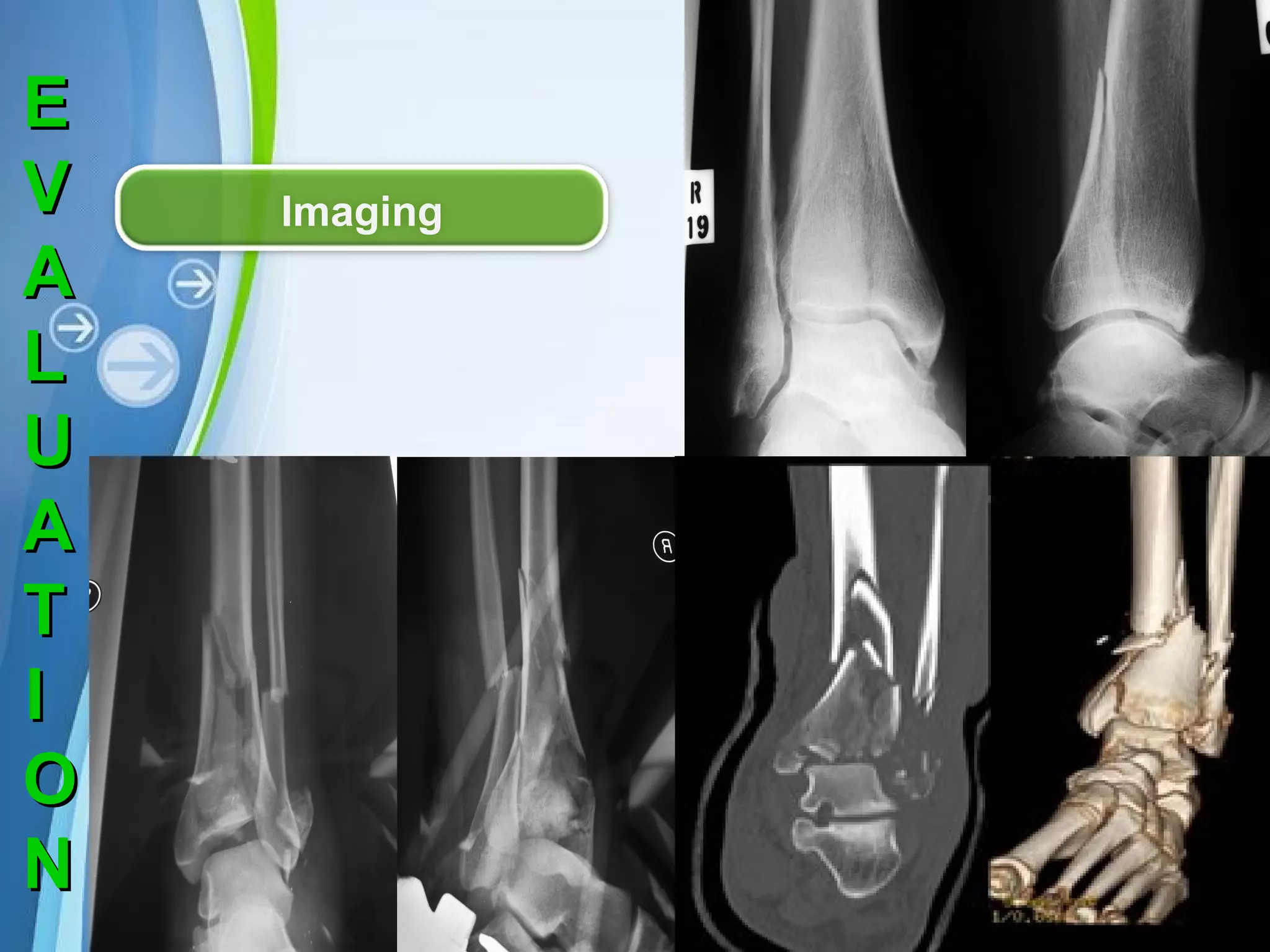
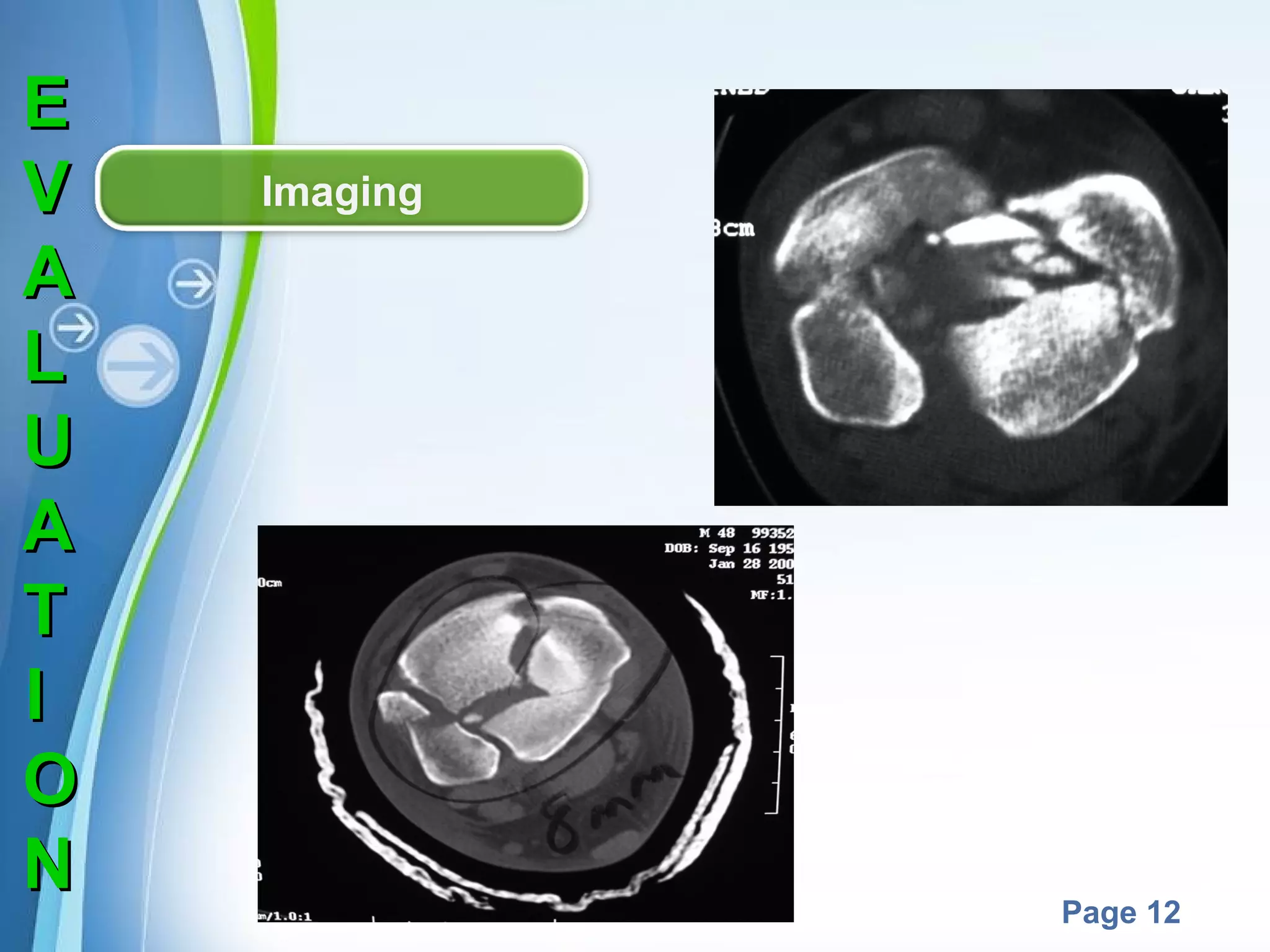
  • #12 To fully evaluate the fracture, your doctor may recommend an x-ray (left), a CAT scan (center), or a three-dimensional CAT scan (right).
  • #16 The AO/OTA classification (part of a comprehensive classification of long-bone fractures and tibia, numbered 43) is as follows: Type A: These fractures are extra-articular and subcategorized as simple (A1), comminuted (A2), or severely comminuted (A3). Type B: These fractures involve only a portion of the articular surface and a single column. Subcategories include pure split (B1), split with depression (B2), and depression with multiple fragments (B3). Type C: These fractures involve the whole of the articular surface. Type C fractures may be categorized as a simple split in the articular surface and the metaphysis (C1), an articular split that is simple with a metaphysis split that is multifragmentary (C2), or a fracture with multiple fragments of the articular surface and the metaphysis (C3).