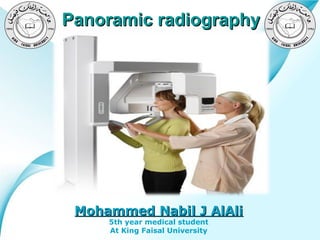
Panoramic radiography

Mohammed Nabil J AlAli
5th year medical student
Powerpoint Templates
At King Faisal University

Page 1
Outlines
- What is Panoramic X-ray?
- What are some common uses of the procedure?
- How should I prepare?
- What are the components ?
- How does the procedure work?
- What will I experience during and after the procedure?
- What are the benefits vs. risks?
- What are the limitations of Panoramic X-ray?
- Images .
Powerpoint Templates

Page 2
Panoramic radiography
Panoramic means “Wide View”

Powerpoint Templates

Page 3
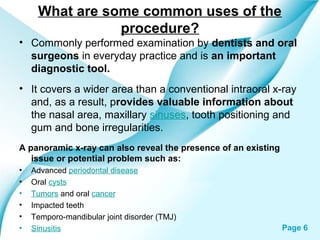
What is Panoramic X-ray?
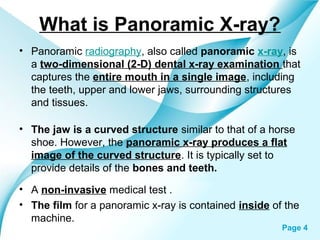
• Panoramic radiography, also called panoramic x-ray, is
a two-dimensional (2-D) dental x-ray examination that
captures the entire mouth in a single image, including
the teeth, upper and lower jaws, surrounding structures
and tissues.
• The jaw is a curved structure similar to that of a horse
shoe. However, the panoramic x-ray produces a flat
image of the curved structure. It is typically set to
provide details of the bones and teeth.
• A non-invasive medical test .
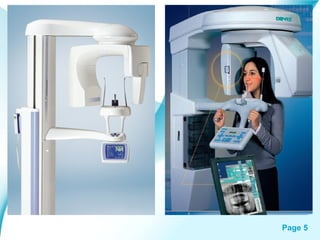
• The film for a panoramic x-ray is contained inside of the
machine.
Powerpoint Templates

Page 4
Powerpoint Templates

Page 5
What are some common uses of the
procedure?
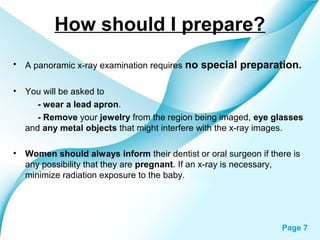
• Commonly performed examination by dentists and oral
surgeons in everyday practice and is an important
diagnostic tool.
• It covers a wider area than a conventional intraoral x-ray
and, as a result, provides valuable information about
the nasal area, maxillary sinuses, tooth positioning and
gum and bone irregularities.
A panoramic x-ray can also reveal the presence of an existing
issue or potential problem such as:
•
•
•
•
•
•

Advanced periodontal disease
Oral cysts
Tumors and oral cancer
Impacted teeth
Temporo-mandibular joint disorder (TMJ)
Powerpoint Templates
Sinusitis

Page 6
How should I prepare?
•

A panoramic x-ray examination requires no

•

You will be asked to
- wear a lead apron.
- Remove your jewelry from the region being imaged, eye glasses
and any metal objects that might interfere with the x-ray images.

•

Women should always inform their dentist or oral surgeon if there is
any possibility that they are pregnant. If an x-ray is necessary,
minimize radiation exposure to the baby.

Powerpoint Templates

special preparation.

Page 7
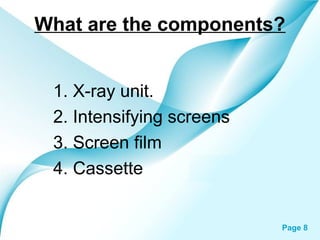
What are the components?
1. X-ray unit.
2. Intensifying screens
3. Screen film
4. Cassette
Powerpoint Templates

Page 8
How does the procedure work?
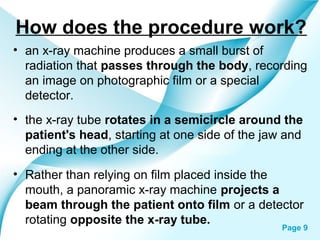
• an x-ray machine produces a small burst of
radiation that passes through the body, recording
an image on photographic film or a special
detector.
• the x-ray tube rotates in a semicircle around the
patient's head, starting at one side of the jaw and
ending at the other side.
• Rather than relying on film placed inside the
mouth, a panoramic x-ray machine projects a
beam through the patient onto film or a detector
rotating oppositePowerpoint Templates
the x-ray tube.

Page 9
What will I experience during
and after the procedure?
• A panoramic x-ray exam is painless, fast
and easy and may be recommended over
intraoral x-rays for patients that have a
sensitive gag reflex.

Powerpoint Templates

Page 10
What are the
benefits vs. risks?
Benefits
•
•

No radiation remains in a patient's body after an x-ray examination.
X-rays usually have no side effects in the typical diagnostic
range for this exam.
• Panoramic x-rays can be used for very young children since the
film does not have to be placed inside the mouth.

Risks
•

Women should always inform their dentist or oral surgeon if there is
any possibility that they are pregnant.

Powerpoint Templates

Page 11
What are the limitations of
Panoramic X-ray?
• A panoramic x-ray does not provide precise and
detailed information about each individual tooth or
soft tissues, such as the muscles.
•

It is generally used as an initial evaluation of the
bones and teeth. If further evaluation is needed, a
computed tomography (CT) scan or magnetic resonance
imaging (MRI) may be ordered.

Powerpoint Templates

Page 12
Images
Powerpoint Templates

Page 13
Normal panoramic

Powerpoint Templates

Page 14
Projection of OP

Powerpoint Templates

Page 15
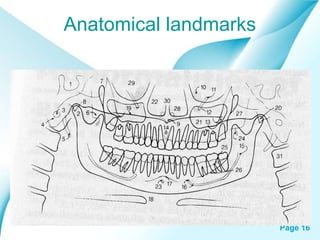
Anatomical landmarks

Powerpoint Templates

Page 16
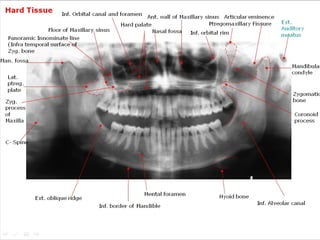
Hard Tissue

Inf. Orbital canal and foramen Ant. wall of Maxillary sinus Articular eminence
Ptregomaxillary Fissure
Hard palate
Floor of Maxillary sinus
Nasal fossa Inf. orbital rim
Panoramic Innominate line
(Infra temporal surface of
Zyg. bone

Man. fossa

Ext.
Auditory
meatus

Mandibular
condyle

Lat.
ptreg.
plate

Zygomatic
bone

Zyg.
process
of
Maxilla

Coronoid
process

C- Spine

Ext. oblique ridge

Mental foramen
Inf. border of Mandible

Powerpoint Templates

Hyoid bone
Inf. Alveolar canal

Page 17
Soft tissues on OP

Powerpoint Templates

Page 18
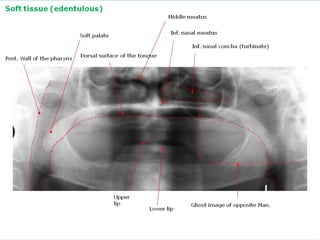
Soft tissue (edentulous)
Middle meatus
Inf. nasal meatus

Soft palate

Inf. nasal concha (turbinate)
Post. Wall of the pharynx

Dorsal surface of the tongue

Upper
lip

Lower lip

Ghost image of opposite Man.

Powerpoint Templates

Page 19
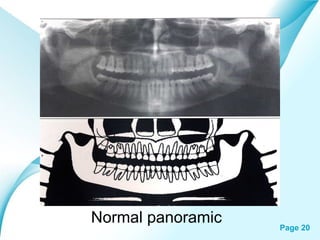
Normal panoramic
Powerpoint Templates

Page 20
Abnormal panoramic

Powerpoint Templates

Page 21
Powerpoint Templates

Page 22
Powerpoint Templates

Page 23
Powerpoint Templates

Page 24
Powerpoint Templates

Page 25
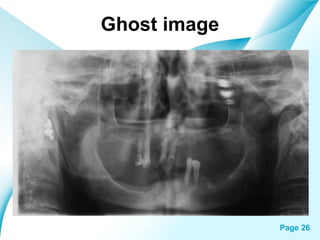
Ghost image

Powerpoint Templates

Page 26
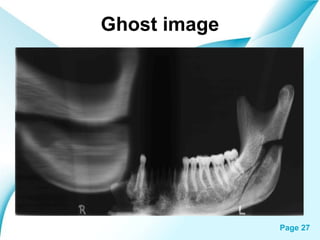
Ghost image

Powerpoint Templates

Page 27
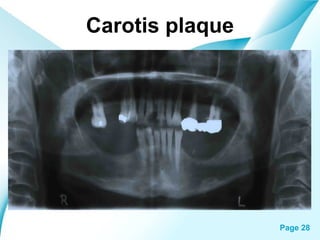
Carotis plaque

Powerpoint Templates

Page 28
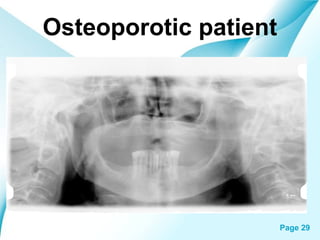
Osteoporotic patient

Powerpoint Templates

Page 29
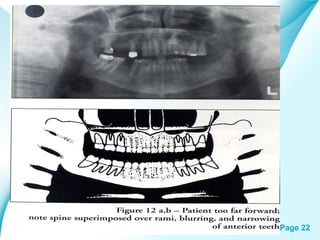
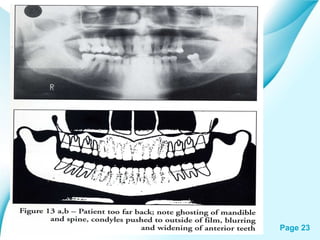
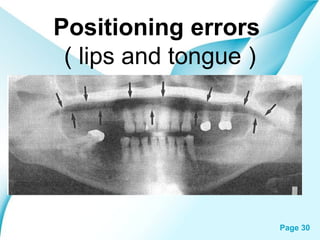
Positioning errors
( lips and tongue )

Powerpoint Templates

Page 30
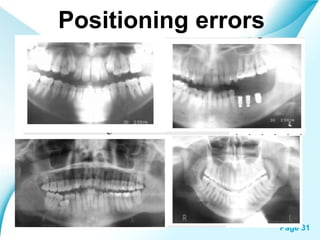
Positioning errors

Powerpoint Templates

Page 31
Resources

http://www.radiologyinfo.org/en/info.cfm?pg=

http://ccnmtl.columbia.edu/broadcast/hs/dent

Powerpoint Templates

Page 32
Thank you

Powerpoint Templates

Page 33

panorama x ray

  • 1.
    Panoramic radiography Mohammed NabilJ AlAli 5th year medical student Powerpoint Templates At King Faisal University Page 1
  • 2.
    Outlines - What isPanoramic X-ray? - What are some common uses of the procedure? - How should I prepare? - What are the components ? - How does the procedure work? - What will I experience during and after the procedure? - What are the benefits vs. risks? - What are the limitations of Panoramic X-ray? - Images . Powerpoint Templates Page 2
  • 3.
    Panoramic radiography Panoramic means“Wide View” Powerpoint Templates Page 3
  • 4.
    What is PanoramicX-ray? • Panoramic radiography, also called panoramic x-ray, is a two-dimensional (2-D) dental x-ray examination that captures the entire mouth in a single image, including the teeth, upper and lower jaws, surrounding structures and tissues. • The jaw is a curved structure similar to that of a horse shoe. However, the panoramic x-ray produces a flat image of the curved structure. It is typically set to provide details of the bones and teeth. • A non-invasive medical test . • The film for a panoramic x-ray is contained inside of the machine. Powerpoint Templates Page 4
  • 5.
  • 6.
    What are somecommon uses of the procedure? • Commonly performed examination by dentists and oral surgeons in everyday practice and is an important diagnostic tool. • It covers a wider area than a conventional intraoral x-ray and, as a result, provides valuable information about the nasal area, maxillary sinuses, tooth positioning and gum and bone irregularities. A panoramic x-ray can also reveal the presence of an existing issue or potential problem such as: • • • • • • Advanced periodontal disease Oral cysts Tumors and oral cancer Impacted teeth Temporo-mandibular joint disorder (TMJ) Powerpoint Templates Sinusitis Page 6
  • 7.
    How should Iprepare? • A panoramic x-ray examination requires no • You will be asked to - wear a lead apron. - Remove your jewelry from the region being imaged, eye glasses and any metal objects that might interfere with the x-ray images. • Women should always inform their dentist or oral surgeon if there is any possibility that they are pregnant. If an x-ray is necessary, minimize radiation exposure to the baby. Powerpoint Templates special preparation. Page 7
  • 8.
    What are thecomponents? 1. X-ray unit. 2. Intensifying screens 3. Screen film 4. Cassette Powerpoint Templates Page 8
  • 9.
    How does theprocedure work? • an x-ray machine produces a small burst of radiation that passes through the body, recording an image on photographic film or a special detector. • the x-ray tube rotates in a semicircle around the patient's head, starting at one side of the jaw and ending at the other side. • Rather than relying on film placed inside the mouth, a panoramic x-ray machine projects a beam through the patient onto film or a detector rotating oppositePowerpoint Templates the x-ray tube. Page 9
  • 10.
    What will Iexperience during and after the procedure? • A panoramic x-ray exam is painless, fast and easy and may be recommended over intraoral x-rays for patients that have a sensitive gag reflex. Powerpoint Templates Page 10
  • 11.
    What are the benefitsvs. risks? Benefits • • No radiation remains in a patient's body after an x-ray examination. X-rays usually have no side effects in the typical diagnostic range for this exam. • Panoramic x-rays can be used for very young children since the film does not have to be placed inside the mouth. Risks • Women should always inform their dentist or oral surgeon if there is any possibility that they are pregnant. Powerpoint Templates Page 11
  • 12.
    What are thelimitations of Panoramic X-ray? • A panoramic x-ray does not provide precise and detailed information about each individual tooth or soft tissues, such as the muscles. • It is generally used as an initial evaluation of the bones and teeth. If further evaluation is needed, a computed tomography (CT) scan or magnetic resonance imaging (MRI) may be ordered. Powerpoint Templates Page 12
  • 13.
  • 14.
  • 15.
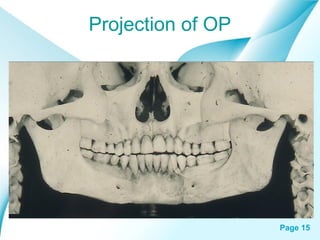
    Projection of OP PowerpointTemplates Page 15
  • 16.
  • 17.
    Hard Tissue Inf. Orbitalcanal and foramen Ant. wall of Maxillary sinus Articular eminence Ptregomaxillary Fissure Hard palate Floor of Maxillary sinus Nasal fossa Inf. orbital rim Panoramic Innominate line (Infra temporal surface of Zyg. bone Man. fossa Ext. Auditory meatus Mandibular condyle Lat. ptreg. plate Zygomatic bone Zyg. process of Maxilla Coronoid process C- Spine Ext. oblique ridge Mental foramen Inf. border of Mandible Powerpoint Templates Hyoid bone Inf. Alveolar canal Page 17
  • 18.
    Soft tissues onOP Powerpoint Templates Page 18
  • 19.
    Soft tissue (edentulous) Middlemeatus Inf. nasal meatus Soft palate Inf. nasal concha (turbinate) Post. Wall of the pharynx Dorsal surface of the tongue Upper lip Lower lip Ghost image of opposite Man. Powerpoint Templates Page 19
  • 20.
  • 21.
  • 22.
  • 23.
  • 24.
  • 25.
  • 26.
  • 27.
  • 28.
  • 29.
  • 30.
    Positioning errors ( lipsand tongue ) Powerpoint Templates Page 30
  • 31.
  • 32.
  • 33.

Editor's Notes

  • #5 What is Panoramic X-ray? Panoramic radiography, also called panoramic x-ray, is a two-dimensional (2-D) dental x-ray examination that captures the entire mouth in a single image, including the teeth, upper and lower jaws, surrounding structures and tissues. The jaw is a curved structure similar to that of a horse shoe. However, the panoramic x-ray produces a flat image of the curved structure. It is typically set to provide details of the bones and teeth. An x-ray (radiograph) is a noninvasive medical test that helps physicians diagnose and treat medical conditions. Imaging with x-rays involves exposing a part of the body to a small dose ofionizing radiation to produce pictures of the inside of the body. X-rays are the oldest and most frequently used form of medical imaging. Unlike a traditional intraoral x-ray where the film is placed inside of the mouth, the film for a panoramic x-ray is contained inside of the machine.
  • #7 What are some common uses of the procedure? A panoramic x-ray is a commonly performed examination by dentists and oral surgeons in everyday practice and is an important diagnostic tool. It covers a wider area than a conventional intraoral x-ray and, as a result, provides valuable information about the nasal area, maxillary sinuses, tooth positioning and gum and bone irregularities. This examination is also used to plan treatment for full and partial dentures, braces, extractions and implants. A panoramic x-ray can also reveal the presence of an existing issue or potential problem such as: advanced periodontal disease oral cysts tumors and oral cancer impacted teeth temporomandibular joint disorder (TMJ) sinusitis
  • #8 How should I prepare? A panoramic x-ray examination requires no special preparation. You will be asked to wear a lead apron as a safety precaution to protect the rest of your body from any radiation exposure that may scatter from the panoramic x-ray beam. You may also be asked to remove your jewelry from the region being imaged, eye glasses and any metal objects that might interfere with the x-ray images. Women should always inform their dentist or oral surgeon if there is any possibility that they are pregnant. Many imaging tests are not performed during pregnancy so as not to expose the fetus to radiation. If an x-ray is necessary, precautions will be taken to minimize radiation exposure to the baby. See the Safety page for more information about pregnancy and x-rays.
  • #9 What does the equipment look like? A panoramic x-ray machine consists of an x-ray tube mounted on a horizontal arm. X-ray film or a detector are mounted on another horizontal arm on the opposite side of the patient. For a sharper, clearer image, the patient's head is positioned with chin, forehead and side rests. The patient is also provided with a bite blocker to prop open the oral cavity.
  • #10 How does the procedure work? X-rays are a form of radiation like light or radio waves. X-rays pass through most objects, including the body. Once it is carefully aimed at the part of the body being examined, an x-ray machine produces a small burst of radiation that passes through the body, recording an image on photographic film or a special detector. During a panoramic x-ray examination, the x-ray tube rotates in a semicircle around the patient's head, starting at one side of the jaw and ending at the other side. Rather than relying on film placed inside the mouth, a panoramic x-ray machine projects a beam through the patient onto film or a detector rotating opposite the x-ray tube. Until recently, x-ray images were maintained as hard film copy (much like a photographic negative). Today, most images are digital files that are stored electronically. These stored images are easily accessible and are frequently compared to current x-ray images for diagnosis and disease management. The digital format also allows the dentist to adjust and change the contrast, brightness and darkness of the image for better visualization of certain structures and tissues. Images on film cannot be adjusted or changed.
  • #11 What will I experience during and after the procedure? A panoramic x-ray exam is painless, fast and easy and may be recommended over intraoral x-rays for patients that have a sensitive gag reflex.
  • #12 What are the benefits vs. risks? Benefits No radiation remains in a patient's body after an x-ray examination. X-rays usually have no side effects in the typical diagnostic range for this exam. Panoramic x-rays can be used for very young children since the film does not have to be placed inside the mouth. Risks Women should always inform their dentist or oral surgeon if there is any possibility that they are pregnant. See the Safety page for more information about pregnancy and x-rays.
  • #13 What are the limitations of Panoramic X-ray? A panoramic x-ray does not provide precise and detailed information about each individual tooth or soft tissues, such as the muscles. It is generally used as an initial evaluation of the bones and teeth. If further evaluation is needed, a computed tomography (CT) scan or magnetic resonance imaging (MRI) may be ordered. Frequently, there is also a degree of distortion on the panoramic x-ray, therefore it may be difficult to obtain accurate measurements.