The Tibia
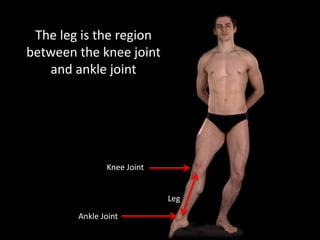
The leg is the region
between the knee joint
and ankle joint
Ankle Joint
Knee Joint
Leg
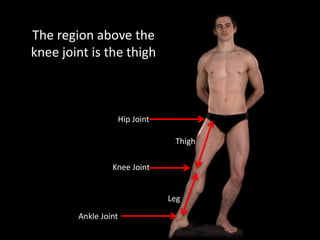
The region above the
knee joint is the thigh
Hip Joint
Knee Joint
Thigh
Leg
Ankle Joint
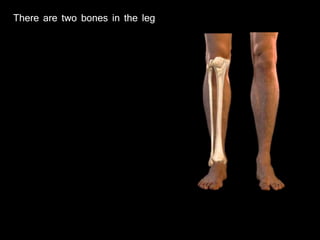
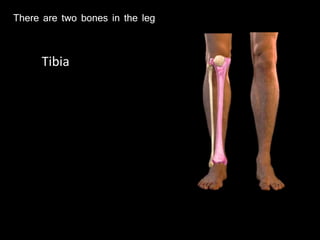
There are two bones in the leg
Tibia
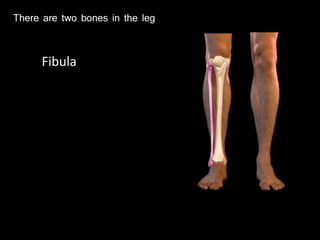
There are two bones in the leg
Fibula
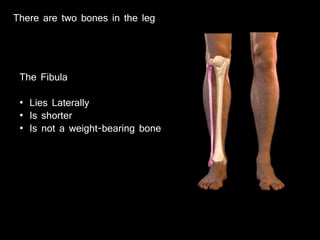
There are two bones in the leg
The Fibula
• Lies Laterally
• Is shorter
• Is not a weight-bearing bone
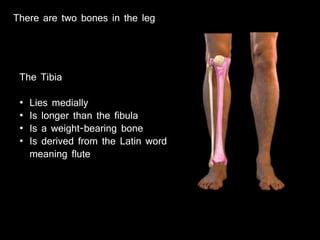
There are two bones in the leg
The Tibia
• Lies medially
• Is longer than the fibula
• Is a weight-bearing bone
• Is derived from the Latin word
meaning flute
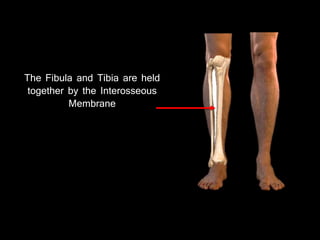
The Fibula and Tibia are held
together by the Interosseous
Membrane
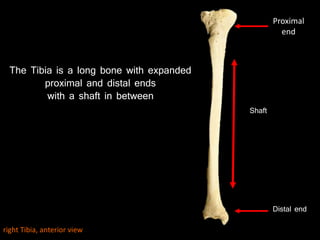
The Tibia is a long bone with expanded
proximal and distal ends
with a shaft in between
Proximal
end
Distal end
Shaft
right Tibia, anterior view
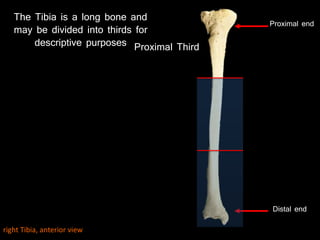
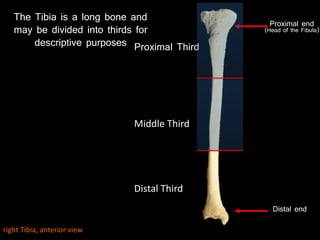
The Tibia is a long bone and
may be divided into thirds for
descriptive purposes
Proximal end
Distal end
Proximal Third
right Tibia, anterior view
Proximal end
(Head of the Fibula)
Distal end
Proximal Third
Middle Third
right Tibia, anterior view
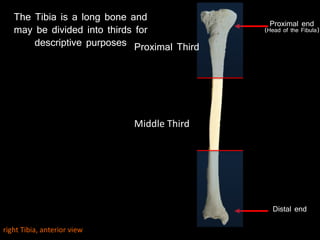
The Tibia is a long bone and
may be divided into thirds for
descriptive purposes
Proximal end
(Head of the Fibula)
Distal end
Proximal Third
Middle Third
Distal Third
right Tibia, anterior view
The Tibia is a long bone and
may be divided into thirds for
descriptive purposes
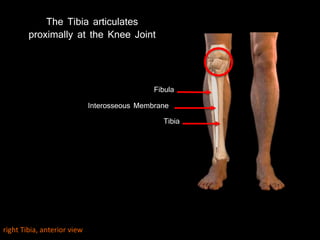
The Tibia articulates
proximally at the Knee Joint
Tibia
Fibula
Interosseous Membrane
right Tibia, anterior view
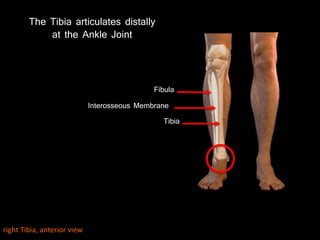
Tibia
Fibula
Interosseous Membrane
The Tibia articulates distally
at the Ankle Joint
right Tibia, anterior view
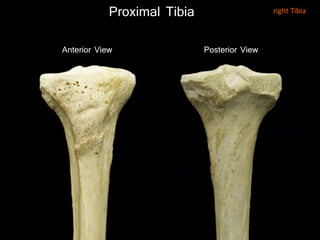
The Proximal Tibia
Proximal Tibia
Anterior View Posterior View
right Tibia
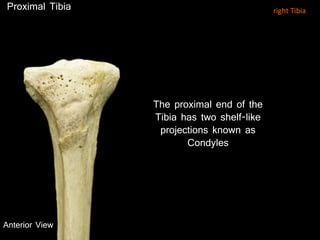
The proximal end of the
Tibia has two shelf-like
projections known as
Condyles
Anterior View
Proximal Tibia right Tibia
Proximal Tibia
Anterior View
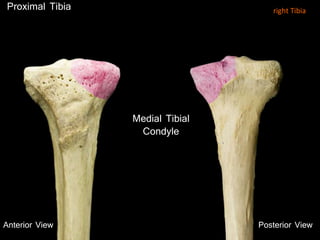
Medial Tibial
Condyle
Posterior View
right Tibia
Proximal Tibia
Anterior View Posterior View
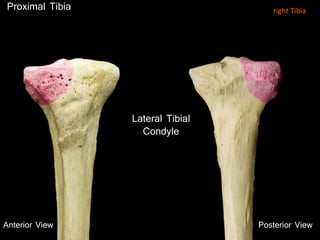
Lateral Tibial
Condyle
right Tibia
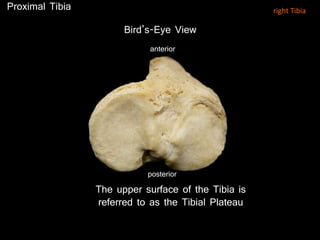
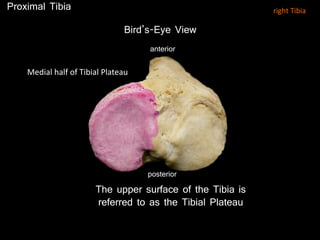
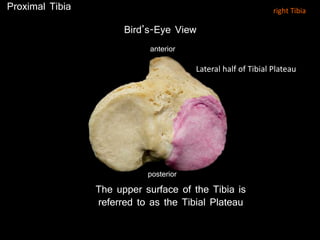
The upper surface of the Tibia is
referred to as the Tibial Plateau
Bird’s-Eye View
posterior
anterior
Proximal Tibia right Tibia
The upper surface of the Tibia is
referred to as the Tibial Plateau
Bird’s-Eye View
posterior
anterior
Proximal Tibia
Medial half of Tibial Plateau
right Tibia
The upper surface of the Tibia is
referred to as the Tibial Plateau
Bird’s-Eye View
posterior
anterior
Proximal Tibia
Lateral half of Tibial Plateau
right Tibia
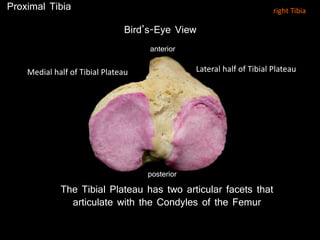
The Tibial Plateau has two articular facets that
articulate with the Condyles of the Femur
Bird’s-Eye View
posterior
anterior
Proximal Tibia right Tibia
Lateral half of Tibial PlateauMedial half of Tibial Plateau
Bird’s-Eye View
posterior
anterior
Proximal Tibia
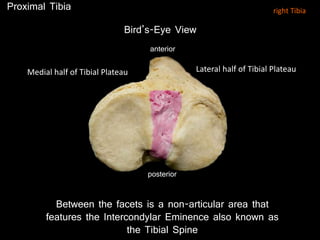
Between the facets is a non-articular area that
features the Intercondylar Eminence also known as
the Tibial Spine
right Tibia
Lateral half of Tibial PlateauMedial half of Tibial Plateau
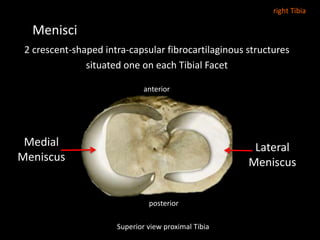
Menisci
2 crescent-shaped intra-capsular fibrocartilaginous structures
situated one on each Tibial Facet
Superior view proximal Tibia
Medial
Meniscus
Lateral
Meniscus
anterior
posterior
right Tibia
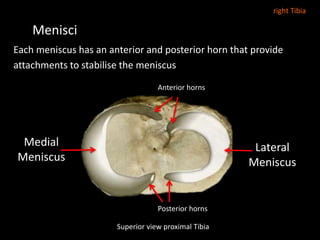
Menisci
Each meniscus has an anterior and posterior horn that provide
attachments to stabilise the meniscus
Superior view proximal Tibia
Medial
Meniscus
Lateral
Meniscus
Anterior horns
Posterior horns
right Tibia
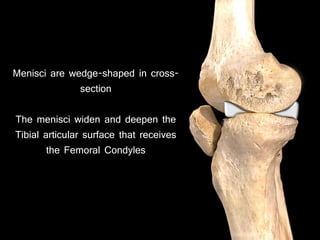
Menisci are wedge-shaped in cross-
section
The menisci widen and deepen the
Tibial articular surface that receives
the Femoral Condyles
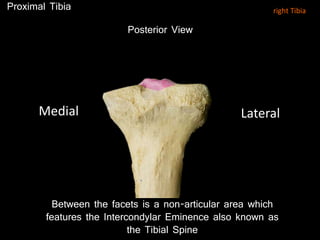
Between the facets is a non-articular area which
features the Intercondylar Eminence also known as
the Tibial Spine
Posterior View
Proximal Tibia
LateralMedial
right Tibia
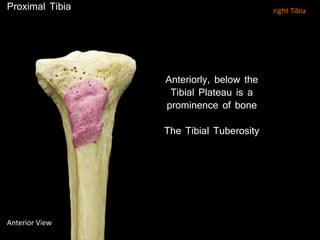
Anteriorly, below the
Tibial Plateau is a
prominence of bone
The Tibial Tuberosity
Proximal Tibia
Anterior View
right Tibia
Proximal Tibia
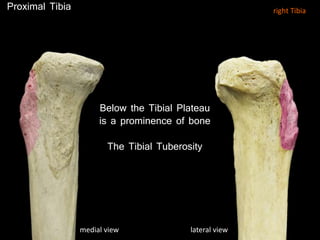
Below the Tibial Plateau
is a prominence of bone
The Tibial Tuberosity
medial view lateral view
right Tibia
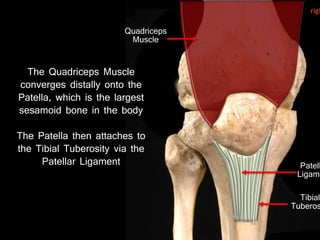
The Quadriceps Muscle
converges distally onto the
Patella, which is the largest
sesamoid bone in the body
The Patella then attaches to
the Tibial Tuberosity via the
Patellar Ligament
Tibial
Tuberos
Patell
Ligame
Quadriceps
Muscle
righ
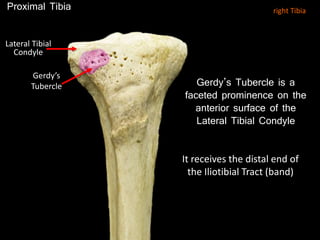
Gerdy’s Tubercle is a
faceted prominence on the
anterior surface of the
Lateral Tibial Condyle
Lateral Tibial
Condyle
Gerdy’s
Tubercle
It receives the distal end of
the Iliotibial Tract (band)
Proximal Tibia right Tibia
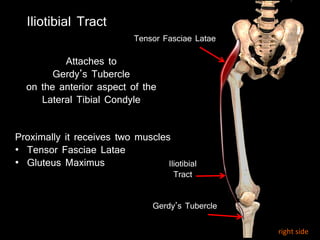
Attaches to
Gerdy’s Tubercle
on the anterior aspect of the
Lateral Tibial Condyle
Iliotibial
Tract
Tensor Fasciae Latae
Gerdy’s Tubercle
Proximally it receives two muscles
• Tensor Fasciae Latae
• Gluteus Maximus
Iliotibial Tract
right side
Proximal Tibia
Posterior View
lateralmedial
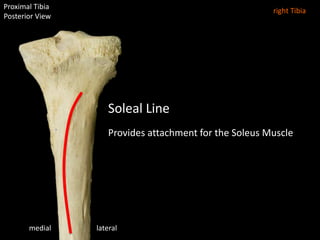
Soleal Line
Provides attachment for the Soleus Muscle
right Tibia
Tibial Shaft
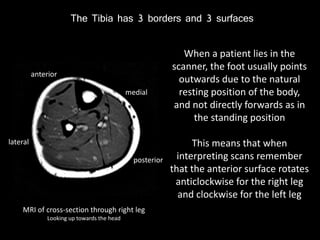
The Tibia has 3 borders and 3 surfaces
MRI of cross-section through right leg
Looking up towards the head
anterior
posterior
medial
lateral
When a patient lies in the
scanner, the foot usually points
outwards due to the natural
resting position of the body,
and not directly forwards as in
the standing position
This means that when
interpreting scans remember
that the anterior surface rotates
anticlockwise for the right leg
and clockwise for the left leg
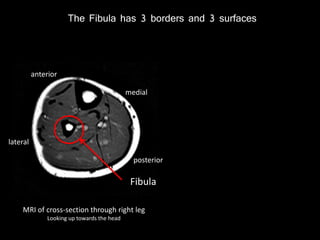
The Fibula has 3 borders and 3 surfaces
MRI of cross-section through right leg
Looking up towards the head
Fibula
anterior
posterior
medial
lateral
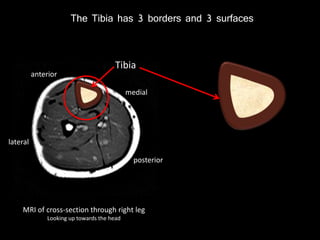
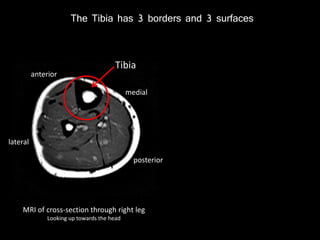
The Tibia has 3 borders and 3 surfaces
MRI of cross-section through right leg
Looking up towards the head
Tibia
anterior
posterior
medial
lateral
The Tibia has 3 borders and 3 surfaces
MRI of cross-section through right leg
Looking up towards the head
Tibia
anterior
posterior
medial
lateral
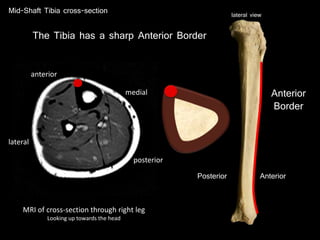
Anterior
The Tibia has a sharp Anterior Border
Mid-Shaft Tibia cross-section
Posterior
Anterior
Border
lateral view
MRI of cross-section through right leg
Looking up towards the head
anterior
posterior
medial
lateral
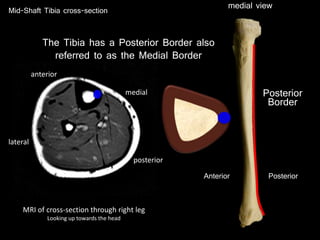
The Tibia has a Posterior Border also
referred to as the Medial Border
Mid-Shaft Tibia cross-section
Posterior
Border
medial view
MRI of cross-section through right leg
Looking up towards the head
anterior
posterior
medial
lateral
Anterior Posterior
Anterior
Mid-Shaft Tibia cross-section
Posterior
Lateral
Border
lateral view
MRI of cross-section through right leg
Looking up towards the head
anterior
posterior
medial
lateral
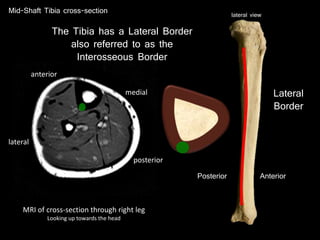
The Tibia has a Lateral Border
also referred to as the
Interosseous Border
Anterior
Mid-Shaft Tibia cross-section
Posterior
Lateral
Border
lateral view
MRI of cross-section through right leg
Looking up towards the head
anterior
posterior
medial
lateral
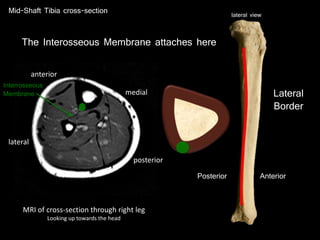
The Interosseous Membrane attaches here
Interrosseous
Membrane
Mid-Shaft Tibia cross-section
MRI of cross-section through right leg
Looking up towards the head
anterior
posterior
medial
lateral
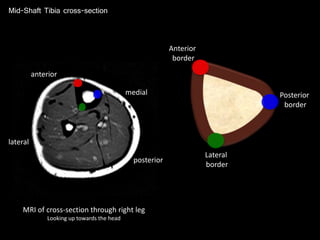
Anterior
border
Posterior
border
Lateral
border
Mid-Shaft Tibia cross-section
MRI of cross-section through right leg
Looking up towards the head
anterior
posterior
medial
lateral
Anterior
border
Posterior
border
Lateral
border
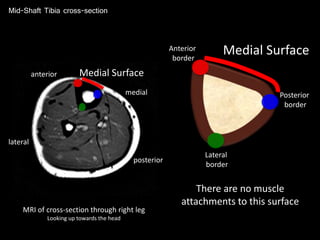
Medial Surface
There are no muscle
attachments to this surface
Medial Surface
Mid-Shaft Tibia cross-section
MRI of cross-section through right leg
Looking up towards the head
anterior
posterior
medial
lateral
Anterior
border
Posterior
border
Lateral
border
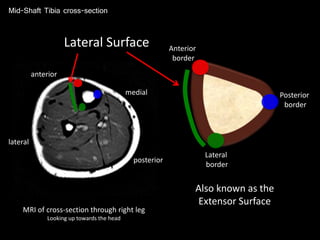
Lateral Surface
Also known as the
Extensor Surface
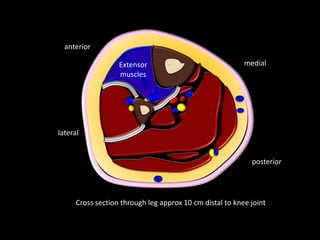
Cross section through leg approx 10 cm distal to knee joint
anterior
posterior
medial
lateral
Extensor
muscles
Mid-Shaft Tibia cross-section
MRI of cross-section through right leg
Looking up towards the head
anterior
posterior
medial
lateral
Anterior
border
Posterior
border
Lateral
border
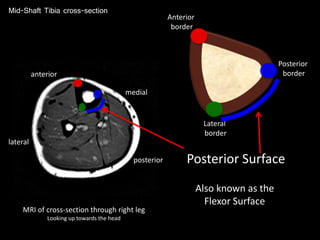
Posterior Surface
Also known as the
Flexor Surface
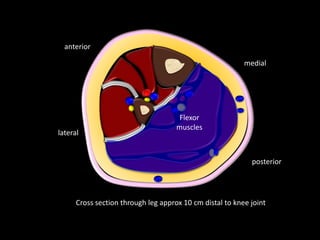
Cross section through leg approx 10 cm distal to knee joint
anterior
posterior
medial
lateral
Flexor
muscles
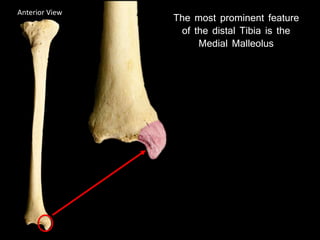
Distal Tibia
Anterior View
The most prominent feature
of the distal Tibia is the
Medial Malleolus
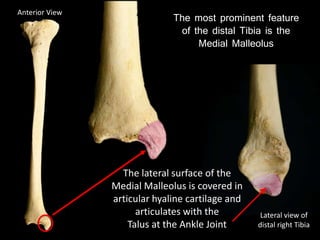
The most prominent feature
of the distal Tibia is the
Medial Malleolus
Anterior View
The lateral surface of the
Medial Malleolus is covered in
articular hyaline cartilage and
articulates with the
Talus at the Ankle Joint
Lateral view of
distal right Tibia
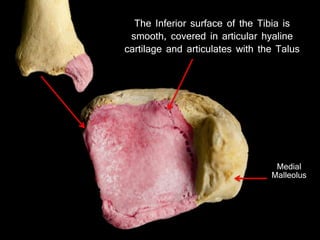
Lateral surface
The Inferior surface of the Tibia is
smooth, covered in articular hyaline
cartilage and articulates with the Talus
Medial
Malleolus
mediallateral
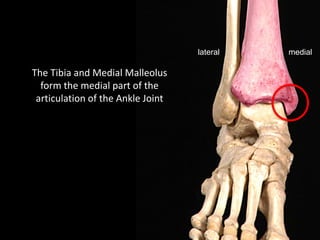
The Tibia and Medial Malleolus
form the medial part of the
articulation of the Ankle Joint
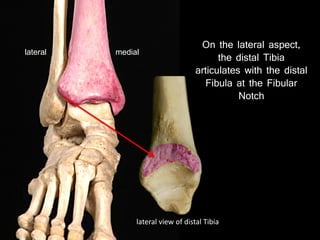
On the lateral aspect,
the distal Tibia
articulates with the distal
Fibula at the Fibular
Notch
mediallateral
lateral view of distal Tibia
Muscle Attachments
Proximal Tibia
Anterior View
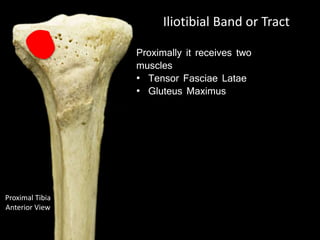
Iliotibial Band or Tract
Proximally it receives two
muscles
• Tensor Fasciae Latae
• Gluteus Maximus
Proximal Tibia
Anterior View
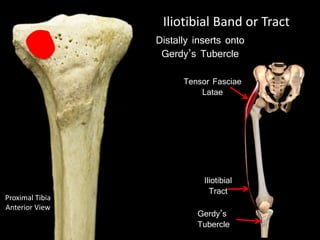
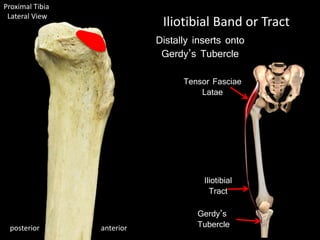
Iliotibial Band or Tract
Distally inserts onto
Gerdy’s Tubercle
Iliotibial
Tract
Tensor Fasciae
Latae
Gerdy’s
Tubercle
Proximal Tibia
Lateral View
anteriorposterior
Iliotibial Band or Tract
Distally inserts onto
Gerdy’s Tubercle
Iliotibial
Tract
Tensor Fasciae
Latae
Gerdy’s
Tubercle
Proximal Tibia
Anterior View
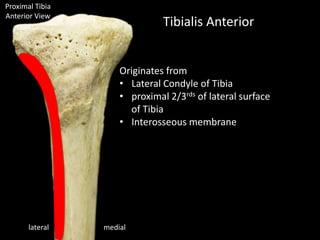
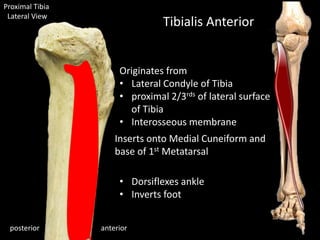
Tibialis Anterior
lateral medial
Originates from
• Lateral Condyle of Tibia
• proximal 2/3rds of lateral surface
of Tibia
• Interosseous membrane
Proximal Tibia
Anterior View
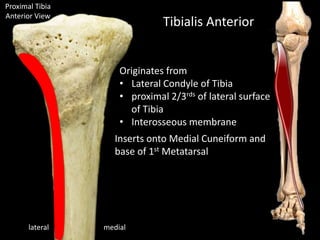
Tibialis Anterior
lateral medial
Inserts onto Medial Cuneiform and
base of 1st Metatarsal
Originates from
• Lateral Condyle of Tibia
• proximal 2/3rds of lateral surface
of Tibia
• Interosseous membrane
Proximal Tibia
Anterior View
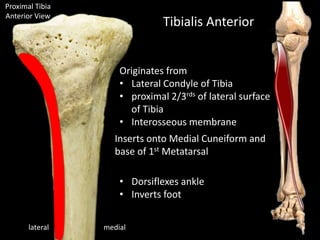
Tibialis Anterior
lateral medial
Inserts onto Medial Cuneiform and
base of 1st Metatarsal
• Dorsiflexes ankle
• Inverts foot
Originates from
• Lateral Condyle of Tibia
• proximal 2/3rds of lateral surface
of Tibia
• Interosseous membrane
Proximal Tibia
Lateral View
anteriorposterior
Tibialis Anterior
Inserts onto Medial Cuneiform and
base of 1st Metatarsal
• Dorsiflexes ankle
• Inverts foot
Originates from
• Lateral Condyle of Tibia
• proximal 2/3rds of lateral surface
of Tibia
• Interosseous membrane
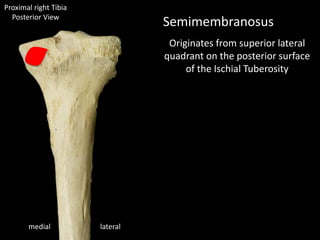
Semimembranosus
Originates from superior lateral
quadrant on the posterior surface
of the Ischial Tuberosity
Proximal right Tibia
Posterior View
lateralmedial
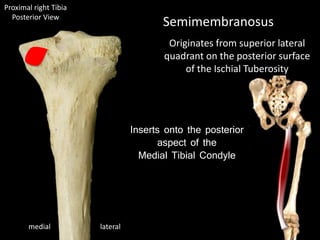
Semimembranosus
Originates from superior lateral
quadrant on the posterior surface
of the Ischial Tuberosity
Inserts onto the posterior
aspect of the
Medial Tibial Condyle
Proximal right Tibia
Posterior View
lateralmedial
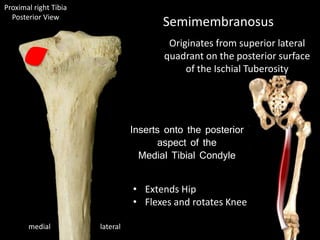
Semimembranosus
Originates from superior lateral
quadrant on the posterior surface
of the Ischial Tuberosity
• Extends Hip
• Flexes and rotates Knee
Proximal right Tibia
Posterior View
lateralmedial
Inserts onto the posterior
aspect of the
Medial Tibial Condyle
Proximal right Tibia
Medial View
posterioranterior
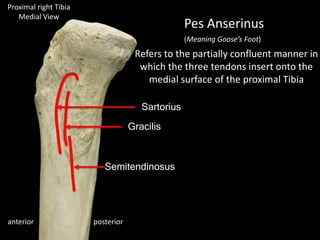
Pes Anserinus
Sartorius
Gracilis
Semitendinosus
(Meaning Goose’s Foot)
Refers to the partially confluent manner in
which the three tendons insert onto the
medial surface of the proximal Tibia
posterioranterior
Pes Anserinus
Sartorius
Gracilis
Semitendinosus
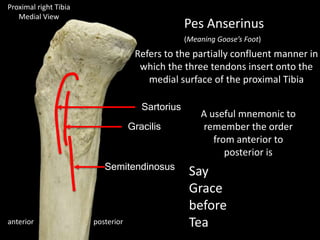
A useful mnemonic to
remember the order
from anterior to
posterior is
Say
Grace
before
Tea
(Meaning Goose’s Foot)
Refers to the partially confluent manner in
which the three tendons insert onto the
medial surface of the proximal Tibia
Proximal right Tibia
Medial View
posterioranterior
Pes Anserinus
Sartorius
Gracilis
Semitendinosus
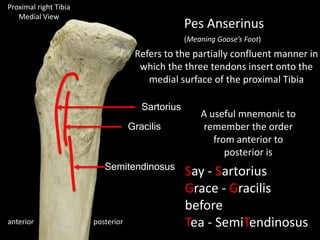
A useful mnemonic to
remember the order
from anterior to
posterior is
Say - Sartorius
Grace - Gracilis
before
Tea - SemiTendinosus
(Meaning Goose’s Foot)
Refers to the partially confluent manner in
which the three tendons insert onto the
medial surface of the proximal Tibia
Proximal right Tibia
Medial View
posterioranterior
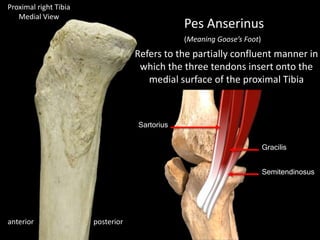
Pes Anserinus
Sartorius
Gracilis
Semitendinosus
(Meaning Goose’s Foot)
Refers to the partially confluent manner in
which the three tendons insert onto the
medial surface of the proximal Tibia
Proximal right Tibia
Medial View
Proximal right Tibia
Posterior View
lateralmedial
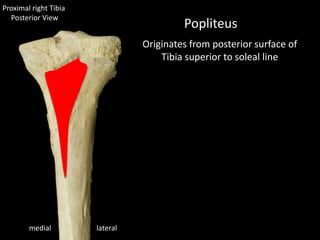
Popliteus
Originates from posterior surface of
Tibia superior to soleal line
lateralmedial
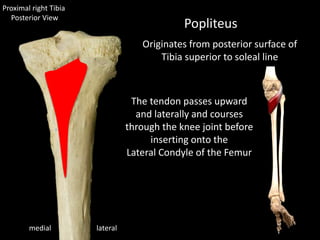
Popliteus
Originates from posterior surface of
Tibia superior to soleal line
The tendon passes upward
and laterally and courses
through the knee joint before
inserting onto the
Lateral Condyle of the Femur
Proximal right Tibia
Posterior View
lateralmedial
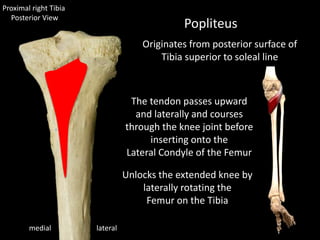
Popliteus
The tendon passes upward
and laterally and courses
through the knee joint before
inserting onto the
Lateral Condyle of the Femur
Unlocks the extended knee by
laterally rotating the
Femur on the Tibia
Originates from posterior surface of
Tibia superior to soleal line
Proximal right Tibia
Posterior View
lateralmedial
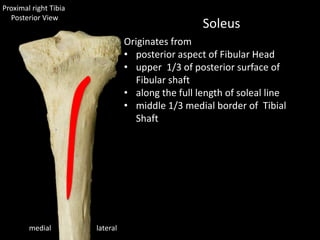
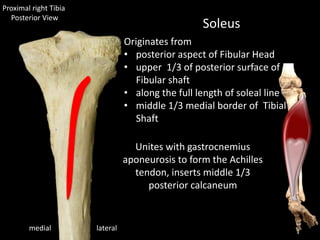
Soleus
Originates from
• posterior aspect of Fibular Head
• upper 1/3 of posterior surface of
Fibular shaft
• along the full length of soleal line
• middle 1/3 medial border of Tibial
Shaft
Proximal right Tibia
Posterior View
lateralmedial
Soleus
Unites with gastrocnemius
aponeurosis to form the Achilles
tendon, inserts middle 1/3
posterior calcaneum
Originates from
• posterior aspect of Fibular Head
• upper 1/3 of posterior surface of
Fibular shaft
• along the full length of soleal line
• middle 1/3 medial border of Tibial
Shaft
Proximal right Tibia
Posterior View
lateralmedial
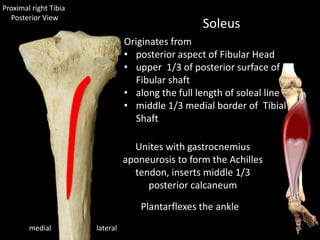
Soleus
Plantarflexes the ankle
Originates from
• posterior aspect of Fibular Head
• upper 1/3 of posterior surface of
Fibular shaft
• along the full length of soleal line
• middle 1/3 medial border of Tibial
Shaft
Proximal right Tibia
Posterior View
Unites with gastrocnemius
aponeurosis to form the Achilles
tendon, inserts middle 1/3
posterior calcaneum
lateralmedial
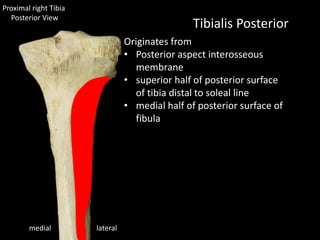
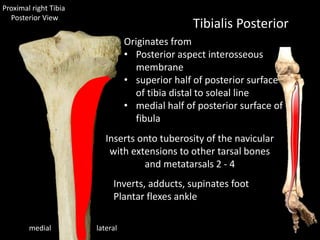
Tibialis Posterior
Proximal right Tibia
Posterior View
Originates from
• Posterior aspect interosseous
membrane
• superior half of posterior surface
of tibia distal to soleal line
• medial half of posterior surface of
fibula
lateralmedial
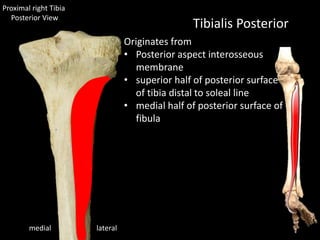
Tibialis Posterior
Proximal right Tibia
Posterior View
Originates from
• Posterior aspect interosseous
membrane
• superior half of posterior surface
of tibia distal to soleal line
• medial half of posterior surface of
fibula
lateralmedial
Tibialis Posterior
Originates from
• Posterior aspect interosseous
membrane
• superior half of posterior surface
of tibia distal to soleal line
• medial half of posterior surface of
fibula
Inserts onto tuberosity of the navicular
with extensions to other tarsal bones
and metatarsals 2 - 4
Inverts, adducts, supinates foot
Plantar flexes ankle
Proximal right Tibia
Posterior View
anteriorposterior
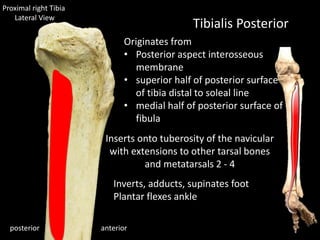
Tibialis Posterior
Inverts, adducts, supinates foot
Plantar flexes ankle
Proximal right Tibia
Lateral View
Originates from
• Posterior aspect interosseous
membrane
• superior half of posterior surface
of tibia distal to soleal line
• medial half of posterior surface of
fibula
Inserts onto tuberosity of the navicular
with extensions to other tarsal bones
and metatarsals 2 - 4
Proximal Tibia
Posterior View
lateralmedial
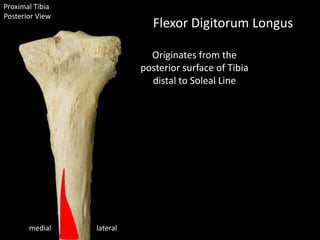
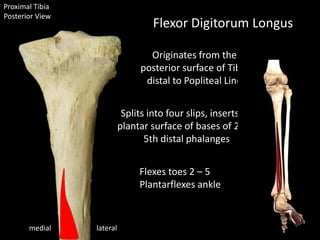
Flexor Digitorum Longus
Originates from the
posterior surface of Tibia
distal to Soleal Line
Proximal Tibia
Posterior View
lateralmedial
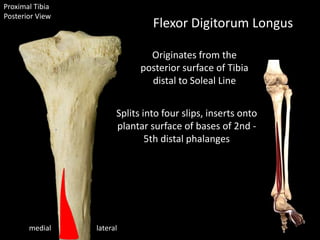
Flexor Digitorum Longus
Originates from the
posterior surface of Tibia
distal to Soleal Line
Splits into four slips, inserts onto
plantar surface of bases of 2nd -
5th distal phalanges
Proximal Tibia
Posterior View
lateralmedial
Flexor Digitorum Longus
Originates from the
posterior surface of Tibia
distal to Popliteal Line
Splits into four slips, inserts on
plantar surface of bases of 2nd -
5th distal phalanges
Flexes toes 2 – 5
Plantarflexes ankle
Ligament Attachments
Proximal right Tibia
Posterior View
lateralmedial
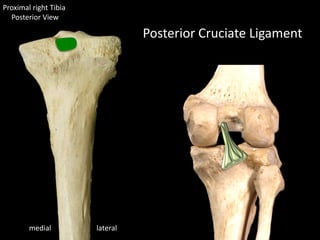
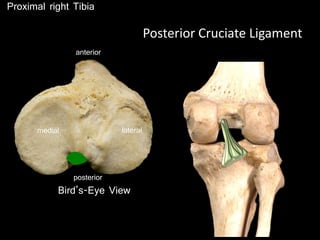
Posterior Cruciate Ligament
posterioranterior
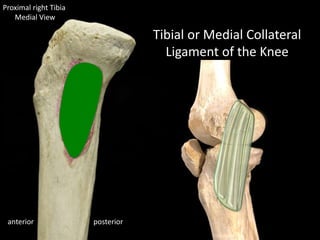
Tibial or Medial Collateral
Ligament of the Knee
Proximal right Tibia
Medial View
Proximal right Tibia
posterior
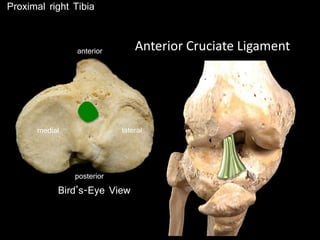
anterior Anterior Cruciate Ligament
Bird’s-Eye View
medial lateral
Proximal right Tibia
posterior
anterior
Posterior Cruciate Ligament
Bird’s-Eye View
medial lateral
posterior
anterior
Proximal right Tibia
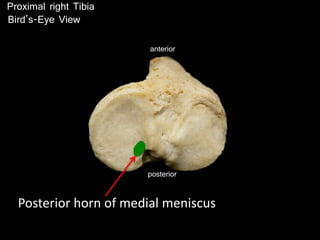
Posterior horn of medial meniscus
Bird’s-Eye View
posterior
anterior
Posterior horn of medial meniscus
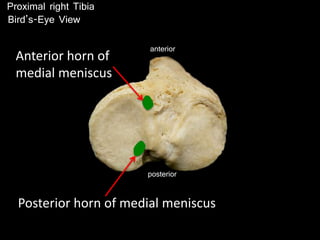
Anterior horn of
medial meniscus
Proximal right Tibia
Bird’s-Eye View
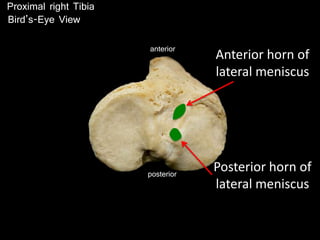
posterior
anterior
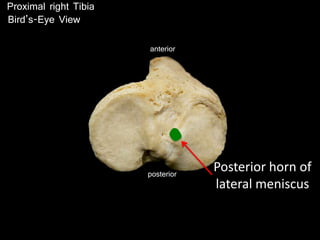
Posterior horn of
lateral meniscus
Proximal right Tibia
Bird’s-Eye View
posterior
anterior
Posterior horn of
lateral meniscus
Anterior horn of
lateral meniscus
Proximal right Tibia
Bird’s-Eye View
posterior
anterior
Posterior horn of
lateral meniscus
Anterior horn of
lateral meniscus
Posterior horn of
medial meniscus
Anterior horn of
medial meniscus
Proximal right Tibia
Bird’s-Eye View
posterior
anterior
Posterior horn of
lateral meniscus
Anterior horn of
lateral meniscus
Posterior horn of
medial meniscus
Anterior horn of
medial meniscus
Proximal right Tibia
Bird’s-Eye View
Muscle Summaries
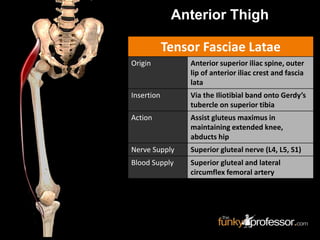
Tensor Fasciae Latae
Origin Anterior superior iliac spine, outer
lip of anterior iliac crest and fascia
lata
Insertion Via the Iliotibial band onto Gerdy’s
tubercle on superior tibia
Action Assist gluteus maximus in
maintaining extended knee,
abducts hip
Nerve Supply Superior gluteal nerve (L4, L5, S1)
Blood Supply Superior gluteal and lateral
circumflex femoral artery
Anterior Thigh
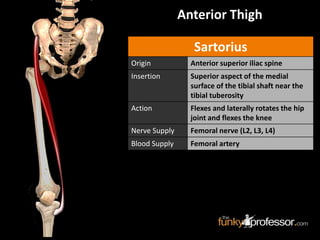
Sartorius
Origin Anterior superior iliac spine
Insertion Superior aspect of the medial
surface of the tibial shaft near the
tibial tuberosity
Action Flexes and laterally rotates the hip
joint and flexes the knee
Nerve Supply Femoral nerve (L2, L3, L4)
Blood Supply Femoral artery
Anterior Thigh
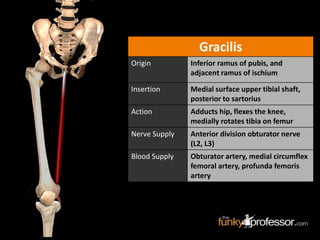
Gracilis
Origin Inferior ramus of pubis, and
adjacent ramus of ischium
Insertion Medial surface upper tibial shaft,
posterior to sartorius
Action Adducts hip, flexes the knee,
medially rotates tibia on femur
Nerve Supply Anterior division obturator nerve
(L2, L3)
Blood Supply Obturator artery, medial circumflex
femoral artery, profunda femoris
artery
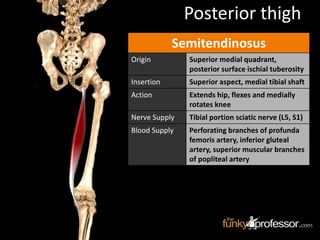
Semitendinosus
Origin Superior medial quadrant,
posterior surface ischial tuberosity
Insertion Superior aspect, medial tibial shaft
Action Extends hip, flexes and medially
rotates knee
Nerve Supply Tibial portion sciatic nerve (L5, S1)
Blood Supply Perforating branches of profunda
femoris artery, inferior gluteal
artery, superior muscular branches
of popliteal artery
Posterior thigh
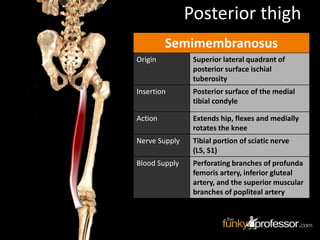
Semimembranosus
Origin Superior lateral quadrant of
posterior surface ischial
tuberosity
Insertion Posterior surface of the medial
tibial condyle
Action Extends hip, flexes and medially
rotates the knee
Nerve Supply Tibial portion of sciatic nerve
(L5, S1)
Blood Supply Perforating branches of profunda
femoris artery, inferior gluteal
artery, and the superior muscular
branches of popliteal artery
Posterior thigh
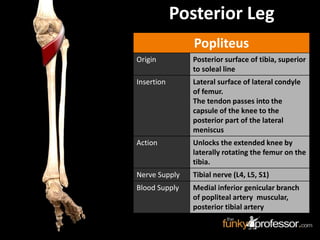
Popliteus
Origin Posterior surface of tibia, superior
to soleal line
Insertion Lateral surface of lateral condyle
of femur.
The tendon passes into the
capsule of the knee to the
posterior part of the lateral
meniscus
Action Unlocks the extended knee by
laterally rotating the femur on the
tibia.
Nerve Supply Tibial nerve (L4, L5, S1)
Blood Supply Medial inferior genicular branch
of popliteal artery muscular,
posterior tibial artery
Posterior Leg
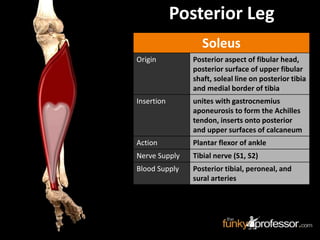
Soleus
Origin Posterior aspect of fibular head,
posterior surface of upper fibular
shaft, soleal line on posterior tibia
and medial border of tibia
Insertion unites with gastrocnemius
aponeurosis to form the Achilles
tendon, inserts onto posterior
and upper surfaces of calcaneum
Action Plantar flexor of ankle
Nerve Supply Tibial nerve (S1, S2)
Blood Supply Posterior tibial, peroneal, and
sural arteries
Posterior Leg
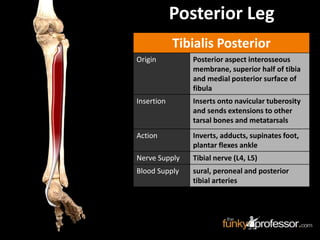
Tibialis Posterior
Origin Posterior aspect interosseous
membrane, superior half of tibia
and medial posterior surface of
fibula
Insertion Inserts onto navicular tuberosity
and sends extensions to other
tarsal bones and metatarsals
Action Inverts, adducts, supinates foot,
plantar flexes ankle
Nerve Supply Tibial nerve (L4, L5)
Blood Supply sural, peroneal and posterior
tibial arteries
Posterior Leg
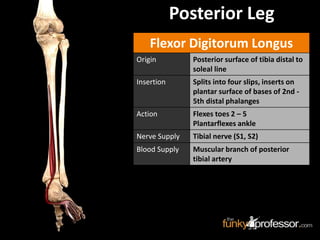
Flexor Digitorum Longus
Origin Posterior surface of tibia distal to
soleal line
Insertion Splits into four slips, inserts on
plantar surface of bases of 2nd -
5th distal phalanges
Action Flexes toes 2 – 5
Plantarflexes ankle
Nerve Supply Tibial nerve (S1, S2)
Blood Supply Muscular branch of posterior
tibial artery
Posterior Leg
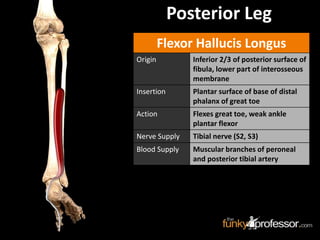
Flexor Hallucis Longus
Origin Inferior 2/3 of posterior surface of
fibula, lower part of interosseous
membrane
Insertion Plantar surface of base of distal
phalanx of great toe
Action Flexes great toe, weak ankle
plantar flexor
Nerve Supply Tibial nerve (S2, S3)
Blood Supply Muscular branches of peroneal
and posterior tibial artery
Posterior Leg
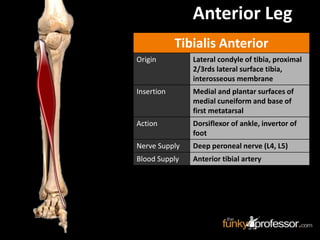
Tibialis Anterior
Origin Lateral condyle of tibia, proximal
2/3rds lateral surface tibia,
interosseous membrane
Insertion Medial and plantar surfaces of
medial cuneiform and base of
first metatarsal
Action Dorsiflexor of ankle, invertor of
foot
Nerve Supply Deep peroneal nerve (L4, L5)
Blood Supply Anterior tibial artery
Anterior Leg

Slideshow: Tibia

  • 1.
  • 2.
    The leg isthe region between the knee joint and ankle joint Ankle Joint Knee Joint Leg
  • 3.
    The region abovethe knee joint is the thigh Hip Joint Knee Joint Thigh Leg Ankle Joint
  • 4.
    There are twobones in the leg
  • 5.
    There are twobones in the leg Tibia
  • 6.
    There are twobones in the leg Fibula
  • 7.
    There are twobones in the leg The Fibula • Lies Laterally • Is shorter • Is not a weight-bearing bone
  • 8.
    There are twobones in the leg The Tibia • Lies medially • Is longer than the fibula • Is a weight-bearing bone • Is derived from the Latin word meaning flute
  • 9.
    The Fibula andTibia are held together by the Interosseous Membrane
  • 10.
    The Tibia isa long bone with expanded proximal and distal ends with a shaft in between Proximal end Distal end Shaft right Tibia, anterior view
  • 11.
    The Tibia isa long bone and may be divided into thirds for descriptive purposes Proximal end Distal end Proximal Third right Tibia, anterior view
  • 12.
    Proximal end (Head ofthe Fibula) Distal end Proximal Third Middle Third right Tibia, anterior view The Tibia is a long bone and may be divided into thirds for descriptive purposes
  • 13.
    Proximal end (Head ofthe Fibula) Distal end Proximal Third Middle Third Distal Third right Tibia, anterior view The Tibia is a long bone and may be divided into thirds for descriptive purposes
  • 14.
    The Tibia articulates proximallyat the Knee Joint Tibia Fibula Interosseous Membrane right Tibia, anterior view
  • 15.
    Tibia Fibula Interosseous Membrane The Tibiaarticulates distally at the Ankle Joint right Tibia, anterior view
  • 16.
  • 17.
    Proximal Tibia Anterior ViewPosterior View right Tibia
  • 18.
    The proximal endof the Tibia has two shelf-like projections known as Condyles Anterior View Proximal Tibia right Tibia
  • 19.
    Proximal Tibia Anterior View MedialTibial Condyle Posterior View right Tibia
  • 20.
    Proximal Tibia Anterior ViewPosterior View Lateral Tibial Condyle right Tibia
  • 21.
    The upper surfaceof the Tibia is referred to as the Tibial Plateau Bird’s-Eye View posterior anterior Proximal Tibia right Tibia
  • 22.
    The upper surfaceof the Tibia is referred to as the Tibial Plateau Bird’s-Eye View posterior anterior Proximal Tibia Medial half of Tibial Plateau right Tibia
  • 23.
    The upper surfaceof the Tibia is referred to as the Tibial Plateau Bird’s-Eye View posterior anterior Proximal Tibia Lateral half of Tibial Plateau right Tibia
  • 24.
    The Tibial Plateauhas two articular facets that articulate with the Condyles of the Femur Bird’s-Eye View posterior anterior Proximal Tibia right Tibia Lateral half of Tibial PlateauMedial half of Tibial Plateau
  • 25.
    Bird’s-Eye View posterior anterior Proximal Tibia Betweenthe facets is a non-articular area that features the Intercondylar Eminence also known as the Tibial Spine right Tibia Lateral half of Tibial PlateauMedial half of Tibial Plateau
  • 26.
    Menisci 2 crescent-shaped intra-capsularfibrocartilaginous structures situated one on each Tibial Facet Superior view proximal Tibia Medial Meniscus Lateral Meniscus anterior posterior right Tibia
  • 27.
    Menisci Each meniscus hasan anterior and posterior horn that provide attachments to stabilise the meniscus Superior view proximal Tibia Medial Meniscus Lateral Meniscus Anterior horns Posterior horns right Tibia
  • 28.
    Menisci are wedge-shapedin cross- section The menisci widen and deepen the Tibial articular surface that receives the Femoral Condyles
  • 29.
    Between the facetsis a non-articular area which features the Intercondylar Eminence also known as the Tibial Spine Posterior View Proximal Tibia LateralMedial right Tibia
  • 30.
    Anteriorly, below the TibialPlateau is a prominence of bone The Tibial Tuberosity Proximal Tibia Anterior View right Tibia
  • 31.
    Proximal Tibia Below theTibial Plateau is a prominence of bone The Tibial Tuberosity medial view lateral view right Tibia
  • 32.
    The Quadriceps Muscle convergesdistally onto the Patella, which is the largest sesamoid bone in the body The Patella then attaches to the Tibial Tuberosity via the Patellar Ligament Tibial Tuberos Patell Ligame Quadriceps Muscle righ
  • 33.
    Gerdy’s Tubercle isa faceted prominence on the anterior surface of the Lateral Tibial Condyle Lateral Tibial Condyle Gerdy’s Tubercle It receives the distal end of the Iliotibial Tract (band) Proximal Tibia right Tibia
  • 34.
    Attaches to Gerdy’s Tubercle onthe anterior aspect of the Lateral Tibial Condyle Iliotibial Tract Tensor Fasciae Latae Gerdy’s Tubercle Proximally it receives two muscles • Tensor Fasciae Latae • Gluteus Maximus Iliotibial Tract right side
  • 35.
    Proximal Tibia Posterior View lateralmedial SolealLine Provides attachment for the Soleus Muscle right Tibia
  • 36.
  • 37.
    The Tibia has3 borders and 3 surfaces MRI of cross-section through right leg Looking up towards the head anterior posterior medial lateral When a patient lies in the scanner, the foot usually points outwards due to the natural resting position of the body, and not directly forwards as in the standing position This means that when interpreting scans remember that the anterior surface rotates anticlockwise for the right leg and clockwise for the left leg
  • 38.
    The Fibula has3 borders and 3 surfaces MRI of cross-section through right leg Looking up towards the head Fibula anterior posterior medial lateral
  • 39.
    The Tibia has3 borders and 3 surfaces MRI of cross-section through right leg Looking up towards the head Tibia anterior posterior medial lateral
  • 40.
    The Tibia has3 borders and 3 surfaces MRI of cross-section through right leg Looking up towards the head Tibia anterior posterior medial lateral
  • 41.
    Anterior The Tibia hasa sharp Anterior Border Mid-Shaft Tibia cross-section Posterior Anterior Border lateral view MRI of cross-section through right leg Looking up towards the head anterior posterior medial lateral
  • 42.
    The Tibia hasa Posterior Border also referred to as the Medial Border Mid-Shaft Tibia cross-section Posterior Border medial view MRI of cross-section through right leg Looking up towards the head anterior posterior medial lateral Anterior Posterior
  • 43.
    Anterior Mid-Shaft Tibia cross-section Posterior Lateral Border lateralview MRI of cross-section through right leg Looking up towards the head anterior posterior medial lateral The Tibia has a Lateral Border also referred to as the Interosseous Border
  • 44.
    Anterior Mid-Shaft Tibia cross-section Posterior Lateral Border lateralview MRI of cross-section through right leg Looking up towards the head anterior posterior medial lateral The Interosseous Membrane attaches here Interrosseous Membrane
  • 45.
    Mid-Shaft Tibia cross-section MRIof cross-section through right leg Looking up towards the head anterior posterior medial lateral Anterior border Posterior border Lateral border
  • 46.
    Mid-Shaft Tibia cross-section MRIof cross-section through right leg Looking up towards the head anterior posterior medial lateral Anterior border Posterior border Lateral border Medial Surface There are no muscle attachments to this surface Medial Surface
  • 47.
    Mid-Shaft Tibia cross-section MRIof cross-section through right leg Looking up towards the head anterior posterior medial lateral Anterior border Posterior border Lateral border Lateral Surface Also known as the Extensor Surface
  • 48.
    Cross section throughleg approx 10 cm distal to knee joint anterior posterior medial lateral Extensor muscles
  • 49.
    Mid-Shaft Tibia cross-section MRIof cross-section through right leg Looking up towards the head anterior posterior medial lateral Anterior border Posterior border Lateral border Posterior Surface Also known as the Flexor Surface
  • 50.
    Cross section throughleg approx 10 cm distal to knee joint anterior posterior medial lateral Flexor muscles
  • 51.
  • 52.
    Anterior View The mostprominent feature of the distal Tibia is the Medial Malleolus
  • 53.
    The most prominentfeature of the distal Tibia is the Medial Malleolus Anterior View The lateral surface of the Medial Malleolus is covered in articular hyaline cartilage and articulates with the Talus at the Ankle Joint Lateral view of distal right Tibia
  • 54.
    Lateral surface The Inferiorsurface of the Tibia is smooth, covered in articular hyaline cartilage and articulates with the Talus Medial Malleolus
  • 55.
    mediallateral The Tibia andMedial Malleolus form the medial part of the articulation of the Ankle Joint
  • 56.
    On the lateralaspect, the distal Tibia articulates with the distal Fibula at the Fibular Notch mediallateral lateral view of distal Tibia
  • 57.
  • 58.
    Proximal Tibia Anterior View IliotibialBand or Tract Proximally it receives two muscles • Tensor Fasciae Latae • Gluteus Maximus
  • 59.
    Proximal Tibia Anterior View IliotibialBand or Tract Distally inserts onto Gerdy’s Tubercle Iliotibial Tract Tensor Fasciae Latae Gerdy’s Tubercle
  • 60.
    Proximal Tibia Lateral View anteriorposterior IliotibialBand or Tract Distally inserts onto Gerdy’s Tubercle Iliotibial Tract Tensor Fasciae Latae Gerdy’s Tubercle
  • 61.
    Proximal Tibia Anterior View TibialisAnterior lateral medial Originates from • Lateral Condyle of Tibia • proximal 2/3rds of lateral surface of Tibia • Interosseous membrane
  • 62.
    Proximal Tibia Anterior View TibialisAnterior lateral medial Inserts onto Medial Cuneiform and base of 1st Metatarsal Originates from • Lateral Condyle of Tibia • proximal 2/3rds of lateral surface of Tibia • Interosseous membrane
  • 63.
    Proximal Tibia Anterior View TibialisAnterior lateral medial Inserts onto Medial Cuneiform and base of 1st Metatarsal • Dorsiflexes ankle • Inverts foot Originates from • Lateral Condyle of Tibia • proximal 2/3rds of lateral surface of Tibia • Interosseous membrane
  • 64.
    Proximal Tibia Lateral View anteriorposterior TibialisAnterior Inserts onto Medial Cuneiform and base of 1st Metatarsal • Dorsiflexes ankle • Inverts foot Originates from • Lateral Condyle of Tibia • proximal 2/3rds of lateral surface of Tibia • Interosseous membrane
  • 65.
    Semimembranosus Originates from superiorlateral quadrant on the posterior surface of the Ischial Tuberosity Proximal right Tibia Posterior View lateralmedial
  • 66.
    Semimembranosus Originates from superiorlateral quadrant on the posterior surface of the Ischial Tuberosity Inserts onto the posterior aspect of the Medial Tibial Condyle Proximal right Tibia Posterior View lateralmedial
  • 67.
    Semimembranosus Originates from superiorlateral quadrant on the posterior surface of the Ischial Tuberosity • Extends Hip • Flexes and rotates Knee Proximal right Tibia Posterior View lateralmedial Inserts onto the posterior aspect of the Medial Tibial Condyle
  • 68.
    Proximal right Tibia MedialView posterioranterior Pes Anserinus Sartorius Gracilis Semitendinosus (Meaning Goose’s Foot) Refers to the partially confluent manner in which the three tendons insert onto the medial surface of the proximal Tibia
  • 69.
    posterioranterior Pes Anserinus Sartorius Gracilis Semitendinosus A usefulmnemonic to remember the order from anterior to posterior is Say Grace before Tea (Meaning Goose’s Foot) Refers to the partially confluent manner in which the three tendons insert onto the medial surface of the proximal Tibia Proximal right Tibia Medial View
  • 70.
    posterioranterior Pes Anserinus Sartorius Gracilis Semitendinosus A usefulmnemonic to remember the order from anterior to posterior is Say - Sartorius Grace - Gracilis before Tea - SemiTendinosus (Meaning Goose’s Foot) Refers to the partially confluent manner in which the three tendons insert onto the medial surface of the proximal Tibia Proximal right Tibia Medial View
  • 71.
    posterioranterior Pes Anserinus Sartorius Gracilis Semitendinosus (Meaning Goose’sFoot) Refers to the partially confluent manner in which the three tendons insert onto the medial surface of the proximal Tibia Proximal right Tibia Medial View
  • 72.
    Proximal right Tibia PosteriorView lateralmedial Popliteus Originates from posterior surface of Tibia superior to soleal line
  • 73.
    lateralmedial Popliteus Originates from posteriorsurface of Tibia superior to soleal line The tendon passes upward and laterally and courses through the knee joint before inserting onto the Lateral Condyle of the Femur Proximal right Tibia Posterior View
  • 74.
    lateralmedial Popliteus The tendon passesupward and laterally and courses through the knee joint before inserting onto the Lateral Condyle of the Femur Unlocks the extended knee by laterally rotating the Femur on the Tibia Originates from posterior surface of Tibia superior to soleal line Proximal right Tibia Posterior View
  • 75.
    lateralmedial Soleus Originates from • posterioraspect of Fibular Head • upper 1/3 of posterior surface of Fibular shaft • along the full length of soleal line • middle 1/3 medial border of Tibial Shaft Proximal right Tibia Posterior View
  • 76.
    lateralmedial Soleus Unites with gastrocnemius aponeurosisto form the Achilles tendon, inserts middle 1/3 posterior calcaneum Originates from • posterior aspect of Fibular Head • upper 1/3 of posterior surface of Fibular shaft • along the full length of soleal line • middle 1/3 medial border of Tibial Shaft Proximal right Tibia Posterior View
  • 77.
    lateralmedial Soleus Plantarflexes the ankle Originatesfrom • posterior aspect of Fibular Head • upper 1/3 of posterior surface of Fibular shaft • along the full length of soleal line • middle 1/3 medial border of Tibial Shaft Proximal right Tibia Posterior View Unites with gastrocnemius aponeurosis to form the Achilles tendon, inserts middle 1/3 posterior calcaneum
  • 78.
    lateralmedial Tibialis Posterior Proximal rightTibia Posterior View Originates from • Posterior aspect interosseous membrane • superior half of posterior surface of tibia distal to soleal line • medial half of posterior surface of fibula
  • 79.
    lateralmedial Tibialis Posterior Proximal rightTibia Posterior View Originates from • Posterior aspect interosseous membrane • superior half of posterior surface of tibia distal to soleal line • medial half of posterior surface of fibula
  • 80.
    lateralmedial Tibialis Posterior Originates from •Posterior aspect interosseous membrane • superior half of posterior surface of tibia distal to soleal line • medial half of posterior surface of fibula Inserts onto tuberosity of the navicular with extensions to other tarsal bones and metatarsals 2 - 4 Inverts, adducts, supinates foot Plantar flexes ankle Proximal right Tibia Posterior View
  • 81.
    anteriorposterior Tibialis Posterior Inverts, adducts,supinates foot Plantar flexes ankle Proximal right Tibia Lateral View Originates from • Posterior aspect interosseous membrane • superior half of posterior surface of tibia distal to soleal line • medial half of posterior surface of fibula Inserts onto tuberosity of the navicular with extensions to other tarsal bones and metatarsals 2 - 4
  • 82.
    Proximal Tibia Posterior View lateralmedial FlexorDigitorum Longus Originates from the posterior surface of Tibia distal to Soleal Line
  • 83.
    Proximal Tibia Posterior View lateralmedial FlexorDigitorum Longus Originates from the posterior surface of Tibia distal to Soleal Line Splits into four slips, inserts onto plantar surface of bases of 2nd - 5th distal phalanges
  • 84.
    Proximal Tibia Posterior View lateralmedial FlexorDigitorum Longus Originates from the posterior surface of Tibia distal to Popliteal Line Splits into four slips, inserts on plantar surface of bases of 2nd - 5th distal phalanges Flexes toes 2 – 5 Plantarflexes ankle
  • 85.
  • 86.
    Proximal right Tibia PosteriorView lateralmedial Posterior Cruciate Ligament
  • 87.
    posterioranterior Tibial or MedialCollateral Ligament of the Knee Proximal right Tibia Medial View
  • 88.
    Proximal right Tibia posterior anteriorAnterior Cruciate Ligament Bird’s-Eye View medial lateral
  • 89.
    Proximal right Tibia posterior anterior PosteriorCruciate Ligament Bird’s-Eye View medial lateral
  • 90.
    posterior anterior Proximal right Tibia Posteriorhorn of medial meniscus Bird’s-Eye View
  • 91.
    posterior anterior Posterior horn ofmedial meniscus Anterior horn of medial meniscus Proximal right Tibia Bird’s-Eye View
  • 92.
    posterior anterior Posterior horn of lateralmeniscus Proximal right Tibia Bird’s-Eye View
  • 93.
    posterior anterior Posterior horn of lateralmeniscus Anterior horn of lateral meniscus Proximal right Tibia Bird’s-Eye View
  • 94.
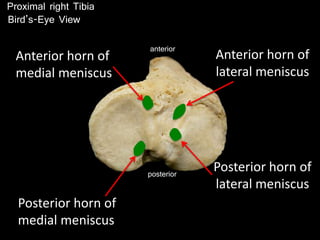
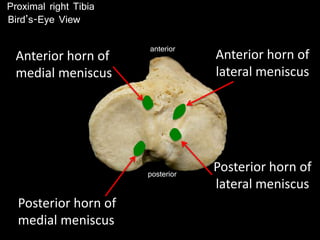
    posterior anterior Posterior horn of lateralmeniscus Anterior horn of lateral meniscus Posterior horn of medial meniscus Anterior horn of medial meniscus Proximal right Tibia Bird’s-Eye View
  • 95.
    posterior anterior Posterior horn of lateralmeniscus Anterior horn of lateral meniscus Posterior horn of medial meniscus Anterior horn of medial meniscus Proximal right Tibia Bird’s-Eye View
  • 96.
  • 97.
    Tensor Fasciae Latae OriginAnterior superior iliac spine, outer lip of anterior iliac crest and fascia lata Insertion Via the Iliotibial band onto Gerdy’s tubercle on superior tibia Action Assist gluteus maximus in maintaining extended knee, abducts hip Nerve Supply Superior gluteal nerve (L4, L5, S1) Blood Supply Superior gluteal and lateral circumflex femoral artery Anterior Thigh
  • 98.
    Sartorius Origin Anterior superioriliac spine Insertion Superior aspect of the medial surface of the tibial shaft near the tibial tuberosity Action Flexes and laterally rotates the hip joint and flexes the knee Nerve Supply Femoral nerve (L2, L3, L4) Blood Supply Femoral artery Anterior Thigh
  • 99.
    Gracilis Origin Inferior ramusof pubis, and adjacent ramus of ischium Insertion Medial surface upper tibial shaft, posterior to sartorius Action Adducts hip, flexes the knee, medially rotates tibia on femur Nerve Supply Anterior division obturator nerve (L2, L3) Blood Supply Obturator artery, medial circumflex femoral artery, profunda femoris artery
  • 100.
    Semitendinosus Origin Superior medialquadrant, posterior surface ischial tuberosity Insertion Superior aspect, medial tibial shaft Action Extends hip, flexes and medially rotates knee Nerve Supply Tibial portion sciatic nerve (L5, S1) Blood Supply Perforating branches of profunda femoris artery, inferior gluteal artery, superior muscular branches of popliteal artery Posterior thigh
  • 101.
    Semimembranosus Origin Superior lateralquadrant of posterior surface ischial tuberosity Insertion Posterior surface of the medial tibial condyle Action Extends hip, flexes and medially rotates the knee Nerve Supply Tibial portion of sciatic nerve (L5, S1) Blood Supply Perforating branches of profunda femoris artery, inferior gluteal artery, and the superior muscular branches of popliteal artery Posterior thigh
  • 102.
    Popliteus Origin Posterior surfaceof tibia, superior to soleal line Insertion Lateral surface of lateral condyle of femur. The tendon passes into the capsule of the knee to the posterior part of the lateral meniscus Action Unlocks the extended knee by laterally rotating the femur on the tibia. Nerve Supply Tibial nerve (L4, L5, S1) Blood Supply Medial inferior genicular branch of popliteal artery muscular, posterior tibial artery Posterior Leg
  • 103.
    Soleus Origin Posterior aspectof fibular head, posterior surface of upper fibular shaft, soleal line on posterior tibia and medial border of tibia Insertion unites with gastrocnemius aponeurosis to form the Achilles tendon, inserts onto posterior and upper surfaces of calcaneum Action Plantar flexor of ankle Nerve Supply Tibial nerve (S1, S2) Blood Supply Posterior tibial, peroneal, and sural arteries Posterior Leg
  • 104.
    Tibialis Posterior Origin Posterioraspect interosseous membrane, superior half of tibia and medial posterior surface of fibula Insertion Inserts onto navicular tuberosity and sends extensions to other tarsal bones and metatarsals Action Inverts, adducts, supinates foot, plantar flexes ankle Nerve Supply Tibial nerve (L4, L5) Blood Supply sural, peroneal and posterior tibial arteries Posterior Leg
  • 105.
    Flexor Digitorum Longus OriginPosterior surface of tibia distal to soleal line Insertion Splits into four slips, inserts on plantar surface of bases of 2nd - 5th distal phalanges Action Flexes toes 2 – 5 Plantarflexes ankle Nerve Supply Tibial nerve (S1, S2) Blood Supply Muscular branch of posterior tibial artery Posterior Leg
  • 106.
    Flexor Hallucis Longus OriginInferior 2/3 of posterior surface of fibula, lower part of interosseous membrane Insertion Plantar surface of base of distal phalanx of great toe Action Flexes great toe, weak ankle plantar flexor Nerve Supply Tibial nerve (S2, S3) Blood Supply Muscular branches of peroneal and posterior tibial artery Posterior Leg
  • 107.
    Tibialis Anterior Origin Lateralcondyle of tibia, proximal 2/3rds lateral surface tibia, interosseous membrane Insertion Medial and plantar surfaces of medial cuneiform and base of first metatarsal Action Dorsiflexor of ankle, invertor of foot Nerve Supply Deep peroneal nerve (L4, L5) Blood Supply Anterior tibial artery Anterior Leg